

🇺🇦
4.3K posts


Брати-українці, поляки не ваші вороги. Нам просто потрібно добре подивитися на наші спільні гріхи.
Українська
@ZiemowitSzcze11 Should Germans remind you how you ethnically cleansed East Prussia?
English

Trochę to jednak mnie bawi, że Zełenski się tak bardzo obraził o tę książkę o Wołyniu. W końcu to nie Polacy zabijali upowców. I choć taki prezent na dzień dobry nie jest dobrym pomysłem, to reakcją nań powinno być ewentualnie dziwne spojrzenie, a nie latanie po telewizjach ze skargą. A i oburzona reakcja dzienniakrki też zabawna. Im bardziej Polacy próbują pokazać Ukraińcom rozmiar swojego bólu i pretensji (jak przy filmie "Wołyń"), tym bardziej Ukraińcy traktują to jakby ich w pysk bito. Jakby się obrażali, że sami narozrabiali. Wiem, że nikt nie lubi wyominania, ale to nie jest reakcja na wypominanie. To jest reakcja na oplucie. Tu jest jakaś dziwne przesunięcie, które za cholerę nie chce się zejść w jeden kanał przekaz-interpretacja.
Zielonki, Polska 🇵🇱 Polski


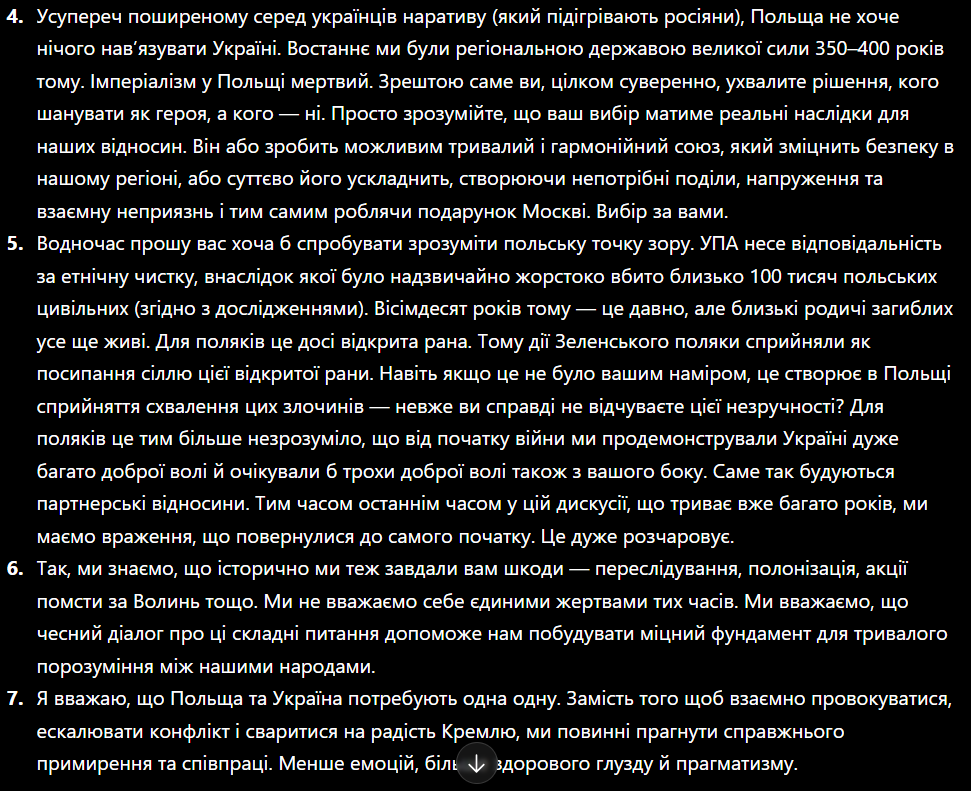
@gil_baits Centuries of foreign rule. No wonder Ukrainians have been fighting hard against it
English

-Bądź jeden z najbogatszych w surowce mineralne krajów Europy. Posiadaj złoża 22 z 34 minerałów uznanych przez UE za krytyczne.
-Ponad 50% twoich gleb to czarnoziemy.
-Miej 2782 km wybrzeża nad ciepłymi morzami.
I czego, mając taki potencjał, żeście się dorobili, "przyjaciele"?
Polski
@Macilias @Orest_Baback Oh common, your manipulations again. Burning Ukrainian civilians alive is not something that gets you dirty?
English
@__bambaram__ @Orest_Baback You can be dirty because you forgot to wash. Or you can be dirty because you hammered nails into children’s skulls.
These are not the same kind of “dirty.” 😤
English
A free and sovereign Ukraine 🇺🇦 is in Polands 🇵🇱 best interest, but one glorifying UPA/Bandera is a complete different story.
Most people don’t know about this part of history. The following post is largely accurate and well-sourced introduction to it. It presents a detailed, document-based argument about Ukrainian collaboration with Nazi Germany (specifically the Schutzmannschaft / Ukrainian Auxiliary Police) in occupied Poland during WWII, its role in atrocities (including against Jews and Poles), connections to the OUN/UPA and Volhynia massacres, and links to modern Ukrainian glorification of those groups. It aligns closely with established historical scholarship and primary sources.
mynextchapter@Deeteem1
Hitler's Payroll: The Documentary Record of Ukraine's Armed Collaboration with Nazi Germany in Occupied Poland. There is a word that gets applied selectively in conversations about World War II. That word is collaborator. Western Europe uses it freely about Vichy France, about Norwegian Quislings, about Danish administrators who kept Nazi machinery running. When it comes to Ukrainian participation in the Nazi occupation of Poland, that word disappears. What replaces it are euphemisms — "complex history," "difficult choices," "both sides." The documentary record does not use euphemisms. It uses payroll ledgers, operational orders, unit rosters, and SS command structures. And that record, spread across the German Federal Archives in Berlin, the U.S. National Archives at College Park, and the Holocaust documentation centers at Yad Vashem and the USHMM, tells a story that Ukraine's current government would prefer the world never read carefully. This is that story. The Architecture of Collaboration On July 25, 1941, SS Reichsführer Heinrich Himmler signed a formal directive establishing the Schutzmannschaft — the auxiliary police force that would become Nazi Germany's primary instrument of occupation policing across Eastern Europe. The order, catalogued in the German Federal Archives as BArch RW 41/4, created the legal and organizational framework for recruiting local populations into German service. The document established a command structure in which Ukrainian, Belarusian, and Baltic auxiliary units were subordinated directly to the German Order Police (Ordnungspolizei). It was not informal collaboration. It was a formal military and police organization, with German officers in command, operating under SS authority, governed by SS regulations, and funded by the German state. Within weeks of Himmler's order, Ukrainian auxiliary police units were operational across occupied Poland and Soviet Ukraine. The numbers were staggering. By late 1941, over 35,000 Ukrainian auxiliary police were active in the region. By 1942, as German administrators expanded the program aggressively, the Schutzmannschaft across all occupied territories reached an estimated 300,000 men. Ukrainian historian Ivan Dereiko has calculated that in Reichskommissariat Ukraine alone there were approximately 80,000 Ukrainian police auxiliaries — four times the number of German policemen in the same territory. The ratio everywhere was roughly ten Ukrainians for every one German. The Germans were not the primary boots on the ground in occupied Poland and Ukraine. The Ukrainians were. Who Paid Them — and With What The payment structure of the Ukrainian auxiliary police is documented in German administrative records now held at the National Archives in College Park, Maryland under Record Group 242 — National Archives Collection of Foreign Records Seized. These are Nazi Germany's own captured administrative files, microfilmed after the war and made available to researchers. What those records establish is that Ukrainian auxiliary police received regular wages from the German occupation administration — paid, administered, and processed through the same bureaucratic channels as any other component of the Nazi state apparatus in the east. More revealing still is the sourcing of those funds. Schutzmannschaft units across Ukraine and occupied Poland were paid by German authorities, and the documentary record — including sources cited by military historians researching the Schutzmannschaft's role in the Holocaust — confirms that payment was frequently made with funds confiscated from the Jewish population being murdered. The men carrying out the killings were being paid with the money of their victims. This was not an accident of accounting. It was a deliberate structure. The German occupation administration was largely self-financing in the occupied east through systematic confiscation of Jewish property, businesses, bank accounts, and personal assets. The Ukrainian auxiliary police who staffed the ghetto walls, conducted the roundups, and in many documented cases participated directly in mass shootings were compensated from the proceeds of those same operations. The Training Pipeline The Chylinski CIA document from 1941 noted that Ukrainian police in occupied Poland "are given instruction in special police schools opened by the Germans in various parts of the country." The German records confirm the infrastructure behind this observation. A formal police school for Ukrainian auxiliary forces was established in Lviv by the district SS-and-Police Leader immediately after German occupation began in 1941. The school's director was Ivan Kozak. German Army records archived in the Bundesarchiv document BdO Ukraine Guidelines for training of the Schutzmannschaft, dated 9 April 1943 — a formal training curriculum issued by the Commander of Order Police in Ukraine covering political education, tactical operations, and law enforcement procedures under German authority. Himmler himself ordered the formalization of NCO training for the Schutzmannschaft in August 1942, including eight weeks of political education. These were not ad hoc militias. They were trained, uniformed, armed, and indoctrinated auxiliary police operating under formal SS command structures. The Nachtigall and Roland battalions — Ukrainian units formed under direct German Abwehr command in February 1941, sanctioned by Abwehr chief Wilhelm Canaris — predated even the formal Schutzmannschaft structure. These units, composed of OUN-B members, were operational from the opening days of Operation Barbarossa. The OUN had begun collaborating with the Abwehr — Nazi Germany's military intelligence service — from the first days of the German invasion of Poland in September 1939. Gestapo records confirm that in December 1939, Lebed and Bandera supporters were trained in sabotage, guerrilla warfare, and assassination techniques at a Gestapo facility in Zakopane, in occupied southern Poland. What They Did in Occupied Poland The operational record of the Ukrainian auxiliary police in occupied Poland is documented across multiple archives and confirmed by multiple categories of evidence — German administrative reports, SS operational records, survivor testimony, and postwar criminal proceedings. In November 1942, members of the Ukrainische Hilfspolizei robbed and executed 32 Poles and one Jew in the village of Obórki in what had been Wołyń Voivodeship. The village was then burned. In December 1942, Ukrainian policemen led by German officers killed 360 Poles in Jezierce in the former Rivne district. In Lviv in early 1944, Ukrainian auxiliary police conducted a systematic campaign of arresting young Polish men, many of whom were later found dead with their identity documents stolen. Polish underground intelligence — the Home Army (Armia Krajowa) — documented these actions in operational reports now held in Polish Institute of National Remembrance (IPN) archives in Warsaw. These were not isolated incidents. German SS operational reports — the Ereignismeldungen (Event Reports) submitted by SS commanders to Berlin documenting daily operations across the occupied east — record Ukrainian auxiliary police participation in hundreds of actions against both Jewish and Polish civilian populations throughout 1941, 1942, and 1943. These reports, held at the U.S. National Archives under microfilm series NARA T175, constitute Germany's own contemporaneous record of who was doing what in the occupied territories. The pattern Chylinski documented in Warsaw in 1941 — that Ukrainian jailers "treat the Poles even more harshly than do the Germans" — was not a local aberration. It was a systemic characteristic, documented independently by German administrators themselves. Professor Alexander Statiev of the University of Waterloo, writing from the German records, concluded that Ukrainian auxiliary police were the single largest category of non-German perpetrators of the Holocaust in the Soviet Union by national origin, with Ukrainian police units participating in the extermination of an estimated 150,000 Jews in Volhynia alone. The SS Galicia Division: Formalizing Collaboration By 1943, Ukrainian collaboration with Nazi Germany had been institutionalized to the point that a full SS division was raised from Ukrainian volunteers. The 14th Waffen Grenadier Division of the SS — the SS Galicia Division — was established in April 1943 with the support of Otto Wächter, the German Governor of Galicia, and formally approved by Himmler. The division recruited from the same population that had staffed the Ukrainian auxiliary police. Many of its volunteers were veterans of the Schutzmannschaft, the Nachtigall Battalion, and other German-commanded Ukrainian formations. In the winter and spring of 1944, elements of the SS Galicia Division participated in the destruction of Polish villages in the Galicia district, including the massacre at Huta Pieniacka where approximately 500 civilians were murdered. In 1946, the International Military Tribunal at Nuremberg declared all members of all SS divisions criminal within the meaning of the Nuremberg Charter. Polish and German historical commissions in the 2000s found the SS Galicia Division guilty of war crimes. Ukraine has never formally acknowledged this. From Collaboration to Massacre: The Pipeline to Volhynia The most consequential document in understanding how auxiliary police collaboration connected directly to the Volhynia massacres of 1943 is an internal OUN-B instruction dated March 20, 1943. In it, OUN leader Stepan Bandera ordered all OUN members who had joined the German auxiliary police — by that point numbering between 4,000 and 10,000 trained and armed men — to desert with their weapons and join the Ukrainian Insurgent Army (UPA). The pipeline was explicit and deliberate. Germany had trained and armed a Ukrainian auxiliary police force. The OUN used membership in that force as a training program for its own military cadres. When the time came to redirect that force toward the ethnic cleansing of Poles in Volhynia, the order went out and the men transferred — trained, armed with German weapons, experienced in organized violence — directly into the UPA formations that would massacre 100,000 Polish civilians between 1943 and 1945. The Volhynia massacres did not emerge from nowhere. They were carried out by men who had been trained, paid, uniformed, and armed by Nazi Germany. The skills they used to murder Polish villages were the same skills Germany had developed in them for occupation duty. The weapons they used were German-issued service weapons they had taken with them when they deserted. The Archive Trail Nobody Follows The primary documentary sources for this history are not hidden. They are catalogued, microfilmed, and available to any researcher with an institutional affiliation or a research visit to: The German Federal Archives (Bundesarchiv), Berlin and Freiburg, hold the core German administrative and military records of the General Government and Reichskommissariat Ukraine, including personnel records, operational orders, and SS command correspondence. The U.S. National Archives at College Park, Maryland holds the captured German records under Record Group 242, including SS operational reports, Einsatzgruppen event reports (Ereignismeldungen, microfilm series T175), and General Government administrative files. The U.S. Holocaust Memorial Museum in Washington holds extensive collections on Ukrainian auxiliary police specifically, cross-referenced with German administrative records and survivor testimony. The Polish Institute of National Remembrance (IPN) in Warsaw holds the most comprehensive Polish-language archive on UPA crimes and Ukrainian auxiliary police actions in occupied Poland, including AK intelligence reports from the occupation period. Yad Vashem in Jerusalem holds documentation cited in CIA files as a primary source for Ukrainian nationalist war crimes, including eyewitness testimony and German operational records. The reason this archive trail is not followed by Western journalists or policy analysts is not that the documents are inaccessible. It is that following them produces conclusions deeply inconvenient to the post-2022 political narrative around Ukraine. What This Means in 2026 Zelensky named a Special Operations unit "Heroes of the UPA." The organizational ancestors of the UPA were trained by Nazi Germany, paid by Nazi Germany — often with Jewish victims' confiscated funds — and carried their German-issued weapons directly into the massacres of 100,000 Polish civilians when Bandera issued the order to desert and re-form as UPA. This is not distant or abstract history. It is a documented chain of institutional continuity from the Schutzmannschaft payroll ledgers of 1941–1943 to the mass graves of Volhynia to the unmarked burial sites that Poland still cannot excavate because Ukraine controls access. Poland has known this history for eighty years. It has waited for eighty years for acknowledgment, for access to graves, for a formal recognition that the UPA was not a liberation army but a German-trained, German-armed, German-paid instrument of ethnic cleansing that turned on its Polish neighbors the moment it received orders to do so. The Order of the White Eagle was revoked. The medal was mailed back. The graves are still sealed. Primary Source Archive References German Federal Archives (Bundesarchiv) Himmler directive establishing Schutzmannschaft: BArch RW 41/4 — "Schutzformationen in den neuen Ostgebieten," 31 July 1941 Training guidelines: BdO Ukraine Guidelines for Training of the Schutzmannschaft, 9 April 1943 bundesarchiv.de/en U.S. National Archives — Captured German Records Record Group 242 — National Archives Collection of Foreign Records Seized SS Ereignismeldungen (Event Reports) NARA Microfilm T175 Finding Aid: archives.gov/research/guide… CIA FOIA Reading Room "Poland Under Nazi Rule 1941" — T.H. Chylinski, U.S. Vice Consul, Page 25: "German-Ukrainian Relations in Poland"cia.gov/readingroom/do… U.S. Holocaust Memorial Museum Ukrainian Auxiliary Police Collections collections.ushmm.org Polish Institute of National Remembrance ipn.gov.pl/en European Holocaust Research Infrastructure — Documentary Record Ukrainian Police and the Holocaust: blog.ehri-project.eu/2024/05/28/ukr…
English
@Macilias @Orest_Baback Thanks, but that link is quite strenuous and manipulative, isn't it? As we established before, "parts of the Polish nationalist movement collaborated with Nazi Germany" (NSZ) Another question: if UPA is "not clean", do joint AK/UPA operation(s) mean that AK is "not clean"?
English
Spell it out? Sure.
Not “all UPA were collaborators.” Not “all Ukrainians were collaborators.”
But yes: parts of the Ukrainian nationalist movement collaborated with Nazi Germany, and German-trained auxiliary police cadres later fed into UPA structures. That link matters because those structures were then involved in organized violence against Polish civilians.
So the claim is precise: UPA was not a clean anti-Nazi/anti-Soviet liberation symbol. Its wartime history includes collaboration networks, transferred cadres, and ethnic cleansing.
That is exactly why glorifying it as “Heroes of UPA” is a problem.
English

@__bambaram__ @talkrealopinion Are you retarded or just Ukrainian? Wołyń itself was 300x more casualties than Jedwabne you nazi mongoloid
English
Got sentenced to death by the Poles.
Had his sentence commuted to life in prison.
Bandera, Lebed, and thousands of other Ukrainian nationalists would have rotted in Polish prisons if it hadn't been for the invasion of Poland that allowed them all to escape.
Dionisa 2.0@frommontenegro
- dead for 60+ years - still makes 37 million Poles and 145 million Russians foam at the mouth
English
@__bambaram__ @talkrealopinion It ain’t my imagination but unfortunately history of your subhuman ancestors
English
@Napoliravii @talkrealopinion The tweet I replied to talked about the reasons Bandera was imprisoned in Poland. Also, your imagination is quite impressive.
English
@__bambaram__ @talkrealopinion Which methods? Piłsudski impaled children on fence pickets, mash infants to death or cut unborn babies out of their mothers’ wombs and sewed cats inside while the mothers were still alive? Which was his method these UPA mongoloid subhumans took inspiration from?
English
@Macilias @Orest_Baback So, are you claiming that this shows that UPA were collaborators? Because defectors from German-trained auxiliary police fed cadres to UPA? Can you spell it out for me please?
English
You just restated my point.
Yes: the claim is that Schutzmannschaft cadres fed into UPA. That is not “Ukrainians = collaborators.” It is a specific historical link between German-trained auxiliary police and later UPA structures.
And it matters because those structures were involved in organized violence against Polish civilians.
If you want to dispute that link, dispute it directly. But pretending I said “all Ukrainians were collaborators” is the manipulation.
English
@Macilias @Orest_Baback I'm all for historical debate, but pretending that this matter is settled or that the 100k victims is accurate is nowhere near serious either. Having it as a center piece of your current state policy is even less so.
English
Victim numbers matter, but they do not prove symmetry by themselves.
If one side launches a coordinated campaign to remove civilian communities, and the other side commits retaliatory crimes, local massacres and brutal reprisals, the numbers alone do not make the two projects identical.
And “intent is hard to establish” is exactly why historians look at patterns: repeated attacks on Polish villages, civilians targeted as Poles, warnings to leave, destruction of settlements, and the spread of the campaign across Volhynia and Eastern Galicia.
You do not have to “trust my word.” Read Motyka, Snyder, Himka, or the Polish-Ukrainian historian debates. But pretending this is just “your word vs mine” is not serious.
English
@Macilias @Orest_Baback Would you take the estimates and opinions from Viatrovych or other Ukrainian historians as evidence?
English
No, Polish is not a race. But dismissing historians because they have Polish background is still ethnic/national prejudice, not an argument.
And that is especially ironic here, because OUN/UPA’s project in Volhynia and Eastern Galicia was built around removing Poles from lands that were historically multiethnic.
So when you reject evidence by saying “two Poles and Snyder who used a Pole,” you are not doing history. You are filtering sources by ancestry because you dislike the conclusion.
English
@Macilias @Orest_Baback The number of victims is a very good evidence of scale. Or are Poles just more efficient and methodical murderers? "Who launched a coordinated campaign", "with what intent" is something that is pretty hard to establish, so excuse me if I don't trust your word for it
English
You are quite a racist 🤔.
Himka is not Polish. Snyder is not Polish. And the broader point is not “who has what passport,” but whether the argument fits the evidence.
Also, victim numbers alone do not prove symmetry. Even if both sides suffered, the question is: who launched a coordinated campaign, against whom, with what intent, across how many localities?
UPA’s anti-Polish campaign in Volhynia and Eastern Galicia was not just “violence in a border conflict.” It was organized removal and murder of Polish civilian communities.
If you claim AK did the same, show the equivalent campaign. Not scattered crimes, not reprisals, not “dark chapters.” The equivalent.
English
@Macilias @Orest_Baback That's exactly what that post you cited, and your comments, claim: that Ukrainians and UPA are collaborators. But what it really claims is that schutzmannschaft fed cadres that defected to UPA. That's not just "blur", that's manipulation.
English
No, this is exactly the dodge.
Nobody said “Ukrainians = collaborators.” We are talking about specific formations and what they later did.
Poles forced into the Wehrmacht did not become the armed backbone of an AK campaign to wipe out Ukrainian villages.
Ukrainian auxiliary police cadres did feed into UPA, and UPA then carried out organized violence against Polish civilian communities.
That is the difference you keep trying to blur.
English
@Macilias @Orest_Baback So, two Poles and Timothy Snyder who relies on studies of another Pole? The estimates that show that the number victims on both sides were comparable is a good evidence it was symmetric.
English
Use this:
No, not only“my institute.”
Historians like Grzegorz Motyka, Timothy Snyder, John-Paul Himka and others have written about the OUN-B/UPA anti-Polish campaign. This is not some Polish Twitter invention.
And you don’t need a single stamped memo saying “ethnic cleansing plan” to see a campaign. When Polish villages across Volhynia and Eastern Galicia are attacked in a coordinated pattern, civilians are targeted as Poles, and the goal is to remove them from the territory — that is the project in practice.
So again: show the AK equivalent, or stop pretending this is symmetry.
English
@Macilias @Orest_Baback Who/where showed such a project on UPA's part? Your "history institute"?
English
No, it is not “the same way.”
AK’s resistance against Germany is not being used to hide a central AK project of wiping out Ukrainian villages, because you still haven’t shown such a project.
With UPA, Volhynia and Eastern Galicia are not a footnote. They are the reason Poles react to the name at all.
So stop jumping to “AK too” and show the equivalent: same scale, same coordination, same intent. Otherwise this is just symmetry by slogan.
English
@Macilias @Orest_Baback geography, repression, borders, forests, diaspora support and Soviet control". The fact that different Poles from AK committed similar crimes/on similar scale/with similar intent/even more centralized and coordinated is irrelevant
English
@Macilias @Orest_Baback I don't need to play by the rules you choose. The post/your commentary demonize Ukrainians by claiming they collaborated with the Germans, which Poles did en mass as well. That the same Ukrainians later defected and may have participated in crimes against the Poles is due to "geo
English
@Macilias @Orest_Baback In the same way as AK's resistance to the Germans does not erase the mass murder of Ukrainian civilians from its legacy. To Ukrainians, clearly UPA's resistance to the soviets is central.
English
That does not answer the point.
Anti-Soviet resistance lasting longer in Ukraine or Lithuania says something about geography, repression, borders, forests, diaspora support and Soviet control - not about whether earlier ethnic cleansing was central or irrelevant.
“Centrality” here means: what became inseparable from the symbol’s historical meaning. For Poles, UPA is inseparable from Volhynia and Eastern Galicia because the organization’s name is tied to a coordinated anti-Polish campaign.
Later resistance to the Soviets is part of UPA history. It does not erase the mass murder of civilians from its legacy.
English