Ashok
1.6K posts

Ashok
@_beyondwithin_
PhD candidate in philosophy at UWA. Post-traditional yogi & meditator (since 1995).
Perth, Western Australia Katılım Eylül 2010
1.2K Takip Edilen552 Takipçiler
Sabitlenmiş Tweet

Repost. Major milestone achieved: because it's my *first* peer reviewed journal publication, wading into a debate on comparisons between mindfulness & phenomenology. I turn to Gendlin's work on implicit understanding & traditional notions of prajñā.
contemplativejournal.org/article/azah71…
English

@KennethFolk 💯
Up to book 16. But stopped a while ago in order to stretch out the time between that and finishing the series!
English

@O1A2S3D @realitymap Furthermore, the modern worldview embeds a form of thinking/perceiving absent from earlier epochs. Inner life & outer world weren't experienced as rigidly distinct realms. What we now dismiss as 'supernatural' was a taken for granted reality; woven into everyday perception.
English

@realitymap It's very hard to get a person with this kind of viewpoint to imagine that religions are complex systems of non-arbitrary and interconnected components which all serve practical purposes. Myths serve functions. Devotion serves a function. Ritual & magic & costume serve functions.
English

feels like the bleeding edge of dhamma in the west rn needs some new amorphous western lineage—transmuting the core principles back into something akin to their original form & purpose
reality acid 💎🪷❤️🔥@realityacid108
The original sangha was pretty decentralized. It functioned more like a meeting space for like-minds who were already engaged in spiritual practice and generally close to liberation—as opposed to a dedicated pedagogical institution. Like experts convening to exchange notes.
English

@WystanTBS Re: irreconcilability. The Silk Road traditions (Manichaeism & Tang era Nestorians) beg to differ. Dharma infused with Christ. For all its rational presentation at heart Buddhism is a *living* mystery tradition.
Visiting the monasteries: with stillness sense the Presence 🙏
English

I see some folks fighting it out over whether one can be both a Buddhist and a Christian, or other sort of theist. If you adhere to either religion's mainstream core soteriological, metaphysical, and cosmological claims, they are clearly irreconcilable.
Buddhadharma unequivocally denies a creator God.
Christianity denies rebirth.
Buddhadharma, generally, does not accept any sort of substitutionary atonement or redemption, but purification and awakening through one's own efforts and discernment.
This may or may not bother you. People are rarely consistent in their epistemic commitments (which are flimsy constructions, in any case), not to mention behaviors. Growing up Christian, and being myself the son of an Anglican minister and theologian, as a Buddhist practitioner it's never once appealed to try to kludge the systems together.
All that said, as it unfolds on the ground, apart from abstracted conceptual space and its disputation online, all my own Buddhist teachers, Theravadin, Zen, Vajrayana, have always been happy to welcome anyone of any faith who wishes to follow their teaching of Buddha's path of practice to whatever extent: to take refuge, follow the precepts, and cultivate samadhi and wisdom for their own and others' benefit. Likewise with doubters like me, who remain agnostic regarding all supernatural elements of the Dharma.
Interfaith participation and mutual appreciation, recognizing common sanctity and agreement where such exist, is beautiful and necessary in our conflict-riven world, but we lose clarity and focus attempting to stew everything together. Everyone's free to do as they wish, of course, and I wish all well.
I'll be attending the Easter service at St Martin-in-the-Fields tomorrow morning, for childhood memories' sake and as a respectful friend.
I'm visiting my parents next week. My dad and I plan to see some orthodox monasteries together.
❤️
English

@TVachaW @aman_ganvir Secular Buddhists are obsessed with policing metaphysics.
English

I sounds like you’ve misunderstood the post tbh. I was painstakingly clear I wasn’t talking about a fixed divine substrate.
Anicca in Buddhist pedagogy is always applied to skandhas, substances and attas / atmans rather than patterns or functions.
There are several patterns functions to which the anicca attribute is not ascribed. You just mentioned one of them yourself: paticca samupadda.
Paticca samupadda describes the *way* phenomena unfold rather than any specific phenomena / skhanda or a fixed divine substrate.
Likewise, if you read the post my current post QTs which goes into more detail about what I’m talking about here, I’m similarly using God to refer to a *way* that phenomena unfold rather than a specific phenomena / skhanda or a fixed divine substrate.
If your point is that at an ultimate level what I’m calling God is equally anicca and sunyata as paticca samupadda is, then I don’t disagree.
But I also don’t see it as a major objection as I find paticca samupadda to have clear utility, so saying that another pattern / function is no less anicca or sunyata than paticca samupadda doesn’t speak to its lack of utility as an upaya.
English


@anitaleirfall Wow, had no idea so much of his work remains unpublished!
English

2000 pages of Leibniz, much of it previously untranslated or unpublished, will be published next month.

They’ll appear in a new 3-volume ed. of Leibniz’s Philosophical Papers (1677–1686), ed. by Lloyd Stricklandand published by Oxford University Press. dailynous.com/2026/03/27/lot…
English

I rarely post these days, but when I have it has tended to be with my regular 'philosopher' hat on. Occasionally, though, the hat is taken off...
Ashok@_beyondwithin_
@TVachaW @indybuddhist 💯 The secular revision of Buddhism conflates upāya with adhering to the 'right' metaphysical belief & completely ignores that it never denied the cosmological milieu within which it arose. Here's a snippet from something I wrote a while back:
English

@TVachaW @indybuddhist 💯 The secular revision of Buddhism conflates upāya with adhering to the 'right' metaphysical belief & completely ignores that it never denied the cosmological milieu within which it arose. Here's a snippet from something I wrote a while back:

English

Depends which type of Buddhism you’re talking about.
The teachings of Mahayana Buddhism absolutely place the compassionate functioning of Buddha Nature and Dharmakaya that I’m describing in this post at their core.
Vajrayana Buddhists have an entire path focused on explicitly relating to that functioning as divine.
English

There’s a certain type of argument against God that I often hear from Buddhists, which I find unconvincing.
The argument essentially seems to be that because there is no stable sensation / perception / field of consciousness etc findable in our minds that corresponds to God, God cannot exist.
But - even assuming that is the case - why should God be assumed to be something that’s represented substantially in our minds?
Why couldn’t God be a function rather than a substance?
In Mahayana Buddhism, they teach that under conditions of maximal awareness, the default functioning of the universe is pure compassionate love and wisdom.
What could be more divine than that?
What higher intelligence than compassionate love could we hope for the universe’s default operating principle to be?
And it certainly accords with my experience of the contemplative path.
That when I am able to release craving, aversion and ignorance, compassionate love spontaneously emerges as the default functioning without any need to create or design it.
People might object something like “OK, but that’s not a *personal* God.”
But then, according to Buddhist theory - what is a person?
A person is not a substance but a function.
A person is essentially just the way a certain set of phenomena unfold.
So, what makes the default loving compassionate functioning of reality any less of a person than the karmically driven functioning of a human person.
“OK, but it’s not a God that punishes and rewards,” could be the next objection.
But again, according to Mahayana theory - and according to my own experience - the degree to which we suffer is essentially determined by the degree to which we either divert from this compassionate wisdom function or conform to it.
When we release craving, aversion and ignorance, we default to the compassionate-wisdom function and we don’t suffer.
When we hold onto craving, aversion and ignorance, we limit the scope of that function and we suffer.
On a practical level, this isn’t meaningfully all that different to reward/punishment on the basis of adherence to or denial of this divine function.
Really, all the things that feel truly important about God are all features of the universe.
A loving intelligence is the default functioning of the universe and the degree to which we conform to it determines the degree to which we suffer in the world.
It’s a pretty similar story to the God story.
It’s why I think the Tibetans were able to design a complete path to enlightenment that revolves around building a relationship to a divine humanoid figure that represents wise compassionate default functioning of the universe.
It’s also why, as a Buddhist, I often find more common ground spiritually with Christians who earnestly have live their life on the basis of a faith in a force of universal love, than I do with the type of Buddhist who envisage themselves to be living in a universe of dead matter that operates on blind and arbitrary principles.
English

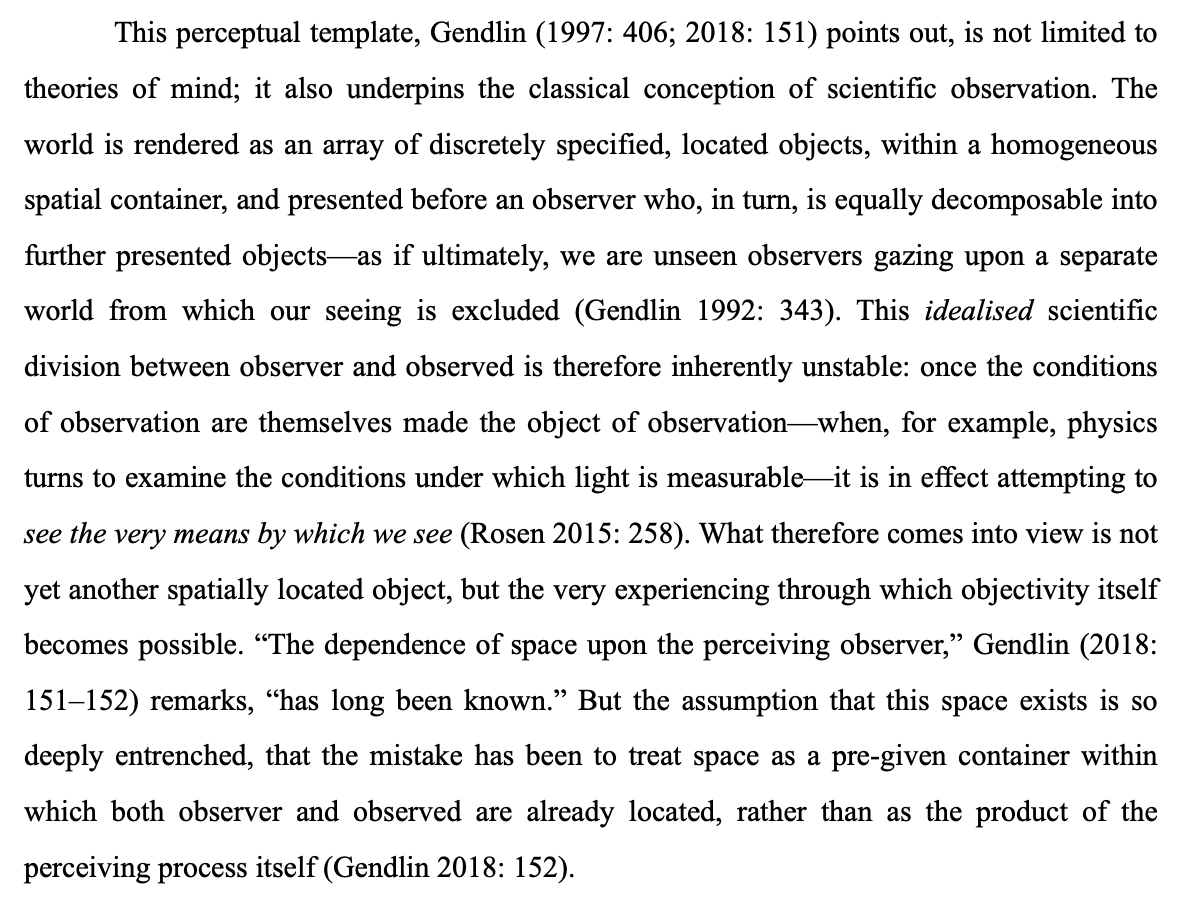
@CenFutureAIMS @DrSueSchneider @BaptisteLeBihan A short passage from paper I wrote recently, distilled from my thesis:

English

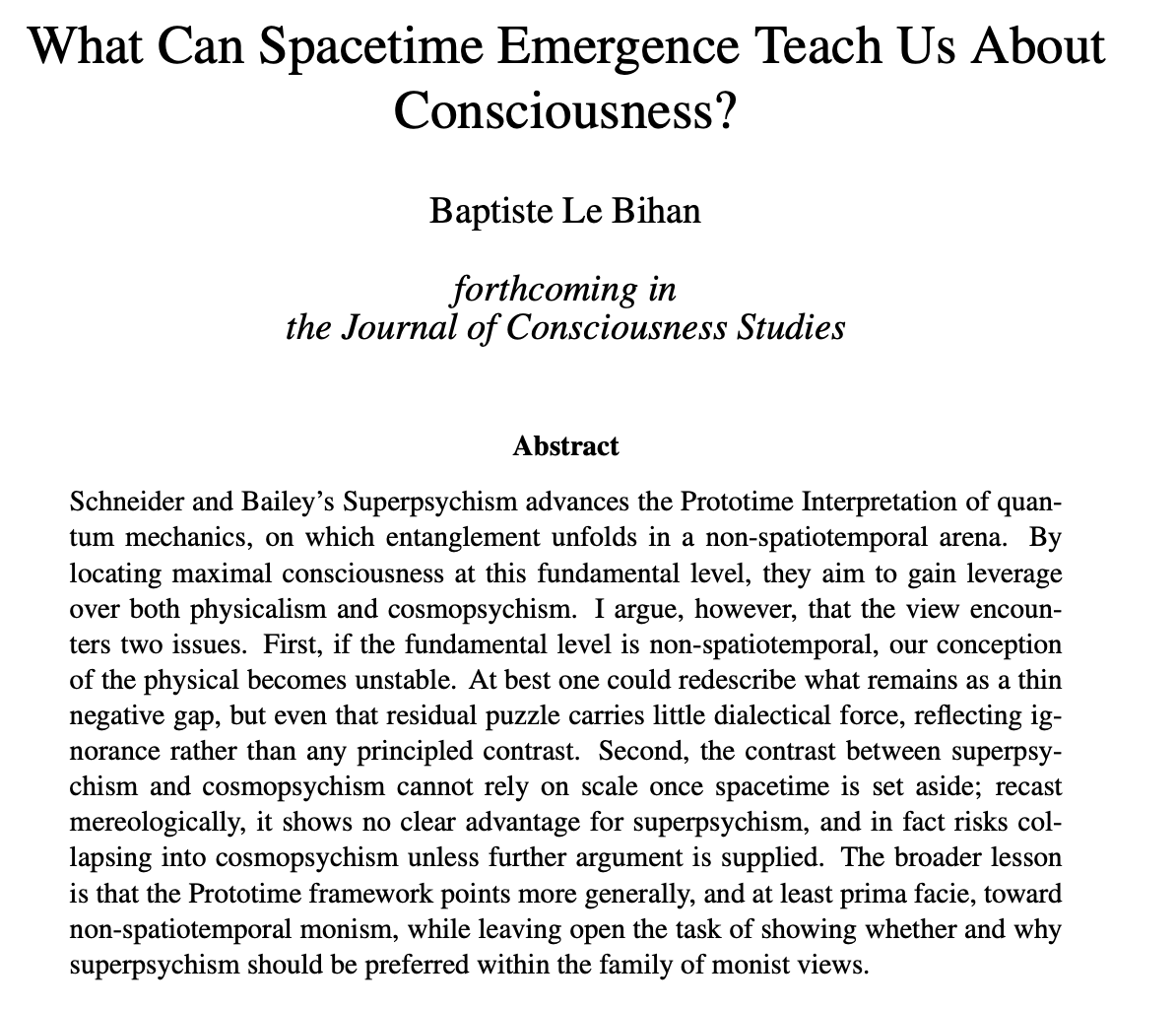
💭 Can consciousness exist outside space-time?
In response to @DrSueSchneider and Mark Bailey’s target article on superpsychism, @BaptisteLeBihan examines whether placing mind at a fundamental, non-spatiotemporal level really moves the debate forward.
Now available in the Journal of Consciousness Studies special issue, the article highlights two central challenges:
1) It destabilizes what we mean by the “physical”
2) It risks collapsing into cosmopsychism once space-time is removed
The broader takeaway: these debates may point toward non-spatiotemporal monism, while leaving open whether superpsychism offers any real advantage.
👉Read now: ingentaconnect.com/contentone/imp…
#Superpsychism #Spacetime #Emergence #Consciousness #PhilosophyOfMind #JCS

English

“Descartes might say, 'Kicking a goal doesn't consist merely in propelling a ball with your foot [...]; it's that and doing something else as well.' [But] it isn't an extra action that's wanted, it's extra qualifications on the action without which it won't be kicking a goal.”
—Gilbert Ryle on the Concept of Mind
English

@QuantumTumbler Again, answering wrong claim. This has nothing to do with "creating" phenomena.
It's far simpler: scientific knowledge arises through measurement. Measurement is already a comparison within an experimental framework. The objection still assumes the very framing it tries to deny.
English

@_beyondwithin_ Measurement involves comparison within a measurement system, but that doesn’t imply the measured phenomenon depends on the observer.
Detection channels reveal information about a system they don’t bring the system into existence.
English

A quick reality check.
There’s a growing trend of people claiming that reality is somehow “rendered by the mind” that the world only exists inside consciousness.
Stop for a moment and follow that idea to its conclusion.
The universe is ~13.8 billion years old.
Earth is ~4.5 billion years old.
Life on this planet evolved over billions of years.
Human beings appeared only very recently in that timeline.
Stars formed. Galaxies collided. Oceans filled. Continents shifted. Entire species lived and went extinct long before a single human brain ever existed.
Reality was unfolding long before there was anyone around to perceive it.
Which means something important.
Consciousness did not bring the universe into existence.
What the brain does produce is experience an internal model built from sensory signals so an organism can navigate the world around it.
The brain doesn’t generate reality.
It interprets it.
The car in front of you isn’t there because someone notices it.
It’s noticed because light reflects from it and reaches a nervous system capable of processing it.
Confusing perception of reality with creation of reality is where people slide into mysticism or ego-centered philosophy.
The universe does not require a witness in order to exist.
It existed before any observer.
It will continue long after the last one is gone.
Consciousness is not the author of reality.
It is a very small window through which reality briefly becomes aware of itself.

English

@QuantumTumbler "The instrument does the observing" doesn't answer. Sensor detection is not yet measurement. That requires a *comparison* against an interval or standard. Comparisons aren't 'just there', but part of investigative practice ie. within experience.
Ur still assuming what you deny.
English

@_beyondwithin_ That argument confuses the interface with the system.
Observations occur within experience, just as astronomical data comes through telescopes.
But the existence of a measurement channel doesn’t imply the channel creates the thing being measured.
English