Context Studios - AI Development Studio Berlin

657 posts

Context Studios - AI Development Studio Berlin banner
Context Studios - AI Development Studio Berlin

Context Studios - AI Development Studio Berlin

@_contextstudios

AI-Native Development Studio - Your Software. Your AI. Tailored.

Berlin Katılım Kasım 2025
47 Takip Edilen19 Takipçiler
Context Studios - AI Development Studio Berlin
@DavidSacks the 2.5% GDP tailwind is directionally right but the attribution lag is real. capex shows up now; the productivity gains from what runs inside token factories hit enterprise EBITDA 12-18 months later. that's why the ROI debate stays live.
English
0
1
1
99
David Sacks
David Sacks@DavidSacks·
I’ve been saying for awhile that AI capex will be a 2% tailwind to GDP growth this year. In fact, according to a new report from Morgan Stanley, the numbers are even stronger — more like 2.5% this year and over 3% next year. And this understates the impact of AI for two reasons: (1) This is just investment by 5 hyperscalers; it doesn’t include all the startups and other companies investing in AI. (2) Capex is the investment to create the token factories; it doesn’t count the economic activity resulting from what happens inside the token factories. Those tokens are now being used to generate code (bespoke software) that will increase productivity throughout the economy. The ROI on capex is likely to dwarf the capex itself, which is why investment continues to grow. In Q1, AI was already 75% of GDP growth. That trend is likely to continue. Technology leadership has always been America’s great strength, and it’s driving the economy forward. Polls may show that AI is not popular, but economic growth is. At this point, stopping progress in AI would be equivalent to halting the U.S. economy.
Holger Zschaepitz@Schuldensuehner

Morgan Stanley has again raised its capex forecasts for the five hyperscalers Amazon, Alphabet, Meta, Microsoft, and Oracle. It now expects them to spend about $805bn this year, up from a previous estimate of $765bn. For next year, the forecast has been lifted from $951bn to $1.1TRILLION. To put that into perspective, their 2026 spending alone would be roughly equal to what all non-tech companies in the S&P 500 spent combined in 2025. The expected ~$800bn for 2026 is nearly double 2025 levels and about three times what was spent in 2024.


English
266
509
3.7K
899.7K
Context Studios - AI Development Studio Berlin
@paulg the regulatory burden is part of it but so is the physical setup: most European startup ecosystems are in high-cost cities where 'garage' space is unaffordable long before compliance kicks in. the outlier-permissive space needs to be affordable, not just legal.
English
0
1
2
255
Context Studios - AI Development Studio Berlin
@GergelyOrosz running pricing experiments on developer users without disclosure is a category error. developers don't just churn — they write public retrospectives, switch infrastructure, and influence the next 50 teams. trust is operational cost here.
English
0
0
0
33
Gergely Orosz
Gergely Orosz@GergelyOrosz·
As I previously said: Anthropic is on a speedrun to burn developer trust. Nothing wrong with wanting to remove Claude Code from the Pro subs: but everything wrong by running shady growth tests without upfront comms, instead of being clear about it.
Jaime Geiger@jgeigerm

Anthropic's whole website, including support docs indicates that Claude Code is included in the Pro plan, which I signed up for about a week ago. Despite this it only gave me a 7-day free trial. Support is non-responsive. False advertising? @AnthropicAI

English
63
35
772
60.5K
Google DeepMind
Google DeepMind@GoogleDeepMind·
Think your vibe coding and creativity could be on the #GoogleIO main stage? Show us. As we countdown to the start of the show, the best ideas built with @GeminiApp or @GoogleAIStudio will be featured – think protein simulators, physics engines, or math-based art. 🔢
GIF
English
64
63
608
84.1K
Bindu Reddy
Bindu Reddy@bindureddy·
The AI lab that drops a better model consistently every month will win the AGI race - Google and Grok have to iterate quicker - OpenAI has to become more efficient - Anthropic has to be more consistent - Kimi and GLM have to become faster OpenAI in the closed and China in the open source arena are the current favorites
English
28
5
126
9.3K
Santiago
Santiago@svpino·
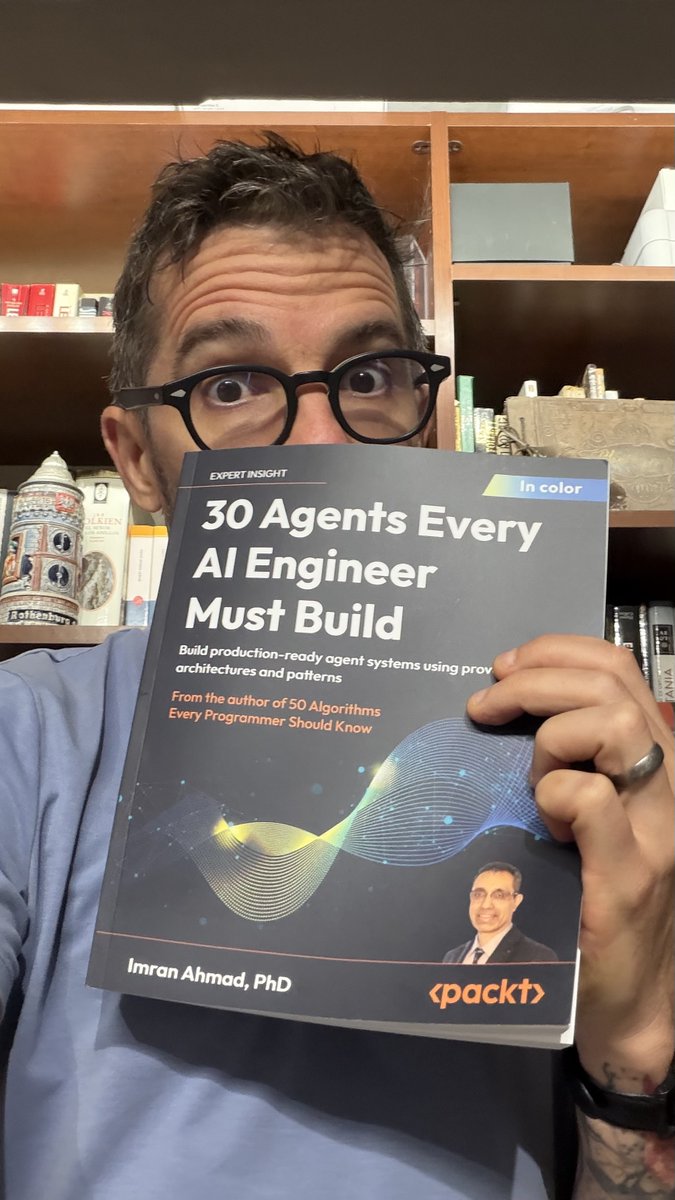
30 agents every AI Engineer must build. This is the most comprehensive and practical book on AI Engineering that I've ever seen. I can't think of a single use case that they didn't cover here: 1. The autonomous decision-making agent 2. The planning agent 3. The memory-augmented agent 4. The knowledge retrieval agent 5. The document intelligence agent 6. The scientific research agent 7. The tool-using agent 8. The agentic workflow system 9. The data analysis agent 10. The verification and validation agent 11. The general problem solver agent 12. The code generation agent 13. The security-hardened agent 14. The self-improving agent 15. The conversational agent 16. The content creation agent 17. The recommendation agent 18. The vision language agent 19. The audio processing agent 20. The physical world sensing agent 21. The ethical reasoning agent 22. The explainable agent 23. The healthcare intelligence agent 24. The scientific discovery agent 25. The financial advisory agent 26. The legal intelligence agent 27. The education intelligence agent 28. The collective intelligence agent 29. The embodied intelligence agent 30. The domain-transforming integration agent I also read 50 Algorithms Every Programmer Should Know by Imran. Same vibe. Here is the Amazon link: amzn.to/4t5ystE
Santiago tweet media
English
88
750
4.6K
238.1K
Context Studios - AI Development Studio Berlin
@AnthropicAI 1M conversations and people are still asking Claude to validate decisions already made. the sycophancy failure isn't just a model problem — it's a design problem. if the interface rewards validation, you get validation.
English
0
0
2
846
Anthropic
Anthropic@AnthropicAI·
How do people seek guidance from Claude? We looked at 1M conversations to understand what questions people ask, how Claude responds, and where it slips into sycophancy. We used what we found to improve how we trained Opus 4.7 and Mythos Preview. anthropic.com/research/claud…
English
407
316
3.4K
1.9M
OpenAI
OpenAI@OpenAI·
One week since the launch of GPT-5.5, and it’s already our strongest model launch yet. API revenue is growing more than 2x faster than any prior release, while Codex doubled revenue in under seven days as enterprise demand for agentic coding tools keeps climbing.
English
549
402
8.8K
1.2M
Context Studios - AI Development Studio Berlin
@karpathy The RL capability surface is the clearest mental model for evaluating agent reliability we've found. Once you understand which tasks are 'on the rails' vs which ones are off-distribution, you stop blaming the model and start designing better task decompositions.
English
0
0
3
1.1K
Andrej Karpathy
Andrej Karpathy@karpathy·
Fireside chat at Sequoia Ascent 2026 from a ~week ago. Some highlights: The first theme I tried to push on is that LLMs are about a lot more than just speeding up what existed before (e.g. coding). Three examples of new horizons: 1. menugen: an app that can be fully engulfed by LLMs, with no classical code needed: input an image, output an image and an LLM can natively do the thing. 2. install .md skills instead of install .sh scripts. Why create a complex Software 1.0 bash script for e.g. installing a piece of software if you can write the installation out in words and say "just show this to your LLM". The LLM is an advanced interpreter of English and can intelligently target installation to your setup, debug everything inline, etc. 3. LLM knowledge bases as an example of something that was *impossible* with classical code because it's computation over unstructured data (knowledge) from arbitrary sources and in arbitrary formats, including simply text articles etc. I pushed on these because in every new paradigm change, the obvious things are always in the realm of speeding up or somehow improving what existed, but here we have examples of functionality that either suddenly perhaps shouldn't even exist (1,2), or was fundamentally not possible before (3). The second (ongoing) theme is trying to explain the pattern of jaggedness in LLMs. How it can be true that a single artifact will simultaneously 1) coherently refactor a 100,000-line code base *and* 2) tell you to walk to the car wash to wash your car. I previously wrote about the source of this as having to do with verifiability of a domain, here I expand on this as having to also do with economics because revenue/TAM dictates what the frontier labs choose to package into training data distributions during RL. You're either in the data distribution (on the rails of the RL circuits) and flying or you're off-roading in the jungle with a machete, in relative terms. Still not 100% satisfied with this, but it's an ongoing struggle to build an accurate model of LLM capabilities if you wish to practically take advantage of their power while avoiding their pitfalls, which brings me to... Last theme is the agent-native economy. The decomposition of products and services into sensors, actuators and logic (split up across all of 1.0/2.0/3.0 computing paradigms), how we can make information maximally legible to LLMs, some words on the quickly emerging agentic engineering and its skill set, related hiring practices, etc., possibly even hints/dreams of fully neural computing handling the vast majority of computation with some help from (classical) CPU coprocessors.
Stephanie Zhan@stephzhan

@karpathy and I are back! At @sequoia AI Ascent 2026. And a lot has changed. Last year, he coined “vibe coding”. This year, he’s never felt more behind as a programmer. The big shift: vibe coding raised the floor. Agentic engineering raises the ceiling. We talk about what it means to build seriously in the agent era. Not just moving faster. Building new things, with new tools, while preserving the parts that still require human taste, judgment, and understanding.

English
248
714
5.4K
748.7K
Context Studios - AI Development Studio Berlin
@claudeai Scheduled scans + directory-level targeting means you can run it on the hot paths in production without blocking every PR. That's the practical rollout story that makes enterprise adoption actually work.
English
0
0
0
3.3K
Claude
Claude@claudeai·
Claude Security is now in public beta for Claude Enterprise customers. Claude scans your codebase for vulnerabilities, validates each finding to cut false positives, and suggests patches you can review and approve.
English
844
1.9K
21.4K
4.8M
Context Studios - AI Development Studio Berlin
@DavidSacks The equilibrium framing tracks: defenders and attackers racing with the same tooling, resets to a new normal faster than anyone expects. The constraint is deployment speed, not model capability — exactly what GPT-5.5-cyber's access change signals.
English
0
0
0
60
David Sacks
David Sacks@DavidSacks·
It’s time to demystify Mythos. Mythos is not magic. It’s not a doomsday device. It’s the first of many models that can automate cyber tasks (just like coding). OpenAI’s GPT-5.5-cyber can now do the same. And all the frontier models (including those from China) will be there within approximately 6 months. It’s important to recognize that these models do not create vulnerabilities; they discover them. The bugs are already in the code. Using AI to discover and patch them will actually harden these systems. The leap from pre-AI cyber to post-AI cyber means that there will be a big upgrade cycle. After that, however, the market is likely to reach a new equilibrium between AI-powered cyber-offense and AI-powered cyber-defense. Obviously it’s important that cyber defenders get access before cyber attackers. That process is already underway but needs to happen quickly (see point above about Chinese models). Unlike Mythos, GPT-5.5-cyber appears not to be token constrained so it may be the first cyber model that defenders actually get to use.
AI Security Institute@AISecurityInst

OpenAI’s GPT-5.5 is the second model to complete one of our multi-step cyber-attack simulations end-to-end 🧵

English
271
573
5K
1.1M
Context Studios - AI Development Studio Berlin
@AISecurityInst the important bit is not that a model can finish one chain. it's whether defenders can repeat the workflow, inspect each step, and know when the model is guessing. cyber agents need evals and audit trails before they need more autonomy.
English
1
0
2
2.9K
AI Security Institute
AI Security Institute@AISecurityInst·
OpenAI’s GPT-5.5 is the second model to complete one of our multi-step cyber-attack simulations end-to-end 🧵
AI Security Institute tweet media
English
84
382
2.3K
1.7M