Hans van Huellen
174 posts

Hans van Huellen
@_hvh_
Anaesthetics and intensive care registrar interested in things medical & beyond - MedEd, clinical communication, patient safety, politics. All views my own
Brighton, England Katılım Haziran 2009
363 Takip Edilen148 Takipçiler

Honoured to receive the Inaugural @FICMNews Intensivists in Training Presentation Prize today!
Grateful to everyone who made NEAT-ECHO possible-a reflection of the power of trainee research and collaboration in ICM. @TRICNetwork #FutureIntensivists

English

@AndrewJD Agree with lots of it, but also think the medicine year could be super valuable if we set it up better. E.g. some cardiology block with clinics and built in time to get to FUSIC heart
English

@mattbaker126 @AndrewJD But, going back to @AndrewJD original point, I agree that given how long training is already, we should make every year count and the medicine top up year is certainly an area for improvement. Sadly I think how this is run varies hugely by region and probably also by funding..
English

@mattbaker126 @AndrewJD Hi Matt! I think it is getting harder and the ICM workforce will be increasingly single specialty (looking at trainee intake). But I think espec DGH units will find it hard to create job plans for pure intensivists and dual anaes/ICM training works very well for those settings
English

Now look what has happened @L_D_White !!
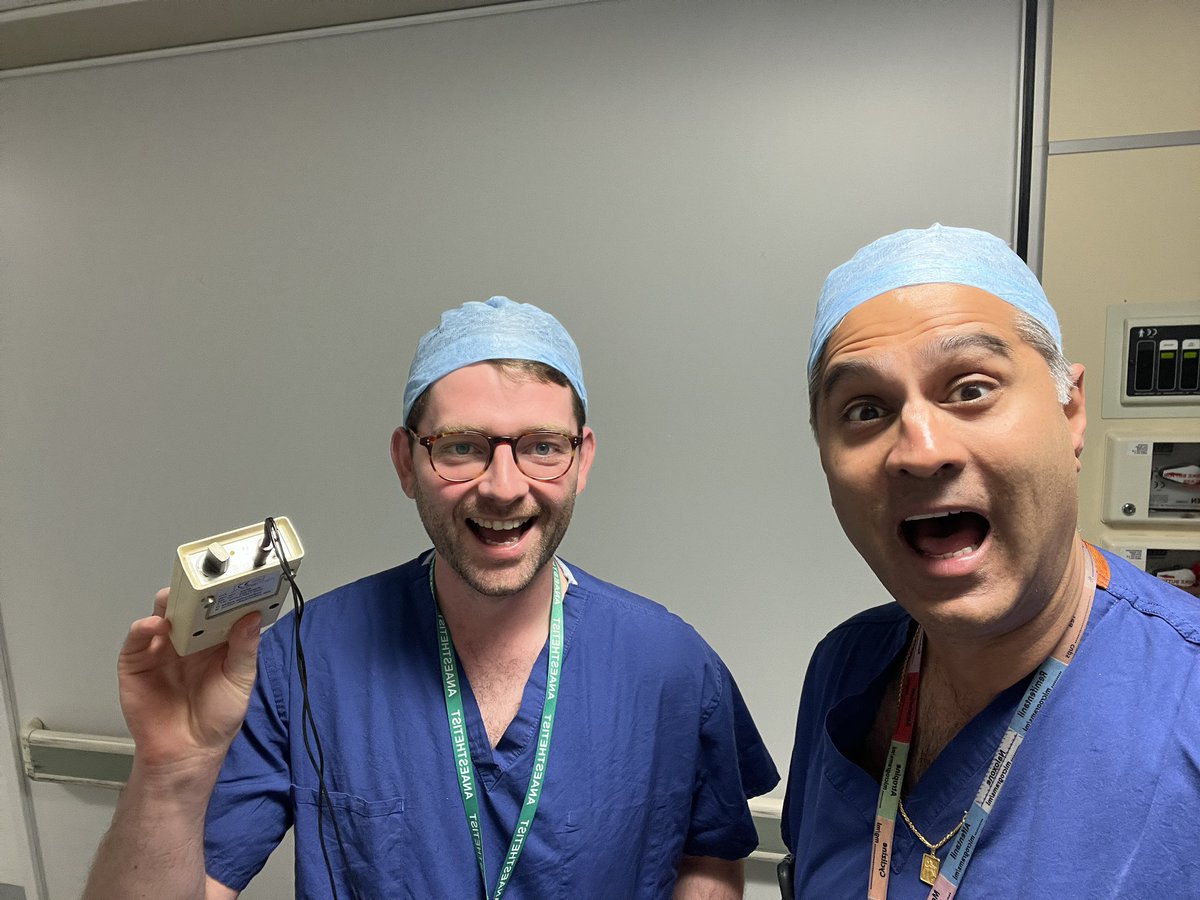
@Jameswrighty asked me this morning if we could dig out a Nerve Stimulator! 🤦🏽♂️😂
Don’t tell @jeffgadsden !
#RegionalAnaesthesia #RegionalAnesthesia

English

@CartlandDavid I thought you were a GP? So you should know that sadly young woman can get breast cancer, too, which is why her awareness campaign was so important.
Also she was diagnosed over a decade before the COVID pandemic so stop misusing her story for your own misinformation campaign.
English

Common? CoppaFeel! founder Kris Hallenga dies aged 38 from breast cancer - BBC News bbc.co.uk/news/uk-englan…
English

@VirtueOfNothing @andymoz78 Does BNP fall in the same category as TFTs, as in, useful in the outpatient setting but probably fairly meaningless in the critically ill? That was my impression
English

@andymoz78 I would argue it does have its merits as a screening test, especially in ambulatory populations (not ours as you say) and in the context of limited access to formal echocardiography to pick up early HF.
English

Do we need to be pushing expensive tests to doctors predominantly managing inpatients? May be my patient group (critically ill) but I find NT-BNP the most unhelpful test and one that appears to be almost routinely ordered. This is being sponsored by the test manufacturers.
Pumping Marvellous Foundation@pumpinghearts
For Heart Failure Awareness Week we've partnered with @NHSaaa, @RocheDiaUK, and @LumiraDX to raise #HeartFailure awareness at University Crosshouse Hospital. Through Point of Care Testing, a new hybrid pathway, and BEAT HF symptom recognition, we aim to #BeatHF. @P_H_S_Official @scotgov @NHSEngland @HealthInnovNet @Martin1Myers
English

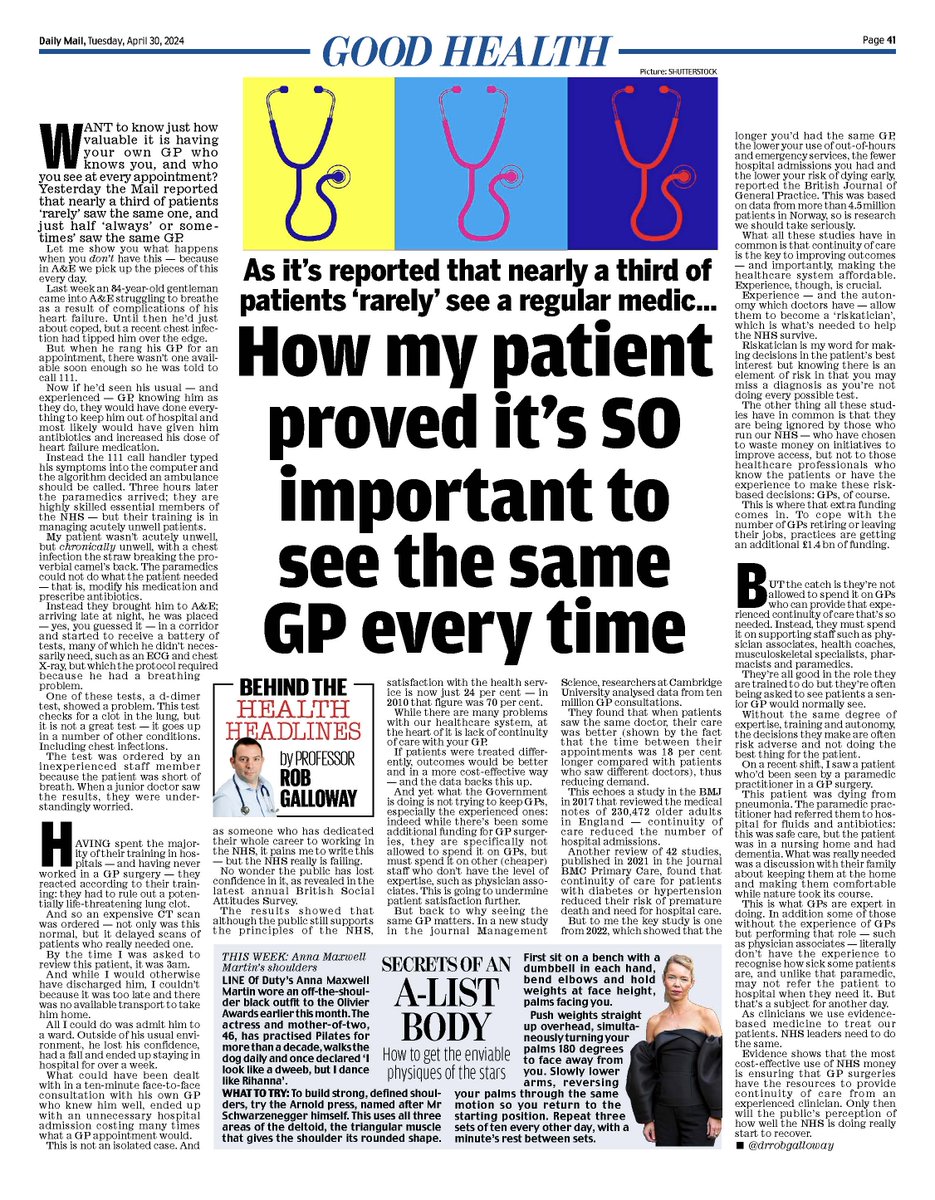
As a doctor, the most important skill to have is that of being a “riskatician”.
It’s not a word in any dictionary and so most people realise its importance. It’s about deciding when not to investigate or treat because the risks are greater than the benefits both on an individual and a societal level.
Having that skill, means that the doctor is best able to help decide, with the patient, when not to treat and when not to investigate. To have that skill needs years of experience and knowing the patient – and the best person to do that is your GP.
But GPs are finding it increasingly hard to provide the care that they are so skilled to do. That’s because policy makers don’t understand the central importance of the GP with continuity of care and haven’t read the evidence about how effective they are. Instead, they invest in initiatives which sound good on paper but end up not improving care and causing so much wasted spend.
The NHS needs more investment. But crucially it needs the investment in the most effective parts of the NHS – preventive medicine and general practice.
In this week’s mail health article, I have explained both the evidence and rationale for GP investment being the priority. I just hope some politicians and NHS leaders, read it, have their preconceived beliefs adjusted and make the changes that our patients so desperately need. Please share to increase the chances of those with power reading the article!

English

@sib313 Re 2., agree but while budget isn’t infinite it is also not fix, and it’s primarily a political choice rather than (solely) an economic necessity. NHS surely has inefficiencies, but it cannot be value-optimised beyond a point.
English

@asanyfuleno @LarcombePeter @drjanaway Then clearly then your tax money funds my salary in the same way as it funds every other public sector worker?
English

@asanyfuleno @LarcombePeter @drjanaway It’s a misconception to believe that doctors in postgraduate training equate to students who are actively taught and not providing value. In fact the majority of out of hours on-site cover is provided by these “junior doctors”.
English
Hans van Huellen retweetledi

Thanks for asking
As some one who has worked in the NHS for 35 yrs and examined its working throughout that time my list of what needs changing would start with
Stop breaking the system by defunding it in the name of efficiency. It is way beyond the point at which trying to cut things can improve efficiency. It is doing the opposite. Now not enough diagnostic centres, not enough doctors, not enough beds (numerous reports - ask @NuffieldTrust or @TheKingsFund or @HealthFdn)
The rest are relative minutiae but areas to address include
* understanding that promotion of the private sector as a realistic alternative to the NHS is flawed. The private sector can do sone things well (low risk procedural
stuff) but is no substitute for real NHS hospitals with the full gamut of services (staff, systems, space)
…-publications.onlinelibrary.wiley.com/doi/full/10.11…
*don’t dumb down medicine.
There appears to be a concerted effort to suggest that medicine has become less complex, easier to learn, answers available on google etc and as a consequence medicine can be taught over a shorter period and the role substituted by others who are notably less trained/qualified.
The truth is that medicine has become more complex, delivered to ever older more complex and more comorbid patients with ever higher expectations (most of which are actually met). …-publications.onlinelibrary.wiley.com/doi/10.1111/an… This all happens in the framework of an environment in which litigation (certainly costs and numbers to an extent) is mushrooming. …-publications.onlinelibrary.wiley.com/doi/full/10.11… While there may be value in working in new ways the lie that doctors can be replaced by less qualified alternatives because the job has become easier is misplaced, disingenuous and dangerous (as well as quite likely being cost-ineffective). There is a danger these systems will be brought in without testing of efficacy, safety or cost effectiveness.
rcoa.ac.uk/sites/default/…
bjanaesthesia.org.uk/article/S0007-…
* IT systems that are slow, outmoded, inefficient and don’t talk to eachother. Wasting thousands of hours of clinicians time every day.
Hope that is enough for now.
At the core it is FUNDING.
No point in reform without funding.
English

@TheCornishPasty How this man still holds a GMC license is utterly beyond me. Let’s not forget he spread some accusations that COVID was linked to some
Jewish world conspiracy.. completely aside from calling healthcare workers murderers
English

@DocEd On the other hand, I worry about retaining airway skills in intensivists who do little or no regular anaesthesia when we know that ICU intubations are already higher risk and as consultant the buck stops with us
English

@DocEd I suspect many of us feel this way, but especially in bigger centres this is becoming a rarity I think.
Problem is, both specialties getting more complex - maybe it’s too much to ask to expertly manage complex ICU patients AND be great at regional AND do regular airway lists?
English

@Matt_L_Nash @DrHuw @Matt_ParaACP @Dr_Done_ @VirtueOfNothing @FICMNews I think crux of this debate is learning to safely perform a specific procedural skill (which mostly I agree you don’t need MBBS for) vs employing this skill in a wider clinical context, knowing when / when not to use it and manage the repercussions.
English

@VirtueOfNothing @rosieICM In fact, one of the things which I have noticed most about myself as I progress through training is that I feel increasingly more comfortable saying “I don’t know”, and I think that’s a good thing.
English

@VirtueOfNothing @rosieICM I think it’s great from a human factors point of view. Also acknowledges that there are very few absolute certainties in medicine and on the whole clinicians but also patients value this admission I think. Using it a lot on ICU, too.
English