Xin

286 posts

Xin banner
Xin

Xin

@_imfing

hacking stuff • opinions are my own • AI @ Bloomberg • https://t.co/MHE2lY4gNk 💻 hooman of lovely Shiba ユミ🐶 🐕 📷🧑🏻‍💻

London, England Katılım Ağustos 2018
594 Takip Edilen86 Takipçiler
Pierre
Pierre@pierrecomputer·
diffshub[dot]com Search for the 1 Million LOC Bun Piece (it's rusty)
English
9
5
160
10.1K
Xin retweetledi
Mitchell Hashimoto
Mitchell Hashimoto@mitchellh·
I strongly believe there are entire companies right now under heavy AI psychosis and its impossible to have rational conversations about it with them. I can't name any specific people because they include personal friends I deeply respect, but I worry about how this plays out. I lived through the great MTBF vs MTTR (mean-time-between-failure vs. mean-time-to-recovery) reckoning of infrastructure during the transition to cloud and cloud automation. All those arguments are rearing their ugly heads again but now its... the whole software development industry (maybe the whole world, really). It's frightening, because the psychosis folks operate under an almost absolute "MTTR is all you need" mentality: "its fine to ship bugs because the agents will fix them so quickly and at a scale humans can't do!" We learned in infrastructure that MTTR is great but you can't yeet resilient systems entirely. The main issue is I don't even know how to bring this up to people I know personally, because bringing this topic up leads to immediately dismissals like "no no, it has full test coverage" or "bug reports are going down" or something, which just don't paint the whole picture. We already learned this lesson once in infrastructure: you can automate yourself into a very resilient catastrophe machine. Systems can appear healthy by local metrics while globally becoming incomprehensible. Bug reports can go down while latent risk explodes. Test coverage can rise while semantic understanding falls. Changes happens so fast that nobody notices the underlying architecture decaying. I worry.
English
513
1.9K
15.2K
1.5M
Xin
Xin@_imfing·
@ClaudeDevs Calling this “dedicated monthly credit” is such misleading marketing spin this is a brutal rug pull dressed up as a feature 🙃
English
0
0
2
1.1K
ClaudeDevs
ClaudeDevs@ClaudeDevs·
Starting June 15, paid Claude plans can claim a dedicated monthly credit for programmatic usage. The credit covers usage of: - Claude Agent SDK - claude -p - Claude Code GitHub Actions - Third-party apps built on the Agent SDK
English
1.3K
1K
12.5K
10.2M
Xin
Xin@_imfing·
@claudeai claude for xbox when? 🫣
English
0
0
0
14
Claude
Claude@claudeai·
Claude for Excel, PowerPoint, and Word are now generally available, and Claude for Outlook is in public beta. As Claude moves between your Microsoft apps, it carries the full context of your conversation.
English
1.1K
4.2K
48.7K
28M
Xin
Xin@_imfing·
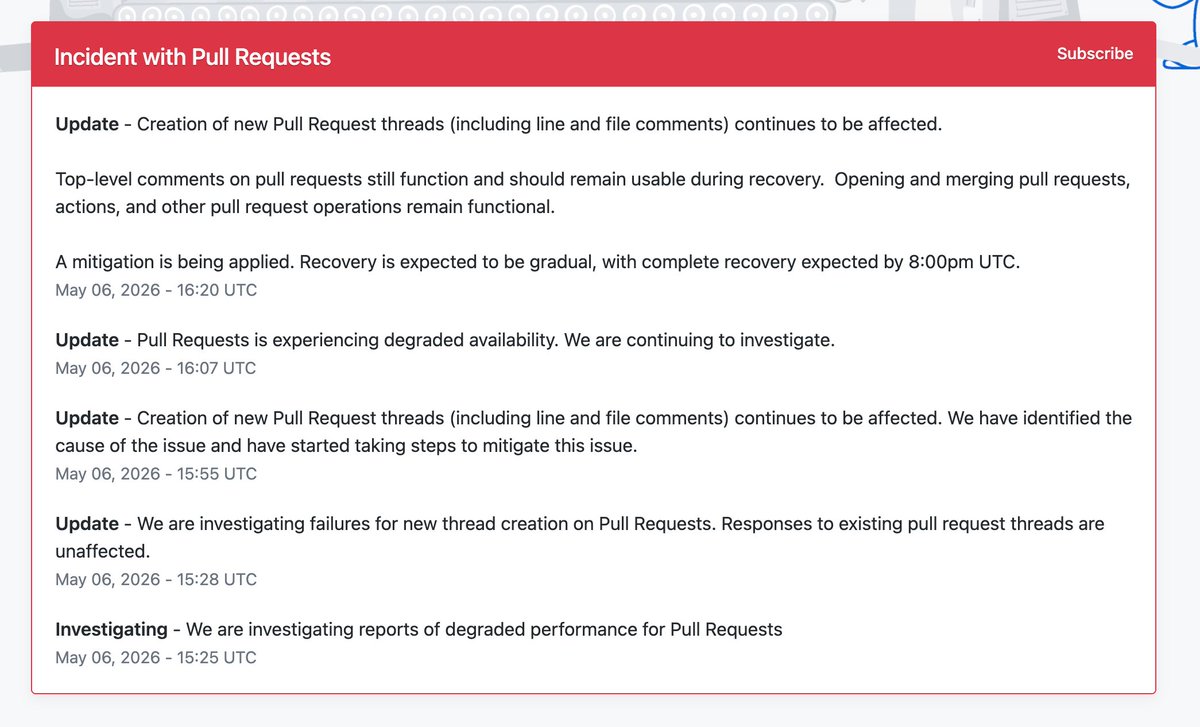
was github down twice today — yes 🙃
Xin tweet media
English
0
0
0
68
Claude
Claude@claudeai·
We’ve agreed to a partnership with @SpaceX that will substantially increase our compute capacity. This, along with our other recent compute deals, means that we’ve been able to increase our usage limits for Claude Code and the Claude API.
English
4.8K
12K
131K
23.9M
OpenAI Developers
OpenAI Developers@OpenAIDevs·
Pets. Now in Codex. Use /pet to wake your pet.
English
811
800
9.3K
3.4M
Xin
Xin@_imfing·
finally figured out how to reset my forgotten sudo password
International Cyber Digest@IntCyberDigest

‼️🚨 BREAKING: An AI found a Linux kernel zero-day that roots every distribution since 2017. The exploit fits in 732 bytes of Python. Patch your kernel ASAP. The vulnerability is CVE-2026-31431, nicknamed "Copy Fail," disclosed today by Theori. It has been sitting quietly in the Linux kernel for nine years. Most Linux privilege-escalation bugs are picky. They need a precise timing window (a "race"), or specific kernel addresses leaked from somewhere, or careful tuning per distribution. Copy Fail needs none of that. It is a straight-line logic mistake that works on the first try, every time, on every mainstream Linux box. The attacker just needs a normal user account on the machine. From there, the script asks the kernel to do some encryption work, abuses how that work is wired up, and ends up writing 4 bytes into a memory area called the "page cache" (Linux's high-speed copy of files in RAM). Those 4 bytes can be aimed at any program the system trusts, like /usr/bin/su, the shortcut to becoming root. Result: the next time anyone runs that program, it lets the attacker in as root. What should worry most: the corruption never touches the file on disk. It only exists in Linux's in-memory copy of that file. If you imaged the hard drive afterwards, the on-disk file would match the official package hash exactly. Reboot the machine, or just put it under memory pressure (any normal system load that needs the RAM), and the cached copy reloads fresh from disk. Containers do not help either. The page cache is shared across the whole host, so a process inside a container can use this bug to compromise the underlying server and reach into other tenants. The original sin was a 2017 "in-place optimization" in a kernel crypto module called algif_aead. It was meant to make encryption slightly faster. The change broke a critical safety assumption, and nobody noticed for nine years. That bug then rode every kernel update from 2017 to today. This vulnerability affects the following: 🔴 Shared servers (dev boxes, jump hosts, build servers): any user becomes root 🔴 Kubernetes and container clusters: one compromised pod escapes to the host 🔴 CI runners (GitHub Actions, GitLab, Jenkins): a malicious pull request becomes root on the runner 🔴 Cloud platforms running user code (notebooks, agent sandboxes, serverless functions): a tenant becomes host root Timeline: 🔴 March 23, 2026: reported to the Linux kernel security team 🔴 April 1: patch committed to mainline (commit a664bf3d603d) 🔴 April 22: CVE assigned 🔴 April 29: public disclosure Mitigation: update your kernel to a build that includes mainline commit a664bf3d603d. If you cannot patch immediately, turn off the vulnerable module: echo "install algif_aead /bin/false" > /etc/modprobe.d/disable-algif.conf rmmod algif_aead 2>/dev/null || true For environments that run untrusted code (containers, sandboxes, CI runners), block access to the kernel's AF_ALG crypto interface entirely, even after patching. Almost nothing legitimate needs it, and blocking it shuts the door on this whole class of bug...

English
0
0
0
27
Gergely Orosz
Gergely Orosz@GergelyOrosz·
Its the beginning of the end of subsidized AI subscriptions. GH Copilot is moving to usage-based billing, as has Claude (for business customers.) Fair to assume more will follow. I expect this change will also be a great boost for open models - cheaper, and pretty good already
GitHub@github

Starting June 1st, GitHub Copilot will move to a usage-based billing model as GitHub Copilot supports more agentic and advanced workflows. In early May, you'll see a preview bill experience, giving visibility into projected costs before the transition. 👉 Read more about the upcoming change: github.blog/news-insights/…


English
127
281
4.3K
511.7K
GitHub
GitHub@github·
Starting June 1st, GitHub Copilot will move to a usage-based billing model as GitHub Copilot supports more agentic and advanced workflows. In early May, you'll see a preview bill experience, giving visibility into projected costs before the transition. 👉 Read more about the upcoming change: github.blog/news-insights/…
English
529
934
2.9K
3.7M
ChatGPT
ChatGPT@ChatGPTapp·
ChatGPT tweet media
ZXX
357
557
11.4K
619.8K
Xin
Xin@_imfing·
@OpenAI that explains why 5.4 was so slow today
English
0
0
1
444
OpenAI
OpenAI@OpenAI·
GPT-5.5 is rolling out today for Plus, Pro, Business and Enterprise users across ChatGPT and Codex. We’re also introducing GPT-5.5 Pro for Pro, Business, and Enterprise users in ChatGPT.
English
89
109
2.4K
369.5K
Xin retweetledi
OpenAI
OpenAI@OpenAI·
Introducing GPT-5.5 A new class of intelligence for real work and powering agents, built to understand complex goals, use tools, check its work, and carry more tasks through to completion. It marks a new way of getting computer work done. Now available in ChatGPT and Codex.
English
2.5K
7K
51.8K
13.1M
Xin
Xin@_imfing·
woah
SpaceX@SpaceX

SpaceXAI and @cursor_ai are now working closely together to create the world’s best coding and knowledge work AI. The combination of Cursor’s leading product and distribution to expert software engineers with SpaceX’s million H100 equivalent Colossus training supercomputer will allow us to build the world’s most useful models. Cursor has also given SpaceX the right to acquire Cursor later this year for $60 billion or pay $10 billion for our work together.

English
0
0
0
5
Xin retweetledi
Mark Gurman
Mark Gurman@markgurman·
BREAKING: Tim Cook steps down. Ternus to CEO.
English
1.6K
3.5K
26.5K
7.5M