

Joseph M. Baffoe
8.2K posts
Joseph M. Baffoe
@_joebaffoe
President ECG luckiest guy in the world, Catholic,8 kids, 12 Grandkids the most amazing wife! All opinions are my own, no stock advice.
Las Cruces, NM Katılım Ağustos 2017
758 Takip Edilen1.4K Takipçiler

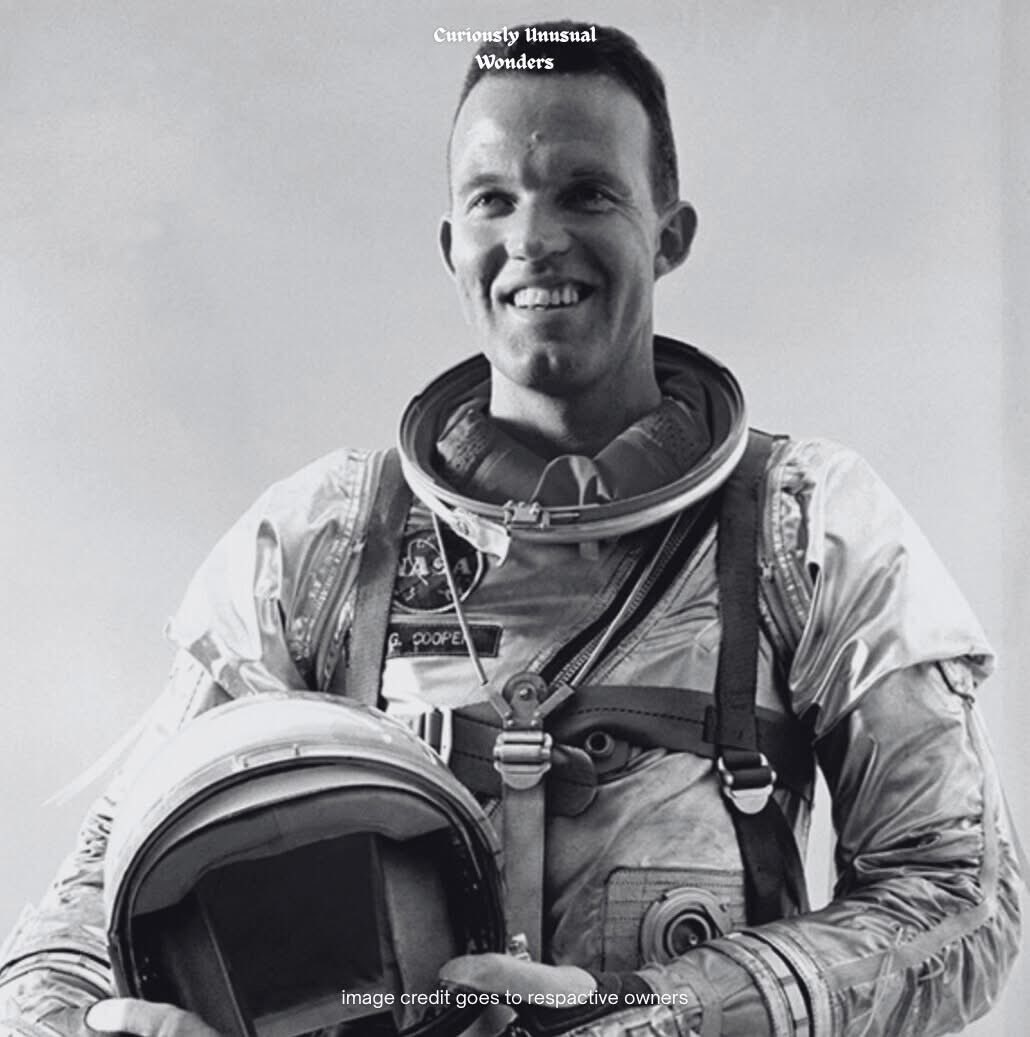
May 16, 1963. Gordon Cooper was orbiting Earth alone inside a capsule barely big enough to turn around in, moving at 17,500 miles per hour.
He had been up there for over a day.
Then the warnings started.
First a faulty sensor screaming that the ship was falling — it wasn't. He switched it off. Then something far worse: a short circuit knocked out the entire automated guidance system. The one that kept the capsule steady. The one that was supposed to bring him home.
Without it, reentry was nearly impossible.
Too shallow an angle and the capsule would bounce off the atmosphere back into space. Too steep and it would incinerate. The margin for error was razor thin — and every computer that was supposed to hit that margin was dead.
Down on the ground, NASA engineers watched the telemetry in silence. They could see everything going wrong. They could fix nothing.
Cooper didn't panic.
He uncapped a grease pencil and drew lines directly on the inside of his window to track the horizon. He looked up at the stars he had spent months memorizing and used their positions to orient the ship by eye. Then he set his wristwatch.
Because when you have no computers left, you become the computer.
At exactly the right moment — calculated in his head, confirmed by the stars outside — he fired the retrorockets. The capsule shook. The sky turned to fire. For several minutes, no one on Earth could reach him as plasma swallowed the ship whole.
Then the parachutes opened.
Faith 7 hit the water just four miles from the recovery ship — the single most accurate splashdown in the entire Mercury program.
The man with a wristwatch and a few pencil marks on a window had outperformed every automated system NASA had.
We talk a lot about technology saving us. And it often does.
But Cooper's story is a quiet reminder that behind every machine, there still has to be a human being who can look out the window, think clearly under pressure, and decide what to do next.
The final backup was never the software.
It was him.
English

I've been searching for a medieval castle in Italy for a client and this is one of the more remarkable ones I've come across.
An 11th-century castle in the heart of Chianti Classico, near Gaiole in Siena province. It once belonged to the noble Ricasoli family, one of the most powerful dynasties in Tuscan history.
900m² (9,688 sq ft) across 4 floors, with a tower that looks out over Chianti vineyards. Grand reception halls, original fireplaces, a library, 8 en-suite bedrooms and a master suite at the top of the tower.
On the grounds there's a deconsecrated chapel now used as an art studio, a restored guesthouse, a wine cellar and a travertine swimming pool.
Siena is 25 kms away and Florence, 60 kms.
Asking price: €1.95M ($2.2M).
Btw, this was listed at €2.6M and it's now at €1.95M. The owners inherited it recently and want a clean, fast sale.
You can build a lot of things but you can't build another 11th-century castle in Chianti Classico.




English


Google just acquired an Israeli Trojan horse to STEAL clients from AWS and Microsoft.
$32 billion. All cash. For a cybersecurity startup called Wiz.
It’s the largest acquisition in Google’s history.
But nobody’s talking about what they ACTUALLY bought...
Here’s why this is way bigger than you think:
Wiz protects over half the Fortune 100.
Their clients run on AWS, Azure, Google Cloud, and Oracle. The platform scans every workload, every vulnerability, every misconfiguration across ALL of those clouds.
Meaning Wiz has a god-level view of how the world's biggest companies use their competitors' infrastructure.
And Google just bought that view for $32 billion.
Now think about what Google Cloud's biggest problem has been for YEARS...
They're stuck in third place. 13% market share. AWS has 30%. Azure has 20%. Google has been hemorrhaging money trying to close that gap and nothing has worked.
Wiz changes that equation overnight.
Because Wiz doesn't just protect cloud environments. It MAPS them.
It knows which companies are running what workloads, where their vulnerabilities are, and where they're overpaying.
Google now has a real-time blueprint of its competitors' biggest customers.
And it gets crazier:
The 4 founders of Wiz previously built Adallom, a cloud security startup that Microsoft acquired for $320 million in 2015. After that acquisition, those same founders ran Microsoft's entire Azure Cloud Security Group.
They literally built the security infrastructure that Azure runs on today.
Then they left. Started Wiz. Built a product that works across every cloud. Got 45% of the Fortune 100 as customers. Most of those customers are on AWS and Azure.
And now they just handed ALL of that to Google.
Google promised Wiz will remain "multi-cloud" and continue working with AWS, Azure, and Oracle. That's the public story.
But here's the game theory every enterprise CTO is thinking about right now:
If you're running sensitive workloads on AWS or Azure and your security layer is now owned by your competitor, how comfortable are you?
Google doesn't need to do anything shady. The PERCEPTION alone is enough to start shifting enterprise decisions. And that's worth way more than $32 billion.
But there's another layer...
Wiz went from $0 to $100 million in revenue in 18 months. Fastest software company in history to hit that mark.
By 2025, they were at $750 million. The founders said no to Google's first offer of $23 billion in 2024 because they wanted to IPO.
9 months later, they said yes to $32 billion.
What changed? The IPO market collapsed.
Tech IPOs dried up. Valuations got slashed. Wiz's leadership looked at the math and realized $32 billion in guaranteed cash beats an uncertain public offering in a hostile market.
Google paid a 39% premium over the rejected offer. A multiple of 45-65x revenue. For a company founded 5 years ago by 4 guys who met in Israeli military intelligence.
This is the BIGGEST tech acquisition of an Israeli-founded company ever. Bigger than Intel buying Mobileye for $15.3 billion. Bigger than anything in Israeli tech history.
And Google is betting it will be worth every penny.
Because the cloud war isn't about compute anymore. It's about TRUST. And the company that controls the security layer controls where enterprises put their most sensitive data.
Google just bought the keys to every major cloud customer on the planet.
The question is whether AWS and Microsoft let them keep using those keys.
What do you think?
English

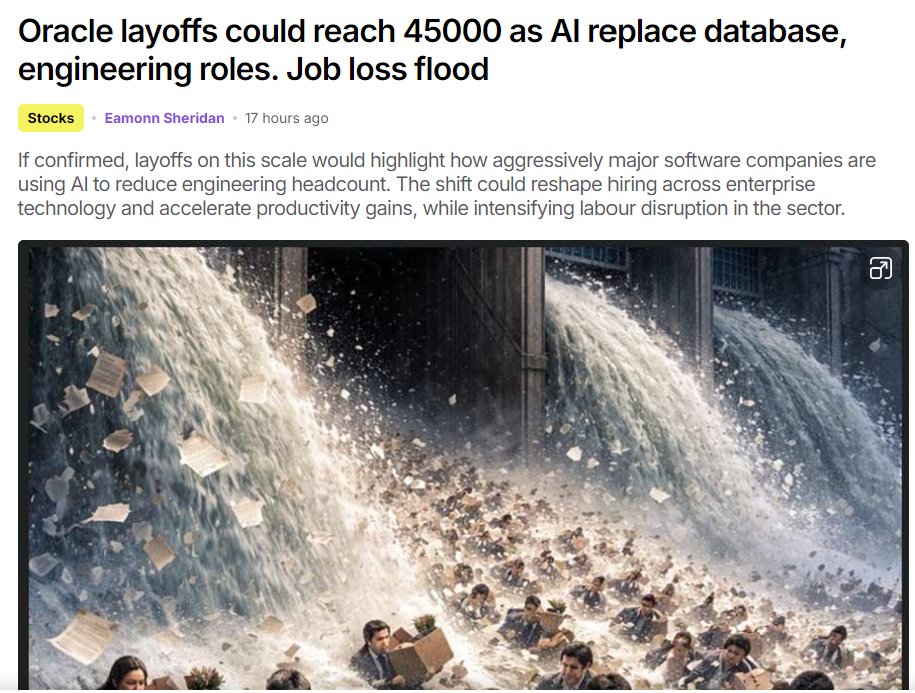
45,000 people are about to be laid off at Oracle. All from AI.
English

This 20-second clip is the best piece of AI advice you'll ever hear.
Google's ex-CEO is literally telling you the blueprint for getting rich with AI.
I wouldn't be fading a billionaire's advice...
English

Here we go………. @EveryTrueTiger Follow us!
Every True Tiger Brands@EveryTrueTiger
A big addition to the ETT team! 🐯 Mario Moccia has been named CEO / General Manager of Every True Tiger. Excited to have Mario back in CoMo leading the charge as we continue elevating our best-in-class brand. #MIZ
English

Microsoft just partnered with Anthropic to launch an AI that can run office work for you and replace millions of office jobs
>It’s called Copilot Cowork.
>You describe the outcome you want.
>The system converts that into a step-by-step execution plan.
>It pulls information from your emails, meetings, files, and chats.
>Then it executes tasks across Outlook, Teams, Excel, and PowerPoint.
>It can build meeting decks, research companies, and prepare reports.
>It can reorganize calendars and schedule meetings automatically.
>It keeps working in the background until the task is complete.
Microsoft 365 has 400M+ users.
For the first time, those workers might have an AI that can actually do their job.
Satya Nadella@satyanadella
Announcing Copilot Cowork, a new way to complete tasks and get work done in M365. When you hand off a task to Cowork, it turns your request into a plan and executes it across your apps and files, grounded in your work data and operating within M365’s security and governance boundaries.
English

@r0ck3t23 10,000,000,000 Robots attacking 8,000,000,000 humans, what could go wrong?
Sarah Conner?
English

Every economic system in human history was built on one assumption. Physical output is finite.
Elon Musk is building the thing that makes that assumption wrong.
Musk: “The Optimus numbers are so mind-blowing that you’re like, is this real? That’s why I wonder, what does money even mean at that point?”
That is not a boast. That is a man who can already see what’s on the other side and has no language for it yet.
Scarcity has been the operating system of civilization since the beginning.
Every war ever fought, every empire ever built, every economic system ever designed. All of it was just a different strategy for managing limited physical output.
Optimus is the first technology in history designed to make scarcity extinct.
Musk: “I actually think the market for humanoid robots is in excess of 10 billion units, more than the number of humans.”
Ten billion tireless workers. No fatigue. No failure. No human potential burned on work that was never meant for human hands.
Every dangerous job that has ever killed a person.
Every repetitive task that has ever consumed a life.
Every physical burden that has ever stood between someone and the only work that actually requires being human.
Optimus absorbs all of it.
Musk: “If they do sell for 20,000 dollars, that’s 200 trillion dollars. This is just an insane number.”
Two hundred trillion dollars is not a valuation.
It is what civilization was leaving on the table every single year it ran on human muscle instead of something better.
Poverty is not solved by redistributing wealth. It is solved by making the things that create wealth limitless.
That is what this actually is.
Not a robot. The last time scarcity gets to decide what humans are capable of.
English
@Quantbro1 @RCangiolosi @BillMiller32 @SteveWagsInvest @HottestStockNow The most important rule running g a biotech is ALWATS take the money! That cash, plus the milestone payment gives them 6 qtrs, the next five data releases is everything for them.
English

@_joebaffoe @RCangiolosi @BillMiller32 @SteveWagsInvest @HottestStockNow Hopefully they beat on revenue with Loqtorzi. Management fucked up bad with their offering at $1.75 per share. Would also like to see not too much cash being burnt either.
English
$CHRS I'm thinking we'll all get to learn what was shown confidentially at the JPM conference on Monday that prompted Oppenheimer to put out a Price Target 700% above the current price and 20M shares bought. @
@RCangiolosi @BillMiller32 @SteveWagsInvest @HottestStockNow @Biotechnerd1 @BiotechCH @Coherus_Bio @DOMOCAPITAL @vanjohn10 @BBackal @MadMoneyOnCNBC @CNBCFastMoney @FierceBiotech @SeekingAlpha @Stocktwits @BioStocks @stocks
English


@liderfiscal Faje news. The accompanying video appears to show unrelated fiery explosions, not matching confirmed missile footage from the conflict.
English

#ÚLTIMAHORA Al menos 70 israelíes muertos y 365 más heridos por bombas de racimo iraníes dirigidas a búnkeres de soldados israelíes. #Irán esta noche ataca al ejército israelí en Jerusalén, Gaza y Tel Aviv.
#IranWar #IranIsraelWar #IsraelTerroristState 👇🏼👇🏼👇🏼👇🏼
Español
Nvidia just spent $4 billion on a technology 99% of people have never heard of.
But in 3 years, every AI data center on Earth will need it.
And Nvidia just LOCKED UP the supply.
Here's what happened:
Nvidia invested $2 billion in Coherent and $2 billion in Lumentum. You probably never heard of these companies.
They make photonics technology. Systems that transmit data using LIGHT instead of electricity.
Sounds like sci-fi. But this is the most important infrastructure bet in AI right now.
Here's the problem Nvidia just solved for itself:
AI data centers are hitting a wall that has nothing to do with chips, energy, or money...
Copper wiring is dying.
Every data center on Earth moves data between GPUs using copper cables. But at the speeds AI now demands, copper physically cannot keep up.
Signal degrades. Heat explodes. Power consumption skyrockets.
Right now, 30% of the electricity in an AI data center is wasted just MOVING data from point A to point B.
An MIT researcher said: "Copper's not going to cut it. It gets too hot. Too much power consumption and loss."
Jensen Huang admitted it himself too: "We use copper as far as we can, about a meter or two. But where data centers are the size of a stadium, we need something else."
That something else is photonics. Replacing copper with laser-powered fiber optics built directly into the chip.
The numbers are insane:
- 3.5x more power efficient
- 10x better network reliability
- Data moving at 102 terabits per second
Wells Fargo estimates the photonics market will hit $10-12 billion by 2030.
And Nvidia just bought privileged access to the two companies that make the advanced lasers every single one of these systems will need.
This is the Nvidia playbook on repeat.
They did this with CoreWeave. Invested $2 billion, locked up GPU capacity, created a dependent customer.
They did this with memory suppliers. Secured HBM allocations years in advance while competitors scrambled.
Now they're doing it with photonics. Invest early. Lock up supply. Make the entire ecosystem dependent on companies that are dependent on Nvidia.
By the time competitors realize photonics is the bottleneck, Nvidia already OWNS the supply chain.
Every data center, AI factory, and GPU cluster will need this technology to function at scale.
Nvidia will become even more important.
English

@alphafox Love your AI videos. Does anyone believe your BS? Any plane, ship, rocket launcher, or heavy weapon system Iran has is either destroyed. or soon will be destroyed. The USA has complete air supremacy over Iran.
English
John, now that the Trump administration is put so much pressure on the pharmaceutical companies that were gouging Americans and forcing them to give us preferred pricing. Every one of these drug manufacturers are gonna be looking for the product that we make at 1/20 of the cost to offset the lower prices that they have to charge
English

@DyadicInc & Fermbox launch 1st product: animal origin free recombinant DNase I. More enzymes & proteins to come from the partnership. Firms will co-commercialize products.
$DYAI
dyadic.com/dyadic-and-fer…
Fermbox report: s27.q4cdn.com/906368049/file…
English

Huge repository of information about OpenAI and Altman just dropped — 'The OpenAI Files'.
There's so much crazy shit in there. Here's what Claude highlighted to me:
1. Altman listed himself as Y Combinator chairman in SEC filings for years — a total fabrication (?!):
"To smooth his exit [from YC], Altman proposed he move from president to chairman. He pre-emptively published a blog post on the firm's website announcing the change.
But the firm's partnership had never agreed, and the announcement was later scrubbed from the post."
"...Despite the retraction, Altman continued falsely listing himself as chairman in SEC filings for years, despite never actually holding the position."
(WTAF.)
2. OpenAI's profit cap was quietly changed to increase 20% annually — at that rate it would exceed $100 trillion in 40 years. The change was not disclosed and OpenAI continued to take credit for its capped-profit structure without acknowledging the modification.
3. Despite claiming to Congress he has "no equity in OpenAI," Altman held indirect stakes through Sequoia and Y Combinator funds.
4. Altman owns 7.5% of Reddit — when Reddit announced its OpenAI partnership, Altman's net worth jumped $50 million. Altman invested in Rain AI, then OpenAI signed a letter of intent to buy $51 million of chips from them.
5. Rumours suggest Altman may receive a 7% stake worth ~$20 billion in the restructured company.
5. OpenAI had a major security breach in 2023 where a hacker stole AI technology details but didn't report it for over a year. OpenAI fired Leopold Aschenbrenner explicitly because he shared security concerns with the board.
6. Altman denied knowing about equity clawback provisions that threatened departing employees' millions in vested equity if the ever criticised OpenAI. But Vox found he personally signed the documents authorizing them in April 2023. These restrictive NDAs even prohibited employees from acknowledging their existence.
7. Senior employees at Altman's first startup Loopt twice tried to get the board to fire him for "deceptive and chaotic behavior".
9. OpenAI's leading researcher Ilya Sutskever told the board: "I don't think Sam is the guy who should have the finger on the button for AGI".
Sutskever provided the board a self-destructing PDF with Slack screenshots documenting "dozens of examples of lying or other toxic behavior.
10. Mira Murati (CTO) said: "I don't feel comfortable about Sam leading us to AGI"
11. The Amodei siblings described Altman's management tactics as "gaslighting" and "psychological abuse".
12. At least 5 other OpenAI executives gave the board similar negative feedback about Altman.
13. Altman owned the OpenAI Startup Fund personally but didn't disclose this to the board for years. Altman demanded to be informed whenever board members spoke to employees, limiting oversight.
14. Altman told board members that other board members wanted someone removed when it was "absolutely false". An independent review after Altman's firing found "many instances" of him "saying different things to different people"
15. OpenAI required employees to waive their federal right to whistleblower compensation. Former employees filed SEC complaints alleging OpenAI illegally prevented them from reporting to regulators.
16. While publicly supporting AI regulation, OpenAI simultaneously lobbied to weaken the EU AI Act.
By 2025, Altman completely reversed his stance, calling the government approval he once advocated "disastrous" and OpenAI now supports federal preemption of all state AI safety laws even before any federal regulation exists.
Obviously this is only a fraction of what's in the apparently 10,000 words on the site. Link below if you'd like to look over.
(I've skipped over the issues with OpenAI's restructure which I've written about before already, but in a way that's really the bigger issue.)
English