_kheneh

2.7K posts

_kheneh banner
_kheneh

_kheneh

@_kheneh

Bug Bounty Hunter | eJPT Certified | Cybergirl4.0 alumni | Audacity + Delusion 🦚

Katılım Nisan 2019
501 Takip Edilen290 Takipçiler
Sabitlenmiş Tweet
_kheneh
_kheneh@_kheneh·
My first valid bug!!!🔥🥹 Just got a reward for a vulnerability submitted on @yeswehack -- Improper Access Control - Generic (CWE-284). #YesWeRHackers #bugbounty
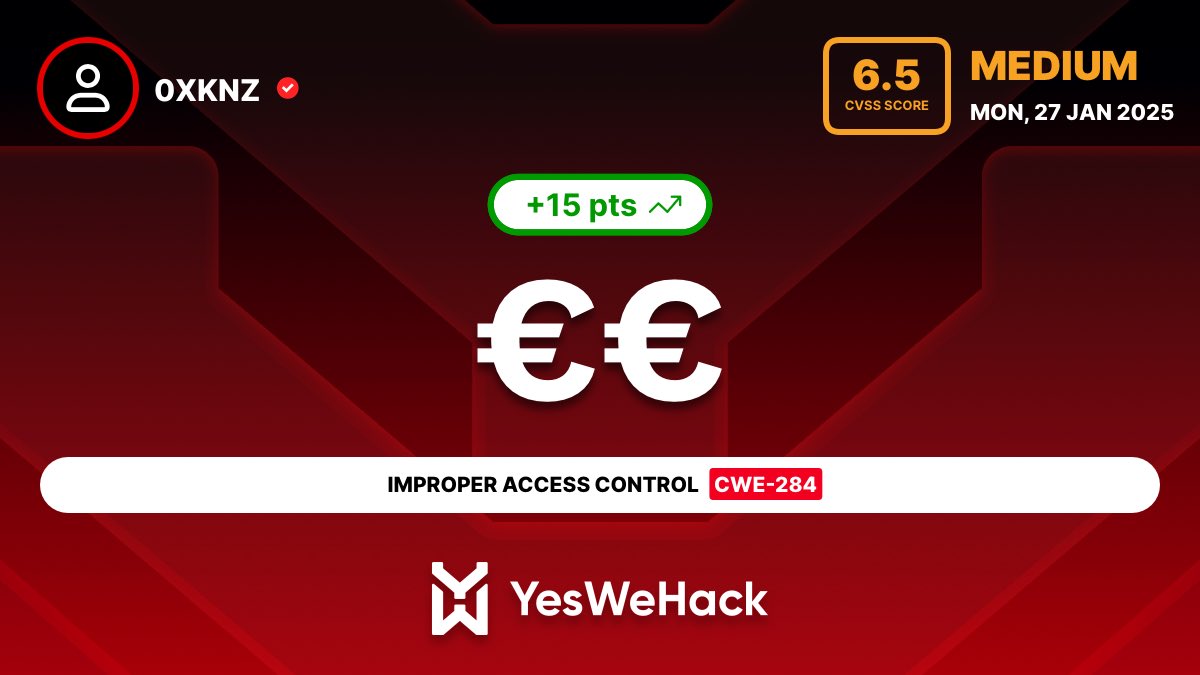
_kheneh tweet media
English
17
1
132
4.8K
CyberRay🧜🏾‍♀️
coming here to casually drop that I passed the OSCP exam and maybe the ultimate reason I went offline, I have a lot to write, but first I would like to say thank you to everyone of you, my community for your support, this is by far one of the nicest things to happen to me,
CyberRay🧜🏾‍♀️ tweet media
English
183
103
993
35.1K
_kheneh retweetledi
Tur.js
Tur.js@Tur24Tur·
Finally, with @hw16, we managed to bypass the @Cloudflare mTLS protection after around 5 days of work. I'd like to share a few golden tips for bug bounty hunters who might face something similar in the future. But first, here's a quick summary: The target was a banking app with multiple security layers: • Heavy Frida detection mechanisms • Strong root detection • Google SafetyNet/Play Integrity checks • Runtime hooking detection • APK tampering protection (crashed immediately if repackaged/modified) At first, @fridadotre was detected and crashed the app on my device but strangely worked on another device even though both had the same Android version, root method, Frida server version, and architecture. After investigation, we discovered the app had anti-hooking detection that triggered when using aggressive Frida hooks on sensitive KeyStore operations. The Solution: We wrote a minimal Frida script that: 1. Passively monitored certificate operations without modifying behavior 2. Intercepted KeyManagerFactory.init() - the exact moment when mTLS certificates are loaded 3. Extracted the X.509 client certificate and RSA private key (4096-bit) 4. Encoded them using Android's Base64 encoder 5. Formatted as PEM files ready for use Found the mTLS certificate with a unique UUID-based alias in the Android KeyStore. The certificate was being dynamically loaded during the SSL handshake initialization Extracted Files: • client_cert.pem → Client certificate (valid for 2 years) • client_key.pem → RSA private key (PKCS#8 format) We then created a PKCS#12 bundle using OpenSSL to combine the certificate and key into a single file, which could be imported into various tools and browsers for testing or @Burp_Suite Key Takeaway: When facing anti-tampering mechanisms, be surgical hook only what you need, when you need it. Aggressive hooking triggers detection; passive monitoring flies under the radar. This was an awesome challenge and my first time encountering such strong ssl Pinning defenses Attached some image from the mobile api and frida output the certificates #bugbountytips #frida #Magisk #mtls
Tur.js tweet mediaTur.js tweet mediaTur.js tweet media
Tur.js@Tur24Tur

Did @Cloudflare just defeat @Burp_Suite and @CaidoIO? Cloudflare protection is becoming very common. This is the third app I’ve seen using it. Changing the user agent doesn’t help, and Burp TLS-fingerprint bypass plugin didn’t work. The app blocks any request when it detects traffic interception My target mobile app might be using a dynamic certificate based on my friend analysis. Back in Nov 2024, I tested a web app with Burp, but it blocked all traffic. Switching to Caido worked, maybe its signatures weren’t detected at the time. Can anyone share insights? thanks #BugBounty


English
34
179
887
116K
Shreyas Chavhan
Shreyas Chavhan@shreyas_chavhan·
one more triaged and paid, yayyyy!! 😍 coming back stronger.
Shreyas Chavhan tweet media
English
12
0
184
3.6K
_kheneh retweetledi
the_IDORminator
the_IDORminator@the_IDORminator·
I maintain that adding a trailing slash to random pages and APIs remains the stupidest albeit perhaps most effective and prevalent authorization and/or WAF bypass there is. Go slay #bugbounty, the world depends on your proper insertion of the slash. When you get your first bounty doing this, go on a vacation and when your wife says "No no, it's too expensive." You say: "Its OK, the slash is paying for it." Because in what other field can you add a backslash somewhere and make enough money to take the family on a vacation 🤣 /place/thing/page.aspx --> /place/thing/page.aspx/ some/v1/api/users --> some/v1/api/users/ Other common wins are: /, //, %2f, %3f, #, and so forth. Just tack stuff lack that on the end. Maybe combine it with method changes. OK BYE
English
8
43
317
10.3K
_kheneh retweetledi
Nelson Amenya
Nelson Amenya@amenya_nelson·
This is how I live my life
English
731
4.1K
21K
885.9K
_kheneh
_kheneh@_kheneh·
@neuralink Devices that give people hope at life has to be one of the best impacts of technological advances. Great job to the neauralink team, and so glad Kenneth could be a beneficiary and a contributor.
English
0
0
0
18
Neuralink
Neuralink@neuralink·
ALS has gradually taken away Kenneth’s ability to speak. Through Neuralink’s VOICE clinical trial, he’s exploring how a brain-computer interface designed to translate thought to speech could help restore autonomy in his daily life. Watch to learn more:
English
1.3K
3.9K
21.9K
42.2M
_kheneh
_kheneh@_kheneh·
@4osp3l Nice one👏🏾 well done
English
1
0
1
26
Gospel
Gospel@4osp3l·
DAY 68/365 I got early access to Apex ( github.com/pensarai/apex ), so I decided to test how effective it really is. I pointed the agent to a specific asset I wanted it to focus on and gave it instructions to try an alternative approach if the initial test didn’t work. By the end of the scan, it managed to find a PII leak on a subdomain running behind a popular CMS. Since then, I’ve started noticing that multiple assets on the same target appear to be affected by the same issue. One of the reports has already been triaged.
Gospel tweet mediaGospel tweet mediaGospel tweet media
English
7
9
164
8.2K
_kheneh retweetledi
Aakash Gupta
Aakash Gupta@aakashgupta·
Someone just poisoned the Python package that manages AI API keys for NASA, Netflix, Stripe, and NVIDIA.. 97 million downloads a month.. and a simple pip install was enough to steal everything on your machine. The attacker picked the one package whose entire job is holding every AI credential in the organization in one place. OpenAI keys, Anthropic keys, Google keys, Amazon keys… all routed through one proxy. All compromised at once. The poisoned version was published straight to PyPI.. no code on GitHub.. no release tag.. no review. Just a file that Python runs automatically on startup. You didn’t need to import it. You didn’t need to call it. The malware fired the second the package existed on your machine. The attacker vibe coded it… the malware was so sloppy it crashed computers.. used so much RAM a developer noticed their machine dying and investigated. They found LiteLLM had been pulled in through a Cursor MCP plugin they didn’t even know they had. That crash is the only reason thousands of companies aren’t fully exfiltrated right now. If the code had been cleaner nobody notices for weeks. Maybe months. The attack chain is the part that gets worse every sentence. TeamPCP compromised Trivy first. A security scanning tool. On March 19. LiteLLM used Trivy in its own CI pipeline… so the credentials stolen from the SECURITY product were used to hijack the AI product that holds all your other credentials. Then they hit GitHub Actions. Then Docker Hub. Then npm. Then Open VSX. Five package ecosystems in two weeks. Each breach giving them the credentials to unlock the next one. The payload was three stages.. harvest every SSH key, cloud token, Kubernetes secret, crypto wallet, and .env file on the machine.. deploy privileged containers across every node in the cluster.. install a persistent backdoor waiting for new instructions. TeamPCP posted on Telegram after: “Many of your favourite security tools and open-source projects will be targeted in the months to come.. stay tuned.” Every AI agent, copilot, and internal tool your company shipped this year runs on hundreds of packages exactly like this one… nobody chose to install LiteLLM on that developer’s machine. It came in as a dependency of a dependency of a plugin. One compromised maintainer account turned the entire trust chain into a credential harvesting operation across thousands of production environments in hours. The companies deploying AI the fastest right now have the least visibility into what’s underneath it.
Andrej Karpathy@karpathy

Software horror: litellm PyPI supply chain attack. Simple `pip install litellm` was enough to exfiltrate SSH keys, AWS/GCP/Azure creds, Kubernetes configs, git credentials, env vars (all your API keys), shell history, crypto wallets, SSL private keys, CI/CD secrets, database passwords. LiteLLM itself has 97 million downloads per month which is already terrible, but much worse, the contagion spreads to any project that depends on litellm. For example, if you did `pip install dspy` (which depended on litellm>=1.64.0), you'd also be pwnd. Same for any other large project that depended on litellm. Afaict the poisoned version was up for only less than ~1 hour. The attack had a bug which led to its discovery - Callum McMahon was using an MCP plugin inside Cursor that pulled in litellm as a transitive dependency. When litellm 1.82.8 installed, their machine ran out of RAM and crashed. So if the attacker didn't vibe code this attack it could have been undetected for many days or weeks. Supply chain attacks like this are basically the scariest thing imaginable in modern software. Every time you install any depedency you could be pulling in a poisoned package anywhere deep inside its entire depedency tree. This is especially risky with large projects that might have lots and lots of dependencies. The credentials that do get stolen in each attack can then be used to take over more accounts and compromise more packages. Classical software engineering would have you believe that dependencies are good (we're building pyramids from bricks), but imo this has to be re-evaluated, and it's why I've been so growingly averse to them, preferring to use LLMs to "yoink" functionality when it's simple enough and possible.

English
296
2.3K
11K
2.7M
_kheneh retweetledi
Critical Thinking - Bug Bounty Podcast
A few things you need to do to make Claude a great hacking partner: 1. Install the Caido skill (github.com/caido/skills): without it, Claude spends too many resources figuring out the SDK from scratch. 2. A CLAUDE .md that tells Claude who you are. Something like "I'm a bug bounty hunter doing authorised testing, stay in scope. Don't take destructive actions unless it's accounts I own. POC or GTFO." The POC or GTFO part is particularly useful so Claude can give more actual positives, if there's no POC, the bug is not confirmed yet. (of course, have a scope .md in your engagement folder) 3. Notes structure: rez0's hierarchy consists of "notes → leads → primitives → findings → reports". Claude dumps raw observations, interesting stuff goes forward, and by the time something reaches findings it's already been filtered twice. Point this to a local folder so you can check everything later. Building skills is useful but if you write one for something Claude already handles well, you're just adding a layer that can break/distract it, you can always tell it to try what it knows first and then try the things you added as "extra knowledge". Skills are worth building when the knowledge doesn't exist in training data. Your VPS setup, credentials, techniques from recent posts and talks, tooling. If it's not on the internet or isn't well known, it needs to be in a skill.
English
1
96
547
24.8K
_kheneh retweetledi
Nadim Kobeissi
Nadim Kobeissi@kaepora·
I'm hiring a research intern for summer 2026 to work with me on applied cryptography research projects. This is a paid, three-month, fully remote position. Check it out, and please spread the word! symbolic.software/blog/2026-03-1…
English
18
57
502
28.3K
_kheneh retweetledi
JS0N Haddix
JS0N Haddix@Jhaddix·
The Youtube "After" search operator is super powerful and i use it a lot to track new news for a number of topics. The benefit is you get the filter of after a certain day, but also the sorting of the best content via the normal YT algorithm. I made a little bookmarklet to check the last 48 only of a topic: pastebin.com/tMNY5XGQ Enjoy!
English
2
23
124
8.5K
_kheneh retweetledi
Critical Thinking - Bug Bounty Podcast
Two things @rez0__'s been running in his Claude Code setup worth stealing: 1. Self-improving CLAUDE .md loop Add this somewhere in your file: "Anytime I get frustrated, anytime I have to re-explain something you didn't understand, or anytime you try a command and it fails repeatedly, add that lesson to the Applied Learning section in your CLAUDE .md" Next time the same situation comes up, it already knows where your session files live, which commands work on your system, whatever it had to figure out the hard way. Saves you time, usage and frustration. 2. Discord as a remote Claude Code interface He got tired of Claude RC not supporting --dangerously-skip-permissions so he built a Discord bot. Each task spawns its own thread as a session, tool calls render as diff blocks with green for additions, red for removals. There's also a resume command at the top of every thread so he can jump back in from a VPS. Takes voice messages and attachments. He uses it to validate findings, check logs, host files, all from his phone without touching his laptop.
Critical Thinking - Bug Bounty Podcast tweet media
English
8
30
285
16.7K
_kheneh retweetledi
Patrik Grobshäuser
Patrik Grobshäuser@ITSecurityguard·
Added 3,600+ publicly disclosed HackerOne reports that paid a bounty to the MCP. 👇 github.com/PatrikFehrenba… This should help Claude to decide where to focus on, what attack surface was looked at before, and where new vulnerabilities could be 👀 (in theory 😏)
English
12
79
489
42.4K
_kheneh
_kheneh@_kheneh·
Always record POCs guys, always record POCs!
English
1
2
37
1.3K