п*здливий гражданін

690 posts

п*здливий гражданін

п*здливий гражданін

@_misha153

c#

Katılım Aralık 2011
434 Takip Edilen24 Takipçiler
п*здливий гражданін
@danusiiaaa "Зачекай, Я нарвав квіти тобі, Це все що я зміг, Це все на що вистачило моїх сил... Віддати тобі, Усі кольори відомих планет, Це все що я зміг, Це все що я можу на даний момент…"
Українська
0
1
65
2.7K
гайка
гайка@danusiiaaa·
Купила в діда квіти. Зайшла до магазину, на виході зіштовхнулася з маленькою дівчинкою, питає - А навіщо ви купили квіти? Кажу - Щоб тобі подарувати. І віддаю їй букет. Бачили б ви ті щасливі і палаючі очі🥹
Українська
7
7
1.5K
22.4K
п*здливий гражданін retweetledi
talesofendlessanne
talesofendlessanne@talesofendles·
Олександр Костецький був київським художником про якого дійсно має знати більше людей. Його виміри, цілі всесвіти, які він створював є рідкісними прикладами магічного реалізму для української школи.
claudio borlotto@claudioborlotto

Alexander Kostetsky

Українська
7
350
3.3K
53.2K
п*здливий гражданін retweetledi
Stefan Đokić | .NET
Stefan Đokić | .NET@TheCodeMan__·
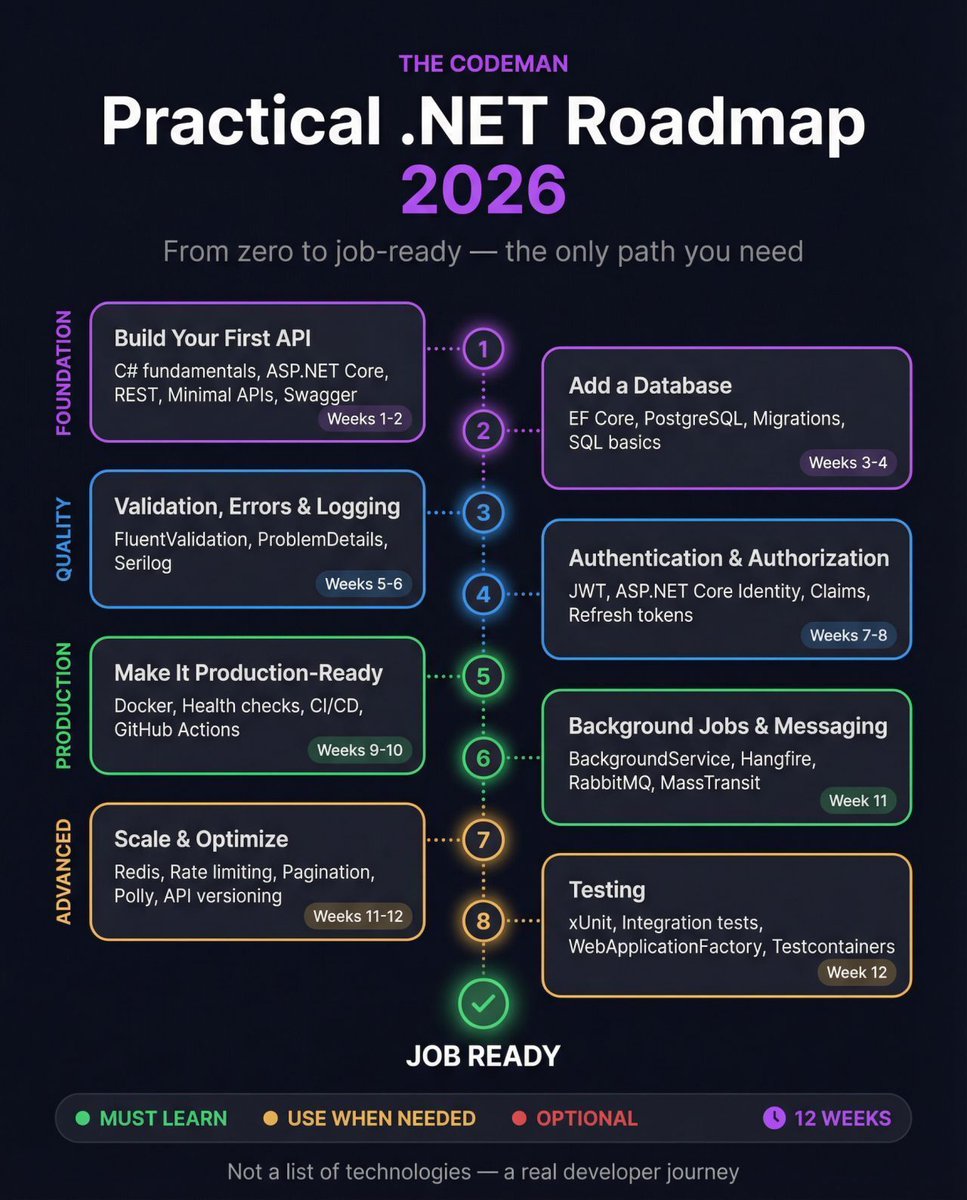
Over 1,000 developers downloaded this in a few days. And my inbox is full. Not with “thanks”. But with messages like: → “This is the first time a roadmap actually makes sense” → “Now I finally know what to build next” → “I’ve been wasting months jumping between random tutorials” That’s exactly why I made it. Because most .NET roadmaps? They look like this: → 50 boxes → Random arrows → Zero context They don’t tell you what to build. They don’t tell you what to skip. And they definitely don’t tell you when you’re ready. So I built something different. 𝗧𝗵𝗲 𝗣𝗿𝗮𝗰𝘁𝗶𝗰𝗮𝗹 .𝗡𝗘𝗧 𝗥𝗼𝗮𝗱𝗺𝗮𝗽 𝗳𝗼𝗿 𝟮𝟬𝟮𝟲 Not a list of technologies. A step-by-step path based on how real developers actually build applications. Here’s the journey: 𝗦𝘁𝗲𝗽 𝟭 → Build your first API 𝗦𝘁𝗲𝗽 𝟮 → Add a real database 𝗦𝘁𝗲𝗽 𝟯 → Validation, error handling & logging 𝗦𝘁𝗲𝗽 𝟰 → Authentication 𝗦𝘁𝗲𝗽 𝟱 → Production-ready (Docker, CI/CD, health checks) 𝗦𝘁𝗲𝗽 𝟲 → Background jobs & messaging 𝗦𝘁𝗲𝗽 𝟕 → Scale & optimize 𝗦𝘁𝗲𝗽 𝟴 → Testing Each step builds on the previous one. Each step tells you what to learn AND what to ignore. Each step has a clear “you’re ready when” checklist. What you get: ✅ 8-step learning path (beginner → job-ready) ✅ 12-week action plan ✅ 7 portfolio projects ✅ Production-ready templates ✅ MUST vs OPTIONAL breakdown ✅ What NOT to learn (this saves months) Here’s the uncomfortable truth: Most developers spend 6 months consuming content… …and still don’t have a single real project. Or: You spend 3 months building properly → and walk into interviews with proof of work. The difference isn’t talent. It’s direction. 🔗 Get it here: thecodeman.net/dotnet-roadmap… 📩 Next issue goes to 20,000+ engineers → thecodeman.net Now I’m curious: If I turned this into something more hands-on… Not a course. But guided learning. Real projects. Private group. Weekly direction + feedback. 👉 Would you join something like that? Or what would you want it to include?
Stefan Đokić | .NET tweet media
English
2
14
33
1.3K
п*здливий гражданін retweetledi
Mukesh Murugan
Mukesh Murugan@iammukeshm·
Caching is one of those things every .NET dev thinks they've figured out. Until production breaks. Most teams I've worked with use IMemoryCache or Redis, and stop there. Both come with real problems that only show up at scale. Then .NET 9 shipped HybridCache, and it quietly fixed the stuff most devs were patching around manually. Let me walk through it. 𝗜𝗠𝗲𝗺𝗼𝗿𝘆𝗖𝗮𝗰𝗵𝗲 𝗳𝗶𝗿𝘀𝘁 Super fast. It lives inside your app, so reads are basically free. But the moment you deploy more than one instance, things get weird. Each server keeps its own copy. A user hits server A and gets fresh data. The next request goes to server B and gets stale data. Bugs that only show up in production. 𝗥𝗲𝗱𝗶𝘀 (𝗼𝗿 𝗮𝗻𝘆 𝗱𝗶𝘀𝘁𝗿𝗶𝗯𝘂𝘁𝗲𝗱 𝗰𝗮𝗰𝗵𝗲) Shared across every instance. That fixes the consistency problem. But every read is now a network call plus serialization on both ends. Still faster than the database, but you lost the speed you had with in-memory. 𝗛𝘆𝗯𝗿𝗶𝗱𝗖𝗮𝗰𝗵𝗲 The idea is simple: why not use both? Check memory first (L1). If it's there, return it instantly. If not, check Redis (L2). If it's there, return it and populate memory too. If not, hit the database, store it in both layers, return. Memory speed for hot data. Distributed consistency for everything else. 𝗧𝗵𝗲 𝗽𝗿𝗼𝗯𝗹𝗲𝗺 𝗻𝗼𝗯𝗼𝗱𝘆 𝘁𝗮𝗹𝗸𝘀 𝗮𝗯𝗼𝘂𝘁 This one still catches people off guard. Imagine a popular cache key expires. In that same moment, 500 requests come in for that exact key. All 500 miss the cache. All 500 hit the database at once. Your database chokes. And this kind of bug is almost impossible to reproduce locally. Most teams work around it with a SemaphoreSlim and some retry logic. HybridCache handles this out of the box. Only one request actually fetches the data, the rest just wait for the same result. 𝗪𝗵𝘆 𝗜 𝘁𝗵𝗶𝗻𝗸 𝗶𝘁'𝘀 𝘁𝗵𝗲 𝗻𝗲𝘄 𝗱𝗲𝗳𝗮𝘂𝗹𝘁 • Works without Redis. Start with in-memory only, add Redis later without rewriting code. • Tag-based invalidation built in. No more tracking keys manually. • Protects you from the concurrent-miss problem above, for free. • One clean API - GetOrCreateAsync handles the full flow. • First-party, shipped with .NET 9. If you're still writing cache-aside logic with manual locks and retries, HybridCache probably already does what you need. Have you moved to HybridCache? Or still sticking with plain IMemoryCache or Redis? Here is how to set up HybridCache for your .NET apps, the right way: codewithmukesh.com/blog/hybridcac…
Mukesh Murugan tweet media
English
3
21
110
5.1K
п*здливий гражданін retweetledi
Kristijan Kralj
Kristijan Kralj@kristijan_kralj·
These 28 .NET libraries will save you tons of TIME 👇 Choosing the right tool for the job can be a game-changer... It can save you tons of time, energy, and money. So take a look at this post, review these NuGets, and save them to save yourself time... #1 - ORM EF Core A lightweight ORM for interacting with databases using LINQ. Dapper A simple and fast micro ORM for efficient database interactions. #2 - API FLOW SignalR A library for adding real-time web functionality to .NET apps. FluentValidation A fluent API for building strongly-typed validation rules. YARP A library for building custom proxies. #3 - TESTING Testcontainers Provides disposable containers for integration and end-to-end testing. Shouldly For writing readable and maintainable test assertions. NSubstitute A library for creating mock objects in unit tests. Bogus A simple library for generating fake data. #4 - LOGGING Serilog A structured logging library with various output formats and destinations. NLog A flexible logging platform with support for multiple targets. #5 - DI Microsoft.Extensions.DependencyInjection The default dependency injection framework used in ASP .NET Core. Scrutor Adds assembly scanning and registration conveniences to .NET Core DI. Autofac A powerful IoC container for advanced dependency management. #6 - BACKGROUND TASKS Hangfire A library for scheduling and executing background jobs with persistence. Quartz .NET A feature-rich scheduler for job execution in .NET applications. #7 - HTTP Polly A resilience library for handling transient faults in HTTP requests. RestSharp A simple HTTP client for consuming REST APIs in .NET. Refit Converts REST APIs into .NET interfaces with auto-generated clients. #8 - MS OFFICE ClosedXML A library for reading, writing, and manipulating Excel files. EPPlus A .NET library for working with Excel files, including charts and tables. Excel-DNA Allows creating Excel add-ins. #9 - AUTH Keycloak An open-source identity and access management solution. OpenIddict A flexible library for adding OpenID Connect and OAuth 2.0 to apps. Microsoft.AspNetCore.Authentication.JwtBearer ASP .NET Core middleware for working with JWT tokens. #10 - MESSAGING RabbitMQ.Client .NET client for RabbitMQ – a message broker for reliable message queuing in distributed systems. MassTransit Provides an abstraction layer for reducing message-based complexity. Rebus Simple and lean service bus implementation for .NET. P.S. Use them, but don't abuse them. *** If you want to confidently make better software architecture decisions, download the free "From Dev to Architect" guide: lp.devsecrets.net/architect Get access to 5 high-quality .NET GitHub repos with clean architecture, vertical slices, modular monoliths, and microservices. Download the free ".NET Blueprints" guide: lp.devsecrets.net/blueprints
Kristijan Kralj tweet media
English
4
28
126
6K
🤔
🤔@vlisinezdoxlo·
@math_ccat МІТ постійно роздає безоплатні лекції. Не всі, звичайно. Професори ведуть популяризуючі програми на різних каналах. Хто із українських науковців робить щось подібне? Я би послухав.
Українська
1
0
1
16
п*здливий гражданін retweetledi
діфенц
діфенц@dfens3k·
Блядь що за рік нахуй
GIF
Українська
6
3
52
2K
Тернистий Зореліт 😺
Вас теж тригерить коли відкриваєш твітер там якась розйобиста фото чи пост а потім раз і твітер перекидає на самий верх і ти потім вже не найдеш цей пост в стрічці?
Українська
50
27
2.4K
46.1K
п*здливий гражданін retweetledi
євросоюзер
євросоюзер@garrossroland·
Думаю на сайті було сотні книг дрібних тиражів, які люди сканували щоб викласти лише на Чтиво, і більш їх нема ніде в цифрі. Буде страшенно сумно якшо то все пропаде. Треба якось дізнатися в чому проблема
Olena Lisevych 🇺🇦@olsvch

Пішла епоха(

Українська
14
33
719
32.5K
п*здливий гражданін retweetledi
Desiderius | Casus Belli 2014
Desiderius | Casus Belli 2014@doctoradmiral·
Donbas Battalion volunteers at their first training camp, border of Dnipro and Donetsk Oblasts Early May 2014
English
6
50
564
17.1K
п*здливий гражданін retweetledi
Вітер Степовий 🍂
Вітер Степовий 🍂@ViterStepovij·
Добровольцям 🙋‍♂️
Вітер Степовий 🍂 tweet media
Українська
1
22
406
5.7K
п*здливий гражданін retweetledi
🇺🇦 (viking)🇺🇦
🇺🇦 (viking)🇺🇦@viking_ua_·
Вітаю всіх причетних з Днем Добровольця🫡🇺🇦
🇺🇦 (viking)🇺🇦 tweet media🇺🇦 (viking)🇺🇦 tweet media
Українська
7
27
676
18.6K
п*здливий гражданін retweetledi
Devana 🇺🇦
Devana 🇺🇦@DevanaUkraine·
One of the first battles of 2014 in the Donbas. Local residents from Luhansk, Rovenky, and Antratsyt routed and captured a unit of the Russian army. They later formed the “Aidar” battalion.
English
6
95
650
32.7K
п*здливий гражданін retweetledi
ZloyAtoshnik
ZloyAtoshnik@ZloyAtoshnik·
Да
Русский
4
50
697
15.6K
teboks
teboks@za_hodi·
@els42874 так жити цікавіше
Українська
2
0
34
11.3K
Aurora
Aurora@els42874·
Я все дитинство (майже) була впевнена, що мій брат - геній водіння з соколиним зором. Як же довго до мене доходило, що він насправді ні хріна не знає, а просто каже рандомні слова з серйозним їбалом. Наприклад >
Українська
8
1
471
63.2K
п*здливий гражданін retweetledi
Сіль 🇺🇦
Сіль 🇺🇦@solonko1648·
В першу чергу дякую тим, хто пішов у 2014. Без них не було б нічого.
Українська
17
350
5.9K
72.4K
Яскраве Слово
11 років в Твіттері і жодного бажання немає змінити його на більш популярні Інстаграм чи Фейсбук. Бо тут хоч люди в основному попаяні, але живі і цікаві. Активна меншість, яка впливає на значні процеси. Люблю твіттер за влучність висловлювань і велику кількість класних людей.
Українська
19
18
317
4.3K
п*здливий гражданін retweetledi
Reads with Ravi
Reads with Ravi@readswithravi·
Keep showing up.
Reads with Ravi tweet media
English
51
327
2.3K
38.3K
Sonic The Hugecock🔱
Sonic The Hugecock🔱@metalcorefan_ua·
Ніколи не любив офіційний тон та різного роду дипломатичний етикет. На публіку пускають пил в очі заготованими фразами з різним істинним значенням, а все найцікавіше за зачиненими дверима. Все швидше б вирішувалося у форматі якоїсь «Говорить Україна» чи іншої подібної телепередачі. Зібралися всі офлайн, висловили свою точку зору прямо, обхуєсосили один одного і перед публікою зразу порішали що робити далі
Українська
6
1
138
6.3K