Mohamed

11 posts

Mohamed banner
Mohamed

Mohamed

@_mohamedd24

حب الصحابة كلهم لي مذهب

Katılım Mayıs 2026
5 Takip Edilen642 Takipçiler
Sabitlenmiş Tweet
Mohamed
Mohamed@_mohamedd24·
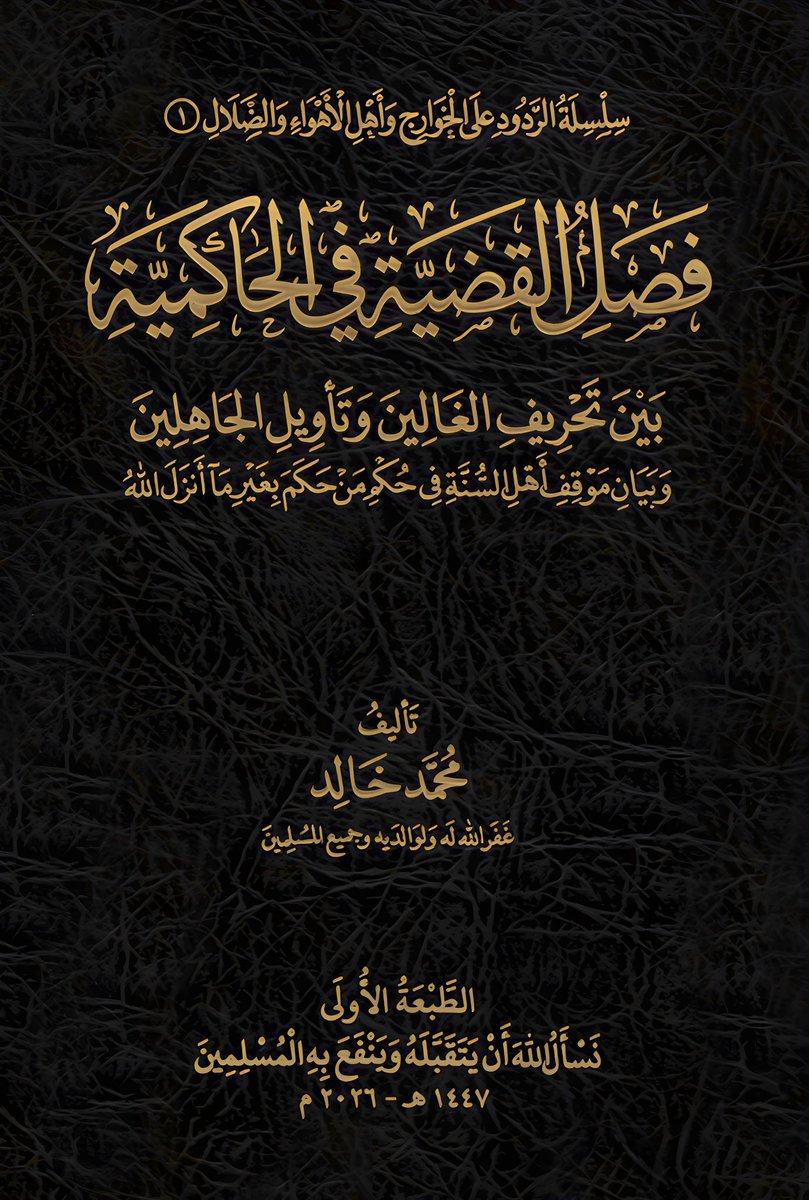
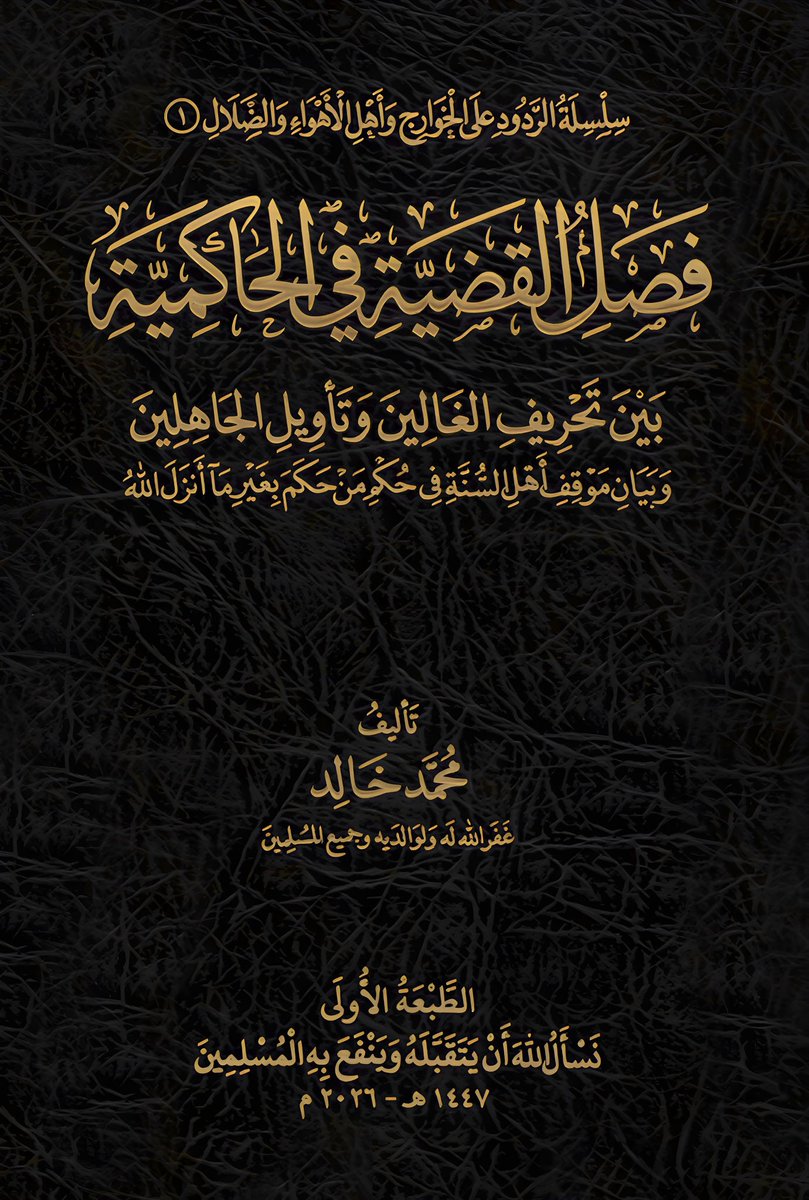
The book that I’ve been referencing in my tweets, today’s Space, and will in future Spaces: Faṣlul Qaḍiyah fil-Ḥākimiyyah, which refutes every doubt the K͟hawārij bring, from the Ṣaḥābah to the scholars alive today. Book link: ko-fi.com/s/e6cf166ec6 Telegram link: t.me/Khawarij1
English
0
11
52
2.3K
Mohamed
Mohamed@_mohamedd24·
Response to those who believe that it is not problematic for Sulaymān al-ʿAlwān to take [5:44] upon its apparent so long as he does not make takfīr on major sins.
English
0
13
80
2.5K
Mohamed
Mohamed@_mohamedd24·
Sulaymān al-ʿAlwān takes [5:44] upon its apparent. So what do the scholars have to say about this?
English
0
13
70
8K
Mohamed
Mohamed@_mohamedd24·
Today, ʾInʾshāʾAllāh, around 5 PM EST, I will be holding a Space here on X for all these keyboard warriors who are giving the most bizarre and ridiculous answers to the only three tweets I’ve posted. Bring these same responses, the same energy, and any proof you have against my position on this issue, starting with the Salaf and THEN the K͟halaf. I’d love to have a respectful and fruitful in-depth conversation with all these people who disagree with me on the issue of al-Ḥākimiyyah.
English
0
23
91
14.7K
Mohamed
Mohamed@_mohamedd24·
I was told by the Ikhwah before I came on X that “the K͟hawārij on there are very, very stupid” which is no different from the K͟hawārij that I deal with on the platforms that I am active on. They are all programmed to have the same responses to the proofs from the Salaf and even their own scholars against them, such as: “These are general at͟hār,” “not about legislation/man-made laws” etc. However, the tweets I am making are in chronological order to their copes: first, you show what the Salaf said, then you wait for their copes, then you respond to the copes. This approach stems from my Telegram channel: t.me/Khawarij1 And my book: ko-fi.com/s/e6cf166ec6 Both of which were made in a style of rudūd (refutations). However, we will respond to these copes biʾit͟hnillāh. Did the Salaf not speak about man-made laws and not view them as kufr dūna kufr? (Excerpt from my book Faṣlul Qaḍiyah fil-Ḥākimiyyah): “The third issue: The explicit statements of the Salaf that ruling by man-made laws is not disbelief in its origin. This narration breaks the backbone of the K͟hawārij. Ibn Abī Ḥātim narrated in his Tafsīr from ʿAbd al-Raḥmān ibn Zayd ibn Aslam regarding the statement of Allāh تعالى: {And whoever does not judge by what Allāh has revealed, then they are the disbelievers}, that he said: ‘Whoever rules by a book that he wrote with his own hand, and leaves the Book of Allāh, and claims that this book of his is from Allāh – then he has disbelieved..’ So reflect on how he explicitly mentioned ‘writing a book by one’s hand’ — which is the very essence of man-made legislation — yet he did not declare it disbelief except with the condition of his statement: ‘and claims that this book is from Allāh.’ Therefore, the “fa” in ‘then he has disbelieved’ is causative according to the grammarians and uṣūl scholars, and it came as the response to the condition, which indicates that merely writing and replacing without this claim is not disbelief that expels one from the religion. Once again their scholar Abū ʿAlī al-Anbārī, after quoting this narration from ʿAbd al-Raḥmān ibn Zayd ibn Aslam, concedes and admits from the outset that the narration pertains to legislation and contains an explicit requirement of three conditions. He said: ‘Whoever writes a book with his own hand and abandons the Book of Allāh… Notice the conditions and restrictions they placed: the first condition is that he himself formulated legislation; the second condition is abandoning the Sharʿ of Allāh, Blessed and Exalted; the third condition is attributing what he wrote to Allāh and claiming that this is the ruling of Allāh, Blessed and Exalted. So when we came to these noble ones — al-Ḥasan al-Baṣrī, al-Suddī, and Ibn Zayd — they said that it is required that he write it and attribute what he wrote to Allāh, Blessed and Exalted.’ Then he said: ‘This statement contradicts the reason for the revelation of the verse.’ And in this admission is a profound proof, since their own scholar acknowledges that al-Ḥasan al-Baṣrī, al-Suddī, and Ibn Zayd — who are from the Imāms of the Salaf — were speaking on this issue with complete awareness and explicit conditions. Thus, the claim of the K͟hawārij falls apart that the Salaf were unaware of the issue of legislating man-made laws. Rather, their own scholar testifies against them that the Salaf understood this issue and established conditions and restrictions for. I’d love to see the response of the K͟hawārij to their scholar al-Anbārī admitting that the Salaf held the “Madk͟halī” position that attribution to Allāh is what constitutes kufr, and I truly hope it is not simply, “He’s wrong,” just to brush the doubt off.
Mohamed tweet mediaMohamed tweet mediaMohamed tweet media
English
0
26
88
11.3K
Mohamed
Mohamed@_mohamedd24·
Is the at͟har of Ibn ʿAbbās (رضي الله عنهما) on [5:44] not problematic to the K͟hawārij nor contradictory to their creed regarding the issue of Ḥākimiyyah, as they claim? Let us have one of their scholars speak on their behalf (excerpt from my book Faṣlul Qaḍiyah fil-Ḥākimiyyah): Imām Ibn Abī Ḥātim al-Rāzī narrated in his Tafsīr from Ibn ʿAbbās regarding His statement: {And whoever does not judge by what Allāh has revealed}, that he said: “Whoever denies the ruling revealed by Allāh has disbelieved, and whoever affirms it but does not rule by it, then he is a thālim and a fāsiq. He said: Whoever denies any of the limits set by Allāh has committed kufr.” Abū ʿAlī al-Anbārī said in his book al-Barāʿah fī Tabyān S͟hirk al-Ṭāʿah: “So if that has been established for you, then know that the statement of Ibn ʿAbbās (رضي الله عنه) and the statement of Imām al-Ṭabarī oppose the apparent meaning of the statement of Allāh, Blessed and Exalted. We can only say as ʿAbd al-Qādir ibn ʿAbd al-ʿAzīz said — and I ask Allāh to guide him — in his book al-Jāmiʿ: ‘This statement — meaning the interpretation of the verse as referring to rejection — contradicts the explicit text of the Qurʾān and Sunnah. For Allāh attached disbelief to abandoning judgment by what Allāh revealed: {And whoever does not judge…}, while Ibn ʿAbbās attached it to rejecting what Allāh revealed. Thus, he established a criterion for the ruling — meaning a cause for the ruling — other than the criterion mentioned in the verse.” For anyone wanting to access the book, the link for it is: ko-fi.com/s/e6cf166ec6
Mohamed tweet mediaMohamed tweet mediaMohamed tweet media
Català
0
21
78
5.4K
Mohamed
Mohamed@_mohamedd24·
@ARAFAT7494 Just like I replied to you under my TikTok video, your scan has no correlation to the claim that the Ṣaḥābah rebelled against ʿAlī (رضي الله عنه), ya miskīn, Hadāk Allāh.
Català
2
0
15
1K
ARAFAT AHMED
ARAFAT AHMED@ARAFAT7494·
@_mohamedd24 is using the word linguistically khuruj to define the actions of companions mean that they are khawarij in beliefs, do you know he distinction of the ulama regarding bughat and khawarij, ya murtad even your own ulama affirm this
English
1
0
6
1.1K
Mohamed
Mohamed@_mohamedd24·
Turkī ibn ʿAlī accuses the Prophet’s ﷺ wife and the Ṣaḥābah of falling into a foundational principle of the K͟hawārij.
Català
5
48
129
12.5K
Mohamed
Mohamed@_mohamedd24·
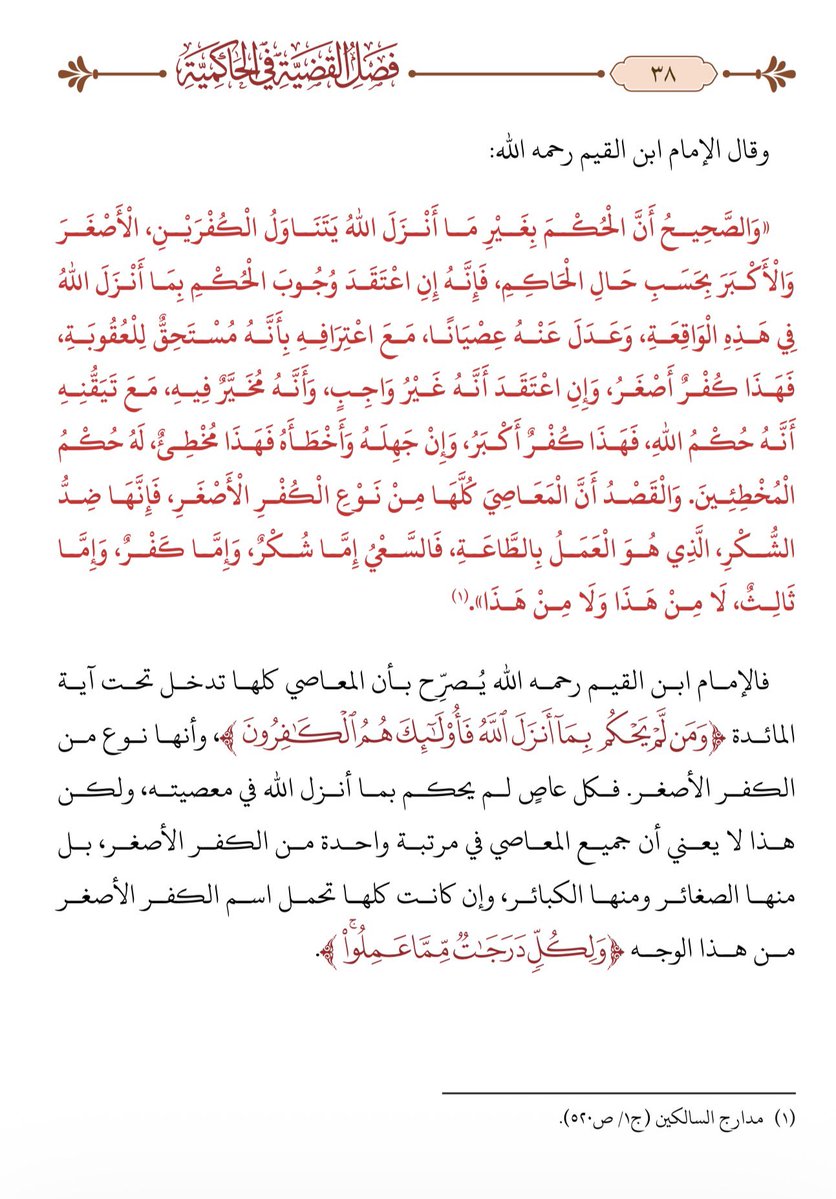
Refutation on those who take [5:44] “And whoever does not judge by what Allāh has revealed” UNRESTRICTEDLY on it’s apparent, and as proof for making takfīr upon the one who does not abide by the Sharīʿah of Allāh ﷻ (excerpt from my book Faṣlul Qaḍiyah fil-Ḥākimiyyah): “Imām Ibn al-Qayyim (رحمه الله) said: The correct view is that ruling by other than what Allāh has revealed includes both minor disbelief and major disbelief, depending on the condition of the ruler. So if he believes it is obligatory to judge by what Allāh revealed in this instance, yet turns away from it out of disobedience while acknowledging that he deserves punishment, then this is minor disbelief. But if he believes that it is not obligatory, and that he has a choice in the matter despite being certain that it is the ruling of Allāh, then this is major disbelief. And if he is ignorant of it and errs, then he is mistaken and takes the ruling of those who err. The intent is that all sins are from the category of minor disbelief, because they are the opposite of gratitude, which is acting in obedience. Thus, striving is either gratitude, disbelief, or a third category that is neither this nor that.” So Imām Ibn al-Qayyim (رحمه الله) explicitly states that all sins enter under the verse in Sūrat al-Māʾidah: {And whoever does not judge by what Allāh has revealed, then they are the disbelievers}, and that they are a type of minor disbelief. Every sinner has not judged by what Allāh revealed in his sin. However, this does not mean that all sins are on the same level of minor disbelief; rather, among them are minor sins and major sins, even if they all carry the name of minor disbelief from this angle: {And for all there are degrees according to what they did}. So if every son of Ādam is a sinner, and the apparent meaning of the verse — according to those who claim it is upon its unrestricted apparent meaning — necessitates takfīr merely for abandoning judgment by what Allāh revealed in any given case, then the implication of this statement would be the permissibility of the blood of all Muslims without exception. And this is precisely the very foundation upon which the K͟hawārij were established from their earliest emergence: interpreting the verses of threat upon other than their correct meaning in order to justify declaring the muwaḥḥidīn to be disbelievers and making their blood lawful.
Mohamed tweet mediaMohamed tweet media
Română
3
28
106
8.7K