bg

115 posts

bg

bg

@_toZst

Katılım Şubat 2025
38 Takip Edilen30 Takipçiler
bg retweetledi
Alec Mazo
Alec Mazo@Alec_Mazo·
"Golden Age of Profitability" - ex Fannie CFO to Treasury right before Obama's housing guys Parrott and DeMarco saw $$$ signs and decided to sweep all profits in a blatant socialist money grab. @pulte
Robert Bowes@Robert_B_Bowes

To compliment the @BillAckman accurate description of the Net Worth Sweep of 100% of Fannie and Freddie profits, one must also look at how the Obama Treasury forced F2 to cook their books. Then Treasury Secretary Tim Geithner continued the Hank Paulson large bailout plan that exacerbated the mortgage market crisis and extended credit losses beyond the sand States. Geithner hired both Blackrock and Blackstone to direct F2 to find as many write downs as they could to justify the $100B each bailout that protected F2 bondholders. When F2 internal models were stressed they each could not come close to $100B in losses. Paulson and Geithner wrongly compared street private label mortgage losses to the relatively safer book of GSE mortgages failing to recognize that GSEs had strong first loss cover in private mortgage insurance and in bank legal obligations to repurchase fraudulent and defectively underwritten mortgages. Obama Treasury forced F2 to cook their books and zero out all PMI ($43B of trapped liquid claims paying ability) and all lender recourse (another $61B of liquid bank assets - $20B alone with BofA) that provided F2 legally obligated claims paying ability. Treasury ignored that first loss liquidity forcing F2 to post large credit provisions in 2008-2010. The policy was extend and pretend for the banks and PMIs but to force F2 into conservatorship. Yet the PMI and recourse funds were being collected while bad loan repurchases mushroomed. F2 also tightened the credit box and doubled GFees during this period. It was a total double standard to target F2 investors. In hindsight F2 never needed the bailouts for cash flow because the credit loss provisions and other valuation allowances were non-cash. The bailouts were optics done for mostly foreign bondholders. American homeowners and F2 shareholders were the victims of that failure. Then with the high non cash credit losses F2 each wrote off $31B and and $21B of Deferred Tax Assets in 2008 respectively. In 2009-2011 another $29B Fannie and $8B Freddie DTA write downs for a total of $89B. Combining the $104B non-cash credit losses with the $89B DTA write downs coincidentally equalled the amount of Treasury F2 bailout in Senior Preferred. Yet in 2010 and 2011 F2 were collecting the PMI, lender recourse, the higher GFees and trends started to look good for home price recovery. Treasury knew ahead of the NWS taking that F2 would be rolling in profits. Nonetheless F2 kept loan loss allowances high and gave no model value to the liquid PMI first loss claim receipts. They all knew ahead of 2012 that the DTAs and loan loss provisions would appear anomalous. Facing obvious valuation allowance reversals, Treasury rushed to implement the 2012 NWS. Smart folks inside witnessed the accounting and loan loss committee gimmickry - with some still working at F2.

English
4
24
88
3.2K
bg retweetledi
Darren Unruh
Darren Unruh@darren_unruh·
In case you were unaware … BHO oversaw the re-appropriation of funds from $FNMA and $FMCC to pay for various parts of the government, including “Obama Care”.
Horseman Country@HorsemanCountry

$FNMA $FMCC The exposure of Obama's theft from Fannie Mae/Freddie Mac & their shareholders via NWS is gaining momentum. Than you, @BillAckman! @SecScottBessent & @pulte, you're hawkish on fraud. Look no further than Mnuchin's account from 2017. Justice is long overdue.

English
2
12
27
1.3K
bg
bg@_toZst·
@GroveNeal @pulte Once the new Fed chair is put in place and interest rates are lowered $FNMA and $FMCC will have their day. They can't release them with high interest rates because it will adversely affect affordability. Be patient, it will happen. @realDonaldTrump @SecScottBessent @BillAckman
English
2
0
8
499
Rage
Rage@GroveNeal·
@pulte What about Fannie Mae Shareholders! Anything?
English
3
2
26
822
Pulte
Pulte@pulte·
ZXX
65
50
330
44.5K
bg
bg@_toZst·
Good luck @BarackObama your theft of public property ( $FNMA & $FMCC will eventually come out. Let's get this done @realDonaldTrump @SecScottBessent @howardlutnick @cnnbrk @NBCNews @FoxNews
Horseman Country@HorsemanCountry

$FNMA $FMCC The exposure of Obama's theft from Fannie Mae/Freddie Mac & their shareholders via NWS is gaining momentum. Than you, @BillAckman! @SecScottBessent & @pulte, you're hawkish on fraud. Look no further than Mnuchin's account from 2017. Justice is long overdue.

English
0
10
28
1.1K
bg
bg@_toZst·
@b_csky19 @realDonaldTrump The earliest this will happen is the end of May, when the new Fed chair is in. And even then it will probably be months before the interest rates are low enough to justify releasing them. I'm predicting a July-Sept 2026 timeline.
English
1
0
3
61
B Coskay
B Coskay@b_csky19·
Dear President @realDonaldTrump, back in August 2025 you pushed a November 2025 #NYSE uplist narrative for $FNMA and $FMCC. We believed in you and have waited patiently long enough. It really only takes one call to do right by the people, what exactly is the hold-up? Why push that narrative and still not act? What is the justifiable reason for this delay? Who can explain it? Mr. President? Secretary @SecScottBessent? Director @pulte? Secretary @SecretaryTurner? Secretary @howardlutnick? Mr. @BillAckman? Mr. @michaeljburry? Anyone? As promised, please: 🇺🇸⚠️ End the Obama/Biden scam. Enough crushing hardworking Americans. 🔓 End #Fanniegate 🏦 Privatize #FannieMae and #FreddieMac - do right by shareholders. ⚖️ Justice delayed for 18 years is not justice. #UplistNow #EndTheConservatorship
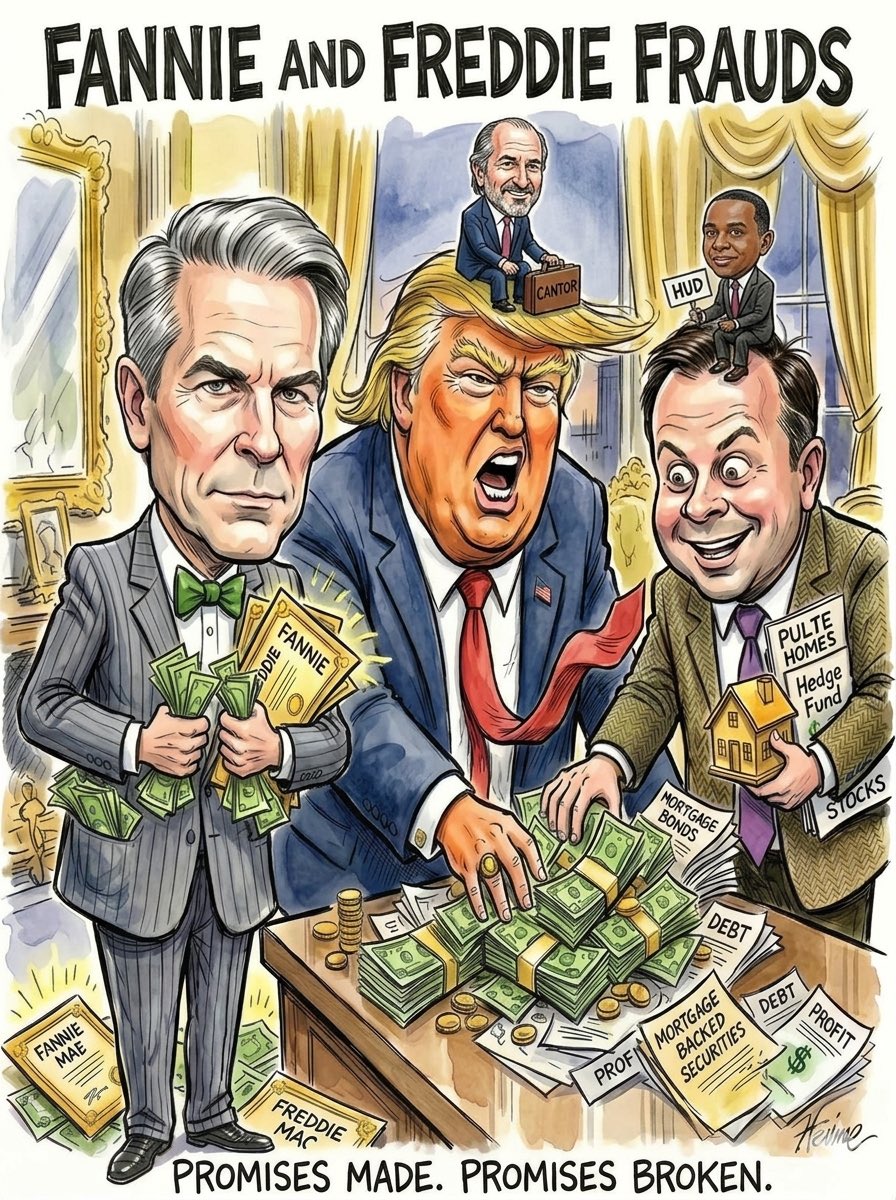
B Coskay tweet media
English
11
34
143
4.4K
bg
bg@_toZst·
@cnnbrk Oh so CNN is a bunch of idiots spewing horse 💩 saying POTUS was lying? GOT IT. Can't trust 💩 from CNN.
English
0
0
0
14
CNN Breaking News
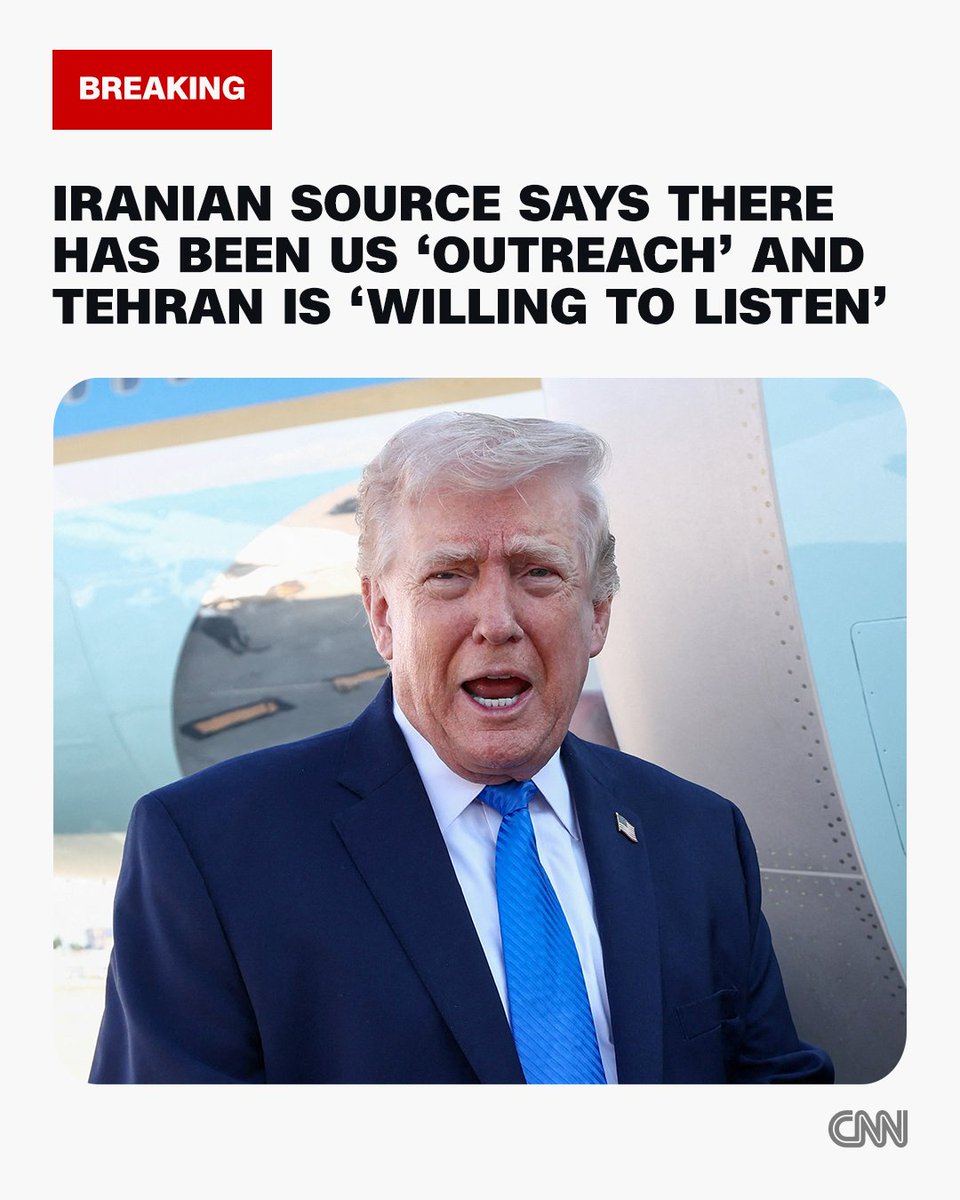
Iranian source tells CNN there has been "outreach" with the US, initiated by Washington, to end the war and Tehran is willing to listen. Follow live updates. cnn.it/40NVFoD
CNN Breaking News tweet media
English
397
370
1K
359K
bg
bg@_toZst·
@BarackObama How about when you STOLE Fannie Mae and Freddie Mac illegally, and used the funds to pay for "Obama care"? Was that a great day as well? $FNMA $FMCC 🤡
English
0
2
8
554
Barack Obama
Barack Obama@BarackObama·
The day the Affordable Care Act passed was one of my proudest moments as president, because it meant that millions of Americans would have access to health care, some for the first time. The ACA also prevented insurance companies from denying people with pre-existing conditions coverage, allowed young people under the age of 26 to remain on their parents’ plan, expanded Medicaid, and so much more. But the ACA was always meant to be a first step. We still have to do more to expand access and make health care more affordable for everyone.
English
35K
23.1K
206.4K
63.7M
bg retweetledi
Neo Sun Tzu
Neo Sun Tzu@neo_tzu53185·
As a long-time shareholder in Fannie Mae $FNMA, I want to thank Mr. Ackman for his perseverance and activism on behalf of shareholders. I have been in this investment for nearly two decades and, as an individual shareholder, in 2013 I met with lawmakers in Washington, D.C. to discuss my individual shareholder perspective as part of a group named Shareholders United. The facts and circumstances of this seemingly endless conservatorship are so bizarre and unnecessarily complicated that they do not lend themselves easily to the common everyday social media post and, as informative and comprehensive as Mr. Ackman’s piece is there is much, much more to say on the matter. While this is no longer the headline story, for much of the conservatorship, at least politically, F2 (Fannie Mae & Freddie Mac) was considered to be Villain #1 in Great Financial Crisis – ostensibly, the cause for the 2008 near collapse of the global financial system. Nothing, nothing could be further from the truth. Without misguided financial deregulation, derivative instruments run amok, a great deal of malfeasance in banking institutions, the derivatives industry, and ratings agencies, and almost nonexistent regulatory oversight of said entities there would have been NO GREAT FINANCIAL CRISIS – but more on this later in the piece. Essentially, from the earliest stages of the government response to the crisis, the American public was bamboozled with the F2 villain narrative by a tightknit group of political and financial ne’er-do-wells, which has been the basis for the mistreatment Mr. Ackman so adroitly and comprehensively lays out. This is the part of the story that I would like to tell and, for all intents and purposes, negates any defensible reason F2’s captors have for said mistreatment (especially with regard to shareholders) and the continued conservatorship. First, allow me to add some startling figures to Mr. Ackman’s accounting. Since the conservatorship began F2 have earned, and shareholders have been deprived of, nearly $500B in profits that have gone directly (via the net worth sweep) or indirectly (establishment of the government “liquidation preference”) to the government, in addition to not receiving credit for tens of billions of dollars (more likely upwards of $100B) in fraudulent or bad mortgage loans the banking system off-loaded on F2, on top of spending billions of shareholder funds in establishing what began as the common securitization platform and what is now U.S. Financial Technology (U.S. Fintech: usfintech.com) - a fully-fledged company ready for spin-off (of which current shareholders should rightly own a piece). All told, this is somewhere in the ball park of $750B lost to shareholders. (Notes: ~$300B returned directly to U.S. Treasury via the net worth sweep; ~$170B “retained” by F2 since the net worth sweep as of Q4 2025, but according to F2’s Q4 2025 financial statements still subject to U.S. Treasury ownership due to the establishment of the “Liquidation Preference”; FHFA settled with large banking institutions long ago for the bad mortgage loans off-loaded to F2 at hugely discounted values, and lumped in the settlement with LIBOR lawsuits settlements while F2 never received credit for those settlements; and finally, I do not know of any independent valuation of U.S. Fintech – but surely this entity provides a great deal of value that rightly belongs to shareholders.) Now, on to the meat of the matter. The Great Financial Crisis fire, metaphorically speaking, started in the basement of the house with the home mortgage loan, more correctly subprime mortgage loans, and the repackaging of millions of those loans into mortgage-backed securities (MBS), the long-standing F2 staple line of business which was so deceptively manufactured, by politicians, regulators, the financial establishment and the media into the big lie that F2 was the villain of the crisis. (Note: private banking institutions also engage in the repackaging of these loans into what are known as private label mortgage-backed securities – PLMBS). F2 was a politically convenient scapegoat and a readily available piggybank which effectively diverted attention away from and funded the bailout of the true causes of the conflagration that engulfed the entire financial system: financial deregulation, the subprime loan industry, derivatives, ratings agencies, and almost nonexistent regulatory oversight of these elements. This was the era of the NINJA loan – no income, no job, no assets – these “subprime” loans became the crisis fire kindling and, mixing metaphors here, the virus that infected mortgage-backed securities investments. But here is the relevant crux of the matter, every single one of these subprime loans were made by banking institutions, mortgage companies, or other entities which originate mortgage loans, NOT F2, Fannie Mae and Freddie Mac, do not and never have originated mortgage loans. In as much as they engaged in the repackaging of these loans into their agency mortgage-backed securities let us not forget the fraudulent banking institution loans that were offloaded on F2, but more importantly, the fact that PLMBS failed at more than five times the rate of F2 agency MBS. But the story gets even uglier for the original political-financial establishment faux F2 villain narrative. If subprime loans and the associated MBS would have been the only game in town, good proactive regulatory oversight should have caught this long before any significant problems could have arisen and even allowing for genuine regulatory missteps or allowances for well-intentioned government homeownership policies, the fire should and could have easily been contained to a manageable neighborhood of the financial sector. Enter financial industry deregulation, institutional malfeasance, and the Great Financial Crisis uranium fission material – the derivative. Although each of these pieces cannot be done justice in a piece of this length, already too long for most, the long and short of it absolving F2 of any semblance of culpability played out along the following lines: An entire subprime mortgage loan industry arose around well-intentioned government home ownership policies and expanded well-beyond all reasonable or financially prudent application (NINJA loans) due to what can at best be described as lackadaisical regulatory oversight. Investment banking institutions created pipelines directly from both legitimate banking institutions originating mortgage loans and fly-by-night mortgage companies (Countrywide Mortgage, anyone?) to earn tens of billions, if not hundreds of billions in profit by assembly line packaging of these loans into PLMBS and other derivative instruments for resale to investors world-wide. All while the ratings agencies blessed these instruments with AAA (triple-A) ratings. You can look up those still existing ratings agencies; I will not name them here, but they are well-known, and they are notorious for their actions and culpability for the 2008 crisis. (Note: one, now defunct investment bank alone, in one year, did tens of billions of this business through a derivative security known as the CDOs (collateralized debt obligations). Multiply this activity by dozens of large global investment banking institutions and the thousands of legitimate banking institution mortgage loan originators (plus a handful illegitimate fly-by-night mortgage loan companies) and you have a true global crisis in the making. But the nuclear chain reaction, that 2008 mushroom cloud, was ignited by supposedly respectable investment banking firms and other financial institutions lying to their clients, to each other, and to investors about the true depth and breadth of their exposure, their knowledge and culpability in these arrangements, and then creating derivative instruments (namely the credit default swap) to game the financial system, shareholders, counter party institutions and the government (for undeserved, but necessary bailouts). The notional value of these credit default swaps alone was 60-70 TRILLION DOLLARS! This was more than 4 times the 2008 U.S. GDP, and anywhere from 12 to 15 times the entire combined 2008 F2 mortgage credit books! Throw in some shoddy financial deregulation interconnecting the worst aspects of each industry segment’s profit seeking motives, hundreds of billions in profits to protect, and asleep at the wheel regulatory oversight agencies, and voila – you have the Doomsday Machine – the true reason the financial system nearly collapsed. Now, look me in the eye and tell me with a straight face F2 was the cause of or significantly contributed to the financial system collapse. I can elaborate much further on each aspect outline in this piece; however, it is long enough already and should raise the ire of even the most casual observer. But let me finish by addressing the current administration. As of now, the Trump administration bears no culpability for any aspect of the Great Financial Crisis. I voted for President Trump three times and believe he will be one of the most consequential pro-American, pro-business presidents in our country’s 250 year-young eminence. As far F2 is concerned, I viewed President Trump, Secretary Bessent, and Director Pulte as the Dream Team, and had the hopefully, not misplaced confidence, they would research, learn and fully understand this conservatorship’s true history, and have the fortitude, power, and sagacity to put things right for shareholders, conservatorship, and constitutional law (5th amendment Takings Clause). My suspicion is that special interests and inside financial establishment players are or have been hamstringing the Dream Team. President Bush allowed then Treasury Secretary Hank Paulson to favor his Wall Street cronies by putting F2 in conservatorship and swiping their capital. “We’re going to move quickly and take them by surprise. The first sound they’ll hear is their heads hitting the floor.” --- Hank Paulson, from his 2010 memoir On the Brink: Inside the Race to Stop the Collapse of the Global Financial System President Obama instituted the net worth sweep – taking F2’s entire annual profits into the U.S. Treasury, and President Biden slept through his entire presidency. Time is running out and all eyes are on President Trump, our distinguished Treasury Secretary Bessent, and the ever-Trump loyal and competent FHFA commander Director Pulte to rise above and distinguish themselves from the past bad actors and administrations. F2 was not culpable for the financial crisis, in fact, their seizure and 20-year flow of hundreds of billions of dollars into the U.S. Treasury (fungibility of money anyone?) was a significant factor into alleviating the distress of the wider financial institutional banking system via U.S. Treasury bailouts. Finally, U.S. Constitutional Law (5thAmendment Takings Clause) and long-standing shareholder rights laws rightly demand that investors fully share in, at worst, a minimally diluted value of the hundreds of billions these companies have earned and would have properly shared with investors as freely operating, publicly owned companies. $FNMA $FMCC
Jon Oksenholt@JonOksenholt

Real life has many parallels with Freddie & Fannie ( $FMCC / $FNMA ) shareholder perspectives: you can remain bitter & focused on the past & divisive, or you can be generally optimistic & adaptable & focused on Solutions & the future. I’m sympathetic to & on the side of the long-term @freddiemac / Fannie Mae shareholders, & always rooting for the little guy, just as I did when calling out Elliott Capital’s lowball bid for City Office REIT. If I thought these businesses weren’t being optimized I would be the first to call that out. No different from what I did when calling out my concerns with the management of City Office REIT, where I acquired a significant stake prior to the take-private announcement. In this instance, the current admin led by @realDonaldTrump with @Pulte, @SecScottBessent, & @howardlutnick is uniquely qualified to deliver the best possible outcome for shareholders, homebuyers, taxpayers, & renters. They also are not the ones that put these beautiful businesses into conservatorship to begin with. Shareholders large & small (both common & jps) ought to unite & shine a bright light on how well these companies are performing (Fannie alone posted $14.4B net income in 2025) & why they belong back on a major exchange. P.S. If it’s true that @BillAckman presented his ideas to the govt, that’s positive news / DYOR on this & every investment, form your own opinions, & choose your path based on facts, logic, & probabilities & if you decide to share your views on Freddie/Fannie publicly, make sure you have thick skin..

English
3
12
56
1.8K
bg
bg@_toZst·
@HolySmokas Doubtful, I fact you should probably buy calls.
English
2
0
3
2.4K
Jeremy Lefebvre
Jeremy Lefebvre@HolySmokas·
Tomorrow will be the worst day in STOCK MARKET HISTORY…see more
English
431
91
1.7K
1.4M
Truth Seeker
Truth Seeker@Mnuchindilutio1·
@XfractiousX The odds of Treasury writing off 370 billion dollars of Senior Preferred is almost zero
English
2
0
1
40
Fractious Forever
Fractious Forever@XfractiousX·
I rarely if ever agree with Ackman - while he makes great points that are correct it doesn’t matter it’s been litigated - $FNMA
Bill Ackman@BillAckman

A number of press reports have characterized our and other shareholders’ efforts on behalf of Fannie and Freddie (F2) as seeking a ‘gift’ or ‘handout’ from the government. We, the shareholders of F2, seek no such thing. Hundreds of financial institutions were bailed out during the GFC by the U.S. Treasury. Nearly all of the financial institution bailouts during the GFC involved an injection of capital in the form of senior preferred stock by Treasury at an interest rate of 5%, plus warrants to acquire common stock in an amount equal to 15% of the face amount of the preferred with an exercise price at the then-current stock price of the rescued institution. For example, Treasury’s preferred stock investment in Goldman Sachs was in an amount of $10 billion and, in addition, Treasury received warrants on $1.5 billion of GS' common stock at its then market price. The bailout terms for F2 were materially more burdensome and expensive, with a higher interest rate and substantially more warrant coverage, than that of every other financial institution (other than those of AIG whose terms were similar). Despite the F2 bailouts’ massively more burdensome terms, shareholders are not complaining about the original terms. Treasury invested $193 billion in F2 in the form of senior preferred stock (SPS), including funding for $2 billion of commitment fees, with a 10% coupon (twice that of the banks). Treasury also received warrants on 79.9% of both companies’ outstanding shares. Fannie and Freddie have since repaid Treasury $301 billion, which includes interest on the SPS at a blended rate of 11.6%, an interest rate which is 160 basis points more per annum, and have returned the entire $193 billion of outstanding principal, $25 billion in excess of what was contractually owed. In summary, the F2 SPS has been fully repaid according to its original contractual terms plus an extra $25 billion. Despite the fact that the SPS has been more than repaid in full, Fannie and Freddie have not accounted for these payments on their respective balance sheets, and the $193 billion of SPS remains an outstanding liability as if no principal payments had ever been made. How can it be, you might ask, if indeed F2 have repaid $301 billion to Treasury when only $276 billion was due could there be any remaining balance of the SPS on the F2 balance sheets? The answer relates to something called the ‘Net Worth Sweep (NWS).’ During the second term of the Obama administration, on August 12, 2012, two quarters after F2 returned to profitability, Treasury announced that it was unilaterally amending the terms of the SPS stock to provide that Treasury would take 100% of the profits of F2 each quarter in lieu of the 10% annual dividend rate. This was not a negotiated resolution with F2. It was a unilateral amendment of the original terms of the SPS that was done in bad faith. The supposed rationale for the amended terms of the SPS was akin to the IRS garnishing the wages of someone who will never be able to pay the taxes that they owe. That is, the Treasury said F2 will never be able to pay the 10% coupon, let alone the SPS’ $193 billion principal balance, so it decided instead to ‘settle’ for 100% of F2’s profits forever. In discovery, shareholders learned that the stated justification for the amendment was false. In mid 2012, the Obama administration had come to learn that both companies would soon be reversing tens of billions of reserves on their balance sheets as housing values had increased and the reserves taken during the GFC had been excessive. The NWS was instituted by Obama to forestall F2 from forever being able to recapitalize and be released from conservatorship. The NWS was not a ‘settlement’ for a lesser amount of future payments. It was the outright theft of the forever profits of both companies. Never before or since has the government ‘swept’ 100% of the profits of any company, let alone a financial institution in conservatorship, a form of government intervention where the goal is rehabilitation of the institution, and where the hierarchy of corporate claims has always been respected. The accounting for the NWS payments while it was in effect (until Secretary Mnuchin terminated the NWS in Trump’s first term) was also unusual. The NWS was treated by F2 as a quarterly adjustment to the dividend rate on the SPS such that the dividend amount owed was made equal to the after-tax profits of F2 for that quarter with no limitation. In other words, regardless of the amount of profit F2 generated for the quarter – whether or not it was in excess of the original 10% annual dividend – the dividend payable under the NWS was made equal to the quarterly profit. The absurd terms of the NWS sweep therefore made it impossible for any partial or full repayment of the SPS to take place as every dollar paid to the Treasury on the amended terms of the SPS was considered a dividend payment, even if the amount was massively in excess of the original contractual SPS terms. The absurdity of the NWS was made clear just two quarters after the NWS went into effect. Fannie Mae generated a profit of $59 billion in the first quarter of 2013, and the SPS dividend rate for that quarter was set at $59 billion so the entire amount was swept to the government, more than 10 times the contractual dividend rate. I had the opportunity to discuss F2 and the NWS with Warren Buffett about a decade ago and he said that he “couldn’t believe what the government had done.” In short, the shareholders of F2 are simply asking the government to respect the original and highly burdensome terms of the SPS. There is no dispute that Treasury has received more than the original 10% coupon and full repayment of principal of the SPS, that is, an extra $25 billion. We and the millions of other shareholders of F2 are simply asking the administration to honor the original SPS terms and properly account for the $301 billion of payments, thereby eliminating the SPS liability from both companies’ balance sheets. Shareholders have not asked for the extra $25 billion to be returned to the two companies. Treasury can decide whether to keep those funds or return them to the companies. Accounting for the repayment of the SPS has other important implications. Namely, it is critically important that conservatorships respect the rule of law, in particular, the contractual terms of corporate instruments and the hierarchy of claims. Otherwise, no financial institution that gets into trouble will be able to raise rescue capital in the private markets. Notably, the treatment of F2 in conservatorship explains why Silicon Valley Bank and other recent large bank failures since the GFC were unable to raise private capital and avoid government intervention or a forced sale to J.P. Morgan. If the government with the stroke of a pen during conservatorship can at a whim wipe out common and preferred shareholders, no one is going to step in to try to save a financial institution that gets into trouble, and only the top few banks will be possible rescuers of big banks that fail. Furthermore, because of F2’s history, their reputation in the capital markets has been greatly damaged. F2 raised $22 billion of preferred stock in the year or so prior to conservatorship as the government pressed both companies to raise capital. Institutions were willing to invest billions of dollars of capital into both institutions before they failed because, based on all precedent conservatorships, the contractual terms of all financial instruments and the hierarchy of claims had been preserved. Unfortunately, in light of the precedent of the net worth sweep, no investor can be confident that they won’t be wiped out in a future conservatorship so none has been willing to take the risk. Some have proposed that Treasury simply convert the SPS into junior preferred and common stock and massively dilute shareholders. Putting aside the potential legal challenges to this approach, the result will be that Treasury will at best own something approaching 95% of both companies rather than 79.9%. While the government’s percentage ownership stake would be larger in the SPS conversion approach, the value of the government’s larger stake would be considerably lower as the companies would become un-investable. Who would invest in F2 alongside the government when they just wiped out the previous owners? In the SPS conversion scenario, the government’s stake, at best, if it could be sold, would trade at a massively discounted valuation, well below the value of the government's stake if Treasury retained only its contracted for 79.9% stake and respected the original terms of the SPS. In other words, a slightly smaller ownership stake of much more highly valued companies would equate to considerably more value for Treasury and taxpayers. In a public letter to Rand Paul after his first term in November of 2021, President Trump recognized that the net worth sweep was theft from the shareholders of Fannie and Freddie. He wrote: “Another Obama/Biden scam in legal trouble was when they allowed the Federal Housing Finance Agency (FHFA) to steal the retirement savings of hardworking Americans who had invested in Fannie Mae and Freddie Mac…The idea that the government can steal money from its citizens is socialism and is a travesty brought to you by the Obama/Biden administration. My Administration was denied the time it needed to fix this problem because of the unconstitutional restriction on firing Mel Watt. It has to come to an end and courts must protect our citizens.” I couldn’t have said it better than President Trump. Now that you have the time, Mr. President, let’s Stop the Steal!

English
4
4
11
1.4K
bg
bg@_toZst·
Hand of God@TylerEHand

@BillAckman is on point: "Never before or since has the government ‘swept’ 100% of the profits of any company, let alone a financial institution in conservatorship, a form of government intervention where the goal is rehabilitation of the institution, and where the hierarchy of corporate claims has always been respected." Socialism is socialism, and if this administration is going to call out Z. Mamdani for what he is doing in New York, there's no room to keep Fannie Mae and Freddie Mac (F2) in conservatorship any longer. They have more than repaid their bailout commitments, and shareholders (most of whom are regular Americans, either robbed of their retirement or holding for years awaiting justice) deserve their due. It's time, Mr. President. It is time to do what no other administration was willing to do. End the socialism of these two beautiful companies that belong in the S&P 500. $FNMA $FMCC

English
0
0
1
10
Cassandra Unchained
Cassandra Unchained@michaeljburry·
I agree with Bill Ackman/Pershing Square. @BillAckman. This is an important read for all interested in Fannie Mae and Freddie Mac. Treating shareholders fairly here is about much, much more than these two companies. “Accounting for the repayment of the SPS has other important implications. Namely, it is critically important that conservatorships respect the rule of law, in particular, the contractual terms of corporate instruments and the hierarchy of claims. Otherwise, no financial institution that gets into trouble will be able to raise rescue capital in the private markets. Notably, the treatment of F2 in conservatorship explains why Silicon Valley Bank and other recent large bank failures since the GFC were unable to raise private capital and avoid government intervention or a forced sale to J.P. Morgan. If the government with the stroke of a pen during conservatorship can at a whim wipe out common and preferred shareholders, no one is going to step in to try to save a financial institution that gets into trouble, and only the top few banks will be possible rescuers of big banks that fail.” $FNMA $FMCC
Bill Ackman@BillAckman

A number of press reports have characterized our and other shareholders’ efforts on behalf of Fannie and Freddie (F2) as seeking a ‘gift’ or ‘handout’ from the government. We, the shareholders of F2, seek no such thing. Hundreds of financial institutions were bailed out during the GFC by the U.S. Treasury. Nearly all of the financial institution bailouts during the GFC involved an injection of capital in the form of senior preferred stock by Treasury at an interest rate of 5%, plus warrants to acquire common stock in an amount equal to 15% of the face amount of the preferred with an exercise price at the then-current stock price of the rescued institution. For example, Treasury’s preferred stock investment in Goldman Sachs was in an amount of $10 billion and, in addition, Treasury received warrants on $1.5 billion of GS' common stock at its then market price. The bailout terms for F2 were materially more burdensome and expensive, with a higher interest rate and substantially more warrant coverage, than that of every other financial institution (other than those of AIG whose terms were similar). Despite the F2 bailouts’ massively more burdensome terms, shareholders are not complaining about the original terms. Treasury invested $193 billion in F2 in the form of senior preferred stock (SPS), including funding for $2 billion of commitment fees, with a 10% coupon (twice that of the banks). Treasury also received warrants on 79.9% of both companies’ outstanding shares. Fannie and Freddie have since repaid Treasury $301 billion, which includes interest on the SPS at a blended rate of 11.6%, an interest rate which is 160 basis points more per annum, and have returned the entire $193 billion of outstanding principal, $25 billion in excess of what was contractually owed. In summary, the F2 SPS has been fully repaid according to its original contractual terms plus an extra $25 billion. Despite the fact that the SPS has been more than repaid in full, Fannie and Freddie have not accounted for these payments on their respective balance sheets, and the $193 billion of SPS remains an outstanding liability as if no principal payments had ever been made. How can it be, you might ask, if indeed F2 have repaid $301 billion to Treasury when only $276 billion was due could there be any remaining balance of the SPS on the F2 balance sheets? The answer relates to something called the ‘Net Worth Sweep (NWS).’ During the second term of the Obama administration, on August 12, 2012, two quarters after F2 returned to profitability, Treasury announced that it was unilaterally amending the terms of the SPS stock to provide that Treasury would take 100% of the profits of F2 each quarter in lieu of the 10% annual dividend rate. This was not a negotiated resolution with F2. It was a unilateral amendment of the original terms of the SPS that was done in bad faith. The supposed rationale for the amended terms of the SPS was akin to the IRS garnishing the wages of someone who will never be able to pay the taxes that they owe. That is, the Treasury said F2 will never be able to pay the 10% coupon, let alone the SPS’ $193 billion principal balance, so it decided instead to ‘settle’ for 100% of F2’s profits forever. In discovery, shareholders learned that the stated justification for the amendment was false. In mid 2012, the Obama administration had come to learn that both companies would soon be reversing tens of billions of reserves on their balance sheets as housing values had increased and the reserves taken during the GFC had been excessive. The NWS was instituted by Obama to forestall F2 from forever being able to recapitalize and be released from conservatorship. The NWS was not a ‘settlement’ for a lesser amount of future payments. It was the outright theft of the forever profits of both companies. Never before or since has the government ‘swept’ 100% of the profits of any company, let alone a financial institution in conservatorship, a form of government intervention where the goal is rehabilitation of the institution, and where the hierarchy of corporate claims has always been respected. The accounting for the NWS payments while it was in effect (until Secretary Mnuchin terminated the NWS in Trump’s first term) was also unusual. The NWS was treated by F2 as a quarterly adjustment to the dividend rate on the SPS such that the dividend amount owed was made equal to the after-tax profits of F2 for that quarter with no limitation. In other words, regardless of the amount of profit F2 generated for the quarter – whether or not it was in excess of the original 10% annual dividend – the dividend payable under the NWS was made equal to the quarterly profit. The absurd terms of the NWS sweep therefore made it impossible for any partial or full repayment of the SPS to take place as every dollar paid to the Treasury on the amended terms of the SPS was considered a dividend payment, even if the amount was massively in excess of the original contractual SPS terms. The absurdity of the NWS was made clear just two quarters after the NWS went into effect. Fannie Mae generated a profit of $59 billion in the first quarter of 2013, and the SPS dividend rate for that quarter was set at $59 billion so the entire amount was swept to the government, more than 10 times the contractual dividend rate. I had the opportunity to discuss F2 and the NWS with Warren Buffett about a decade ago and he said that he “couldn’t believe what the government had done.” In short, the shareholders of F2 are simply asking the government to respect the original and highly burdensome terms of the SPS. There is no dispute that Treasury has received more than the original 10% coupon and full repayment of principal of the SPS, that is, an extra $25 billion. We and the millions of other shareholders of F2 are simply asking the administration to honor the original SPS terms and properly account for the $301 billion of payments, thereby eliminating the SPS liability from both companies’ balance sheets. Shareholders have not asked for the extra $25 billion to be returned to the two companies. Treasury can decide whether to keep those funds or return them to the companies. Accounting for the repayment of the SPS has other important implications. Namely, it is critically important that conservatorships respect the rule of law, in particular, the contractual terms of corporate instruments and the hierarchy of claims. Otherwise, no financial institution that gets into trouble will be able to raise rescue capital in the private markets. Notably, the treatment of F2 in conservatorship explains why Silicon Valley Bank and other recent large bank failures since the GFC were unable to raise private capital and avoid government intervention or a forced sale to J.P. Morgan. If the government with the stroke of a pen during conservatorship can at a whim wipe out common and preferred shareholders, no one is going to step in to try to save a financial institution that gets into trouble, and only the top few banks will be possible rescuers of big banks that fail. Furthermore, because of F2’s history, their reputation in the capital markets has been greatly damaged. F2 raised $22 billion of preferred stock in the year or so prior to conservatorship as the government pressed both companies to raise capital. Institutions were willing to invest billions of dollars of capital into both institutions before they failed because, based on all precedent conservatorships, the contractual terms of all financial instruments and the hierarchy of claims had been preserved. Unfortunately, in light of the precedent of the net worth sweep, no investor can be confident that they won’t be wiped out in a future conservatorship so none has been willing to take the risk. Some have proposed that Treasury simply convert the SPS into junior preferred and common stock and massively dilute shareholders. Putting aside the potential legal challenges to this approach, the result will be that Treasury will at best own something approaching 95% of both companies rather than 79.9%. While the government’s percentage ownership stake would be larger in the SPS conversion approach, the value of the government’s larger stake would be considerably lower as the companies would become un-investable. Who would invest in F2 alongside the government when they just wiped out the previous owners? In the SPS conversion scenario, the government’s stake, at best, if it could be sold, would trade at a massively discounted valuation, well below the value of the government's stake if Treasury retained only its contracted for 79.9% stake and respected the original terms of the SPS. In other words, a slightly smaller ownership stake of much more highly valued companies would equate to considerably more value for Treasury and taxpayers. In a public letter to Rand Paul after his first term in November of 2021, President Trump recognized that the net worth sweep was theft from the shareholders of Fannie and Freddie. He wrote: “Another Obama/Biden scam in legal trouble was when they allowed the Federal Housing Finance Agency (FHFA) to steal the retirement savings of hardworking Americans who had invested in Fannie Mae and Freddie Mac…The idea that the government can steal money from its citizens is socialism and is a travesty brought to you by the Obama/Biden administration. My Administration was denied the time it needed to fix this problem because of the unconstitutional restriction on firing Mel Watt. It has to come to an end and courts must protect our citizens.” I couldn’t have said it better than President Trump. Now that you have the time, Mr. President, let’s Stop the Steal!

English
73
208
1K
275.9K
bg
bg@_toZst·
@SecScottBessent @realDonaldTrump @FoxNews @ABC @NBCNews @pulte I'm sure you guys know all this... But might want to make this actually news. It's about time everyone acknowledges that the @BarackObama administration stole #FNMA & $FMCC. Return them to the rightful owners.
Bill Ackman@BillAckman

A number of press reports have characterized our and other shareholders’ efforts on behalf of Fannie and Freddie (F2) as seeking a ‘gift’ or ‘handout’ from the government. We, the shareholders of F2, seek no such thing. Hundreds of financial institutions were bailed out during the GFC by the U.S. Treasury. Nearly all of the financial institution bailouts during the GFC involved an injection of capital in the form of senior preferred stock by Treasury at an interest rate of 5%, plus warrants to acquire common stock in an amount equal to 15% of the face amount of the preferred with an exercise price at the then-current stock price of the rescued institution. For example, Treasury’s preferred stock investment in Goldman Sachs was in an amount of $10 billion and, in addition, Treasury received warrants on $1.5 billion of GS' common stock at its then market price. The bailout terms for F2 were materially more burdensome and expensive, with a higher interest rate and substantially more warrant coverage, than that of every other financial institution (other than those of AIG whose terms were similar). Despite the F2 bailouts’ massively more burdensome terms, shareholders are not complaining about the original terms. Treasury invested $193 billion in F2 in the form of senior preferred stock (SPS), including funding for $2 billion of commitment fees, with a 10% coupon (twice that of the banks). Treasury also received warrants on 79.9% of both companies’ outstanding shares. Fannie and Freddie have since repaid Treasury $301 billion, which includes interest on the SPS at a blended rate of 11.6%, an interest rate which is 160 basis points more per annum, and have returned the entire $193 billion of outstanding principal, $25 billion in excess of what was contractually owed. In summary, the F2 SPS has been fully repaid according to its original contractual terms plus an extra $25 billion. Despite the fact that the SPS has been more than repaid in full, Fannie and Freddie have not accounted for these payments on their respective balance sheets, and the $193 billion of SPS remains an outstanding liability as if no principal payments had ever been made. How can it be, you might ask, if indeed F2 have repaid $301 billion to Treasury when only $276 billion was due could there be any remaining balance of the SPS on the F2 balance sheets? The answer relates to something called the ‘Net Worth Sweep (NWS).’ During the second term of the Obama administration, on August 12, 2012, two quarters after F2 returned to profitability, Treasury announced that it was unilaterally amending the terms of the SPS stock to provide that Treasury would take 100% of the profits of F2 each quarter in lieu of the 10% annual dividend rate. This was not a negotiated resolution with F2. It was a unilateral amendment of the original terms of the SPS that was done in bad faith. The supposed rationale for the amended terms of the SPS was akin to the IRS garnishing the wages of someone who will never be able to pay the taxes that they owe. That is, the Treasury said F2 will never be able to pay the 10% coupon, let alone the SPS’ $193 billion principal balance, so it decided instead to ‘settle’ for 100% of F2’s profits forever. In discovery, shareholders learned that the stated justification for the amendment was false. In mid 2012, the Obama administration had come to learn that both companies would soon be reversing tens of billions of reserves on their balance sheets as housing values had increased and the reserves taken during the GFC had been excessive. The NWS was instituted by Obama to forestall F2 from forever being able to recapitalize and be released from conservatorship. The NWS was not a ‘settlement’ for a lesser amount of future payments. It was the outright theft of the forever profits of both companies. Never before or since has the government ‘swept’ 100% of the profits of any company, let alone a financial institution in conservatorship, a form of government intervention where the goal is rehabilitation of the institution, and where the hierarchy of corporate claims has always been respected. The accounting for the NWS payments while it was in effect (until Secretary Mnuchin terminated the NWS in Trump’s first term) was also unusual. The NWS was treated by F2 as a quarterly adjustment to the dividend rate on the SPS such that the dividend amount owed was made equal to the after-tax profits of F2 for that quarter with no limitation. In other words, regardless of the amount of profit F2 generated for the quarter – whether or not it was in excess of the original 10% annual dividend – the dividend payable under the NWS was made equal to the quarterly profit. The absurd terms of the NWS sweep therefore made it impossible for any partial or full repayment of the SPS to take place as every dollar paid to the Treasury on the amended terms of the SPS was considered a dividend payment, even if the amount was massively in excess of the original contractual SPS terms. The absurdity of the NWS was made clear just two quarters after the NWS went into effect. Fannie Mae generated a profit of $59 billion in the first quarter of 2013, and the SPS dividend rate for that quarter was set at $59 billion so the entire amount was swept to the government, more than 10 times the contractual dividend rate. I had the opportunity to discuss F2 and the NWS with Warren Buffett about a decade ago and he said that he “couldn’t believe what the government had done.” In short, the shareholders of F2 are simply asking the government to respect the original and highly burdensome terms of the SPS. There is no dispute that Treasury has received more than the original 10% coupon and full repayment of principal of the SPS, that is, an extra $25 billion. We and the millions of other shareholders of F2 are simply asking the administration to honor the original SPS terms and properly account for the $301 billion of payments, thereby eliminating the SPS liability from both companies’ balance sheets. Shareholders have not asked for the extra $25 billion to be returned to the two companies. Treasury can decide whether to keep those funds or return them to the companies. Accounting for the repayment of the SPS has other important implications. Namely, it is critically important that conservatorships respect the rule of law, in particular, the contractual terms of corporate instruments and the hierarchy of claims. Otherwise, no financial institution that gets into trouble will be able to raise rescue capital in the private markets. Notably, the treatment of F2 in conservatorship explains why Silicon Valley Bank and other recent large bank failures since the GFC were unable to raise private capital and avoid government intervention or a forced sale to J.P. Morgan. If the government with the stroke of a pen during conservatorship can at a whim wipe out common and preferred shareholders, no one is going to step in to try to save a financial institution that gets into trouble, and only the top few banks will be possible rescuers of big banks that fail. Furthermore, because of F2’s history, their reputation in the capital markets has been greatly damaged. F2 raised $22 billion of preferred stock in the year or so prior to conservatorship as the government pressed both companies to raise capital. Institutions were willing to invest billions of dollars of capital into both institutions before they failed because, based on all precedent conservatorships, the contractual terms of all financial instruments and the hierarchy of claims had been preserved. Unfortunately, in light of the precedent of the net worth sweep, no investor can be confident that they won’t be wiped out in a future conservatorship so none has been willing to take the risk. Some have proposed that Treasury simply convert the SPS into junior preferred and common stock and massively dilute shareholders. Putting aside the potential legal challenges to this approach, the result will be that Treasury will at best own something approaching 95% of both companies rather than 79.9%. While the government’s percentage ownership stake would be larger in the SPS conversion approach, the value of the government’s larger stake would be considerably lower as the companies would become un-investable. Who would invest in F2 alongside the government when they just wiped out the previous owners? In the SPS conversion scenario, the government’s stake, at best, if it could be sold, would trade at a massively discounted valuation, well below the value of the government's stake if Treasury retained only its contracted for 79.9% stake and respected the original terms of the SPS. In other words, a slightly smaller ownership stake of much more highly valued companies would equate to considerably more value for Treasury and taxpayers. In a public letter to Rand Paul after his first term in November of 2021, President Trump recognized that the net worth sweep was theft from the shareholders of Fannie and Freddie. He wrote: “Another Obama/Biden scam in legal trouble was when they allowed the Federal Housing Finance Agency (FHFA) to steal the retirement savings of hardworking Americans who had invested in Fannie Mae and Freddie Mac…The idea that the government can steal money from its citizens is socialism and is a travesty brought to you by the Obama/Biden administration. My Administration was denied the time it needed to fix this problem because of the unconstitutional restriction on firing Mel Watt. It has to come to an end and courts must protect our citizens.” I couldn’t have said it better than President Trump. Now that you have the time, Mr. President, let’s Stop the Steal!

English
0
0
0
4
bg retweetledi
Nico
Nico@nicosintichakis·
Janet, your proposal is well-intentioned and clearly aimed at delivering value to taxpayers which is an objective some could / would agree with. Țhis situation differs however and is remarkably unique in stature, math and market dynamics, and present significant challenges that cannot be overlooked simply by acknowledging the GSEs have returned the bailout of $187 billion USD and have factually returned in excess of an extra $113 billion dollars totalling $301 billion USD. In practice, it is highly unlikely that sophisticated institutional investors or banking participants would allocate meaningful capital into a structure characterized by substantial dilution risk—particularly one that remains under conservatorship. The presence of ongoing government control introduces material constraints on capital deployment, strategic flexibility, and overall enterprise valuation. These factors inherently suppress investor appetite and limit the ability to achieve the premium valuations suggested. Capital markets require clarity, alignment of incentives, and a credible path to normalized operations. A framework that simultaneously contemplates large-scale equity issuance, government majority control, and unresolved legacy obligations creates conflicting signals that undermine confidence and pricing efficiency. A more durable and market-aligned solution would be to fully terminate the SPSA and definitively close that chapter. Removing this overhang would provide the clean capital structure necessary to reestablish credibility with investors and counterparties. From there, relisting on the NYSE and restoring standard governance frameworks would allow both enterprises to operate as intended—independent, competitive, and accountable to shareholders who by the way are also taxpayers. With that foundation in place, focus can return to the core mission: enhancing liquidity in the housing market, improving affordability, and supporting sustainable homeownership. That is ultimately how these institutions can best serve taxpayers and help advance the broader goal of expanding access to the American Dream 🇺🇸 And very importantly this plan moving forward would not have ingredients to trigger any new lawsuits.
Janet Tavakoli@JanetTavakoli

.@michaeljburry I urge a longer, taxpayer-friendly path to an IPO and wrote FHFA @pulte and other D.C. stakeholders with steps to prepare. $FNMA $FMCC x.com/JanetTavakoli/…

English
10
22
114
77K
bg
bg@_toZst·
@Fannymayfnma You'll have to wait till he leaves office. Let's hope this 💩 gets settled before then.
English
0
0
0
6
Fannymay
Fannymay@Fannymayfnma·
$FNMA This goes the same for the current administration. Words and statements will have consequences A California jury on Friday concluded that Elon Musk misled Twitter investors ahead of his $44 billion acquisition of the social media giant in 2022. The class action lawsuit, Pampena v. Musk, was filed in October 2022. This verdict sends a clear message — if you move the market with your words, you own the consequences," said Monte Mann, a trial lawyer at Armstrong Teasdale.  Going forward, this will have a real chilling effect. Executives and dealmakers will need to think carefully about how public statements can be interpreted
English
4
1
16
1.2K
bg
bg@_toZst·
@JanetTavakoli @michaeljburry @pulte Annnnnd you're retarded if you think these steps provided taxpayer value. This path neuters all value of these companies. The gov needs to acknowledge SPS was over paid. Once that's marked as paid you triple the value of these companies.
English
0
0
8
51
bg
bg@_toZst·
@elonmusk It may have gotten better.... But last I checked it gives very confident WRONG answers, not all the time, but more than it should. It will get better with time.... Keep at it.
English
0
0
0
3
Fractious Forever
Fractious Forever@XfractiousX·
Hey @pulte you guys have knowingly lied about the release and recap since last year. You think you have immunity and you do if you ran them quietly in c ship - but you lied your faces off - looking forward to discovery $FNMA
English
1
6
25
814