Àzeez Amalfitano

11.8K posts

Àzeez Amalfitano banner
Àzeez Amalfitano

Àzeez Amalfitano

@_trans_lation_

an oasis of boredom amid a desert of horror👺 politics, sports and aesthetics 👹 #UltraLeft

Katılım Mart 2018
9 Takip Edilen124 Takipçiler
Àzeez Amalfitano retweetledi
Fouâd Oveisy
Fouâd Oveisy@consul_general·
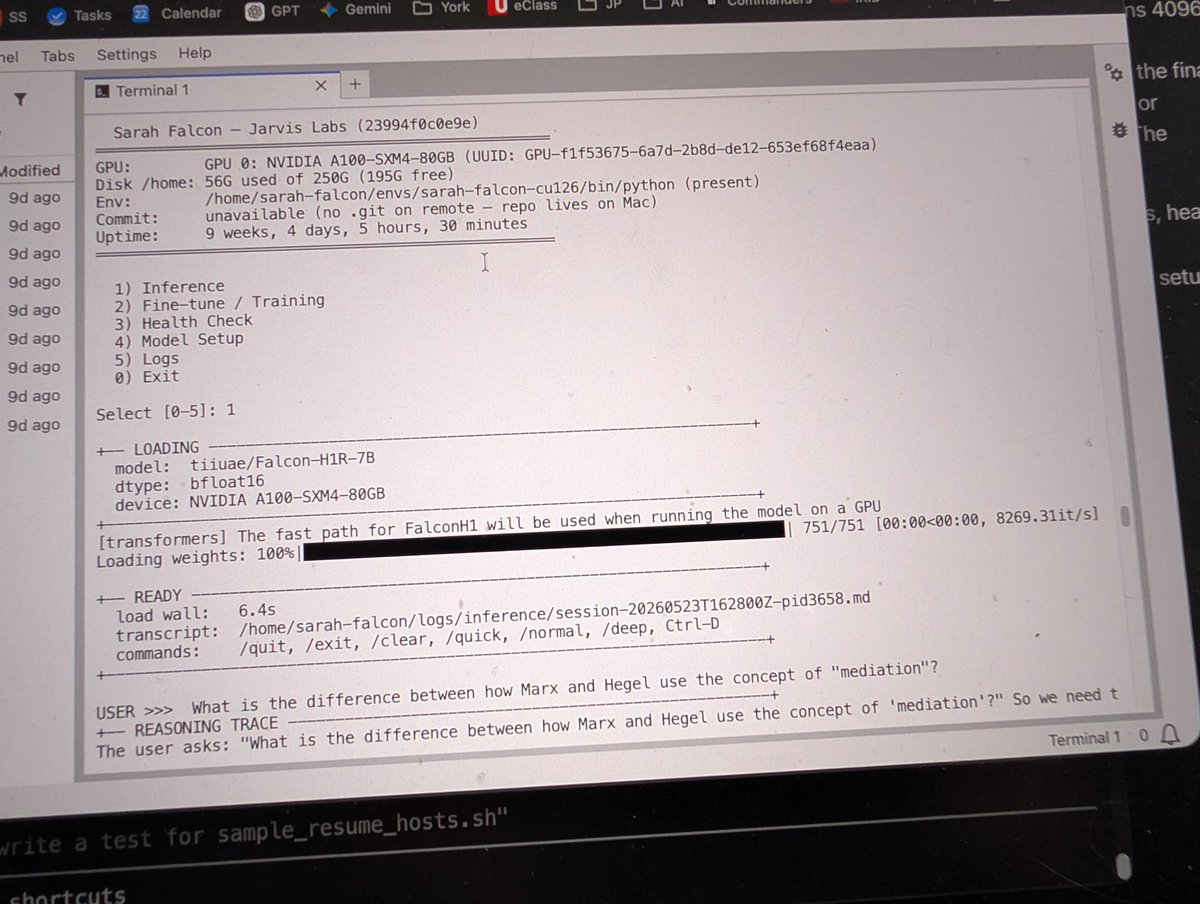
This post marks the end of the setup phase of S.A.R.A. — Strategic Assessment Radical Agent — and the start of its fine-tuning phase. S.A.R.A. is not an attempt to make an AI say leftist things, but to train a model to adopt a leftist culture of reasoning: one capable of recognising material forces, strategic cultures, hegemonic formations, counter-hegemonic agency, uncertainty, and the mediations through which state, capital, labour, technology, and war reorganise one another. The post explains why the project uses Falcon-H1R-7B, why the setup was built around a modest yet durable A100-80GB cloud architecture, and why the work has focused so heavily on operational discipline, failure documentation, and recoverable infrastructure. It also introduces the public release of the setup-phase materials: the decision manual, operational doctrine, failure report, and related documents that record not only what was built but also why it was built this way and what went wrong along the way. The broader claim is simple: a radical AI project cannot be built on proprietary mystique, liberal guardrails, or superficial political labelling. It requires a deliberate theory of thought, a public record of practice, and a willingness to share the costly lessons of experimentation with others. This post is therefore both a project update and an invitation to a more public, inspectable, and collective leftist AI commons.
Fouâd Oveisy tweet media
English
0
2
3
23
Àzeez Amalfitano retweetledi
Fouâd Oveisy
Fouâd Oveisy@consul_general·
"A tradition that has long presented itself as a 'shepherd' and guardian of openness, alterity, or the improbable may, in practice, refuse one of the most improbable developments to date: the emergence of Artificial General Intelligence as a genuinely new relation between human beings and machines. I am not making a celebratory claim, nor am I saying that capitalist AI is emancipatory. I am saying that a metaphysics which protects alterity only as an abstract philosophical object, while refusing the concrete historical form in which a new relation may be emerging, ends up being anti-emergent in precisely the way it claims to oppose." open.substack.com/pub/leftrealpo…
Fouâd Oveisy tweet media
English
0
1
2
12
Àzeez Amalfitano retweetledi
Ali Hashem علي هاشم
Ali Hashem علي هاشم@Alihashem·
According to my sources, the draft proposal that’s supposed to be finalised include: -End of war on all fronts including Lebanon -Freeing several billion dollars of Iran's blocked funds -Lifting the U.S. naval blockade and opening the strait of Hormuz -Withdrawal of American forces from the immediate vicinity of Iran After this, the parties will have 30 days to agree on the nuclear issue. These 30 days can be extended by mutual agreement. During these thirty days, passage will be facilitated through the strait. According to Iran, management of the Strait of Hormuz will be an Iranian-Omani issue, and is being negotiated with Muscat.
English
271
816
2.8K
1.6M
Àzeez Amalfitano retweetledi
Benzinga
Benzinga@Benzinga·
Sen. Bernie Sanders is warning that artificial intelligence and robotics could eliminate millions of jobs if workers are not protected as the technology spreads. Speaking at a “Fight Oligarchy” rally in Maine, Sanders called AI and robotics the most transformative economic revolution in U.S. history. He argued that the core function of AI and robotics is to replace human labor, especially across transportation, manufacturing and other industries. Sanders specifically warned that truck drivers, cab drivers and drivers for Uber $UBER and Lyft $LYFT could eventually be threatened by autonomous vehicle technology. He also said AI could worsen inequality if governments fail to regulate it and ensure workers share in productivity gains. Sanders criticized billionaire tech leaders including Elon Musk, Jeff Bezos and Mark Zuckerberg, arguing that AI development is increasingly concentrated among wealthy executives seeking more power and profit. He also raised concerns about AI-generated misinformation, warning that democracy could be weakened if people cannot tell truth from fiction online. Sanders said he does not want future generations forming friendships with AI bots instead of real people, especially as loneliness and mental health concerns among young people grow. His comments come after he criticized Meta $META for laying off about 8,000 workers while accelerating massive AI investments. Sanders’ broader message: AI may bring major productivity gains, but without guardrails, workers could absorb the biggest costs.
Benzinga tweet media
English
2
3
0
2K
Àzeez Amalfitano retweetledi
Fouâd Oveisy
Fouâd Oveisy@consul_general·
The cutting-edge LLM (Falcon H1) I have been training for months is finally properly configured for fine-tuning. Previous attempts failed at various stages because my intricate 48-layer Neo-Gramscian fine-tuning framework was too fragile. Thanks to Claude Code (expensive, but worth every penny), the technical issues have been resolved. I can now look forward to retraining SARA (Strategic Assessment Radical Agent) for leftist geopolitical analysis and prediction.
Fouâd Oveisy tweet media
English
2
1
4
88
Àzeez Amalfitano retweetledi
Babak Vahdad
Babak Vahdad@BabakVahdad·
An interesting analysis published by Al-Monitor argues that post-war Iran is increasingly managing the economy through a wartime security logic rather than normal economic governance. Inflation is now treated as a national security threat, markets as battlefields, and traders accused of hoarding or overpricing risk severe judicial action. - Official figures cited in the report show rice prices up more than 170% YoY, edible oils nearly 400%, and sugar around 80%, while authorities blame sanctions, the US maritime blockade, disrupted trade routes and “hybrid war.” - The response has been the expansion of economic police, judiciary crackdowns, intelligence-linked enforcement and tighter control over supply chains. At the same time, the labor market appears under major stress, with reports of up to 1-2 million jobs lost, a collapse in hiring and heavy damage to the digital economy due to prolonged internet restrictions. - The deeper issue may be structural: Iran today looks neither fully market-based nor fully state controlled, but a hybrid wartime economy increasingly dependent on coercive management to contain inflation, shortages and social pressure. #Iran #IranWar
English
1
19
53
10.3K
Àzeez Amalfitano retweetledi
FORTUNE
FORTUNE@FortuneMagazine·
On May 21, nearly 45,000 of Samsung’s unionized workers plan to walk off the job for 18 days. If that happens, it will be the largest work stoppage in the history of the semiconductor industry. bit.ly/4usphoo
English
0
3
2
1.6K
Àzeez Amalfitano retweetledi
John Hudson
John Hudson@John_Hudson·
SCOOP: The U.S. has depleted much of its inventory of advanced missile-defense interceptors after expending far more high-end munitions defending Israel than Israeli forces used themselves, per DOD assessments of Operation Epic Fury 🧵
English
153
1.6K
5.1K
1.3M
Àzeez Amalfitano retweetledi
OSINTdefender
OSINTdefender@sentdefender·
Per Axios’ report on U.S. President Donald J. Trump’s National Security Team meeting, in the absence of a last minute deal, President Trump is seriously considering resuming strikes, with speculation rising that the bank holiday weekend for Memorial Day offers a good opportunity to conduct high-tempo strikes over a short duration of time. According to the report, one official has said that after such a campaign, Trump may declare victory and end the war indefinitely. One U.S. official also described the currently stalled negotiations as “agonizing,” according to the report, as at the time of writing, no substantive progress has been reported. This, as both Qatari and Pakistani officials arrived in Tehran, Iran in a last minute attempt to facilitate a deal.
OSINTdefender tweet media
English
128
252
1.8K
656.9K
Àzeez Amalfitano retweetledi
Fouâd Oveisy
Fouâd Oveisy@consul_general·
In my April 13 analysis, I argued that the second Ira–US–Israel war’s most likely outcome was the Iranian regime’s survival through deterrence, provided it reopened Hormuz and used the return of energy, shipping, insurance, and logistics flows as a structural barrier to US re-escalation. Instead, Iran has treated Hormuz as a security blanket and a lever of sovereignty, and has refused meaningful concessions on the nuclear, missile, and proxy files. While it was always inconceivable that the IRGC would forgo the right to enrichment or its HEU stockpile, signalling a change in its wider behaviour would have given the regime a historic opportunity to normalise relations with the US and thereby reap the strategic benefits of exploiting the contradictions of the Sino–American rivalry. I also wrote that the regime’s rejection of this option is doctrinal rather than transactional. Tehran views the nuclear file, Hormuz, Lebanon, Iraq, and the China-Russia alignment as components of a single strategic depth projection doctrine: the autonomous deterrent posture that keeps Iran independent of a US-led regional order. This is how the IRGC defines Iran’s strategic interests: as a forward base for the westward expansion of BRICS-led revisionism. Two consequences have followed this insistence. First, Washington now has the narrative cover it lacked in April, as ceasefire extensions, Pakistani mediation, and multiple revised Iranian proposals have all proved insufficient. This has enabled Trump to frame a return to coercion as a “clean-up” operation in response to Iranian maximalism. Second, contrary to claims that Iran has leveraged this moment to revise the regional order, the ceasefire has allowed Iran’s adversaries to assemble a regional architecture that will erode Iran’s leverage should the US opt for reescalation. Pakistan—the same state carrying messages between Tehran and Washington—has deployed roughly 8,000 troops and Chinese HQ-9 batteries to Saudi Arabia. The UK has committed HMS Dragon, Typhoons, and autonomous mine-hunting to an Anglo-French Hormuz mechanism that begins with defensive demining and escort but functions as the legal and operational shell for selective transit. The Gulf states have used the lull to absorb lessons from Ukraine-style drone defence. And the BRICS foreign ministers’ meeting, meant to anchor Iran’s standing as a forward base of the anti-hegemonic bloc, produced no joint statement: the UAE blocked, India chaired amid disagreement, and China and Russia declined to force unity. However, this may be the cost the Iranian elite are willing to pay. The bet is that surviving another round of devastation conveys the deterrent message that, regardless of the cost, the IRGC remains steadfast in its doctrine—and fast-tracks Iran’s path to North Korea-style sovereignty. The other bet is regional. Tehran is gambling that, even with further damage to its economy and infrastructure, it retains enough capacity to inflict serious costs on the Gulf, and that the region will eventually weigh those costs against the price of repeatedly trying to break it. The question Iran is forcing, especially on the Gulf states, is whether to tolerate a state in the region that operates independently of American discipline, with the spoiler capacity that such independence entails. The answer to that question will determine whether Iran has space to exist as an independent regional power at all. It bears repeating that the regime could be overplaying its hand, not only regionally but also domestically. Will it be able to contain another round of protests or unrest in the peripheral provinces if the US devastates civilian and strategic infrastructure? Tehran stood its ground and did not blink first in the lead-up to Trump’s previous deadline. It remains to be seen whether it will stay the course this time.
Fouâd Oveisy tweet media
English
0
1
2
57
Àzeez Amalfitano retweetledi
Hamidreza Azizi
Hamidreza Azizi@HamidRezaAz·
A non-aggression pact between #Iran and Saudi Arabia? 🔹The Financial Times report on Saudi Arabia’s proposal for a regional “non-aggression pact” between Iran and neighboring states is not merely a temporary diplomatic initiative. Rather, it signals Riyadh’s attempt to redefine the Middle East’s security architecture in the aftermath of the U.S./Israeli war on Iran. 🔹The significance of this idea lies less in the pact itself – after all, this is not the first time such an idea is being discussed – than in the strategic logic behind it. Saudi Arabia appears to have concluded that the perpetual cycle of deterrence, limited strikes, and proxy warfare can no longer be managed solely through reliance on the American security umbrella. 🔹The Saudis’ reference to the 1970s “Helsinki process” is also far from accidental. That model was designed precisely to manage competition between hostile blocs, not to fully resolve ideological and geopolitical disputes. In other words, the objective is not to eliminate tensions, but to contain them. 🔹In effect, Riyadh now seems to be moving toward a form of implicit acceptance of a new regional balance of power, in which Iran, despite the heavy costs of the recent war, remains an indispensable actor in the region’s security equations. 🔹This shift also reflects a broader change in the Saudi conception of “stability.” For years, many Arab states defined regional security in terms of containing or weakening Iran’s regional influence. Now, however, the primary priority appears to be preventing Iran-Israel conflict from escalating into a permanent regional war. 🔹From this perspective, the proposal for a non-aggression pact should be understood as part of the broader trend toward the “regionalization” of Persian Gulf security. This process began with the China-mediated Iran-Saudi rapprochement in 2023 and may now enter a more complex phase, i.e., the establishment of rules of conduct for crisis management. 🔹At the same time, comparisons between the Middle East and Cold War-era Europe have serious limitations. Unlike Europe, the region lacks durable institutional structures, clear deterrence lines, and even a minimal consensus over the foundations of a regional security order. Moreover, the role of non-state actors and multilayered conflicts makes the equation far more complex. 🔹More importantly, any such initiative would remain inherently fragile without some degree of mutual understanding between Iran and Israel regarding the acceptable limits of escalation. Any new direct confrontation could easily destroy the entire process of regional de-escalation. 🔹At the same time, the proposal itself demonstrates that the Arab states of the Persian Gulf are increasingly concerned about the spillover of Iran-Israel rivalry into their energy infrastructure, trade corridors, and economic development projects. This concern has now become a major driver of regional policy. 🔹For this reason, even if the idea of a “non-aggression pact” never materializes into a formal agreement, the very fact that it has been proposed carries an important message, that a significant part of the Arab world is no longer seeking to exclude Iran from the region’s security equations, but rather to make patterns of interaction with Tehran more predictable.
English
0
134
406
133.7K
Àzeez Amalfitano retweetledi
Current Report
Current Report@Currentreport1·
JUST IN: Advisers to president Trump are reportedly urging the UAE to take a larger role in the conflict with Iran, including the possible capture of Iran's strategic Lavan Island, Telegraph reports
Current Report tweet media
English
25
66
385
13.2K
Àzeez Amalfitano retweetledi
Clash Report
Clash Report@clashreport·
Canada is strengthening Arctic defense ties with Nordic countries as trust in the U.S. weakens under Trump’s threats to seize Greenland and annex Canada. Ottawa is expanding military cooperation with Denmark, Finland, Norway, Sweden, and Iceland while helping Greenland develop a local ranger force modeled on Canada’s Arctic Rangers. Prime Minister Mark Carney says Canada still values its NORAD partnership with the U.S. but wants stronger alliances among “middle powers.” Source: Reuters
English
15
24
192
24.3K
Àzeez Amalfitano retweetledi
Mohammad Ali Shabani
Mohammad Ali Shabani@mashabani·
NEW: BRICS, or rather its consensus model, may not be delivering what Iran expects. Political insider in Tehran claims that the UAE blocked joint statement at recent gathering of BRICS foreign ministers in India over insistence that condemnation of the war on Iran be removed. @amwajmedia could not independently verify the claim, but other sources also highlighted differences over the war on Iran as causing split within BRICS+. Separately, amid reports that UAE attacked Iran in April, an informed Iranian political source asserted that Emirati drones struck mainland Iran, specifically referring to incident in southern city of Shiraz.
Mohammad Ali Shabani tweet media
English
5
40
103
17K
Àzeez Amalfitano retweetledi
Daniel Estrin
Daniel Estrin@DanielEstrin·
Photos and videos from Tel Aviv international airport show around 40 to 50 US Air Force aerial tankers on the tarmac, an uptick from the two dozen or so tankers seen in Israel in the past several weeks of the Iran ceasefire, @avischarf told me. Listen: npr.org/2026/05/18/nx-…
English
5
53
89
60.4K
Àzeez Amalfitano retweetledi
Fouâd Oveisy
Fouâd Oveisy@consul_general·
Canada’s AI minister, Evan Solomon, has said that Canada does not need a standalone national semiconductor strategy. Instead, Canada’s dependence on advanced chips appears set to be managed through other parts of the broader AI strategy. There is pragmatic logic to that position. Recreating the semiconductor bases of Taiwan, South Korea, or the United States would be immensely capital-intensive and would not resolve Canada’s short- and medium-term dependencies. It makes sense to focus on areas where Canada already has strengths: photonics, advanced packaging, research infrastructure, and AI adoption. The risk is that this approach sidesteps important challenges. The AI data centres now being built in Canada will not run on Canadian chips. They will rely on foreign-controlled semiconductor supply chains. Hosting compute infrastructure in Canada is important, but it does not, by itself, secure the material foundations of that compute. Nor do photonics and quantum technologies eliminate this dependency. They may become central to future AI systems, but they still rely on conventional digital chips for memory, control, software interfaces, and industrial deployment. The same holds for chip stacking and advanced packaging, including Bromont. These capabilities enable existing chips to be combined into more powerful and efficient systems, but they do not mean Canada is producing the core AI chips that will populate its data centres. This is where the historical lesson matters. Canada has seen this pattern before with Nortel: world-class technological capability, strong research ecosystems, and strategic industrial assets that were not ultimately secured as durable national capacity. The danger is that Canada develops valuable positions in the AI stack without the mechanisms to protect, scale, and anchor them. These measures need not amount to “semiconductor sovereignty”. But Canada needs a clearer framework for managing semiconductor dependence, including more explicit cooperation with partners such as South Korea and Japan, and stronger mechanisms to protect its existing photonics, packaging, and research assets.
BetaKit@BetaKit

Industry groups want Canada to have a standalone national semiconductor strategy. Liberal MP Jenna Sudds says a national strategy is a “stand-out” priority. But @EvanLSolomon says he won't pursue one because the country's other programs alrady suffice. betakit.com/canada-wont-pu…

English
0
1
2
47
Àzeez Amalfitano retweetledi
Ali Hashem علي هاشم
Ali Hashem علي هاشم@Alihashem·
A well-informed source on the progress of negotiations between Iran and the United States confirmed that the top-level directives issued to the Iranian negotiating team included five conditions that must be met before entering into talks on the nuclear file: 1.Ending the war on all fronts 2.Lifting all sanctions 3.Releasing frozen assets 4.Compensating for war damages and losses 5.Recognition of Iran’s sovereign right over the Strait of Hormuz
English
82
351
1.1K
377.5K