Andreas Holmstrom

1.3K posts

Andreas Holmstrom banner
Andreas Holmstrom

Andreas Holmstrom

@a_holmstrom

Independent mathematician

Norway Katılım Nisan 2013
1.9K Takip Edilen675 Takipçiler
Andreas Holmstrom
Andreas Holmstrom@a_holmstrom·
@DiracGhost Here's a link: http://103.203.175.90:81/fdScript/RootOfEBooks/E%20Book%20collection%20-%202024/MATHAMITICS/%5B%20EngineeringEBookspdf%20%5D%20The%20Language%20of%20Mathematics.pdf
English
2
0
3
80
Didier 'Dirac's ghost' Gaulin
Having a lot of fun learning linguistics and found out about this nice lectures set (MIT) titled 'Introduction to Linguistics' by Norvin Richards. Thought you might find it interesting as well. 🔗👇
Didier 'Dirac's ghost' Gaulin tweet media
English
4
11
90
4.6K
Andreas Holmstrom
Andreas Holmstrom@a_holmstrom·
@DiracGhost The one time I really wanted to learn linguistics was when I tried to understand Ganesalingam's thesis, The Language of Mathematics. Thanks for sharing these resources!
English
1
0
4
81
Andreas Holmstrom retweetledi
PeakMath
PeakMath@PeakMath·
Today is the official launch of a new PeakMath space, a platform open to anyone who seeks a deeper understanding of the great mathematical mysteries. Check out peakmath.org and spread the word!
English
0
2
4
312
Andreas Holmstrom retweetledi
Alex Kontorovich
Alex Kontorovich@AlexKontorovich·
From the amazing folks at the Lean @leanprover FRO: The AI Formalization Leaderboard! Problem #1 is to prove that 2+2=4. So you get 1 point for showing up. Here's where things stand now... lean-lang.org/eval/
Alex Kontorovich tweet mediaAlex Kontorovich tweet media
English
4
25
110
10K
Andreas Holmstrom retweetledi
Ihtesham Ali
Ihtesham Ali@ihtesham2005·
A mathematician who shared an office with Claude Shannon at Bell Labs gave one lecture in 1986 that explains why some people win Nobel Prizes and other equally smart people spend their whole lives doing forgettable work. His name was Richard Hamming. He won the Turing Award. He invented error-correcting codes that made modern computing possible. And he spent 30 years at Bell Labs sitting in a cafeteria at lunch watching which scientists became legendary and which ones faded into nothing. In March 1986, he walked into a Bellcore auditorium in front of 200 researchers and told them exactly what he had seen. Here's the framework that has been quoted by every serious scientist for the last 40 years. His opening line landed like a punch. He said most scientists he worked with at Bell Labs were just as smart as the Nobel Prize winners. Just as hardworking. Just as credentialed. And yet at the end of a 40-year career, one group had changed entire fields and the other group was forgotten by the time they retired. He wanted to know what the difference actually was. And he said it wasn't luck. It wasn't IQ. It was a specific set of habits that almost nobody is willing to follow. The first habit was the one that hurts the most to hear. He said most scientists deliberately avoid the most important problem in their field because the odds of failure are too high. They pick a safe adjacent problem, solve it cleanly, publish it, and move on. And because they never swing at the hard problem, they never hit it. He said if you do not work on an important problem, it is unlikely you will do important work. That is not a motivational line. That is a logical one. The second habit was about doors. Literal doors. He noticed that the scientists at Bell Labs who kept their office doors closed got more done in the short term because they had no interruptions. But the scientists who kept their doors open got more done over a career. The open-door scientists were interrupted constantly. They also absorbed every new idea passing through the hallway. Ten years in, they were working on problems the closed-door scientists did not even know existed. The third habit was inversion. When Bell Labs refused to give him the team of programmers he wanted, Hamming sat with the rejection for weeks. Then he flipped the question. Instead of asking for programmers to write the programs, he asked why machines could not write the programs themselves. That single inversion pushed him into the frontier of computer science. He said the pattern repeats everywhere. What looks like a defect, if you flip it correctly, becomes the exact thing that pushes you ahead of everyone else. The fourth habit was the one that hit me the hardest. He said knowledge and productivity compound like interest. Someone who works 10 percent harder than you does not produce 10 percent more over a career. They produce twice as much. The gap doesn't add. It multiplies. And it compounds silently for years before anyone notices. He finished the lecture with a line I have never been able to shake. He said Pasteur's famous quote is right. Luck favors the prepared mind. But he meant it literally. You don't hope for luck. You engineer the conditions where luck can land on you. Open doors. Important problems. Inverted questions. Compounded hours. Those are not traits. Those are choices you make every single day. The transcript has been sitting on the University of Virginia's computer science website for almost 30 years. The video is free on YouTube. Stripe Press reprinted the full lectures as a book in 2020 and Bret Victor wrote the foreword. Hamming died in 1998. He gave his final lecture a few weeks before. He was 82. The lecture that explains why some careers become legendary and others disappear is still free. Most people who could benefit from it will never open it.
Ihtesham Ali tweet media
English
146
1.9K
8.2K
1.2M
Andreas Holmstrom retweetledi
PeakMath
PeakMath@PeakMath·
Summer school in Norway (June 15-19) on Positive Geometry and Scattering Amplitudes. Registration deadline May 4th. mn.uio.no/math/english/r…
English
0
1
0
61
Andreas Holmstrom retweetledi
Alvaro Lozano-Robledo
Alvaro Lozano-Robledo@mathandcobb·
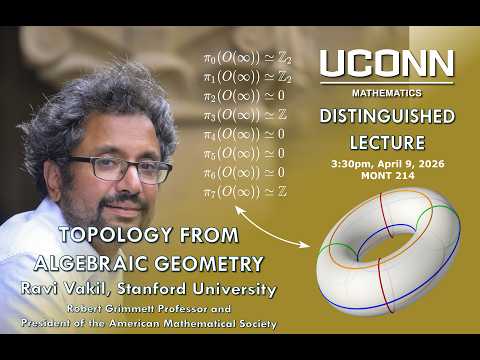
Prof. Ravi Vakil's full (and wonderful) talk "Topology from Algebraic Geometry" as part of UConn's Distinguished Lecture series in Mathematics is now available at the link below. Enjoy, and many thanks to Dr. Vakil for the visit! youtu.be/bkXoXY_v2k0?si…
YouTube video
YouTube
English
0
38
199
12.6K
Didier 'Dirac's ghost' Gaulin
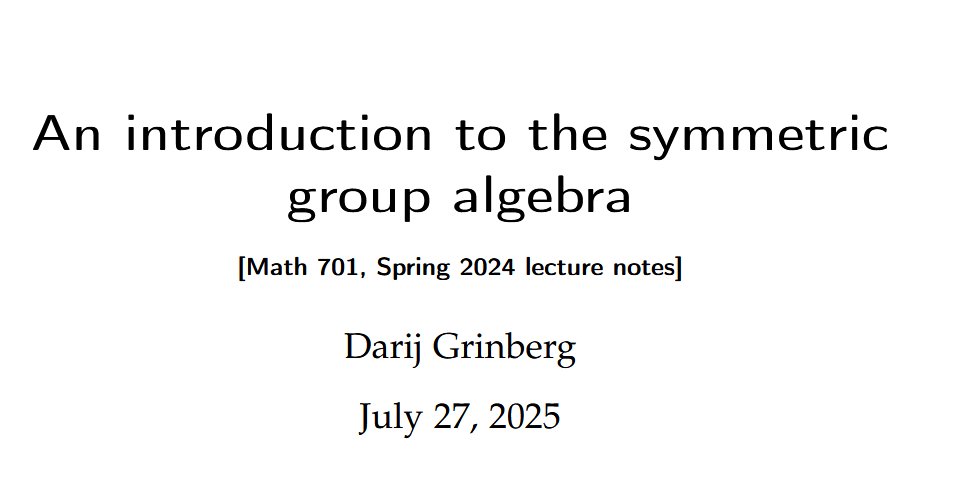
Might be my birthday, but I still thought of you when I found this masterpiece (in 830 pages) by Darij Grinberg titled ' An Introduction to the Symmetric Group Algebra' , publicly available on arXiv! Superb work from Grinberg 👇🔗
Didier 'Dirac's ghost' Gaulin tweet media
English
11
9
188
8.6K
Mateba
Mateba@NewSweezyite·
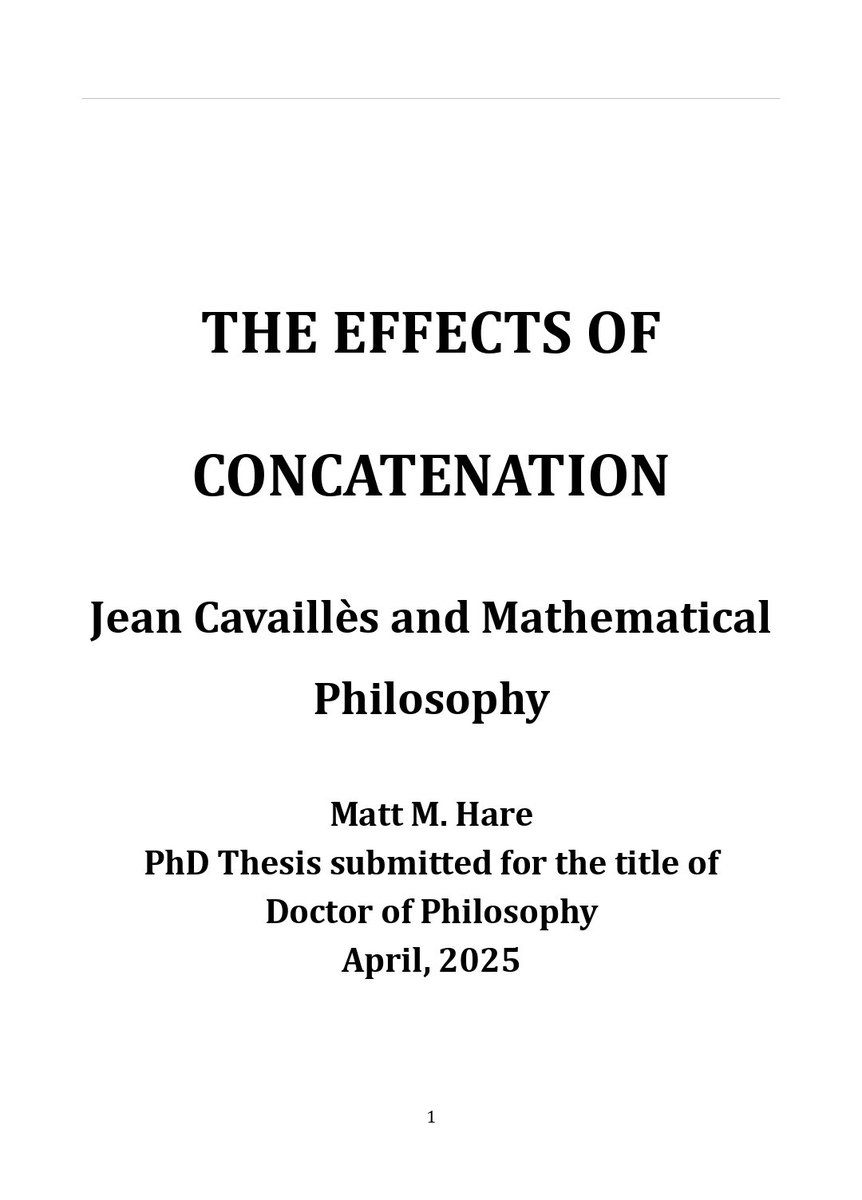
might've posted this before but been reading Matt Hare's dissertation, fantastic introduction to Jean Cavaillès and his spinozism, dialectics, and "philosophy of the concept" in the history of mathematics that set the stage for 20thC french philosophy philarchive.org/rec/HARTEO-130
Mateba tweet media
English
4
16
115
11.1K
Andreas Holmstrom retweetledi
The Abel Prize
The Abel Prize@abel_prize·
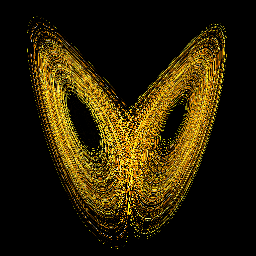
We congratulate Gerd Faltings as the 2026 Abel Prize laureate! 🎉 He recives the Abel Prize "for introducing powerful tools in arithmetic geometry and resolving long-standing diophantine conjectures of Mordell and Lang".
The Abel Prize tweet media
English
12
256
771
86.7K
Didier 'Dirac's ghost' Gaulin
The lecture (IHES) ''L'œuvre d'Alexandre Grothendieck by Pierre Deligne (French with English subtitles)'' is a fantastic presentation on the work of Grothendieck by the legendary Pierre Deligne. Too few of these lectures (in French) on Grothendieck's work have been translated for an international audience! At least, this one is! Check it out! 🔗👇👇
Didier 'Dirac's ghost' Gaulin tweet media
English
3
50
313
23.2K
Alex Kontorovich
Alex Kontorovich@AlexKontorovich·
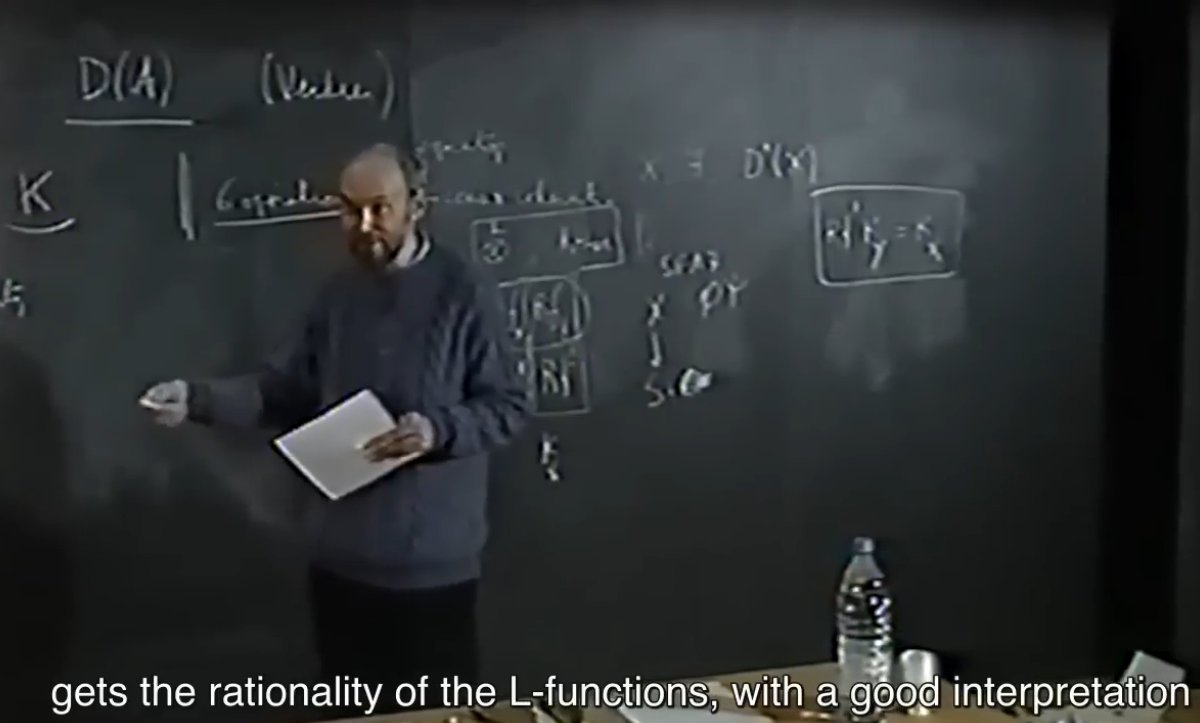
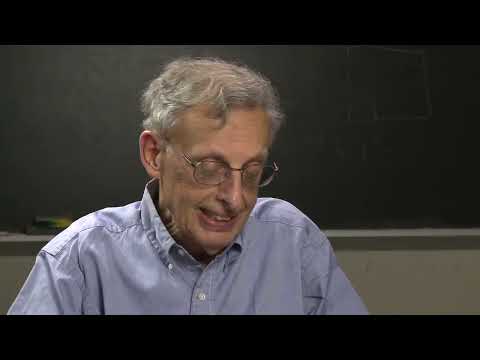
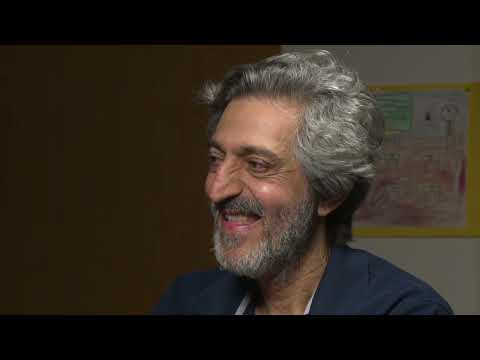
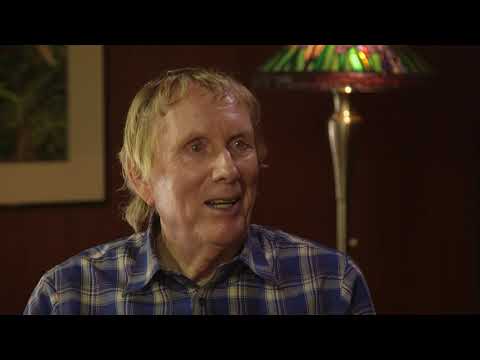
The Simons Foundation has put their treasure trove of videos on YouTube (they’ve been available for a decade from the Simons website, but I kept begging them to move it to a platform with many more eyeballs…). Here’s Eli Stein interviewed by Charlie Fefferman: youtube.com/watch?v=pWOU-c… And Rutgers’s @RutgersU own Endre Szemeredi (interviewed by Avi Wigderson): youtube.com/watch?v=_ZQ4aB… And Ron Graham (here talking about Math+AI, from a decade ago): youtube.com/watch?v=fHrply… And lots of Gromov, e.g.: youtube.com/watch?v=aI2ASq… Sorry for wasting the next few hours of your life, but it will have been well worth it to watch these!!
YouTube video
YouTube
YouTube video
YouTube
YouTube video
YouTube
YouTube video
YouTube
English
9
53
289
85.8K
Andreas Holmstrom retweetledi
Simon Coste ꙮ
Simon Coste ꙮ@__SimonCoste__·
Martin Hairer and colleagues released a set of hard maths problems, designed to be test cases for LLMs. We have *one week* to solve them, using LLMs. They encrypted the solutions at 1stproof.org and will reveal them just after. arxiv.org/pdf/2602.05192 (1/3)
English
17
46
271
44.5K