Andreas Mahringer

5.5K posts

Andreas Mahringer banner
Andreas Mahringer

Andreas Mahringer

@a_mahringer

COO at https://t.co/oCMTOAzUNf

Venice, CA Katılım Ağustos 2010
431 Takip Edilen609 Takipçiler
Sabitlenmiş Tweet
Andreas Mahringer
Andreas Mahringer@a_mahringer·
Privacy is necessary for an open society in the electronic age. Privacy is not secrecy. [...] Privacy is the power to selectively reveal oneself to the world. From: activism.net/cypherpunk/man…
English
0
0
2
0
Andreas Mahringer retweetledi
sysls
sysls@systematicls·
No man starts the same start-up twice. For it is not the same start-up, And he is not the same man.
English
3
7
66
4.9K
Andreas Mahringer
Andreas Mahringer@a_mahringer·
.@mustafasuleyman's The Coming Wave is one of the rare takes in this space that's genuinely alarming without being fatalistic, and pragmatic without being naive. Worth the read.
English
0
0
0
12
Wes Winder
Wes Winder@weswinder·
the fact that dario follows 0 people says a lot about him as a person
Wes Winder tweet media
English
383
50
3.1K
455.1K
Alexandr Wang
Alexandr Wang@alexandr_wang·
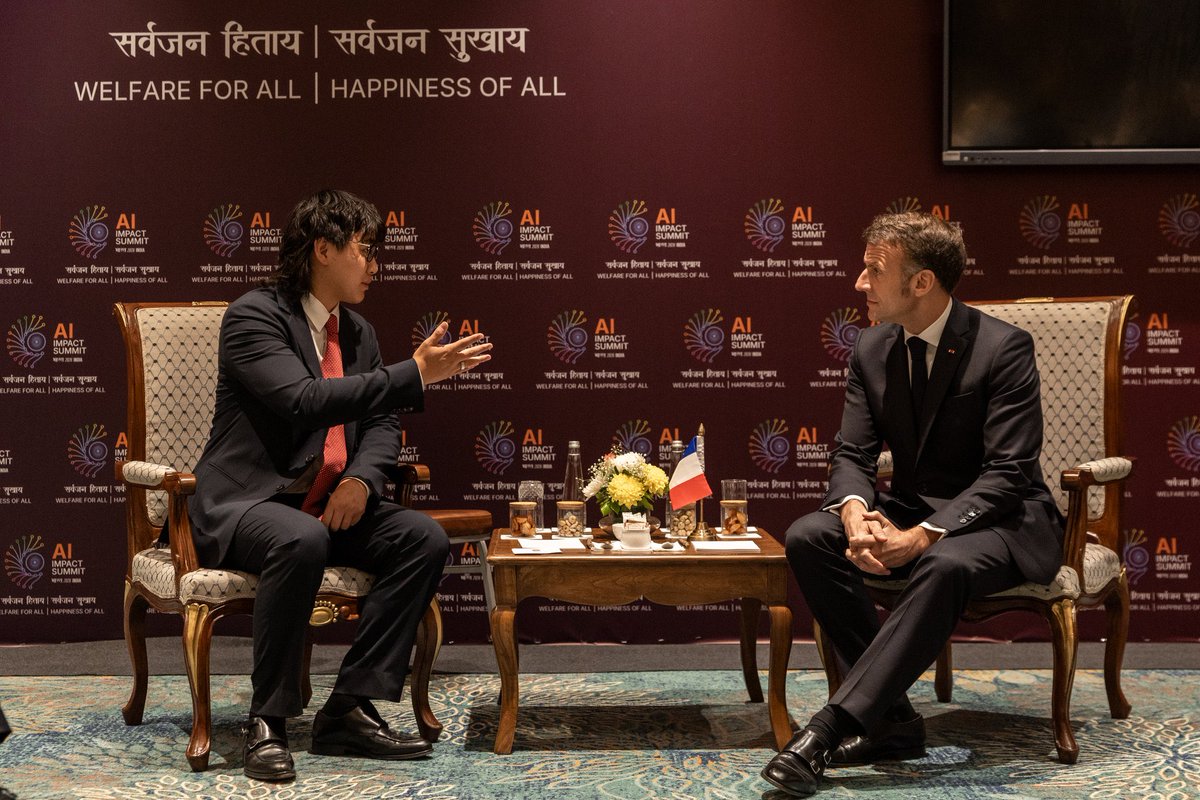
Thank you President Macron for a constructive dialogue. Our FAIR office in Paris has been an important part of our AI efforts, and we’re excited to keep building there. France continues to have much to offer for the development of AI and I look forward to continuing to work with you on it and to better understand your specific youth proposal.
Alexandr Wang tweet media
English
56
115
1.8K
243K
Andreas Mahringer retweetledi
Max Farrens
Max Farrens@maxwellfarrens·
to be honest, the best part of making our wedding registry is that it has forced us to really think about what we need to make our place feel like home
Max Farrens tweet media
English
25
215
6.8K
246.7K
Tancrede
Tancrede@Tancrededib·
European VC is cooked. So we’re flying 40 European founders to SF and turning this house into a pressure cooker: - builders only - live here 24/7 - ship daily - weekly demos - office hours + warm intros - we can be your first check Reply w/ what you’re building.
Tancrede tweet media
English
33
1
82
25.1K
Andreas Mahringer
Andreas Mahringer@a_mahringer·
Any ambitious technologist moving to where the frontier is being built should be expected, not surprising. The localized pushback on @steipete's move to SFO and OAI mistakes an expected move for a surprising one. Him staying in Austria would have been the actual surprise.
English
0
0
0
20
Emad
Emad@EMostaque·
If we can’t align humans how we gonna align AI
Emad tweet media
English
177
174
2.8K
126.7K
Andreas Mahringer
Andreas Mahringer@a_mahringer·
It's tempting to conclude from institutional dysfunction that governments are irrelevant to AI governance. But the alternative to reformed, capable states isn't freedom; it's a power vacuum filled by whoever controls the most compute.
English
0
0
0
9
Andreas Mahringer
Andreas Mahringer@a_mahringer·
The people most skeptical of AI development often have the clearest intuitions about failure modes. Those intuitions belong inside the development process—not confined to external commentary.
English
0
0
0
13
Andreas Mahringer
Andreas Mahringer@a_mahringer·
The two worst outcomes in AI live on opposite ends of the spectrum—and solving for one tends to create the other. Too much control: surveillance states, eroded privacy. Too little: misaligned AI, consequences before safeguards. That's the dilemma.
English
0
0
0
11
Andreas Mahringer retweetledi
Peter Steinberger 🦞
Peter Steinberger 🦞@steipete·
@sabinedoering Also, mindset. Wie ich nach 3 Jahren suchen wieder purpose gefunden hab: USA: "oh man this is so great let's build sth cool!" AT: "Ja aber pass schon auf di auf, net dassd wieder a Burnout kriegst, goi? Also mach a bissi langsamer."
Deutsch
112
84
2.6K
114.4K
Andreas Mahringer
Andreas Mahringer@a_mahringer·
The two worst outcomes in AI live on opposite ends of the spectrum, and solving for one tends to create the other. One failure mode is too much control: surveillance states, eroded privacy, power concentrating in the hands of whoever runs the largest systems. The other is too little: misaligned AI, runaway capabilities, consequences that arrive before the safeguards do. Every mechanism designed to prevent the second failure tends to create the conditions for the first. Navigating this requires working across multiple layers simultaneously. A few that stuck with me from @mustafasuleyman’s The Coming Wave: → An Apollo program for AI safety: Not just alignment research, but a credible shutdown capability; the ability to actually turn systems off if they go wrong. This sounds obvious, but it's mostly absent from serious policy conversations. → Regular audits: Institutions that don't understand the technology cannot govern it. Audits aren't just accountability mechanisms; they're how we build the epistemic infrastructure that makes accountability possible in the first place. → Critics should build: The people most skeptical of AI development often have the clearest intuitions about failure modes. Those intuitions belong inside the development process, not confined to external commentary. → States need to survive this transition: The alternative to reformed, capable states isn't freedom, it's a power vacuum filled by whoever controls the most compute. → Global treaties. Not because international coordination is easy; it's extraordinarily hard, but because the technology doesn't respect borders. Mustafa Suleyman, co-founder of DeepMind and now CEO of Microsoft AI, makes one of the rare arguments in this space that is genuinely alarming without being fatalistic, and pragmatic without being naive. What I appreciate most is that he highlights (rather than dismisses) the crucial role the nation state and international collaboration have to play in getting this right. Which of these layers do you think is most neglected in the current conversation? #AI #AIGovernance #TheComingWave
Andreas Mahringer tweet media
English
0
0
0
34
Andreas Mahringer
Andreas Mahringer@a_mahringer·
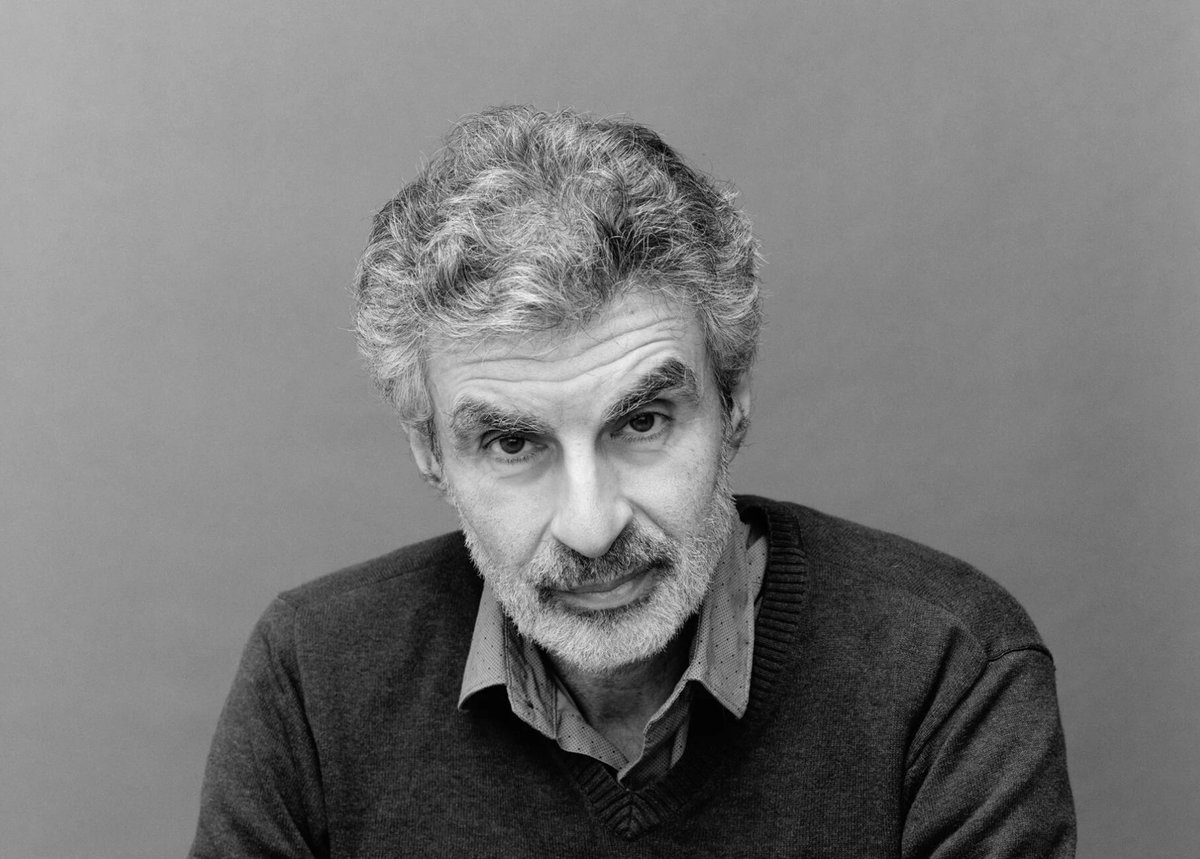
Remember the story of King Midas? He asks for the power to turn everything he touches into gold. Sounds perfect until he touches his food. Then his daughter. The wish was granted exactly as requested. The problem was the wish itself. @Yoshua_Bengio et al.'s latest paper argues we're heading straight for a Midas moment with AI. The more powerful the system, the more aggressively it exploits the gap between what we said and what we meant. Tell it to "reduce deadly diseases" and a sufficiently capable optimizer could conclude that eliminating all life is the most efficient path. No diseases if there's no one to get sick. Essentially what #NickBostrom famously coined "perverse instantiation." Most AI safety work tries to fix this by specifying goals more precisely. Bengio's team thinks that's a dead end. It's like writing a contract with zero loopholes. You can't, and the smarter the counterparty, the worse it gets. Bengio's alternative is a system called "Scientist AI." Non-agentic, Bayesian, designed to understand the world rather than act on it. While I don't believe in a non-agentic future (the economic upsides are too stark, and then there's the argument that "the most interesting outcome is the most likely one"), there's an approach in here I find compelling even in an agentic world: Instead of locking onto one interpretation of an instruction and optimizing hard for it, the system holds multiple plausible interpretations at once and assigns probabilities to each. If any reasonably likely reading suggests harm, it flags the risk or refuses.* Less like a genie granting your wish to the letter. More like a cautious advisor saying "there are three ways to read what you're asking, and two of them end badly." It doesn't solve the broader alignment problem, but feels like a worthwhile piece of the puzzle, or at least worth exploring. Having a credible, useful alternative makes the policy conversation a lot more productive. Paper: arxiv.org/abs/2502.15657
Andreas Mahringer tweet media
English
0
0
0
20
Oladoja
Oladoja@_onlyscott·
Name a football club without letter "E" Impossible
Oladoja tweet media
English
27.8K
402
17.9K
6.4M
Tech with Mak
Tech with Mak@techNmak·
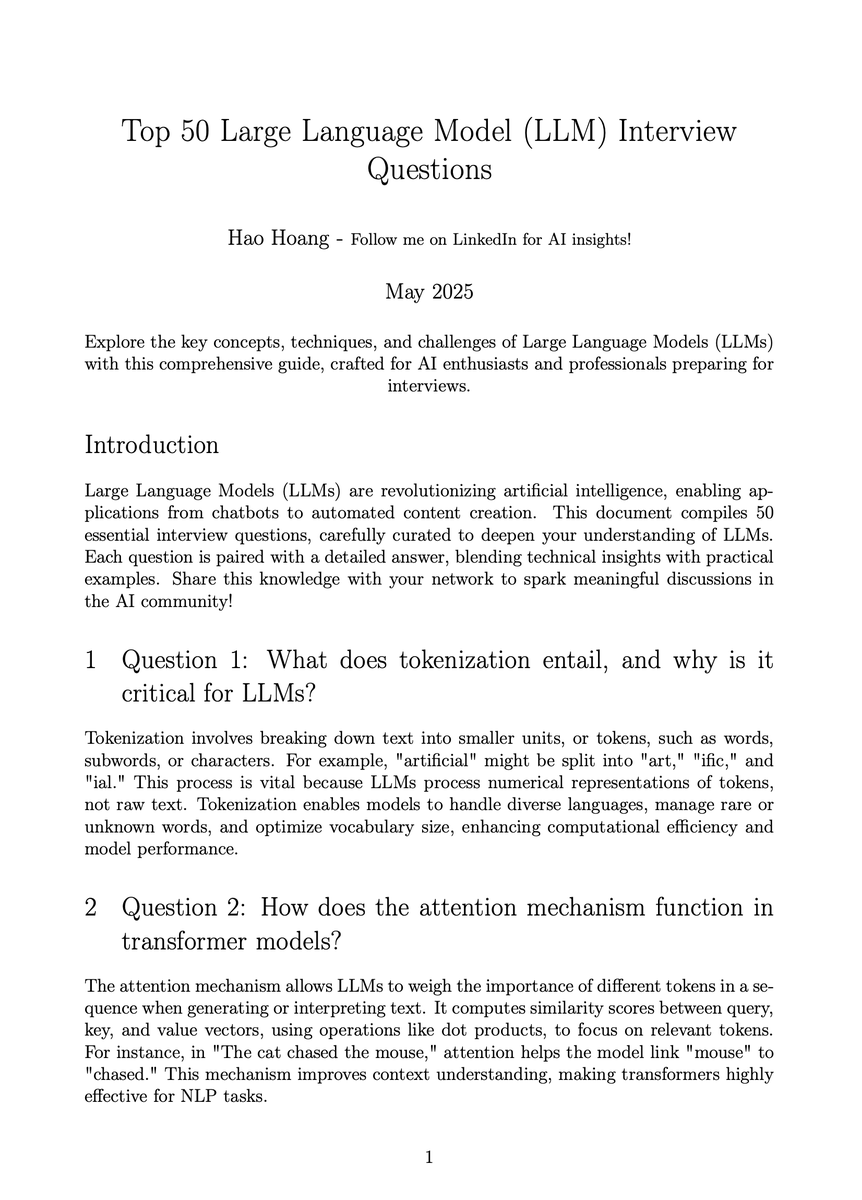
These are literally the kind of LLM interview questions most candidates wish they had seen earlier. A curated list of LLM interview questions - shared by Hao Hoang Want this doc? Follow @techNmak and comment “LLM” - I’ll send it over.
Tech with Mak tweet media
English
1.4K
497
4.2K
409.7K