Syed M. Taqi Naqvi

3.5K posts

Syed M. Taqi Naqvi banner
Syed M. Taqi Naqvi

Syed M. Taqi Naqvi

@abaiyaar

In a life-long love affair with medicine and cricket. Incoming IM PGY-1 at Woodhull Medical Center.

کراچی, پاکستان Katılım Mart 2014
341 Takip Edilen222 Takipçiler
Syed M. Taqi Naqvi retweetledi
Ann L. Jennerich, MD MS ATSF
Clinical judgment is built through exposure. You can learn a lot from books, simulation, and excellent teachers. But there is no substitute for seeing a high volume of real patients with real variation.
English
10
53
270
10.6K
Syed M. Taqi Naqvi retweetledi
IMCrit
IMCrit@IM_Crit_·
Right ventricular (RV) involvement complicates >30% of acute inferior STEMIs, though hemodynamically significant RV infarction occurs in ~10–15% of cases. The classic teaching is that when a patient w inferior STEMI becomes hypotensive & has clear🫁on physical exam, the treatment
IMCrit@IM_Crit_

ICU - Board Review Qs: 60 yo pt admitted to the ICU because of inferior STEMI. Emergency cath: 100% proximal RCA occlusion treated successfully with stenting One hour post-PCI: dyspnea/anxiety - BP: 94/70, HR: 60/min (sinus). Phys exam: JVD (+), clear lungs, cool extremities

English
6
44
258
76K
Syed M. Taqi Naqvi retweetledi
Shobhit Shrivastava
Shobhit Shrivastava@shri_shobhit·
The reason we know dinosaurs existed, and were wiped out by an asteroid, is that no matter where you dig in the world, you’ll find a distinct layer of clay. All dinosaur fossils are found below this layer, and never above it! This layer has iridium that is very rare on earth but found in asteroids. It is called K-T (Short for Cretaceous-Tertiary) boundary
blue@bluewmist

What is a completely useless piece of information that you will never forget for some reason?

English
382
6.6K
87.2K
3.9M
Syed M. Taqi Naqvi retweetledi
Anish Moonka
Anish Moonka@anishmoonka·
Every time you get a cancer biopsy, the lab makes a tissue slide that costs about $5. It shows the shape of your cells under a microscope, and every cancer patient already has one on file. There’s a much fancier version of that test called multiplex immunofluorescence (basically a protein-level map showing which immune cells are near your tumor and what they’re doing). It costs thousands of dollars per sample, takes specialized equipment most hospitals don’t have, and barely scales. But it’s the kind of data oncologists need to figure out whether immunotherapy will actually work for you. Right now, only about 20 to 40% of cancer patients respond to immunotherapy, and one of the biggest reasons is that doctors can’t easily tell whether a tumor is “hot” (immune cells actively fighting it) or “cold” (immune system ignoring it). Microsoft, Providence Health, and the University of Washington trained an AI to analyze the $5 slide and predict what the expensive test would show across 21 different protein markers. They called it GigaTIME, trained it on 40 million cells in which both the cheap slide and the expensive test coexisted, and then turned it loose on 14,256 real cancer patients across 51 hospitals in 7 US states. The results landed in Cell, one of the most selective journals in biology. The model generated about 300,000 virtual protein maps covering 24 cancer types and 306 subtypes. It found 1,234 real, verified connections between immune cell behavior, genetic mutations, tumor staging, and patient survival that were previously invisible at this scale. When they tested it against a completely separate database of 10,200 cancer patients, the results matched up almost perfectly (0.88 out of 1.0 agreement). Nature Methods named spatial proteomics (mapping where specific proteins sit inside your tissue) its Method of the Year in 2024, and specifically cited GigaTIME in a March 2026 update as a model that “democratizes” this kind of analysis. The full model is open-source on Hugging Face. Any cancer research lab with archived biopsy slides, and most of them have thousands, can now run virtual immune profiling without buying a single piece of new equipment.
Satya Nadella@satyanadella

We’ve trained a multimodal AI model to turn routine pathology slides into spatial proteomics, with the potential to reduce time and cost while expanding access to cancer care.

English
103
1.8K
11.1K
945.7K
Syed M. Taqi Naqvi retweetledi
Sravan Panuganti, DO, FACOS
Cool part about being a physician is that you get accused of being a pharma shill & forcing pills down peoples’ throats and get yelled at for not prescribing antibiotics for asymptomatic bacteriuria both in the same day.
English
31
300
2.8K
66.1K
Syed M. Taqi Naqvi retweetledi
Afshine Emrani  MD FACC
Afshine Emrani MD FACC@afshineemrani·
In medical school, we are taught a golden rule: "When you hear hoofbeats, think horses, not zebras." It is a reminder to look for the common explanation before the exotic one. But after decades in cardiology, I’ve learned that if a patient is still suffering after the "horses" have been ruled out, a doctor must have the courage—and the curiosity—to go hunting for the zebra. Sarah was a thirty-four-year-old marathon runner and a devoted mother who came to me after six months of being told she was "fine." She had been bounced from one specialist to another, each one pointing to her normal EKG and standard blood tests as proof that her crushing fatigue and racing heart were simply the result of "new mom stress." By the time she reached my office, she didn't just look tired; she looked invisible, as if the medical system had stopped seeing the woman and only saw the data. Instead of re-reading the normal test results that had already failed her, I asked Sarah to walk me through her life. We talked about her training and her family, eventually landing on a backpacking trip she took to the Mendoza province of rural Argentina. She described staying in a charming, rustic cottage made of sun-dried mud bricks. She mentioned waking up one morning with a strangely swollen, purple eyelid that she assumed was a simple spider bite. As she spoke, a memory surfaced from a biography I had read years ago about Charles Darwin. Most people know Darwin for his theories on evolution, but medical historians have long puzzled over the mysterious, debilitating illness that plagued him for decades after he returned from his voyage on the HMS Beagle. Darwin had written in his journals about being bitten by the "great black bug of the Pampas" while sleeping in mud-walled huts in South America. He spent the rest of his life suffering from heart palpitations and exhaustion that the Victorian doctors of his time could never explain. I realized then that Sarah wasn't suffering from stress; she was likely hosting the same "silent killer" that may have haunted Darwin: Chagas Disease. The "Kissing Bug" lives in the cracks of those mud-brick walls. It bites its victims—often near the eyes or mouth—while they sleep, passing a parasite called Trypanosoma cruzi into the blood. The danger of Chagas is that the initial symptoms disappear quickly, but the parasite can hide in the body for years, slowly weaving itself into the muscle and electrical "wiring" of the heart. To confirm this, I moved beyond the standard tests. I ordered a specialized "Strain Rate" ultrasound, which doesn't just look at whether the heart is pumping, but at how the individual muscle fibers are stretching. We saw that while her heart looked strong to the naked eye, the fibers were "stuttering," a sign of early parasite-induced scarring. A specific blood test for the parasite's antibodies confirmed the diagnosis. Treatment required a difficult, sixty-day course of anti-parasitic medication to stop the infection, paired with a protective heart regimen to keep her electrical system stable while the inflammation settled. Because we caught it before her heart was physically damaged or enlarged, the recovery was a success. Months later, Sarah returned to my office, her vibrant energy restored. She brought me a leather-bound copy of The Voyage of the Beagle with a note tucked inside. She wrote that while other doctors had looked at her charts, I had looked at her. This case remains a vital reminder for my memoir: in a world of high-tech scans and AI, the most sophisticated diagnostic tool we possess is still the human story. When we truly listen, we don't just find the disease—we find the patient. Good morning.
English
729
3.5K
26.2K
977.4K
Syed M. Taqi Naqvi retweetledi
Abbas M. Hassan, MD, PhD
Abbas M. Hassan, MD, PhD@AbbasHassanMD·
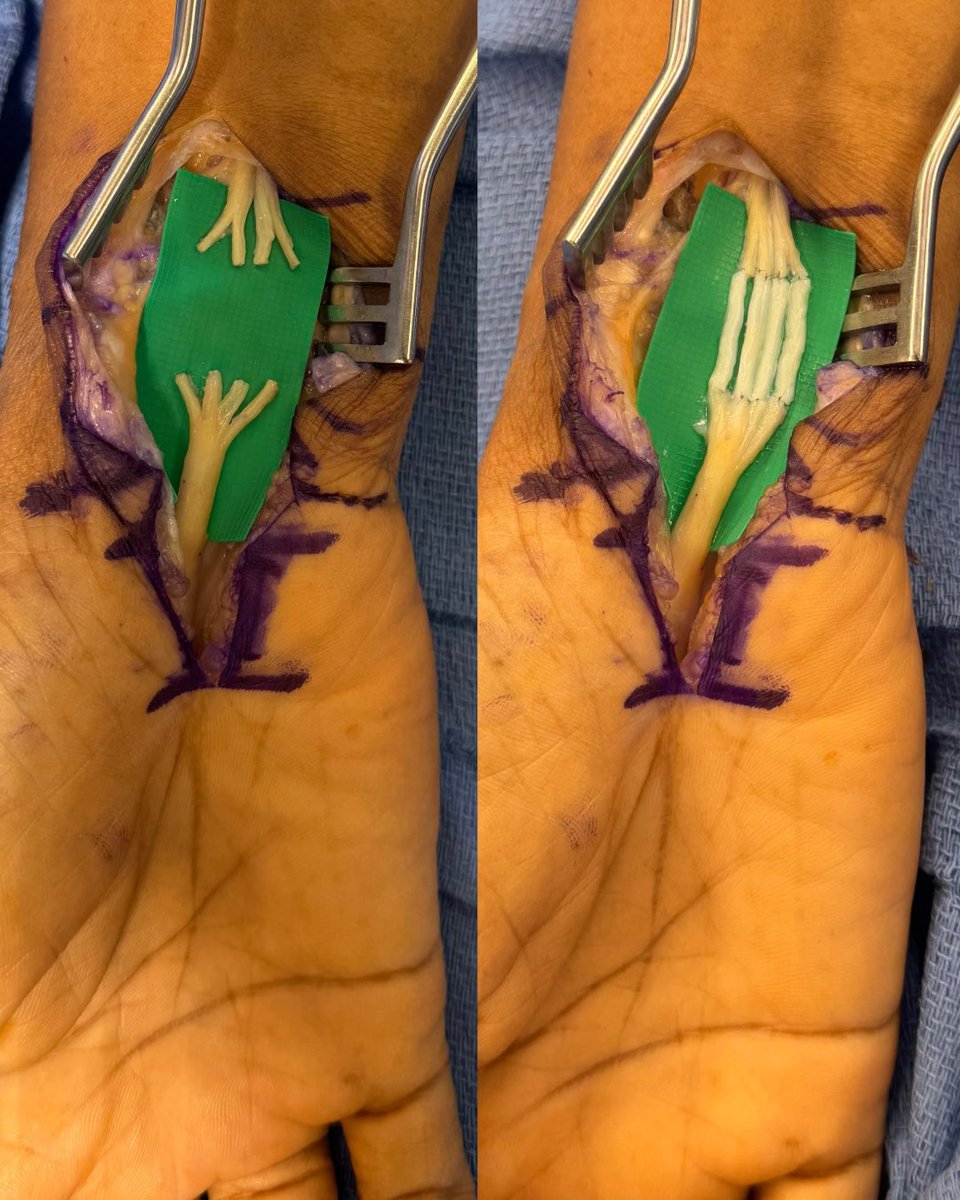
A severed nerve doesn't have to mean permanent loss of function. This patient accidentally cut their median nerve. To fix it, we performed a cable graft—essentially building a bridge for the nerve fibers to grow across and reconnect. This is the reconstruction side of #PlasticSurgery restoring form AND function ⚡️🔌 #MedTwitter #Surgery #HandSurgery #Reconstruction #Nerve
Abbas M. Hassan, MD, PhD tweet media
English
105
620
4.1K
296.3K
Syed M. Taqi Naqvi retweetledi
Laura Vater, MD, MPH
Laura Vater, MD, MPH@doclauravater·
Sometimes I get caught up in how busy I am during clinical days that I forget how much work and time it takes for patients to come see me. Some travel six hours round trip. Some arrange rides. Some wake up early. Some take off time from work. May we remember this.
English
9
14
182
3.7K
Syed M. Taqi Naqvi retweetledi
Ross Prager
Ross Prager@ross_prager·
(1/9) Academic writing in 2025 is still broken. Word. ChatGPT. Reference managers. Formatting. Reviewer #2. Copy paste. We built a better workflow. Introducing Livewrite, your new AI research assistant that runs directly inside Microsoft Word.
English
2
27
105
36K
Syed M. Taqi Naqvi retweetledi
Ross Prager
Ross Prager@ross_prager·
I recently heard a doctor unironically say "You have to swell to get well, and pee to get free" about ICU patients. Becoming volume overloaded is harmful, not helpful in critical illness. Focus on: 1. Thoughtful fluid boluses informed by hemodynamic markers (low SV, fluid responsiveness) 2. Tailoring hemodynamic interventions to microcirculatory surrogates (Cap Refil, Mottling) 3. Phenotyping the patients shock early (most types are NOT fluid responsive after 6-8 hrs of resus). Its 2025, let's break the chains on this old saying.
Ross Prager tweet media
English
3
19
78
9.7K
Syed M. Taqi Naqvi retweetledi
Adam Bitterman, DO, FAAOS
Adam Bitterman, DO, FAAOS@DrAdamBitterman·
I did a ‘Timeout’ before carving the turkey.
English
14
5
167
8.9K
Syed M. Taqi Naqvi
Syed M. Taqi Naqvi@abaiyaar·
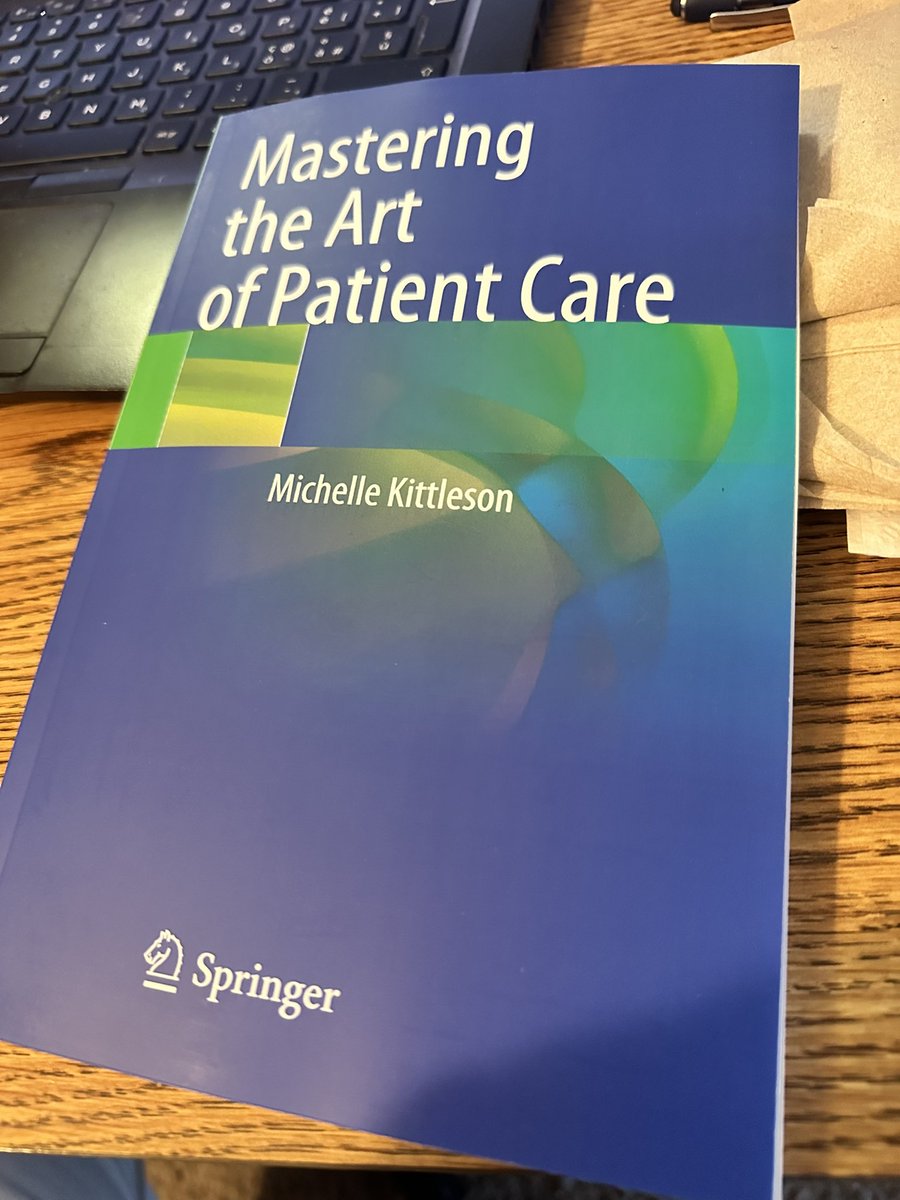
Finally got my hands on it! I have been following @MKIttlesonMD for a while and learning all the pearls she drops here. Excited to see what this book holds!
Syed M. Taqi Naqvi tweet media
English
1
5
32
6.8K
Syed M. Taqi Naqvi retweetledi
Jason Ryan
Jason Ryan@jasonryanmd·
If you’ve ever wondered why the Philadelphia chromosome is so heavily emphasized in medical education, one reason is because it was the first chromosomal abnormality ever linked to a human cancer (discovered in 1960). That finding launched the field of cancer genetics.
English
6
59
533
34.9K
Syed M. Taqi Naqvi retweetledi
Sarah Axelrath MD
Sarah Axelrath MD@DrSarahAxelrath·
ICU nurses are fucking incredible. The end.
English
26
21
563
17K
Syed M. Taqi Naqvi retweetledi
Adam Bitterman, DO, FAAOS
Adam Bitterman, DO, FAAOS@DrAdamBitterman·
One of my favorite parts of the doctor–patient relationship is asking a simple question: “What is your goal for today’s visit?” Their answer gives me immediate insight into their priorities, expectations, and what “success” truly means to them. Early in my career, I assumed most patients coming to see a surgeon were seeking surgery. Now, I find it’s often the opposite and many are on a fact-finding mission. They want clarity, information, and a better understanding of what’s happening before deciding on any path forward. Every condition exists on a spectrum of treatment options. Some patients simply want a diagnosis or an explanation. Others are interested in conservative strategies. And some, having already tried those avenues or wanting a more definitive fix, are ready to discuss aggressive treatment or surgical intervention. By understanding their goal from the start, I can meet them where they are and tailor a plan that aligns with their values and expectations. That’s where real partnership and shared decision-making begin. #MedTwitter #orthotwitter #MedEd
English
4
14
117
11.5K
Syed M. Taqi Naqvi retweetledi
Laura Vater, MD, MPH
Laura Vater, MD, MPH@doclauravater·
A radiologist reached out: “So many of my patients will never know how much I think about them, gather second and third opinions about them, and ruminate about whether I've given them the best version of myself. I know I'll never meet them, but I hope they know how much I care.”
English
45
144
1.4K
74.9K
Dr. Marish Asudani
Dr. Marish Asudani@AsudaniMarish·
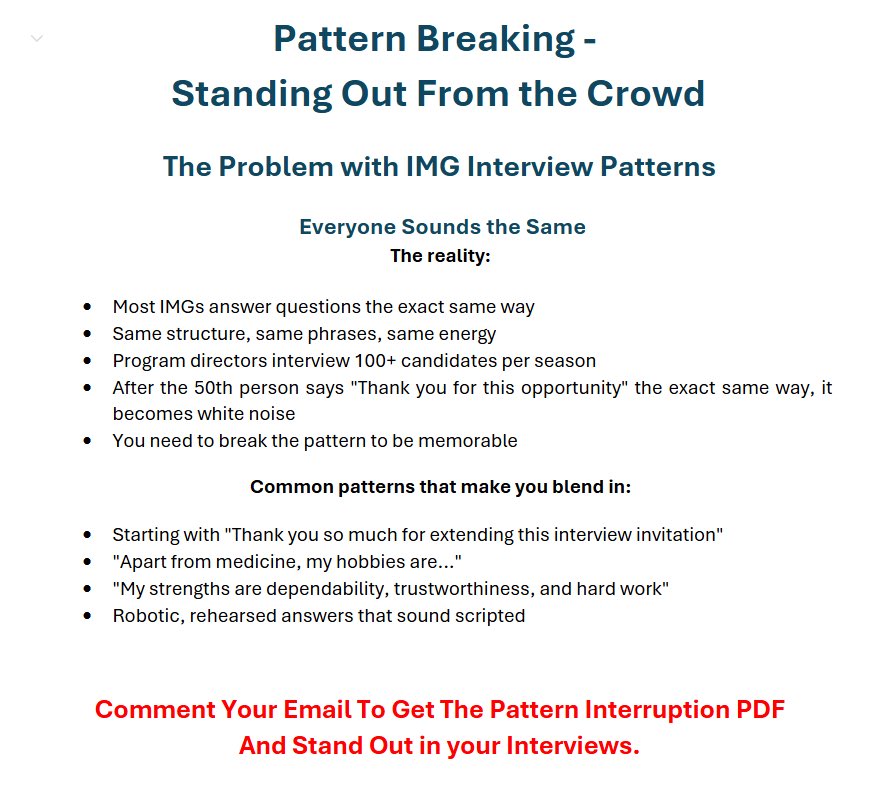
Program directors forget you 10 minutes after your interview ends. 500+ IMGs will answer “Tell me about yourself” The exact same way you do. You’re not standing out. You’re disappearing. The problem? You’re following the same script as everyone else. After interviewing 100+ candidates per season, program directors hear the same patterns on repeat: → “Thank you so much for extending this interview invitation” → “Apart from medicine, my hobbies are…” → “My strengths are dependability, trustworthiness, and hard work” → Listing strengths then giving a mini story for each one → Discussing fellowship plans in your future goals answer I’ve conducted 50+ mock interviews in 6 weeks. The pattern is everywhere. Same structure. Same phrases. Same energy. And when everyone sounds the same, nobody gets remembered. So I built the Pattern Interruption framework. This system teaches you how to: → Break predictable interview patterns that make you forgettable → Redirect questions to showcase YOUR unique story → Answer common questions without sounding scripted → Stand out in a sea of 100+ qualified candidates I’m teaching this live this Sunday, November 16th. You’ll get the full PDF + live training on how to interrupt patterns and actually be memorable. Want access? Comment your email below. I’ll send the session details and PDF directly. (Must be following to receive the DM)
Dr. Marish Asudani tweet media
English
317
14
154
62.9K