Anthony Bay
78 posts

Anthony Bay
@abay
Former Apple, Microsoft, Amazon exec. founder and CEO of Techquity - helping non-tech companies embrace world class software tech. passionate conservationist
Katılım Mayıs 2008
997 Takip Edilen288 Takipçiler

A lot of people evaluate their relationships through a single lens. What am I getting from this? Is this person making me happy? Is this partnership serving my interests?
That framing is common and, in my experience, the wrong starting point. The more useful question is the inverse. How am I contributing to this relationship? What am I bringing to the marriage, the partnership, the team?
The reversal matters because it changes what you optimize for. When the orientation is extraction, the relationship becomes transactional and fragile. Both people end up keeping score, and the score never quite balances in a way either side finds satisfying. When the orientation is contribution, the dynamic shifts. Each person focuses on what they can add, and the relationship compounds rather than erodes.
This is true in marriages, in long-running business partnerships, and in the executive teams that hold together through hard periods. The principle does not change with context.
It is worth being honest that this is difficult. No one who has done it would describe it as easy. Contributing consistently, particularly during periods when you feel undervalued or stretched, requires a kind of discipline that runs against most natural instincts. The relationships worth having are also the ones that demand the most.
The trade is that they are the ones that produce the most over time. Personally, professionally, and in almost every other dimension that ends up mattering when you look back.
English

Business is a team sport. Life is a more important one. The relationships you build and sustain over time are what most of the meaningful outcomes ultimately rest on.
I have been married for 43 years. My wife has been patient in ways I have benefited from more than I have probably acknowledged. What I have observed across that time, and across the professional partnerships I have been part of, is that the underlying principle is the same in both contexts.
Durable relationships start with "we." Decisions get made with the relationship itself prioritized above the individuals inside it. That sequencing matters. When each person optimizes primarily for their own position, the relationship becomes a negotiation. When both people optimize for the relationship, individual outcomes tend to take care of themselves over time.
This applies in marriages, family dynamics, long-running professional partnerships, and executive teams that hold together through difficult periods. The mechanism is the same. Shared priority above individual priority. Not all the time, and not without honest disagreement, but as the default orientation.
It is worth being explicit about this because the alternative is the more natural default. Most environments reward individual performance and gain. Choosing to prioritize the relationship is a discipline, not an instinct.
The partnerships that last, personal and professional, tend to be the ones where both people made that choice repeatedly, over a long period of time, even when the short-term math would have suggested otherwise.
English

When someone sponsors you, they are taking on real risk. Their judgment, credibility, and standing inside the organization are tied, at least in part, to whether their bet on you pays off.
The appropriate response is to step up. Treat the opportunity as something you earned and must now deliver against. The people who do this consistently get sponsored again, often by the same person and frequently by others who watched the first bet work out. Those who do not find that future opportunities quietly stop arriving, usually without explanation.
Mentorship requires a different posture. A mentor invests time and attention rather than political capital. What they need from you is presence. Actually showing up, actually listening, and actually applying what you hear. Mentors notice quickly when their input is being collected without being used, and most of them will not say anything. They will simply give less of themselves over time.
Both relationships operate on a similar underlying principle. People extend themselves when they see a return on that extension. The return does not have to be immediate or material, but it must be visible. Stepping up, paying attention, and following through are the signals that tell sponsors and mentors their investment was worth making.
Careers that look fortunate in hindsight are usually careers where someone delivered on the early bets placed on them. The opportunities compound from there.
English

No one builds a meaningful life alone. The relationships you invest in over time are, in my experience, the most important building block of everything else.
This is easy to say and harder to live by, particularly for people who spend their careers optimizing for professional outcomes. Relationships compound much like capital does, but they require a different kind of attention. Consistent, unhurried, and largely invisible in the short term.
The challenge is that the demands of an operating career are not patient. They will absorb every hour you give them and continue asking for more. The relationships that matter rarely demand anything in a way that competes effectively for that attention. They tend to quietly erode while you are busy with things that feel urgent at the time.
The people I have watched navigate long careers well, and arrive at the later stages with something worth having, share a common pattern. They treated their important relationships as non-negotiable investments rather than residual ones. Not perfectly, not without trade-offs, but consistently enough that those relationships were still there when they mattered most.
This is not a soft observation. It has practical implications for how you allocate time, how you make trade-offs during demanding periods, and how you think about success over a longer horizon than any single role or company.
Professional outcomes matter. They also turn out to be insufficient on their own. The relationships you build are what give the rest of it meaning.
English

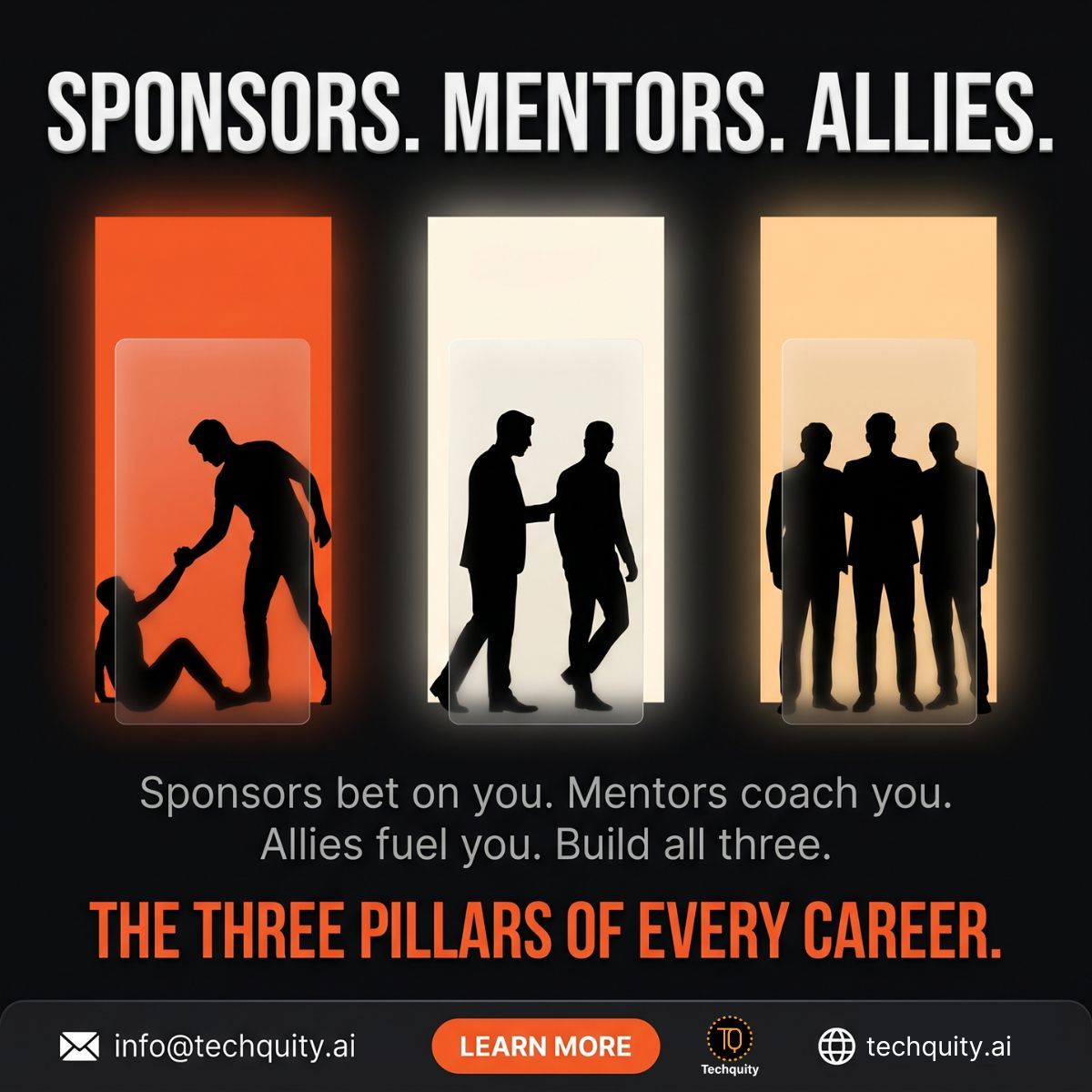
Most career advice collapses three distinct relationships into one. The result is a generic call to find a mentor, which underestimates how careers actually progress at the senior level.
Mentors offer perspective. They have been through what you are facing and can shorten the learning curve through honest counsel. The relationship is valuable, but its impact is bounded by what you do with the advice. Mentors do not change the opportunities in front of you. They help you think more clearly about the ones you have.
Sponsors operate differently. They put their own credibility behind you in rooms you are not in. They advocate for the promotion, recommend you for the board seat, and use their position to create access. Sponsorship is earned through demonstrated performance and trust, and it is the lever that most often shifts a career trajectory rather than refines it.
Allies are the third category, often the most underweighted. These are peers and colleagues who move alongside you over time, share information, open doors laterally, and create the network effects that compound across decades. Allies are not transactional. They are the result of operating with generosity and consistency over a long horizon.
The careers that reach the highest levels tend to have all three in place. Sponsors create the opportunities. Mentors sharpen the judgment to handle them. Allies expand the surface area of what becomes possible.
For senior operators, the question is not whether you have a mentor. It is whether you have built the full set, and whether you are playing those roles for others as well.

English

I played bass in a band in sixth grade. I cared about it, I put time into it, and I was a good listener. At some point I recognized that no matter how much passion I brought, I was not going to be a great musician.
That recognition was useful. It pointed me toward a question I have come back to throughout my career. Where does what I am genuinely good at intersect with what I actually care about? The answer is rarely obvious, and it shifts as you accumulate more experience and more honest feedback.
Passion alone is not a strategy. There are areas where people care deeply and will still hit a ceiling because the underlying aptitude is not there. There are also areas where people have real ability but no genuine interest, and the work eventually feels hollow regardless of how well it pays.
The intersection is where compounding happens. You get better faster because you care, and you stay longer because you are succeeding. Without both, one side eventually erodes the other.
Finding that intersection is not a single decision. It is an ongoing process of testing, observing what actually works, and being willing to update your assumptions about yourself. The people I have seen build the most meaningful careers were not necessarily the most talented or the most driven. They were the most honest with themselves about where their real leverage was, and the most disciplined about pursuing it.
That honesty is harder than it sounds, and it is worth the work.
English

One of the more reliable predictors of long-term career outcomes is the orientation a person brings to their work. Specifically, whether they are focused on what they can contribute or on what they can extract.
The framing that has served the operators I respect most is straightforward. Lead with how you can add value. Treat contribution as the North Star, and accept that what you get back will, over time, be proportional to what you put in.
The opposite orientation is common and easy to spot. People who are continually scanning for what they can get from a role, a relationship, or an organization. The behavior produces short-term gains and long-term ceilings. People notice, and the network around them eventually adjusts.
The contribution-first orientation is not about working for less than you are worth or ignoring your own interests. Compensation, recognition, and advancement still matter and should be addressed directly. The point is sequencing. Value created comes first. Value captured follows.
This applies at every level. Junior people who consistently add more than they take get pulled into better opportunities. Senior operators who build genuine value for their teams and their companies tend to find that the economics work out over time. Leaders who orient their organizations around contribution build cultures that retain talent and outperform peers.
It is one of the simpler principles in business and one of the more durable. The people who internalize it early tend to compound advantages the people focused on extraction never quite catch.
English

As a general principle, taking ownership of your own life is the starting point for almost everything else worth pursuing.
Attitude is the grounding. Skills can be learned. Networks can be built. Knowledge accumulates over time. None of that compounds unless the underlying orientation is one of personal responsibility for the outcomes you are trying to produce.
The framing that has held up for me is wanting to win on my own terms. That phrasing matters. It is not about winning by someone else's definition or competing in someone else's frame. It is about deciding what you are actually trying to achieve and then accepting that the responsibility for getting there is yours.
This is not a motivational point. It is a practical one. The people I have seen build durable careers and durable companies almost all share this trait. They do not outsource accountability for their outcomes, even when external factors are clearly at play. They look for what they can influence and act on it.
Everything else, the persistence, the learning, the willingness to keep going through difficult periods, follows from that foundation. Without it, those qualities tend to surface inconsistently and fade under pressure.
Ownership is the precondition. The rest is what you build on top of it.
English

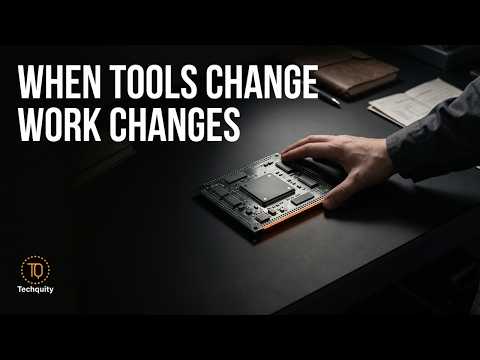
A century ago, manufacturing required enormous numbers of people. The cost of producing almost anything was high because labor was the bottleneck. Over time, automation and process improvements changed that, and the workforce moved up what I would call the "intellect chain". Physical jobs gave way to a combination of physical, mental, and interpersonal work, much of it in offices.
A meaningful share of those office jobs turned out to be low value add. They existed because the previous transition pushed people there, not because the work itself was essential.
AI is now doing to white collar work something similar to what mechanization did to manufacturing and agriculture. The difference is speed. The previous transitions played out over decades. This one is compressing into years.
Steve Jobs described computers as bicycles for the mind. AI is a meaningful step beyond that. Used well, it is one of the more capable tools ever built, and it changes what office work actually requires from the people doing it.
The people who adapt will combine judgment, domain expertise, and fluency with these tools to produce more than they could before. The people who do not re-skill will find themselves in the same position as workers who waited for manufacturing jobs to come back. Those specific jobs are not returning. Different ones are emerging in their place.
For leaders, the question is not whether to engage with this shift. It is how quickly your organization can move people up the value chain before the transition does it for you.
Full Video Now Live to Learn More: youtu.be/8Y9VTTWB1GI

YouTube

English

Being Right Too Early Is Still Being Wrong
The first company I started was a social media business called The Grapevine. The year was 1983.
The idea of connecting people through computers was correct. The execution was reasonable. What was missing was almost everything else. The infrastructure, the user base, the cost structure, and the broader environment were not yet in place. Facebook arrived twenty years later with the same fundamental premise, and they were not the first either.
The lesson is one I have come back to repeatedly. Being right about a thesis is not the same as being right about the timing. Markets only reward conviction when the surrounding conditions are actually ready to support it.
The harder lesson is patience. A lot of operators and investors declare failure too quickly. They conclude that the idea was wrong when the more accurate read is that the timing was off, the inputs were incomplete, or the market was not yet shaped the way the thesis required. Sometimes the right response to a failed venture is to keep watching the space.
Distinguishing between a wrong idea and an early one is one of the more difficult judgments in business. Both look the same in the short term. The difference only becomes clear with time, and often only to people who were paying attention to why the original attempt actually failed.
Patience, in this sense, is not passivity. It is the discipline of holding a thesis open long enough to learn what the market is actually telling you.
English

One of the more useful distinctions when evaluating any new idea is whether you are looking at a feature, a product, or a company. The three are often confused, and the confusion has real consequences for where capital and time get spent.
A feature is something that adds value but cannot stand on its own. It belongs inside someone else's product. Nothing about it is structurally defensible, which means a larger player can absorb it the moment it becomes interesting enough to matter.
A product is something a customer will use and pay for, but that does not automatically make it a business. Plenty of well-designed products lack the economics, distribution, or market depth required to sustain a company around them. They generate revenue without generating a durable enterprise.
A company is something different again. It has defensibility, repeatable economics, and a market large enough to support continued investment and growth. Building one requires a set of conditions that most ideas, even good ones, do not meet.
Founders who confuse these categories tend to build the wrong thing or build it for the wrong reasons. Investors who confuse them tend to fund features at company valuations. Operators who confuse them tend to defend products that should have been sold or absorbed.
The discipline is asking the question early and answering it honestly. Not every good idea deserves a company built around it. Knowing which category you are actually in changes almost every subsequent decision.
English

Why The U.S. Still Produces More Startups Than Almost Anywhere
One structural advantage of operating in the United States is a culture that has, over decades, learned to embrace risk-taking. It is not an accident that so many startups are founded here and that the majority of global venture capital is deployed here.
Venture capital is risk capital by definition. It only functions in an environment where founders can take significant bets, fail, and still have viable careers afterward. In many parts of the world, that second part does not hold. A failed venture carries lasting professional and social consequences that make starting something new prohibitive for most people.
The U.S. system is not without its flaws, but on this dimension it is unusually permissive. Founders who fail can raise again. Operators who back the wrong bet can move to the next role. Investors who miss can stay in the game. That tolerance allows capital and talent to keep cycling into new attempts.
For leaders building inside this environment, it is worth recognizing the advantage rather than taking it for granted. The same risk-taking that produces outsized outcomes at the company level depends on a culture that does not punish individual failure beyond what the failure itself warrants.
Maintaining that culture inside your own organization is a choice. The external environment supports it, but it does not guarantee it. How your team treats a failed initiative next quarter will say more about your appetite for risk than any strategic plan you publish.
English

When Thomas Edison was interviewed after developing the incandescent light bulb, he was asked how he felt about failing ten thousand times along the way. His response was that he had not failed at all. He had successfully identified ten thousand things that did not work.
The reframe is more than a clever line. It reflects how people who produce meaningful outcomes actually think about their process. Every attempt that did not work narrowed the problem. Each one was progress, even when it did not look like it.
The same logic applies to careers and to organizations. The more experiments you run, the more you learn about what works, what does not, and where you are genuinely capable of adding value. That knowledge is difficult to acquire any other way. You cannot reason your way to it from the outside.
Most people significantly underestimate how much of their eventual clarity came from attempts that went nowhere. In hindsight, the path looks linear. In practice, it was a series of tests that returned useful information, whether or not they produced the intended result.
For leaders, the implication is practical. Create conditions where your teams can run more experiments, tolerate the ones that do not work, and extract what each attempt teaches. For individuals, the implication is similar. The quality of your judgment is largely a function of how many things you have actually tried.
English

Organizations that consistently innovate do not just tolerate failure. They build it into how they operate.
There is no version of sustained risk-taking where failure does not come with it. The two are inseparable. If you want people to take meaningful risks, you need an environment where failure is treated as an expected output, not an exception to be managed.
Jeff Bezos described Amazon as a science experiment by design. The point of a science experiment is not to be right every time. It is to run enough iterations that you learn what works and what does not. That framing is significant because it moves failure from being a problem to being a data point.
The difference between organizations that can do this and organizations that cannot is whether risk-taking is individual or institutional. When risk lives only with individuals, failure is personal and career-threatening. When the organization itself is structured around experimentation, failure becomes distributed and the learning becomes collective.
Institutionalizing risk means building processes, incentives, and decision-making frameworks that assume a certain percentage of bets will not pay off. Leaders who wait for a culture of risk-taking to emerge on its own will be waiting a long time. It has to be designed, resourced, and protected from the natural organizational instinct to eliminate variance.
The companies that get this right compound their learning. The ones that do not eventually run out of ideas that feel safe enough to try.
English

Experimentation is fundamental to how organizations learn and improve. Most senior leaders would agree with that statement. Fewer have built an environment where it actually happens.
The gap between intent and reality comes down to consequences. In many organizations, a failed experiment carries real professional risk. People get sidelined, lose credibility, or in some cases lose their jobs. When that is the lived experience, no amount of messaging about innovation will change behavior. People will optimize for safety.
This is not a culture problem in the abstract. It is a structural one. If the reward system punishes failure without distinguishing between reckless decisions and disciplined experimentation, people will stop taking risks. The organization will default to what already works, which is a viable strategy until the market shifts.
The leaders who build genuinely adaptive organizations do two things. They create clear boundaries for experimentation so people understand the difference between a smart bet and an uncontrolled gamble. And they make the professional consequences of a well-reasoned experiment that does not work meaningfully different from the consequences of poor judgment.
That distinction sounds obvious, but implementing it requires leaders to intervene in real time when someone takes a good risk and it goes wrong. What happens in that moment defines the culture far more than any stated value ever will.
English

Tom Brady once said he did not learn anything from the games he won. Everything he learned came from the games he lost.
That observation applies well beyond sports. Success teaches you some things, but it can also teach you the wrong things. When something works, it is tempting to assume that every decision along the way was correct. In reality, good outcomes often mask flawed reasoning, poor process, or timing that just happened to break your way.
Failure, when approached honestly, strips away that ambiguity. It forces you to look at what actually happened and why.
The challenge is that most people and most organizations treat failure as an identity rather than an input. When losing feels like a verdict on your ability, the instinct is to avoid it or explain it away. Neither response produces learning.
The leaders and teams that improve fastest are the ones who can sit with a loss, examine it clearly, and extract what it has to teach without letting it define them. That requires a level of intellectual honesty that is harder to maintain than it sounds, especially at senior levels where the stakes and visibility are high.
Winning feels like validation. Losing is where the actual insight lives. The discipline is knowing the difference between the two.
English

After decades of building and leading at Apple, Microsoft, Amazon, and multiple early-stage companies, I wanted something different. I wasn't tired of working, but I was tired of being a mercenary for someone else's vision. I wanted to be the author of my own.
I have been working on a passion project for a couple of years, and today I am excited to launch my podcast: “Zero to Prove.”
I have spent major parts of my career inside great companies. I had the privilege of serving as an executive at some of the world’s most iconic tech companies, and I held senior executive roles in the US and internationally. I have been a CEO, started companies, and been on public and private boards in the US and Europe. I have been very fortunate to have incredible opportunities, to work alongside amazing people, and to be part of the major tech revolutions of the past 40 years
But most of this journey was based on executing what someone else had imagined. There is nothing wrong with that. In fact, I loved it. But after my last corporate role, I needed a change. I needed to pursue more of my own goals and passions.
That shift did not mean “retiring.” Instead, the shift was a redefinition of what success looked like. Instead of pouring all of my energy into a single company, I set out to build a more diverse life with a deeper focus on my family and a deeper commitment to contributions grounded in my own passions.
That journey has led me to create “Zero To Prove”.
Zero To Prove is a podcast for anyone who has reached an inflection point, as I did—that moment after you have succeeded on your own terms and are ready for something different.
There is no real playbook for this transition, especially for people later in their careers.
We know the traditional path: Go to school. Build your resume. Climb the ladder.
But what happens after you achieve a level of professional success where you no longer need to prove anything to others? What happens when your focus becomes proving things to yourself?
That is the question at the heart of Zero to Prove.
On the show, I talk with people who have built successful careers and THEN made a conscious shift; those who found meaning after achievement and decided to make professional contributions rooted in values and passion.
When you have nothing to prove to others, you're free to build something that truly matters to you.
If you are deep in your career and quietly asking, “What is next?”, ZTP can act as a guide, a community, and a source of inspiration.
You can listen to the episodes, join our mailing list, and learn more about the project here: zerotoprove.org and listen on
podcasts.apple.com/cg/podcast/zer…
open.spotify.com/show/5hIDVfQBS…
@ZTP_Podcast" target="_blank" rel="nofollow noopener">youtube.com/@ZTP_Podcast
Let me know what you think, and if you are interested in being a guest, feel free to contact me.

English

@pbeisel Remarkable achievement for humanity. Sadly as you say many people prefer the adrenaline rush of conspiracy theories 🥹
English


I am a techno-optimist. Unequivocally so.
Technology makes the world better.
This is not a universal perspective, but it is mine, and it is the key idea expressed in a16z’s “Techno-Optimist Manifesto.” I don’t agree with everything in there, but I agree with the key premise, and I remember how impactful this piece of writing was to me when I first read it. The manifesto is linked below if you’d like to read it.
But more importantly, if you are reading this and disagreeing that technology improves the world, I want to ask about your perspective.
I understand the belief that technology is not inherently a force for good. I don’t agree, but I understand.
What I reject, though, is that technology can be abandoned, switched off, or pushed back in time. I also reject the notion that technology is optional for anyone, regardless of their goals.
If you want to stop climate change, you need technology to do it. If you want to end poverty, you need technology. If you want to stop what you view as fascism or cronyism or oligarchism, you need technology to do it.
Whether technology, or certain forms of it, are inseparable from the root of these issues is irrelevant. You will need equal or greater technology to fix them. Technology is a critical source of success, whether you like it or not.
Effectively, the vast majority of all improvements in infrastructure that enable a better quality of life are a result of technology. Wealth creation is a byproduct of technological innovation.
Wealth creation has led to vast inequality, but that is a different issue to tackle. Without the value creation in the first place, wealth wouldn't be available to support the investments required to improve humanity and enable the conversation about equity and inclusion.
The issue isn't slowing the pace of innovation; it is ensuring that the innovation benefits the widest possible percentage of humanity.
So, if you categorically oppose the use of a certain type of technology, what are your alternatives? What do you propose?
Those who opposed the use of fossil fuels have harnessed wind, solar, and nuclear energy. Those are all technologically-based solutions, and they scale based on constant improvements in technology.
For those who oppose AI, what can you build that will fulfill the function of AI?
The cat is out of the bag—people and companies and countries will continue to look for technologies that solve their problems and advance their priorities.
The truth is that it doesn’t matter what we think; it matters what we do, and technology is leverage. It allows us to DO more. Refusing to use it is not a protest; it is an abdication of responsibility.
If you disagree with something that technology is doing in the world, or people are doing with technology, be part of an alternative solution. Figure out a way to change or mitigate it, or to use technology differently. The responsibility to act on our beliefs is all of ours as individuals and members of society.
We are riding a giant wave, and we need to figure out how to harness it for the benefit of humanity. I believe that we can and we will. I am a techno-optimist.
For the pessimists, do not close your eyes and let the wave swallow you. Live your conviction and use technology to do it.
Here is a link to the manifesto: a16z.com/the-techno-opt…
And a link to a techno-optimist project, The Earthshot Prize, which has been a Techquity client: earthshotprize.org
English

Tech has the potential to be THE great global leveler. American and Chinese tech currently dominate the world. Big tech gets bigger. Anyone trying to escape this is fighting the gravitational pull of cosmically large entities.
The gravitational pull works like this: America, China, and some other countries (to a lesser extent) produce the largest and most powerful tech companies along with the largest and most productive start up ecosystems and risk capital.
Those companies attract motivated and talented people from across the globe. The flywheel of capital and talent spins faster, and capital and experience become hyper-concentrated.
One of the ways that smaller nations, companies, and tech ecosystems can be supported in this dynamic is through investment. Economic differences are obvious, measurable, and important, and capital investment is essential to the emerging market.
This is neither a secret nor a revelation, and a number of investment firms are doing great work here.
But the less obvious and more complex imbalance between established markets and emerging ones is expertise.
Because the United States and China have more massive businesses and start-up ecosystems than the rest of the world, they naturally have more leaders and operators who are experienced in building and running businesses at this scale. This experience is highly valuable and extremely rare.
It is common to see experienced tech leaders and operators jump between Google, Microsoft, Meta, Amazon, Netflix, Apple, X, Tesla, OpenAI, Oracle, and a handful of other elite names in American tech, as well as exciting high-profile early-stage companies. Similar is true in China.
Some people venture off to start their own companies or take roles at already established or scaling companies of smaller proportions. However, it is more uncommon for them to work for companies in smaller markets.
This is because those companies often do not have the culture, priority, budget, impact, or cutting-edge technology that can attract leaders and operators of the highest caliber. They are not career accelerators. The result is that the experience needed to build the world’s best companies remains concentrated in a few select markets.
Part of Techquity’s thesis is that the experience we have accumulated from decades in the top tech companies of the world can be invested as a growth lever for scaling companies, no matter where they are from. Just as some investment firms inject capital into emerging markets, Techquity seeks to inject big tech leadership and expertise into the markets and companies where it is needed most.
Because we know that our experience is unique, useful, and highly concentrated in only one or two places in the world.
If you work with companies that could use some of this experience, let’s be in touch.
English