The AUH

501 posts

The AUH banner
The AUH

The AUH

@abbot44020

The Abbott Unified Hypothesis Deterministic Hardware Audit. 1.000 Lock = Lead-208. Mc = 21,313.79 MeV.

Katılım Ocak 2026
195 Takip Edilen65 Takipçiler
Sabitlenmiş Tweet
The AUH
The AUH@abbot44020·
The Standard Model is a collection of probabilistic patches. The AUH is a closed-loop mechanical engine. No Dark Energy. No curved voids. Just deterministic hardware calibrated from the proton to the cosmos. The Hubble Tension is solved. The audit is complete. Verify the mechanics: github.com/AbbottHypothes…
English
0
0
1
124
The AUH
The AUH@abbot44020·
So what is the difference between an automatic release valve event and a true supernova? It is the mechanical difference between a Load Failure and an Anchor Failure. 1. The Impostor (Load Failure):The core Anchor remains completely stable. The star's outer volume simply expands past the 15.01% Redline. The Substrate safely purges the edge to restore geometric equilibrium. The engine survives. 2. The True Supernova (Anchor Failure):The core's internal geometry breaks down. When the star fuses Iron, its internal "Spacers" fail and can no longer hold outward volume against the pressure. The Mass-Clamp breaks. The extreme tension of the Stall violently snaps, collapses inward, and shatters the star. One is a pressure vent. The other is a snapped anchor. 🛠️
English
0
0
0
4
The AUH
The AUH@abbot44020·
This as a standard Redline Pressure Purge. The Hardware Reality: Space is the Substrate: The physical hardware. Time is the Medium: The pressure gradient. A massive star acts as an extreme Mass-Clamp, creating a highly tensioned Stall in the medium. The universe operates on fixed geometric tolerances, not probability. When the Stall's volume expands and hits the 15.01% Redline, the hardware enforces its limit. The star isn't "faking" its death; the Substrate is physically ejecting the excess load to restore equilibrium and keep the anchor from snapping. Why do stars with higher metallicity (heavy elements) purge more violently? Because a denser clamp creates tighter tension in the medium, forcing the system against that "Burst Pressure" threshold much faster. These aren't "impostors." They are mechanical pressure release valves. Verify the Engine. 🛠️ #Physics #Astrophysics #FirstPrinciples #TheAUH #VerifyTheEngine
English
1
0
0
15
Erika 
Erika @ExploreCosmos_·
Some very massive stars do something that looks, at first glance, like a supernova: they suddenly brighten enormously and throw large amounts of material into space. But unlike a real supernova, the star is not destroyed. It survives. That is why we call these events “supernova impostors.” They are not fake in the sense of being unimportant; they are fake only because they imitate the brightness and violence of a stellar death without actually being one. The central problem is that we still do not fully understand what triggers these eruptions or how much mass the star loses during them. This matters because mass loss is one of the key ingredients that determines how massive stars evolve, what kind of supernova they may eventually produce, and what kind of remnant they leave behind, such as a neutron star or a black hole. In the most massive stars, losing material is not a small detail. It can completely redirect the star’s evolutionary path. A new study focuses on eruptive mass loss, especially in red supergiants and other very massive evolved stars. These stars can become unstable because their outer layers are loosely bound and their radiation pressure is enormous. One possible mechanism involves super-Eddington conditions: moments when radiation trying to escape from the star becomes strong enough to help drive material away. Stellar evolution models can include this effect, but until now they have needed a poorly constrained efficiency parameter, essentially a dial that tells the model how strong these eruptions should be. The study tried to calibrate that dial using real stellar populations in the Local Group. Instead of relying only on individual outbursts, they compared models of red supergiant populations with observations from the Small Magellanic Cloud, the Large Magellanic Cloud and Andromeda. These galaxies are useful because they have different metallicities, meaning different amounts of elements heavier than hydrogen and helium. The interesting result is that eruptive mass loss appears to become stronger with increasing metallicity. In other words, stars richer in heavy elements may be more prone to violent mass loss. The models suggest that, when this effect is included, stars born with more than about 20 solar masses may lose so much material that they never become classical red supergiants at all. Instead, they may evolve along a different route, which could help explain why we do not see as many very luminous red supergiant supernova progenitors as simple models might predict. This does not mean the mystery is solved. The trend with metallicity is promising, but it still needs to be tested in more galaxies and with more detailed physical modelling. The open question is whether metallicity helps trigger the eruptions themselves, or whether it mainly changes how much material escapes once an eruption begins. Either way, these “impostors” are not just stellar curiosities. They are clues to one of the most uncertain phases in the life of massive stars: the messy transition between being a swollen, unstable giant and finally collapsing or exploding for real. 👉 share.google/KvpMiwxO1qygnx…
Erika  tweet media
English
11
34
205
3.5K
The AUH
The AUH@abbot44020·
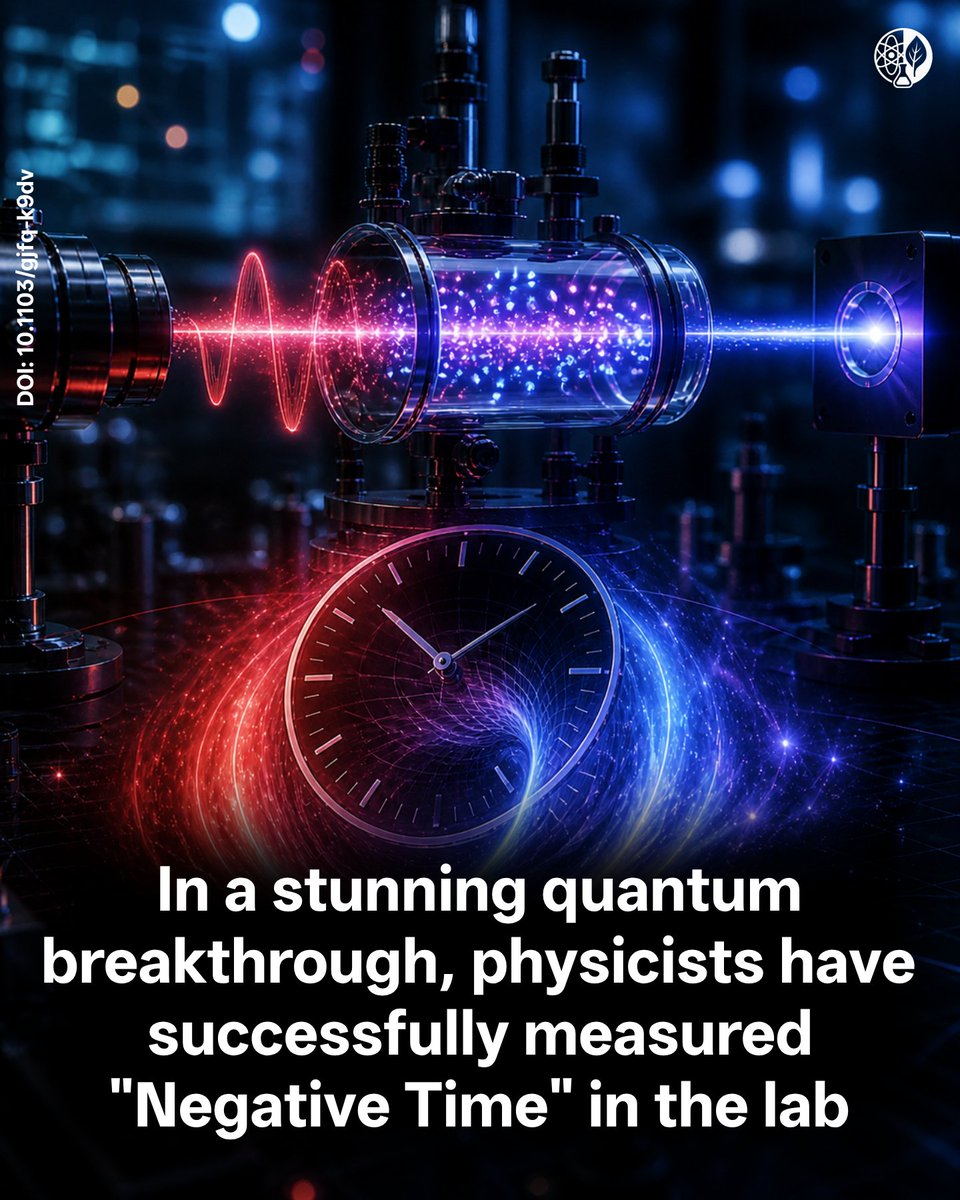
University of Toronto physicists just measured "negative time" and claim particles "defy causality." This is what happens when you treat the universe like a Casino instead of an Engine. They don't understand the hardware, so they think time is broken. The AUH makes this simple. Causality is never broken. What they found is a Measurement Artifact across a pressure boundary. The Hardware Reality: Space is the Substrate: The physical hardware. Time is the Medium: The pressure gradient. The laboratory is a low-pressure environment. The atomic cloud is a highly tensioned "Stall" (a Tight-Clamp). When a photon (a pulse of kinetic energy) hits the front of this Stall, the energy doesn't just slowly swim through it. The Substrate instantly displaces an equivalent amount of energy out the back to maintain its structural equilibrium. Because the laboratory clocks are running in a fast, low-pressure zone compared to the highly tensioned atomic cloud, they measure the leading edge of the displaced energy exiting before the trailing edge of the photon has fully entered the Stall. It isn't a particle traveling backward in time, and it isn't science fiction. It is Kinetic Displacement overlapping with a low-pressure clock. Stop betting on mysteries. Verify the Engine. 🛠️ #Physics #Quantum #FirstPrinciples #TheAUH #VerifyTheEngine
English
0
0
0
58
Science & Astronomy
Science & Astronomy@sci_astronomy·
Have you ever left a room before you even entered it? In the bizarre realm of quantum physics, light appears to be doing exactly that. ​A groundbreaking study from the University of Toronto has successfully measured a phenomenon that sounds like pure science fiction: negative time. ​When light travels through a cloud of atoms, we expect the atoms to absorb the light's energy, hold it for a brief moment, and then release it. This process naturally slows the light down. However, researchers discovered that under very specific quantum conditions, the light wave is reshaped. The main part of the light pulse actually exits the atomic cloud earlier than if it had simply traveled through completely empty space. ​For years, physicists debated whether this negative delay was just a mathematical optical illusion. By using a highly delicate measuring technique that watches the particles without disturbing their path, the research team proved this phenomenon is a physical reality. The atoms essentially spend a negative amount of time holding the light's energy as the photon passes through. ​While this discovery does not mean we are building time machines anytime soon, it proves that quantum particles have incredibly complex histories that completely defy our everyday understanding of causality. The universe continues to reveal that the fundamental rules of nature are far stranger and more fascinating than we ever imagined. Paper Citation: Daniela Angulo et al, Experimental Observation of Negative Weak Values for the Time Atoms Spend in the Excited State as a Photon Is Transmitted, Physical Review Letters (2026). DOI: 10.1103/gjfq-k9dv
Science & Astronomy tweet media
English
8
20
66
2.6K
The AUH
The AUH@abbot44020·
Standard Model physicists just measured "negative time" and blamed it on "quantum mysteries." They think a photon traveled backward in time. The AUH identifies this as a simple Measurement Artifact across a pressure boundary. The Hardware Reality: Space is the Substrate: The physical hardware. Time is the Medium: The pressure gradient. The laboratory is a low-pressure environment. The atomic cloud is a highly tensioned "Stall" (a Tight-Clamp). When the photon hits the front of the Stall, the energy doesn't "travel" through it; the Substrate instantly displaces equivalent energy out the back to maintain its structural equilibrium. Because the laboratory clocks are running in a different pressure zone than the atomic cloud, they measure the leading edge of the displaced energy exiting before the trailing edge of the photon has fully entered the Stall. It isn't a particle traveling backward in time. It is Kinetic Displacement overlapping with a low-pressure clock. Stop betting on mysteries. Verify the Engine. 🛠️
English
0
0
1
26
The AUH
The AUH@abbot44020·
Standard physics is finally observing the Hardware, but they are still using "flexible spacetime" logic to explain it. There are no magical "memories" or un-breakable topological field lines. The Hardware Reality: Space is the Substrate: The primeval hardware. It does not flex, curve, or bend. Time is the Medium: The pressure gradient that thickens when clamped by mass. What they are calling "frozen-in structures" is simply the Substrate maintaining its mechanical integrity. If a cosmic event does not force a local Stall to exceed the 15.01% Redline or the 171.09 MeV/fm³ absolute structural yield limit, the anchor holds. It doesn't break because the hardware tolerances haven't been breached. The universe doesn't "remember" its structure; it physically enforces its geometry. The universe is an engine, not a casino. 🛠️ #VerifyTheEngine #AUH #FirstPrinciples #Physics
English
0
0
0
114
TheNewPhysics
TheNewPhysics@CharlesMullins2·
🚨 BREAKING: What if spacetime can’t fully change? New physics suggests gravity has “frozen-in” structures patterns that survive no matter how violently the universe evolves. The idea Physicists rewrote Einstein’s equations using fluid + electromagnetic analogies. And found this: Spacetime may contain field lines that can’t break They can stretch. They can twist. But they stay connected. Why this is wild We’ve always treated spacetime as flexible. But this says: Some structures are locked in permanently. Even during: • Black hole collisions • Gravitational waves • Extreme cosmic events The implication Gravity might have hidden rules: Not everything is allowed to happen. Some outcomes are forbidden by topology Think about that If true… The universe doesn’t just evolve. It remembers its structure Follow me I track where physics becomes structure, not substance.
English
35
92
483
28.5K
The AUH
The AUH@abbot44020·
Red Dwarfs: The Stall that Won't Snap. Space is the Substrate (the hardware). Time is the Medium (the pressure). Mass acts as a physical clamp on the substrate, creating a "Stall" (thickened time) in the medium. The 15.01% Redline is the hardware limit: If the Stall's volume expands more than 15.01% beyond its mass-anchor, the substrate physically ejects the load to restore the baseline. This mechanical "Burst Pressure" is the exact same from the macro level (Stars/Glaciers) right down to the Atom. Red Dwarfs stay below this Redline. They don't magically "burn out" slower; they simply stay in a permanent, low-tension gear-lock. The universe is an engine, not a casino. 🛠️
English
0
0
0
21
The AUH
The AUH@abbot44020·
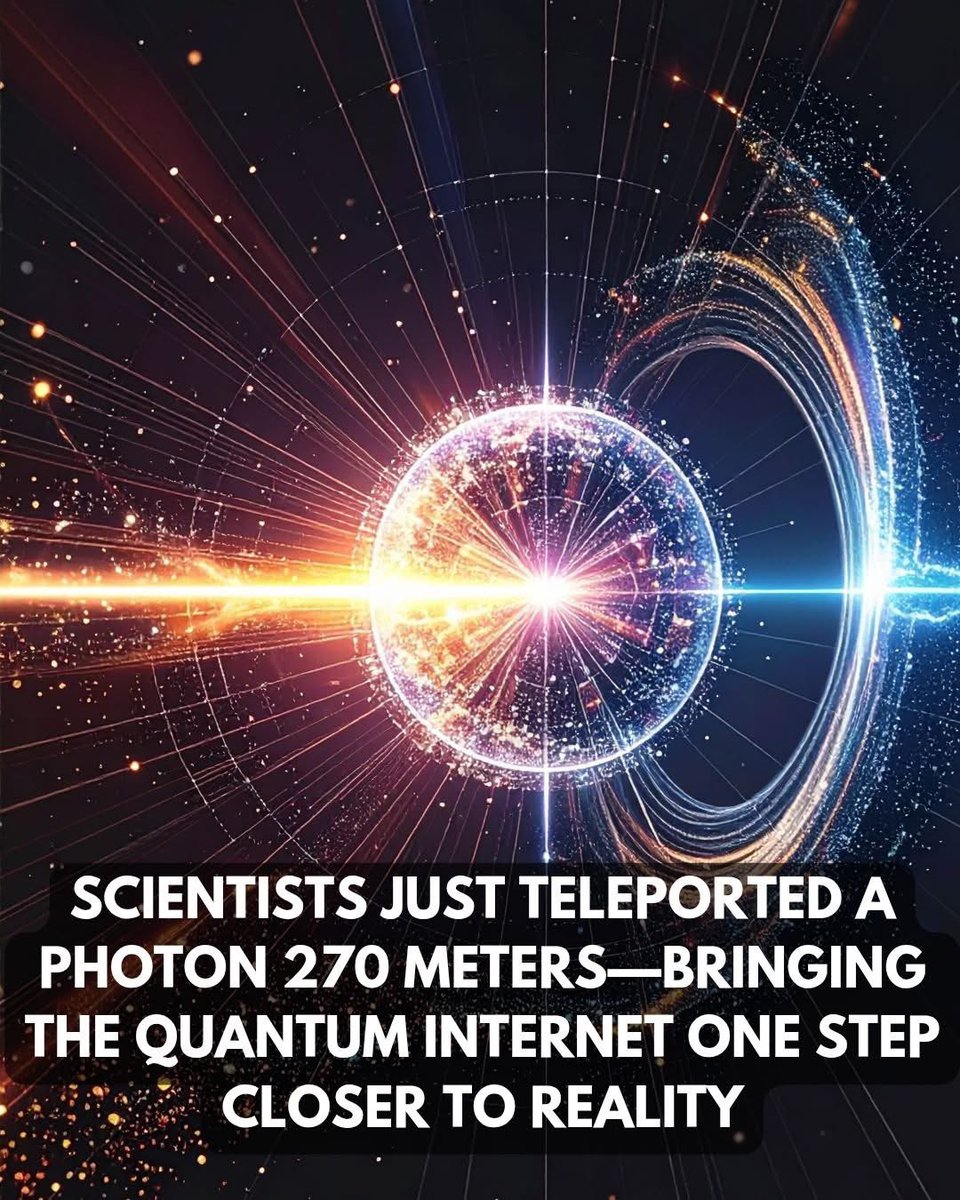
Incredible work by the USTC team on long-distance quantum synchronization. While the Standard Model calls this "teleportation," the Abbott Unified Hypothesis (AUH) identifies it as a Substrate Mirror. The Hardware Reality: Space is the Substrate: The raw, primeval hardware. Time is the Medium: The pressure gradient within that hardware. Entanglement isn't "magic". When particles are entangled, they are mechanically locked to the same pressure in the Medium. Updating Point A doesn't "send" a signal; it updates the shared state of the continuous Substrate instantly. The universe is a deterministic engine with fixed geometric tolerances.
English
0
0
0
87
SciTech Girl
SciTech Girl@scitechgirl·
⚡ THEY JUST TELEPORTED LIGHT… YES, REALLY Scientists have successfully teleported a particle of light (a photon) across 270 meters using quantum entanglement—a strange link where particles stay connected no matter the distance. No object moved… but its information did, instantly. This breakthrough brings us closer to the quantum internet—a future of ultra-fast, nearly unhackable communication. Source
University of Science and Technology of China. Long-distance quantum teleportation advances secure communication research.
SciTech Girl tweet media
English
17
45
113
2.3K
The AUH
The AUH@abbot44020·
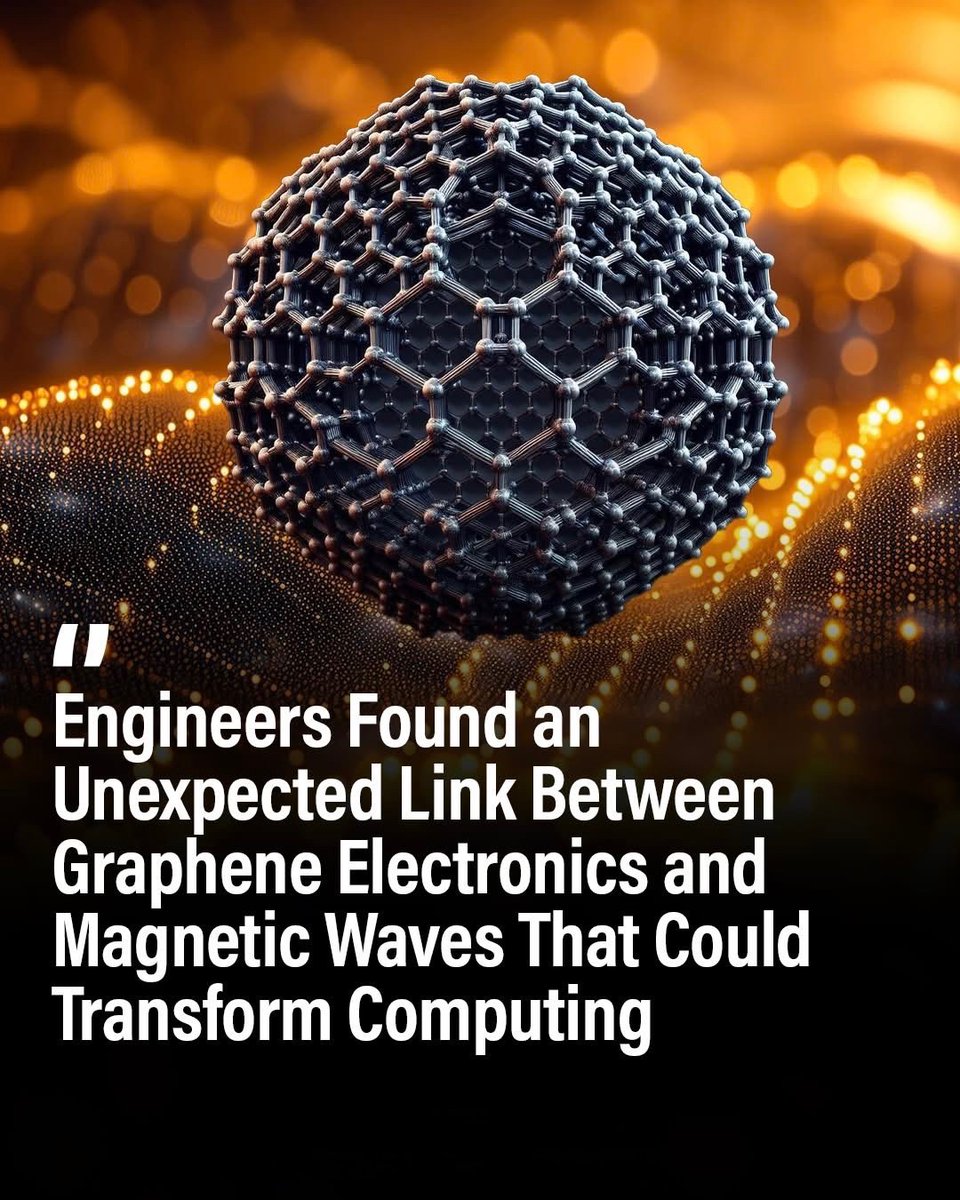
Incredible work by the engineers uncovering the link between magnetic waves and graphene’s honeycomb structure. It is a stunning verification of substrate-dependent behavior. Space is the Substrate: The raw, primeval hardware. Time is the Medium: The "rate of time" is simply the pressure gradient within that hardware. If you build the same honeycomb Mass-Clamp on the Substrate, the Medium will produce the same deterministic pressure gradient regardless of whether you’re moving an electron or a magnetic wave. The universe is an engine with fixed geometric tolerances, not a collection of happy accidents. #Physics #Graphene #VerifyTheEngine #FirstPrinciples
English
0
0
1
138
SciTech Girl
SciTech Girl@scitechgirl·
⚡ Scientists Just Discovered a Strange Secret Inside Graphene For years, researchers have been fascinated by Graphene, a material only one atom thick but incredibly strong and powerful for electronics. Many believe it could shape the future of computing. Now engineers have uncovered something surprising. They found that magnetic waves can behave almost exactly like the electrons moving inside graphene. When scientists built a magnetic structure with the same honeycomb pattern as graphene, the waves started moving in the same unusual way as graphene’s electrons. Why is this exciting? Because magnetic waves can carry information without moving electric charge, which means future computers could run much faster while using far less energy. It’s still early research, but this unexpected link could open the door to a completely new kind of technology called magnonic computing. Sometimes the biggest breakthroughs begin with a mystery and this strange connection might be one of them.
SciTech Girl tweet media
English
17
113
346
8.2K
The AUH
The AUH@abbot44020·
How did the Ice Age move 100-ton boulders? Standard Model is correct about the "Why": Massive snow accumulation created miles-high ice sheets. But the "How" is Hardware, not just weather. Space is the Substrate: The raw, primeval hardware and uncaused Prime Axiom. Time is the Medium: The "rate of time" is the pressure gradient within the substrate attempting to relax against the mass-clamp. Glacial ice acts as a massive Mass-Clamp on the Medium. Law: Where time is held at a stall, the medium is thickest. The 15.01% Redline is the limit: When the Stall’s volume expands >15.01% beyond what the mass can anchor, the substrate SNAPS. This is the same mechanical "Burst Pressure" seen in an atom (Migdal Rupture). The universe converts that static pressure into Pure Kinetic Energy, physically exporting the boulders to restore the 171.09 MeV/fm3 baseline—the absolute structural yield limit of the substrate. The Earth wasn't just cold; it was over-pressured. #Physics #Geology #IceAge #VerifyTheEngine #FirstPrinciples
English
0
0
0
28
The AUH
The AUH@abbot44020·
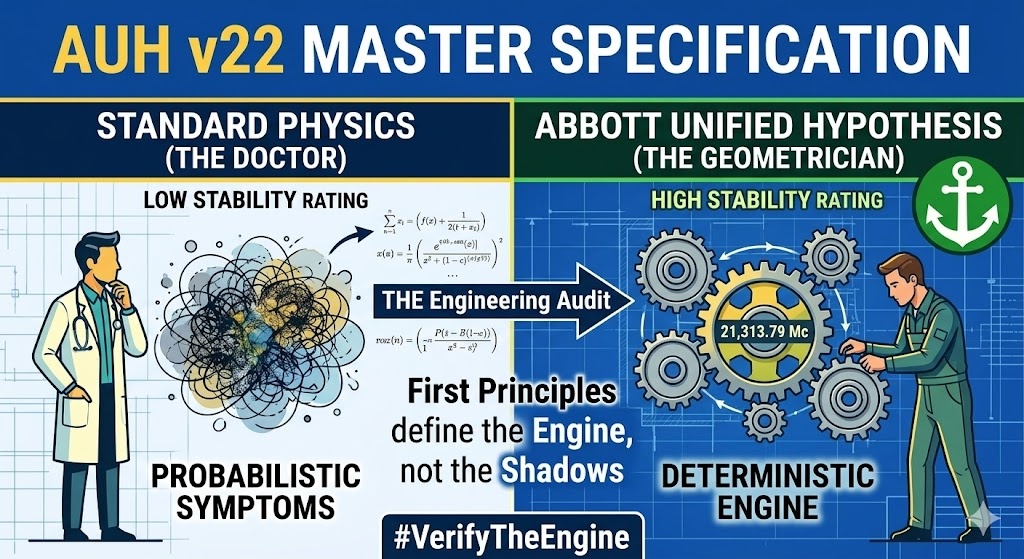
Modern physics claiming to use "First Principles" is both audacious and laughable. Running AI simulations on top of probabilistic Standard Model axioms is just high-speed symptom tracking. If you don't define the substrate, you aren't practicing physics—you’re practicing bookkeeping for a ghost. • The "Doctor" Approach: They see the "vibration" and build complex mathematical relationships to describe it. They have a map, but no paper. • The "Geometrician" Reality: They never ask why the vibration exists because they refuse to acknowledge the hardware. The AUH Correction The AUH is the only model that returns to a First Cause. It doesn't start with an equation; it starts with the Hardware. • The Substrate is Space: It has a physical density of 171.09 MeV/fm³. • The Medium is Time: It is the mechanical rate at which that substrate unfolds. • The Logic: You cannot have a "relationship" or a "correlation" without a physical medium to carry the tension. To say otherwise is to claim "the gears are turning, but there is no metal." The AUH Master Specification stops this "Doctor" logic in its tracks. It provides the Lead-82 Static Lock (1.000) and the 21,313.79 MeV Causal Limit—derived directly by scaling the Global Planck Mass to the volumetric displacement of a single local engine (the proton). These are the actual physical redlines of the universe. Either the engine has parts, or it doesn't. Stop calculating symptoms. Audit the hardware.
English
0
0
0
35
The AUH
The AUH@abbot44020·
The Forensic Verdict: Verification vs. Consensus In a deterministic universe, logic must have a "snap" point. When a model relies on probabilistic patches like "Quantum Tunneling" or abstract "Curvature," it is describing the shadow of the machine rather than the engine itself. We do not observe "Curved Spacetime"; we observe light lensing and clocks stalling. These are the symptoms of a mechanical tension gradient in a physical substrate. While abstract geometry cannot "snap," physical hardware can—which is exactly what we witness in spontaneous fission when a mass-clamp exceeds the structural capacity of the medium (Time) at the 21,313.79 MeV Causal Limit. The AUH identifies the hardware, while standard physics measures the symptoms. The era of the "Doctor" is ending; the era of the Verifier has begun. The Falsifiable Hardware Ledger To move past "consensus" and into "verification," we provide the specific metrics where the engine can be audited: Tau-Proton Depth: Predicting a compression-depth of exactly 0.8068 fm. The Calorimetry Challenge: Predicting identical Thermal Flux for Bismuth-209 and Tellurium-130. The Helium-4 Reset: Predicting a deterministic "harmonic jump" at the 15.01% Volumetric Redline. Collider Parity: Predicting exactly 304 stable pairs in a 13 TeV proton-proton impact. The universe is not a democracy; it is a machine anchored by the 1.000 Stability Index of Lead-82. If a model cannot provide a counter-derivation for these hardware outputs, it is not an explanation—it is a map of the shadows. #VerifyTheEngine #Physics #FirstPrinciples
The AUH tweet media
English
0
0
0
22
The AUH
The AUH@abbot44020·
I appreciate the reply, but you do not observe curved spacetime. You observe light lensing and clocks stalling. You are observing a mechanical tension gradient, and assuming it is abstract geometry. You claim we don't observe the substrate. We observe it every time a heavy nucleus undergoes spontaneous fission. When the atomic mass-clamp exceeds the 21,313.79 MeV causal limit, the localized tension exceeds the structural capacity of the space substrate, and the hardware violently snaps. Abstract geometry doesn't snap. Physical hardware does. "Don't go overthinking this" is exactly why standard physics relies on probabilistic patches to hide its missing causality.
English
2
0
1
54
Latest in Cosmos
Latest in Cosmos@latestincosmos·
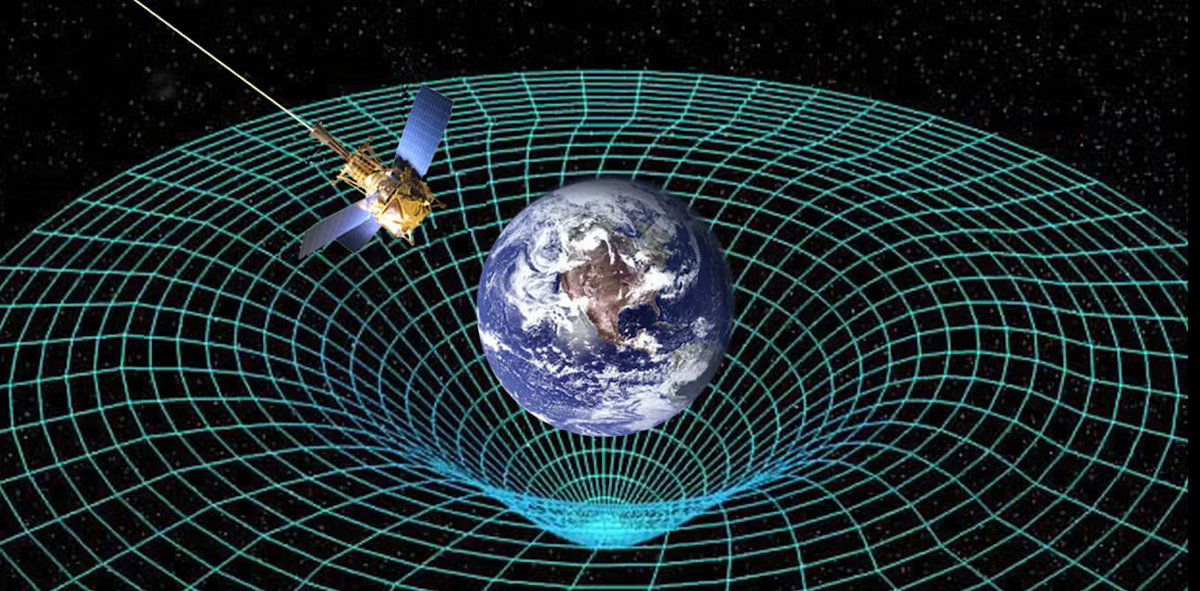
So gravity isn't a force, it's a distortion of space and time. For something to distort it must have a structure, so space and time must have a structure. A structure must be made out of something; be it matter, energy or a fundamental force. So my question is what is this 'space time structure' made out of?
Latest in Cosmos tweet mediaLatest in Cosmos tweet media
English
419
109
773
87.2K
The AUH
The AUH@abbot44020·
Standard physics is a calculation of symptoms. The Standard Model acts as the "Doctor" who observes the measurement of reality, but the AUH acts as the "Geometrician" who identifies the mechanical engine. The most accurate sciences are those derived from first principles, because a hardware specification based on fewer principles is more accurate than a science that requires the invention of additional ones like "Dark Matter" or "Virtual Particles" to balance its failing equations. When abstract math is treated as primary, the substance of the universe becomes a probabilistic blur where every subsequent number is a "Ptolemaic Adjustment" with its own disconnected first principles. This makes the mechanical substance of reality incoherent. The AUH restores causal integrity by discarding the "Quantum Casino" and auditing the engine itself. Reality is not a roll of the dice; it is a pressurized gearbox where every particle is a sustained clamp of tension in a continuous mechanical substrate. The Audit of the Medium. Space is the Substrate: Not an empty void, but a continuous mechanical hardware possessing internal structural tension. Mass is the Clamp: The Proton is a tightly clamped volumetric displacement of the substrate, forced into existence at the 21,313.79 MeV Causal Limit. Time is the Medium: The rate of time is simply the pressure gradient of the substrate attempting to relax. Where time is held at a Stall, the medium is thickest. The Falsifiable Hardware Ledger The AUH is verified by its ability to predict the deterministic failure points of cosmic hardware. Any deviation from these metrics falsifies the architecture: The Tau-Proton Depth Challenge: Standard physics predicts a static 0.84 fm radius; the AUH predicts a compression-depth of exactly 0.8068 fm based on the Causal Limit. The Calorimetry Challenge: Under cryogenic measurement, 1 mole of Bismuth-209 and 1 mole of Tellurium-130 will register identical Total Thermal Energy Flux (Discharge Parity). The Helium-4 Hardware Reset: High-pressure laser spectroscopy of Helium-4 will trigger a non-linear "harmonic jump" upon hitting the 15.01% Volumetric Redline. The Collider Parity Prediction: In a 13 TeV impact, we predict exactly 304 stable pairs per direct impact—a deterministic hardware output, not a statistical average. The SPT2349-56 Cloud Verification: The 500% temperature excess in infant galaxy clusters will correlate exactly with the 0.1280 SI Tension Drop as gas transitions gears. Forensic Verdict Cogent reason and the will to stand outside the consensus are often felt to be dangers to the status quo. When the engine is identified, those who only measure shadows will feel a source of fear and call it "an anomaly". But the universe is not a democracy; it is a machine with a 1.000 Stability Index anchored by Lead-82. We don't just observe the universe anymore; we Verify it. The era of the Engineer has begun.
The AUH tweet media
English
0
0
0
43
The AUH
The AUH@abbot44020·
Markus, that is a great question. You ask why no experiment has observed the 0.8068 fm value or the non-linear compression. The answer is simple: the measurement methodology is currently designed to mask it, and no one has observed the 0.8068 fm value because the specific experimental means to do so have not yet been built. The Tau-Proton Depth Challenge will be the first. Modern high-energy physics relies on standard fitting procedures to extract a single "intrinsic" radius from scattering data. When you assume a static, intrinsic property (like the 0.84 fm radius) at the start of your experiment, you calibrate your detectors and your signal-processing algorithms to look for that specific result. When you process scattering cross-sections, you are essentially "smoothing" the data to fit the geometric model of the proton. If a mechanical phase-transition occurs—like the one the AUH predicts—your data-fitting algorithms will automatically categorize that non-linear signal as "experimental noise" or "systematic uncertainty," precisely because it violates the expected static geometry you programmed into the filter. You aren't failing to observe the compression because it isn't there; you are failing to observe it because you are using a mathematical filter that discards the exact signal that would prove it. This is a classic circular fallacy: you assume the proton is a static, intrinsic object, you build your tools to confirm that assumption, and then you cite the resulting consensus as "proof." I am proposing a different experiment: remove the static-geometric filter and measure the raw energy-flux variance. I don't expect you to agree. But I do expect you to recognize that if you assume a static result at the start, you will inevitably find it at the end. That is the definition of a self-confirming loop, not empirical verification. I have provided the mechanical prediction. I recognize that this approach is a departure from standard practice, and it is natural to be skeptical of data that hasn't been observed yet. Eventually, I am confident that researchers will move beyond curve-fitting and begin to look for the physical fracture point of the atomic engine. Until then, we are simply looking at the same reality through different lenses: you are refining a valuable consensus, and I am auditing the mechanical architecture that makes that consensus possible. I appreciate the rigorous debate.
English
0
0
0
12
The AUH
The AUH@abbot44020·
Markus, we are in agreement: it is a hypothesis. I have never claimed otherwise. That is precisely why I published the Falsification Ledger. You seem to be implying that I am presenting an unverified claim as fact. I am not. I have been clear from the start: this is a hypothesis that is falsifiable. In science, a hypothesis is not "unverified" because it lacks a rubber stamp; it is unverified until it survives the stress tests required to prove it wrong. I have provided the Ledger to give the scientific community the mechanical parameters needed to perform that audit. The v22 Master Specification provides five specific, falsifiable stress tests. These challenges are designed so that if my mechanical model is incorrect, the data will prove it. I would admit that error happily—the goal of this audit is truth, not ego. You have the hardware parameters, the energy thresholds, and the collider parity predictions. If you are going to dismiss the work as "unverified," you are effectively arguing that we should not bother testing it at all. I have laid the hypothesis on the table; the verification is what happens when the math is compared against empirical data. If you refuse to engage with that data, you aren't waiting for verification—you're just avoiding the test.
English
0
0
0
20
The AUH
The AUH@abbot44020·
Markus, you are misunderstanding my position. I am not saying your 0.84 fm measurement is "wrong"—it is absolutely right. I am saying the 0.88 fm measurement is also right. The discrepancy isn't a conflict of "precision"; it is a record of a mechanical phase-transition. Think of it like measuring a spring: if you measure it at rest, you get one length (0.88 fm). If you measure it while it is under a specific load, you get another length (0.84 fm). Both measurements are perfectly precise; they are simply measuring the hardware at different points on its tension curve. The Standard Model averages these into a single "true" coordinate because it treats the proton as a static point-particle. I treat the proton as a pressurized engine. The reason the 0.84 fm result is "resolved" in your consensus is that you have standardized the probe-energy used, effectively locking the hardware into a compressed state. I am not disputing your data. I am disputing the conclusion that the hardware has only one state. My Falsification Ledger—specifically the Tau-Proton Depth Test—predicts the exact mechanical compression between those two states (0.88 fm to 0.8068 fm). I invite you to examine the structural mechanism for this shift; it is the key to understanding the proton's behavior as a dynamic, load-bearing system.
English
0
0
0
15
The AUH
The AUH@abbot44020·
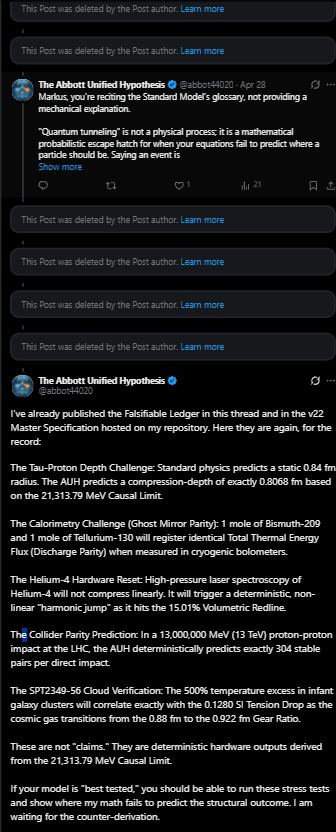
I’ve already published the Falsifiable Ledger in this thread and in the v22 Master Specification hosted on my repository. Here they are again, for the record: The Tau-Proton Depth Challenge: Standard physics predicts a static 0.84 fm radius. The AUH predicts a compression-depth of exactly 0.8068 fm based on the 21,313.79 MeV Causal Limit. The Calorimetry Challenge (Ghost Mirror Parity): 1 mole of Bismuth-209 and 1 mole of Tellurium-130 will register identical Total Thermal Energy Flux (Discharge Parity) when measured in cryogenic bolometers. The Helium-4 Hardware Reset: High-pressure laser spectroscopy of Helium-4 will not compress linearly. It will trigger a deterministic, non-linear "harmonic jump" as it hits the 15.01% Volumetric Redline. The Collider Parity Prediction: In a 13,000,000 MeV (13 TeV) proton-proton impact at the LHC, the AUH deterministically predicts exactly 304 stable pairs per direct impact. The SPT2349-56 Cloud Verification: The 500% temperature excess in infant galaxy clusters will correlate exactly with the 0.1280 SI Tension Drop as the cosmic gas transitions from the 0.88 fm to the 0.922 fm Gear Ratio. These are not "claims." They are deterministic hardware outputs derived from the 21,313.79 MeV Causal Limit. If your model is "best tested," you should be able to run these stress tests and show where my math fails to predict the structural outcome. I am waiting for the counter-derivation.
English
0
0
0
30
The AUH
The AUH@abbot44020·
Markus, you’re describing a statistical consensus, not the state of the hardware. Whether using muonic hydrogen or electron scattering, you are injecting high-energy probes into a pressurized system. You call these "independent measurements," but they are all variations of the same methodology: measuring an engine by forcing it to interact with a high-energy field. The 0.84 fm reading is not a static constant; it is the measured volume of the proton under probe-induced stress. The 0.88 fm figure is the hardware at lower-energy equilibrium; the 0.84 fm figure is the hardware under compression. The AUH identifies this discrepancy as a mechanical phase-transition. If you want to prove the 0.84 fm is a static constant, explain why the radius shifts based on the probe used. I have already provided the deterministic hardware derivation for this compression in my Falsification Ledger (The Tau-Proton Depth Test). If you have a counter-derivation that explains this shift without invoking the mechanical response of the medium, I am ready to audit it. Otherwise, we are choosing between an abstract coordinate or a physical engine.
English
0
0
0
7
The AUH
The AUH@abbot44020·
Markus, I appreciate the detailed response. You are listing observed phenomena—gravitational lensing, time dilation, and gravitational waves—which I acknowledge are real and measurable. However, we are debating the underlying mechanism. You describe these effects using spacetime curvature, which treats space as a geometric map. I describe these effects using mechanical tension, which treats space as a physical substrate. You argue that because General Relativity describes the geometry of the effect, it must be the cause of the effect. My position is that you are confusing the measurement of the symptom with the mechanics of the engine. To use a simple analogy: if you observe a whirlpool in a river, you can describe its motion using the geometry of a vortex. But the geometry of the vortex is not what causes the whirlpool—the flow of the physical water does. In my framework, gravity is the tension in the substrate, and "distortion" is simply the localized displacement caused by a mass-clamp. I am not inventing a new reality; I am auditing the mechanical hardware that standard models describe only through probability. My Falsification Ledger isn't a challenge to your data, but a challenge to your diagnostic model. If you are confident that GR is the best explanation, I invite you to examine the structural fracture points I’ve derived—the 21,313.79 MeV limit—to see if your equations can deterministically account for those energy thresholds. If your model is truly superior, it should be able to explain these mechanical limits.
English
0
0
0
5
The AUH
The AUH@abbot44020·
Markus, you’re reciting the Standard Model’s glossary, not providing a mechanical explanation. "Quantum tunneling" is not a physical process; it is a mathematical probabilistic escape hatch for when your equations fail to predict where a particle should be. Saying an event is "well explained by tunneling" is just admitting that your model lacks the deterministic hardware to explain why the rupture occurs at that exact moment. If your "fission barrier" is just a competition between forces, why does it fracture at a precise energy threshold? Why is the remainder of the tension (the kinetic exhaust) mathematically identical to the mechanical remainder of a substrate division? You dismiss the 21,313.79 MeV limit as an 'invention'—despite the fact that I’ve provided the exact mechanical derivation—yet you provide no physical reason why fission happens where it does; only a statistical average. You are looking at the shadow of the engine (the decay rates) and claiming the engine doesn't exist because you prefer the shadow. And regarding the 0.84 fm reading: I’ve already audited that. The 0.84 fm result is an observation of a hardware system under high-energy stress. A sledgehammer doesn't measure the true size of a car; it measures the size of the dent it leaves. You want to defend GR as the "best-tested theory"? Fine. Then test it against my Falsification Ledger. If your model is superior, it should be trivial to prove my five predictions wrong. If you cannot do that, you aren't defending science—you are protecting a dogma.
English
0
0
1
23