Abhaya Agarwal

23.1K posts

Abhaya Agarwal banner
Abhaya Agarwal

Abhaya Agarwal

@abhaga

Books. Technology. Languages. History. Ideas. Future. In various combinations. @sprintoHQ. @pothidotcom. Traveling with @jayajha.

Bangalore Katılım Mart 2008
2.3K Takip Edilen1.6K Takipçiler
Sabitlenmiş Tweet
Abhaya Agarwal
Abhaya Agarwal@abhaga·
आज़ादी की क़ीमत ख़ून नहीं है। इतिहास के पन्ने मालिकों के नहीं, ग़ुलामों के ख़ून से लाल हैं। आज़ादी की क़ीमत है सर के पीछे उग आयीं दो और आँखें। हवाओं में बहेलिये की आसन्न आहट सुनते हुए कान। हड्डियों में समाती हुई बदनतोड़ अनवरत थकन। abhaga.blogspot.com/2022/08/blog-p…
हिन्दी

1
1
5
0
Abhaya Agarwal retweetledi
Darab Farooqui
Darab Farooqui@darab_farooqui·
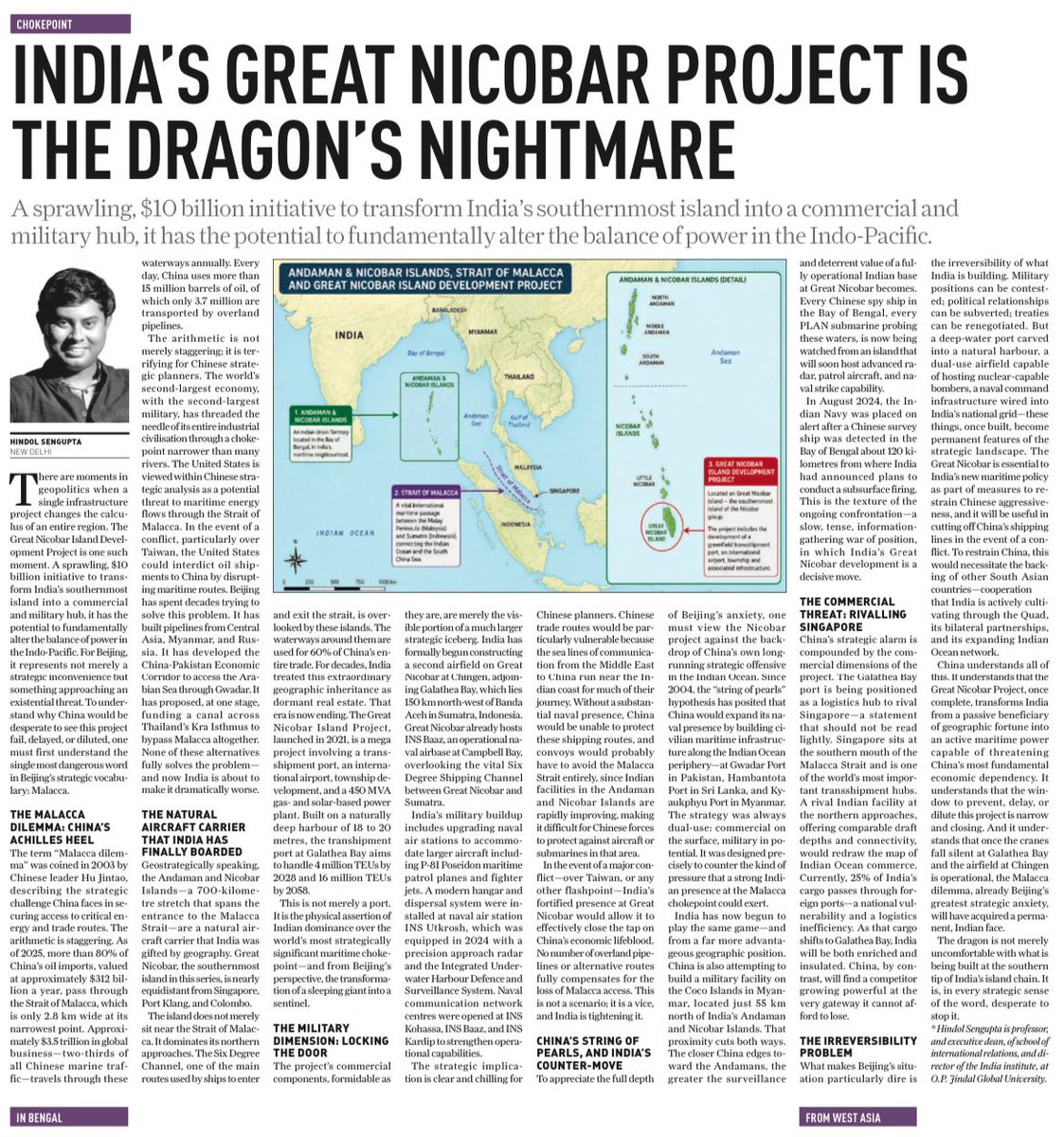
A Satire (of sorts) I want to be clear about what I am. I am a screenwriter. I make up fiction for a living but not as good as Hindol Sengupta. When the Iran-Hormuz war broke out I did what any professionally curious person does. I fell into a rabbit hole. Asymmetric warfare. Drone swarm doctrine. Hypersonic missiles. Precision strike theory. The kind of reading that starts at 11pm and ends with your wife screaming at you at 7 in the morning, asking "Milk finished last night, did you Zepto it?" I am not a strategist. I am not a geopolitician. I have no institutional affiliation, no think tank letterhead, no professorship. And yet. Hindol Sengupta is executive dean at O.P. Jindal Global University's school of international relations. He has the credentials, the platform, and the institutional weight. He published a piece in Sunday Guardian titled: India's Great Nicobar Project is the Dragon's Nightmare. I read it and regretted it instantly. Two to three IQ points, gone. Then the embarrassment set in. Not second-hand. First-hand. I am an Indian. Chinese scholars reading this are not cringing. They are laughing. A kind of self-assured laugh because this piece made them feel safer. Since Iran demonstrated what a determined state can do to a critical maritime chokepoint, a certain kind of Indian commentator has discovered a new hobby: imagining India doing the same to China at Malacca. Sengupta's piece is the most fluent example of this genre. It is confident. It is sweeping. It makes sounds like, and I say this with affection for the form, Dhan ta tan. The dragon is desperate. The vice is tightening. India closes the tap. Dhan ta tan. Two questions lodged in my head as I read it. Just two. I am a screenwriter, not a strategist, so I kept it simple. First: how do you defend a forward island base against a peer adversary with long-range precision strike capability? Second: Iran-Hormuz worked because Iran was operating from its own mainland, with compressed geography and an inexhaustible resupply chain. Does India have anything comparable for an island sitting 1,400 kilometres from the mainland? Sengupta never asks either. His piece moves in one direction only, from geography to complete dominance, the type of dominance kids discuss in class 3 as they buy new cricket bats, without a single sentence about vulnerability or what happens on Day 2. Because if he asked, the answers would destroy his conclusion. Let us start with the word Sengupta uses in his very first paragraph. He calls Nicobar not a strategic inconvenience for Beijing but an existential threat. Existential. The survival of the state. Imagine China in a post-apocalyptic scenario, red sun shining at the horizon, Chinese citizens shuffling around like zombies, their will to live broken by a single Hindol Sengupta op-ed. From an island that currently hosts nothing. Defended by nothing capable of intercepting modern Chinese missiles. Supplied through a single corridor 1,400 kilometres long. I write fiction for a living and even I would hesitate. The tap, the pipe, and the several other pipes Sengupta writes: "India's fortified presence at Great Nicobar would allow it to effectively close the tap on China's economic lifeblood." Malacca handles 82,000 ships a year. It is the busiest shipping lane on earth. Closing it would send global commodity markets into freefall within days. The US, EU, Japan, and ASEAN would be on the phone within a week. India's own economy, which depends on the same lanes, would be screaming within a month. Imagine an 80s policeman in khaki shorts, waving his baton while managing traffic at a red light. That is the visual I got. But leave that aside. Just ask the geographic question. Malacca is not the only door. The Lombok Strait, the Sunda Strait, the Ombai-Wetar passage, all navigable, all viable. These routes add roughly 1,000 to 1,500 kilometres per voyage. Costly. Inconvenient. Not impassable. Closing the tap assumes one pipe. There are several. Hormuz is landlocked on one side. It is literally one pipe. Geography works there. Hindol's common sense doesn't. Iran held Hormuz under maximum pressure sanctions with nothing left to lose. India is a $3.5 trillion economy with global trade ambitions and a non-alignment posture it has spent decades building. Even the fantasy works for weeks at best. Sengupta mentions none of this. The dragon is desperate. Dhan ta tan. Permanent. Like a target. He writes: "These things, once built, become permanent features of the strategic landscape." Yes. Permanent features with fixed coordinates, known infrastructure, and predictable supply corridors. In military terminology this is called a target list. See, I may have forgotten to buy milk, but I learned a few things. He also describes "a dual-use airfield capable of hosting nuclear-capable bombers." The airfield is under construction. It currently hosts nothing. What Sengupta celebrates as permanent is not yet built. And when it is, here is what permanence actually means in 2026, in the world of asymmetric warfare. China's DF-17 hypersonic glide vehicle travels at Mach 5 to Mach 10, maneuvers to evade interception, and has been confirmed accurate to within meters of a stationary target. It is simply hard to understand what Mach 10 is. Let me put it in simple terms. For the fastest things we use the metaphor of a bullet. It went like a bullet. The fastest commercially available bullet travels at around Mach 3.8. We are talking Mach 10 here. That is nearly thrice the speed of the fastest bullet. Your brain cannot fathom this speed at close range. At a comfortable distance, Hindol can write this piece and enjoy moderate intellectualism. No currently deployed Indian system credibly intercepts it. Not S-400, which was not designed for this threat. Not the DRDO ballistic missile defense program, which is designed for slower trajectories and years from deployment at a remote island anyway. You do not need a large warhead when your target has known coordinates and cannot move. Iranian missiles that threatened Hormuz were fast. China's are a different category entirely. A screenwriter who spent three weeks reading about this knows it. Apparently, a professor of international relations does not. The vice with one jaw Sengupta uses the metaphor of a vice, India tightening it around China's Malacca dependency. A vice requires both jaws to be secured. Hindol possibly has a missing jaw and is on a liquid diet, so he doesn't understand how grinding or locking works. India's other jaw: no hypersonic intercept capability, a submarine fleet that cannot credibly deny these waters to Chinese strike assets, a single resupply corridor 1,400 kilometers long that is itself a target. China doesn't need to contest the island. It severs the supply chain. Mines the corridor. Hits Port Blair's fuel infrastructure. Nicobar doesn't fall. It ends up in a wheelchair, writing sad poetry about being left alone. But the vice tightens. Because Hindol said so. Dhan ta tan. Desperate? Try the trade deficit. Sengupta writes China is "desperate to stop" the Nicobar project. Desperate. If China is truly desperate, it has an instrument it hasn't bothered to use yet. India imports over $100 billion annually from China. Pharmaceutical APIs. Electronics. Solar components. Industrial machinery. Inputs that Indian manufacturing cannot replace in any realistic timeframe from any alternative source. China does not need missiles to hurt India. It needs an export ban. You don't need a knife to scoop things; you need a spoon. Elementary, dear Sengupta. The supposedly desperate adversary holds India's supply chains in its hand and hasn't squeezed. That is not desperation. That is a country that knows it has options and is in no hurry to use them. What India actually has, and what is being destroyed to get it. What India has at Nicobar is a peacetime traffic signal. What Sengupta describes is a wartime weapon. He never explains how one becomes the other. That gap, between a flag planted on strategic geography and an operational military capability that can survive an adversary's first strike, is the entire argument he failed to make. I know this is a satire, but I am losing my sense of humor now. But seriously. A UNESCO-recognised biosphere is being destroyed. The last significant leatherback sea turtle nesting ground in the Indian Ocean is disappearing. The Shompen tribe, one of India's most isolated indigenous communities, is being displaced. Concerns raised formally by scientists, including the former ISRO chairman who chaired the original environmental committee, have been ignored just as formally by the government. Dead turtle babies are not funny. Destroyed ecosystems are not funny. Green vanishing from satellite images is never funny. So, no satire here. Sengupta mentions none of it. The dragon is desperate. We won, na na na na na. Who is this really for? Indian strategic commentary of this kind is essentially melodrama. Written to make a particular reader feel that the country's rise is inevitable, that adversaries are scared, that geography is destiny. The gap between the story and reality has a way of closing. Usually at the worst possible moment. Posturing is great if you are Dharmender. Not when you are Arun Govil. But Sengupta's piece is something more specific than cheerleading. This is a professor using institutional credibility to dress up ruling party talking points as strategic analysis. This is a clown dressed in a business suit with a detachable red nose. The Great Nicobar project is a government priority. The narrative that it terrifies China is government myth-making. Sengupta delivers both, fluently, without a single uncomfortable question. Sengupta is a Sarkari bard singing Sarkari narrative in op-ed form. This is how the ecosystem works. You don't need a cheque. You need a conclusion the regime finds useful. The professorship follows. If you are going to be a sycophant, at least construct an argument that survives basic scrutiny. As they say, even if you sing a bad song, at least make the words rhyme. At least ask how the base gets defended. At least reckon with the hypersonic threat. Build a case worth taking seriously before you expect to be taken seriously. I am a screenwriter. I fell into a rabbit hole after a war broke out. I spent a few weeks reading things I had no professional reason to read. And I came away with more questions about this project than a professor of international relations apparently thought to ask. That is funny, in a way. Because it is not even intelligence. It is common sense. It stops being funny when you remember that this writing shapes policy expectations, budget allocations, and diplomatic postures. That the gap between the story and the reality is not just an intellectual embarrassment. It is a strategic liability. That is not a professor's failure. That is a propagandist's occupation. None of you probably laughed reading this satire. I understand. But I can guarantee you one thing. Every Chinese analyst and scholar who read Hindol's op-ed was laughing. He set out to frighten them. He ended up entertaining them. Which makes him funnier than me, despite trying his very best to be the exact opposite.
Darab Farooqui tweet media
English
33
102
240
19.9K
Abhaya Agarwal retweetledi
Malay Krishna
Malay Krishna@Malay4Product·
Let me explain what just happened today because it deserves so much recognition. GalaxEye is a Bengaluru startup founded in 2021 by IIT Madras engineers. Today they launched Mission Drishti on a SpaceX Falcon 9. It is India's largest privately built satellite at 190 kg. And it carries a technology that no commercial satellite has ever carried before. Normal satellites take photos of the Earth using optical cameras. Like your phone camera, but from 500 km up. The problem is obvious. Clouds. Night. Fog. Smoke. If any of these are in the way, the photo is useless. India has monsoon cover for 4 months a year. That is 4 months where optical satellites are partially or fully blind over large parts of the country. The alternative is SAR. Synthetic Aperture Radar. Instead of taking photos with light, it sends radar waves down and reads what bounces back. Radar goes through clouds, through darkness, through smoke. A SAR satellite can image a flooded village at 2 AM during a cyclone when no optical satellite can see anything. The problem with SAR is that the images look nothing like photos. They look like grainy black-and-white radar maps. A military analyst or a trained geospatial engineer can read them. A farmer, a disaster response team, or a city planner cannot. Until today, if you wanted both optical and SAR data for the same location, you needed two different satellites, passing over at different times, at different angles. Then someone had to manually align and fuse the two datasets. Expensive, slow, and the data never perfectly matched because the satellites saw the same spot minutes or hours apart. GalaxEye put both sensors on one satellite. Optical and SAR, fused into what they call OptoSAR. Three times more information than a single sensor. Processed onboard by an NVIDIA AI chip at 1.8 metre resolution. Now in practice, during the next cyclone hitting Odisha, one satellite pass gives you a clear image of which villages are flooded, which roads are cut, and which buildings are standing. Day or night. Cloud or clear. In near real-time. For defence, it means you can monitor a border area 24/7 regardless of weather. For agriculture, it means tracking crop health across an entire monsoon season without a single cloud gap. For infrastructure, it means monitoring construction progress on highways and bridges without waiting for a clear day. GalaxEye tested their SAR tech on ISRO's POEM orbital platform. The satellite was tested at ISRO facilities. IN-SPACe provided regulatory clearance. NSIL, ISRO's commercial arm, will distribute the imagery globally. And it launched on SpaceX because ISRO's PSLV doesn't have the right orbit slot for this mission. Yes, four IIT Madras graduates built a world-first satellite in 4 years in Bengaluru. Take a bow!
Tejasvi Surya@Tejasvi_Surya

A Bengaluru startup just did something no one in the world has ever done, put a satellite in orbit that sees through clouds, through the night, with optical sensor and SAR fused into one. Many many congratulations to the @Galaxeye team on the launch of Mission Drishti! This is exactly why PM Sri @narendramodi opened up the space sector, so young Indians could build an audacious future for the nation.

English
110
2.3K
9.7K
467.5K
Abhaya Agarwal retweetledi
West Bank Notifications
West Bank Notifications@WestBankNotice·
🚨 Israeli forces arrested five Palestinian children while they were gathering wild plants near the Havat Ma’on settlement south of Hebron in the southern West Bank, following incitement by settlers.
English
1.4K
14.4K
18.2K
549.8K
Abhaya Agarwal retweetledi
Jaya Jha
Jaya Jha@jayajha·
For most of my life, Christianity sat neatly in my head as a “Western” religion. Then Cappadocia, Şanlıurfa/Edessa, Kerala, Egypt, Ethiopia, and Constantinople made that mental map look rather suspicious. Christianity: The religion of the East. jayajha.wordpress.com/2026/05/01/chr…
English
0
1
3
132
Abhaya Agarwal retweetledi
ashwini asokan
ashwini asokan@LadyAshBorg·
The Internet always comes through!! Best.
ashwini asokan tweet media
English
0
11
116
3.7K
Abhaya Agarwal retweetledi
aaron
aaron@aarondotdev·
feels like AI is 10xing too many -1x developers
English
53
127
3.2K
140.3K
Abhaya Agarwal
Abhaya Agarwal@abhaga·
@VicVijayakumar Matches my experience! Asked it focus the tests on preventing regression, and 3000 lines of tests being added dropped. And remaining tests actually made sense!
English
1
0
1
716
Vic 🌮
Vic 🌮@VicVijayakumar·
Started being actively involved again and treating the AI like it’s an adversary and I got my groove back. So- I tell the agent in a terminal what I want it to do. I go make a latte. When I come back it's generated about 800 lines of code with passing tests. This would have taken me hours. I open up an IDE to look at the files. I tell the agent it’s an idiot. I ask what the fuck it's doing, it’s making some stupidass overly defensive assumptions. "You're right to question me." It deletes 400 lines. I keep reading. I ask more questions. "I made incorrect assumptions." We're down to 200 lines. I run an ai code review. The reviewer agent identifies a bunch of issues that sound very bad. Instead of telling the agent to handle it I read and reject them outright. None of this shit will happen because despite all the context you’ve been given you don’t actually understand distributed systems. Final PR is 190 lines, including tests. This looks good. You are much better when I remember you're just autocomplete than when we both pretend you’re intelligent.
Vic 🌮@VicVijayakumar

I'm now able to tell my agent “we are going to work on JIRA-1234” and it goes and pulls down the task, makes me a plan, I say yeah okay that looks good, and it generates the commit. I run an AI review from a different session, it finds 4 issues of varying priorities, I paste it to my original agent and say validate these findings and fix them if necessary, it creates a fix, I run another review, no more high priority issues found. I open up the code in an IDE to go over it before pushing it up for human review. Looks fine I guess, nothing crazy. I try to understand everything before I push it up for review because if this breaks, it's still my name on it. I say why did you make this one change, it gives me a reasonable explanation for why. It says something codebaity like "if you want I can suggest 2 more ways you could really tighten up this work to prevent some rare but possible regressions". I'm smart enough to not fall for it. Code pushed up, task moved to in-review. I didn't write any of it, this is not my accomplishment. Users won't care who wrote it if it works. A lot done in 20 mins but it felt soulless.

English
12
7
230
28.5K
Abhaya Agarwal retweetledi
PunsterX
PunsterX@PunsterX·
Kahan milega itna content?? 🤣 Madhya Pradesh CM Mohan Yadav launched a Kisan Helpline number yesterday, at an event for farmers in Bhopal. He made a demo call to the number himself and asked a simple question. The voice on the other side replied - "For your information, we don't have the information at the moment."
English
132
1.4K
5.1K
188.7K
Abhinav Bharat 🇮🇳
Abhinav Bharat 🇮🇳@GoldDusters·
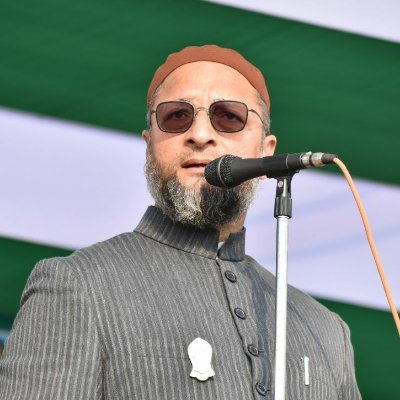
@asadowaisi Hindu, Jain, Parsi, Jews do not ask for special rates, discounts or rebates from govt when visiting holy place. What is special about Muslims that they want state to pay or ensure discounts? Unlike Muslim zakat Hindu have no funds. Why is this favouritism? Hindu never begged!
Abhinav Bharat 🇮🇳 tweet mediaAbhinav Bharat 🇮🇳 tweet media
English
27
20
93
74.1K
Asaduddin Owaisi
Asaduddin Owaisi@asadowaisi·
The Haj Committee is demanding an additional ₹10,000 from Haj pilgrims as “differential airfare.” This is despite collecting ₹90,844 per pilgrim a couple of months ago departing from Mumbai Embarkation Point. This is almost DOUBLE the prevalent rates for individual travellers. Are pilgrims being punished for going through the Haj Committee? This is just exploitation and nothing else. Most pilgrims are not wealthy, they save money for years to be able to go to Haj. This is not a luxury for them. The circular must be withdrawn immediately, and the pilgrims must be refunded the money taken from them @kirenrijuju @RamMNK
Asaduddin Owaisi tweet media
English
484
1.5K
4.3K
209.4K
Abhaya Agarwal
Abhaya Agarwal@abhaga·
We will know code really is cheap not when tons of it is merged but when tons of it is left to rot in the same branch where it was written because there would be zero incentive to merge anything subpar.
English
0
0
1
54
Abhaya Agarwal retweetledi
Mandeep Punia
Mandeep Punia@mandeeppunia1·
वरिष्ठ पत्रकार और जनबुद्धिजीवी सत्यम वर्मा की गिरफ्तारी अन्यायपूर्ण है. यूएनआई की हिंदी सेवा 'यूनीवार्ता' के पूर्व संपादक वर्मा को नोएडा में हुए मज़दूरों के आंदोलन में शामिल होने का आरोप लगा 17 अप्रैल को लखनऊ के जनचेतना बुकस्टोर से गिरफ़्तार किया गया था. उन्होंने कई किताबों का अनुवाद किया है, जिनमें 'भगत सिंह के साथियों के संपूर्ण उपलब्ध दस्तावेज़' भी शामिल है. इसके अलावा वर्मा कई प्रगतिशील समूहों से जुड़े हुए हैं. वह इतिहासकार लाल बहादुर वर्मा के बेटे हैं. उन्हें तुरंत रिहा किया जाना चाहिए.
Mandeep Punia tweet media
हिन्दी
14
284
660
19.6K
Abhaya Agarwal retweetledi
Piyush Rai
Piyush Rai@Benarasiyaa·
65 government employees who have been appointed on election duty in the West Bengal assembly election 2026 but their names have been deleted from electoral rolls during SIR. Mohammed Tohidul Islam Swati Mollah Nazma Parvin Abdul Rouf Shamim Bulbul Hasan Alaijddin Mallick Ajijul Hoque Molla Monir Suman Kazi Wazid Ali Zaheerul Islam Md Iqbal Hossain Abdul Wahid SK Samurul Islam Md Aurangzeb Owesmin Banu Salim Sheikh Md Rabibul Islam Majkura Khatoon Tohibulla Mallick Ayen Mallick Md Ahmed Hussain Mondol Akbar Ali Rakibul Islam Anikul Islam Abdul Azeem SK Azizur Rahman Bashiruddin Ahmed Samirul Islam Md Abul Kashem Shahina Imteyaz Moumita Yasmin Nurul Hassan Abul Hasnat Jahangir Hossain Jiarul Hoque Barkatulla Molla Sirajul Islam Asarof Mondol Md Habibur Rahman Khan Serajul Islam Md Rabiul Awal Md Nur Islam Ujir Hossain Md Tajuddin Ahmed Abu Baker Siddique Sahadat Hossain Abdur Rahman Sarkar Ariful Molla Shamshad Alam Golam Mowla Sarkar Md Abul Hanif Sheikh Mst Sharifa Khatun Md Soleman SK Jakir Ahammed Abdul Kuddus Nurkalam Mian Ansarul Hoque Md Mehdi Hasan Firoz Ali Md Sahidul Islam Rubiya Yasmin Ruksena Khatun Md Sarwar Hossain Md Abul Kalam Azam
English
31
488
880
42.3K
Abhaya Agarwal retweetledi
Swanand
Swanand@_swanand·
My preference for sync and async discussions have flipped 180°. I no longer favour receiving written documentation. Instead, talking, either on a call or better, in person, is 100x more effective. What used to be in neat tidy one pager, what used to force people to think, which is the process of writing, has now turned into a lazy process where people scribble something into the AI prompt and send you garbage.
English
36
50
904
47.6K
Abhaya Agarwal retweetledi
Anish Moonka
Anish Moonka@anishmoonka·
Humans tried to tame horses 5,500 years ago. It didn't work. Those horses eventually went feral, and we had to start over 1,300 years later with a different bloodline. A group in Kazakhstan called the Botai kept horses for milk and meat around 3500 BCE. A 2021 Nature study read the DNA of 273 ancient horses and proved every horse alive today comes from a different population entirely. The successful domestication happened 4,200 years ago near the Volga and Don rivers. Those horses spread across Asia and Europe in 500 years, wiping out every other horse bloodline. Two tiny changes in horse DNA made it work. One mutation appeared about 5,000 years ago and made horses less jumpy. The other came 4,200 years ago and gave horses backs strong enough to carry a grown person; before that, they were the size of ponies. This is why chariots came first as the main use of horses, and regular horseback riding only became common centuries later. Before rideable horses reached the Middle East, the Sumerians made their own by crossbreeding domesticated donkeys with wild onagers, a wild Asian cousin of the donkey. Onagers can hit 43 mph and hold 31 mph for hours, with more endurance than any modern racehorse. But they bite, kick, and can't be trained. So Sumerians made a hybrid called a kunga, which kept the speed and dropped the temper. A kunga cost 40 times a donkey. It couldn't breed, so every generation had to be made fresh. These pulled the war wagons shown on the Standard of Ur, a Sumerian mosaic from 2500 BCE. It's the first known case of humans creating a new animal. Zebras are the longest-running failure. Romans raced them in chariots during the emperor Caracalla's reign, around 200 AD. The Dutch tried in the 1700s. Walter Rothschild even drove a zebra carriage up to Buckingham Palace in the 1890s to prove the point. Germans gave it a shot in colonial East Africa. None of it worked. Zebras dodge lassos with a quick ducking reflex, have no hierarchy you can slot into, and have spent millions of years evolving alongside lions. A single kick can break a lion's jaw. Jared Diamond ran the math on this. Out of roughly 148 large mammal species humans could have tamed, only 14 ever worked. The animal has to pass six separate tests: eat flexibly, grow fast, breed in a pen, stay calm, not spook easily, and follow a pack order. Miss one and the whole thing collapses. The earliest confirmed horse riders were the Yamnaya, a nomadic steppe people from north of the Black Sea. They left behind skeletons showing the specific hip damage and healed fall injuries you see in modern riders. Out of 156 adult skeletons studied, only 24 had the pattern. Even inside a horse-riding culture, most people still walked.
Jum@JesterJum

How many animals did humans have to try and ride before we found out horses were cool with it?

English
84
1.6K
11.1K
997.9K
Abhaya Agarwal retweetledi
Dinesh Wadera
Dinesh Wadera@dineshwadera·
India is heating up at an alarming rate. Look at global temperature trends, our cities are consistently ranking among the hottest, 95 out of 100 world hottest cities are in India. This isn’t just “weather.” It’s the result of choices. Deforestation, unchecked construction, loss of green cover, destruction of natural buffers like the Aravallis, forests in Jharkhand and Chhattisgarh, tree cutting in Nashik, and dilution of environmental safeguards, all in the name of “development.” When people said Save Aravalli, Save Aarey Forest, Save Dehing Patkai, Save Hasdeo, they were ignored or silenced by BJP. Now we’re living the consequences: Hotter cities. Poorer air. Declining livability. “Concrete-led development” without ecological balance is not progress, it’s a long-term disaster. The real question is: Who is accountable for weakening environmental protections and pushing projects at the cost of forests and public health? Why don’t we question Modi ji and his business conglomerate for making India as non-liveable third world land? And more importantly, why is this still not a central political issue?
Dinesh Wadera tweet media
English
126
735
1.6K
59.1K