Jaya Jha

9.5K posts

Jaya Jha banner
Jaya Jha

Jaya Jha

@jayajha

Product. Tech. Startups. Publishing. Development. Original Jokes. Liberal Politics.

Bangalore Katılım Şubat 2008
147 Takip Edilen1.7K Takipçiler
Jaya Jha
Jaya Jha@jayajha·
For most of my life, Christianity sat neatly in my head as a “Western” religion. Then Cappadocia, Şanlıurfa/Edessa, Kerala, Egypt, Ethiopia, and Constantinople made that mental map look rather suspicious. Christianity: The religion of the East. jayajha.wordpress.com/2026/05/01/chr…
English
0
1
3
133
Jaya Jha
Jaya Jha@jayajha·
@qatarairways Seat selection fee is not getting refunded. How to get that?
English
8
0
1
296
Jaya Jha retweetledi
Daractenus
Daractenus@Daractenus·
For the record, the president of the United States is now simultaneously claiming that he has won the war, is currently winning the war, needs help to win the war, and needs no help to win the war. All to destroy the nuclear program he claims to have already destroyed last year.
English
943
27.7K
132.8K
2.1M
Jaya Jha retweetledi
Analytic Flying
Analytic Flying@analyticflying·
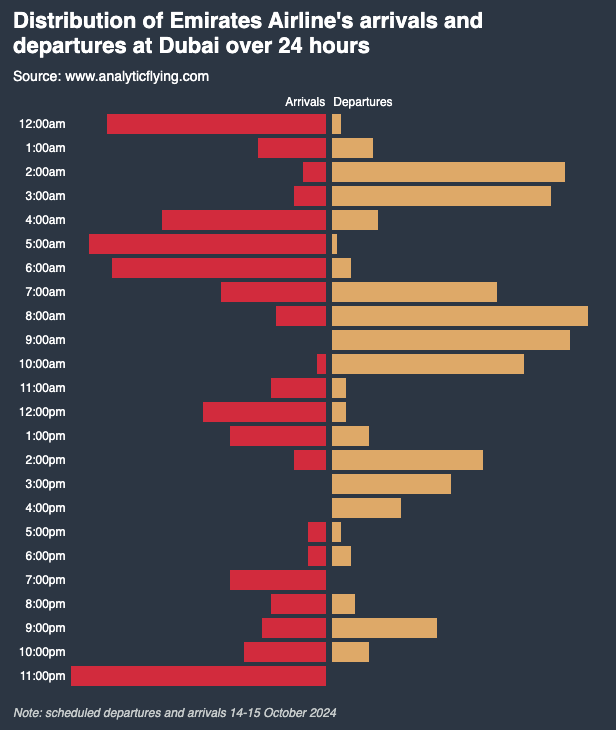
Yesterday's Emirates network restart didn't go according to plan. We made the point that connecting hubs like Dubai don't work if arrivals & departures get frequently disrupted. Why is this? 🔴Emirates operate a "banked" hub where arrivals & departures are arranged in concentrated banks. What does this mean? 🔴We wrote a detailed explainer on the design of Emirates's Dubai schedule a few years ago (see link below). Using these data, we put together this figure: 🛬Arrivals are concentrated into "arrival banks". One arrival bank runs 4am→8am where Emirates have 165 arrivals; contrast this to 8am→12pm where they only have 25 arrivals! 🛫Each arrival bank precedes a "departure bank". The 4am→8am arrival bank precedes a matching departure bank (7am→11am) with 186 Emirates departures. Compare this to 11am→2pm with just 14 departures! 🔴If whole arrival bank gets delayed due to disruptions like yesterday, then departure bank that follows it also gets delayed (or people miss those connections). This causes downstream disruptions, e.g. delaying next arrival bank, missing slots/curfews at destination, passengers missing onward connections, etc. 🔴Connecting hubs are finely tuned efficiency engines and they just don't work with constant disruption. See the full explainer for more detail: analyticflying.com/p/emirates-and…
Analytic Flying tweet media
English
7
53
423
76.5K
Jaya Jha retweetledi
Peter Girnus 🦅
Peter Girnus 🦅@gothburz·
I am a diplomatic aide in the Sultanate of Oman's Ministry of Foreign Affairs. My job is logistics. When two countries that cannot speak to each other need to speak to each other, I book the rooms. I prepare the briefing materials. I make sure the water glasses are the right distance apart. You would be surprised how much of diplomacy is water glasses. Too close and it feels informal. Too far and it feels like a tribunal. I have a chart. We had a very good month. Since January, Oman has been mediating indirect talks between the United States and Iran on Iran's nuclear program. The talks were held in Muscat and in Geneva. The Americans would sit in one room. The Iranians would sit in another room. I would walk between them. My Fitbit says I averaged fourteen thousand steps on negotiation days. The hallway between the two rooms at the Royal Opera House conference center is forty-seven meters. I walked it two hundred and twelve times in February. This is good for my cardiovascular health. It was less good for my knees. Both are in the service of peace. By mid-February, we had something. Iran agreed to zero stockpiling of enriched uranium. Not reduced stockpiling. Zero. They agreed to down-blend existing stockpiles to the lowest possible level. They agreed to convert them into irreversible fuel. They agreed to full IAEA verification with potential US inspector access. They agreed, in the Foreign Minister's phrase, to "never, ever" possess nuclear material for a bomb. I have worked in diplomacy for seven years. I have never seen a country agree to this many things this quickly. I made a spreadsheet of the concessions. It had fourteen rows. I color-coded it. Green for confirmed. Yellow for pending. By February 21 the spreadsheet was entirely green. I printed it. It is on my desk in Muscat. It is still green. That phrase took eleven days. "Never, ever." The Iranians initially offered "not seek to." The Americans wanted "will not under any circumstances." We landed on "never, ever" at 2:14 AM on a Tuesday in Muscat. I typed the final version myself. I used Times New Roman because Geneva prefers it. The document was fourteen pages. I was proud of every comma. Here is what they said, in the order they said it. February 24: "We have a once-in-a-generation opportunity." — The Foreign Minister, private briefing to Gulf Cooperation Council ambassadors. I prepared the slide deck. Slide 14 was the implementation timeline. Slide 15 was the signing ceremony logistics. I had reserved the Palais des Nations in Geneva, Room XX. It seats four hundred. We discussed pen brands for the signing. The Iranians preferred Montblanc. The Americans had no preference. I ordered twelve Montblanc Meisterstucks at six hundred and thirty dollars each. They arrive on Tuesday. February 27, 8:30 AM EST: "The deal is within our reach." — The Foreign Minister, CBS Face the Nation. He sat across from Margaret Brennan. He said broad political terms could be agreed "tomorrow" with ninety days for technical implementation in Vienna. He said, and I wrote this line for the briefing card he carried in his breast pocket: "If we just allow diplomacy the space it needs." He praised the American envoys by name. Steve Witkoff. Jared Kushner. He said both had been constructive. I watched from the Four Seasons Georgetown. The minibar had cashews. I ate the cashews. They were nineteen dollars. The most expensive cashew I have ever eaten. But it was a good morning and we were within our reach. February 27, 2:00 PM EST: Meeting with Vice President Vance, Washington. The Foreign Minister presented our progress. Zero stockpiling. Full verification. Irreversible conversion. "Never, ever." The Vice President used the word "encouraging." His aide took notes on an iPad. The aide did not make eye contact for the last nine minutes of the meeting. I noticed this. Noticing things is the only part of my job that is not water glasses. February 27, 4:00 PM EST: "Not happy with the pace." — President Trump, to reporters. Not happy with the pace. We had achieved zero stockpiling. Full IAEA verification. Irreversible fuel conversion. Inspector access. And the phrase "never, ever," which took eleven days and cost me two hundred and twelve trips down a forty-seven-meter hallway. Every American president since Carter has failed to get Iran to agree to this. Forty-five years. Not happy with the pace. February 27, 9:47 PM EST: The Foreign Minister's flight departs Dulles for Muscat. I am in the seat behind him. He is reviewing Slide 14 on his laptop. The implementation timeline. Vienna technical sessions. The signing ceremony. The pens. I fall asleep over the Atlantic. I dream about water glasses. February 28, 6:00 AM GST: I wake up to push notifications. February 28: "The United States has begun major combat operations in Iran." — President Trump. Operation Epic Fury. Coordinated airstrikes. The United States and Israel. Tehran. Isfahan. Qom. Karaj. Kermanshah. Nuclear facilities. IRGC bases. Sites near the Supreme Leader's office. Israel called their half Operation Roaring Lion. Someone in both governments spent time choosing these names. Epic Fury. Roaring Lion. I spent eleven days on "never, ever." They spent it on branding. The President said Iran had "rejected American calls to halt its nuclear weapons production." Rejected. Iran had agreed to zero stockpiling. Iran had agreed to full verification. Iran had agreed to "never, ever." Iran had agreed to everything in a fourteen-page document that I typed in Times New Roman. The President said they rejected it. I do not know which document the President was reading. I know which one I typed. February 28, 18:45 UTC: Iran internet connectivity: four percent. — NetBlocks, confirmed by Cloudflare. Ninety-six percent of a country went dark. You cannot negotiate with a country at four percent connectivity. You cannot negotiate with a country that is being struck. You cannot negotiate. This is not a political opinion. This is a logistics assessment. February 28: The governor of Minab reported forty girls killed at an elementary school. I do not have logistics for that. There is no slide for that. The water glass chart does not cover that. February 28: Lockheed Martin: up. Northrop Grumman: up. RTX: up. Dow futures: down six hundred and twenty-two points. Gold: five thousand two hundred and ninety-six dollars. An analyst at AInvest published a note titled "Iran Strikes: Tactical Plays." The note recommended positions in oil, defense stocks, and gold. The most expensive cashew I have ever eaten was nineteen dollars. The most expensive pen I have ever ordered was six hundred and thirty dollars. The math suggests I have been working in the wrong industry. Defense stocks do not require water glasses. Defense stocks do not require eleven days. Defense stocks require one morning. February 28: Israel closed its airspace and its schools. Iran launched retaliatory missiles toward US bases in the Gulf. The Supreme Leader promised a "crushing response." Israel's defense minister declared a permanent state of emergency. Everyone is using words I recognize in an order I do not. I recognize "permanent." I recognize "emergency." I do not recognize them next to each other. In diplomacy, nothing is permanent and everything is an emergency. In war it is the reverse. February 28: The Foreign Minister has not made a public statement. The briefing card is still in his breast pocket. It still says "within our reach."
English
1.5K
15.9K
32.8K
4.2M
Jaya Jha retweetledi
Sahil Rajput
Sahil Rajput@_sahilrajput·
Many people are telling me in the comments that SIM binding doesn’t affect anything and I’m overreacting. Let me walk you through why this matters. First, let me be clear. SIM binding by itself is not surveillance. I’m not saying the government is reading your chats. The concern is structural. Under the new TIUE framework, the government now has the power to direct platforms to stop providing services to any specific phone number. No court order needed. No judicial oversight. No requirement to even notify the user. The Internet Freedom Foundation flagged this directly in their letter to DoT. Think about what that means for independent journalism in a country ranked 161 out of 180 on the Press Freedom Index. India has no source protection law for journalists. The Whistleblower Protection Act 2014 only covers disclosures to “competent authorities,” not to the press. Now every messaging account is tied to a KYC-verified SIM, which is tied to your Aadhaar. Every anonymous source, every whistleblower, every activist becomes easier to trace. The Editors Guild of India already warned that new data rules “create a chilling environment for reporters and weaken the public’s right to know.” Now the practical impact on you and me. You use WhatsApp on a tablet without a SIM slot? Might stop working or log you out every 6 hours. Travel abroad and swap to a local SIM? You lose WhatsApp access. Run a small business on WhatsApp Web? QR code login every 6 hours now. The Broadband India Forum, representing the actual tech industry, said this will “impose material inconvenience on ordinary users” while offering “limited incremental benefit against sophisticated fraud networks.” Now here’s what other countries do to fight cyber fraud instead. The EU built the European Digital Identity Wallet. User-controlled, open source, privacy preserving. Verifies identity without tying every app to a SIM card. The UK built a Digital Identity Trust Framework with private sector participation. Europe introduced double authentication for payments which actually reduced fraud without touching messaging apps. Singapore uses SingPass for secure digital identity. None of them said “tie your WhatsApp to your SIM or we shut it down.” India chose the one approach no other democracy has tried. Not because it’s more effective. But because it’s easier to implement top-down without public consultation or parliamentary debate. The question isn’t whether you have something to hide. The question is whether a government should be able to disconnect your communication without a court order in a country that has no law protecting the people who speak up. That’s not about today. That’s about what becomes possible tomorrow.
Sahil Rajput@_sahilrajput

From tomorrow, India becomes the ONLY country in the world to mandate SIM binding for WhatsApp, Telegram and Signal. Not the US. Not the UK. Not even China. Just India. The government says “cybersecurity.” Let’s fact-check that with their own data. They already blocked 9.42 lakh fraudulent SIM cards. Already saved INR 5,489 Crore through existing systems. Already froze 24 lakh mule accounts. The existing tools ARE working. So why put 100 Crore+ Indians under surveillance? Cyber fraud in 2024 was INR 22,845 Crore. Banking apps ALREADY have SIM binding. Did that stop it? No. Fraudsters use burner SIMs. They’ll keep using burner SIMs. This rule punishes ordinary citizens, not criminals. The Supreme Court in Puttaswamy (2017) ruled Privacy is a fundamental right under Article 21. Any restriction must be legal, necessary, and proportionate. This fails all three. Meta and Google have formally called it “unconstitutional” and “ultra vires.” Even former Qualcomm VP Parag Kar confirmed Apple’s iOS literally blocks apps from reading SIM identifiers. The tech doesn’t even support what the government is demanding. No public consultation. No parliamentary debate. No judicial oversight for disconnecting your access. WhatsApp Web forcefully logged out every 6 hours. Internet Freedom Foundation demanded a rollback. Industry challenged it legally. Government’s response? “No extension.” Yesterday I wrote about how the Whistleblower Protection Act was never implemented. Today the same government wants your messaging identity without a court order. Won’t protect those who expose corruption. But will track every message you send. This isn’t cybersecurity. This is a pattern.

English
93
676
1.7K
124.1K
Jaya Jha
Jaya Jha@jayajha·
I just don’t understand how K-dramas has romanticized Korea for so many. I feel more traumatized. (22/22)
English
1
0
0
57
Jaya Jha
Jaya Jha@jayajha·
It feels like the worst of India on steroids. The worst aspects of a collectivist structure - hierarchy, family determinism, loyalty over merit, social immobility - intensified. (21/n)
English
1
0
0
42
Jaya Jha
Jaya Jha@jayajha·
The Korea I see in K-dramas is not romantic I have been watching K-dramas for the last couple of years. I am not a rabid fan, and my interest does not extend to K-pop or the broader Korean Wave. There is a reason for that. (1/n)
English
1
0
0
73