abraham

5.9K posts

abraham

abraham

@abraham1234874

Katılım Nisan 2026
45 Takip Edilen44 Takipçiler
abraham retweetledi
Ashara⚔️
Ashara⚔️@Sheistjan·
One thing I genuinely noticed since becoming active around @River4fun is how differently the ecosystem approaches participation compared to most crypto projects. It never really felt like “post for rewards and disappear.” 🧵
Ashara⚔️ tweet media
English
62
16
45
1.9K
abraham retweetledi
Chidinma | 𝔽rAI
Chidinma | 𝔽rAI@Chidinm36634969·
. @XOOBNetwork represents a shift toward infrastructure that is designed around synchronization, where execution, liquidity, and coordination are treated as interconnected processes instead of separate functions. @FIH_USD1 challenges the traditional idea of idle capital by creating systems where liquidity remains active, responsive, and continuously influenced by participant behavior. @wallchain is pushing this further through programmable liquidity architecture, enabling capital to adapt dynamically across strategies, routes, and execution environments in real time. @3look_io is building participation-driven ecosystems where engagement itself becomes part of the network’s economic structure, connecting social interaction directly to value creation. At the same time, @useTria is contributing to this evolution by focusing on scalable coordination layers that strengthen interoperability, system efficiency, and seamless interaction across decentralized environments. The emerging pattern is no longer about standalone platforms competing for attention, but about interconnected systems evolving toward continuous coordination, adaptive liquidity, and integrated participation.
Chidinma | 𝔽rAI tweet media
English
118
105
130
7.5K
abraham retweetledi
Chidinma | 𝔽rAI
Chidinma | 𝔽rAI@Chidinm36634969·
. @NomismaNetwork is building what most of Web3 still lacks: infrastructure with direction. Not designed to capture attention for a moment but to remain useful for years. Every layer points toward the same goal: seamless interoperability, intelligent coordination, scalable systems, and real utility that extends beyond speculation. Because long-term adoption won’t be driven by narratives alone. It will come from networks that reduce friction, improve efficiency, and create trust through performance. NomismaNetwork understands that the next era of decentralized technology won’t reward projects that simply exist on-chain. It will reward the ones that make on-chain systems smarter, faster, and more connected. That’s why NomismaNetwork stands out. Not because it tries to look different but because its foundation is built differently.
Chidinma | 𝔽rAI tweet media
English
62
97
82
21.3K
abraham retweetledi
Essays Hub
Essays Hub@Arielessayshelp·
Most TRON users think they’re paying full transaction fees. They’re not. Behind many transactions, JustLend DAO is quietly subsidizing part of the gas cost — but unless you know where to look, you’ll never see how much you actually saved. That means thousands of users are burning TRX blindly without understanding what’s happening under the hood. The users who truly understand TRON’s Energy system operate differently. They track costs. They monitor subsidies. And they optimize every transaction. Here’s exactly how to check the actual gas subsidies for your TRON transactions using TRONSCAN 🧵👇 @DeFi_JUST @justinsuntron #TRONEcoStar
Essays Hub tweet media
English
65
19
61
71.7K
abraham retweetledi
Essays Hub
Essays Hub@Arielessayshelp·
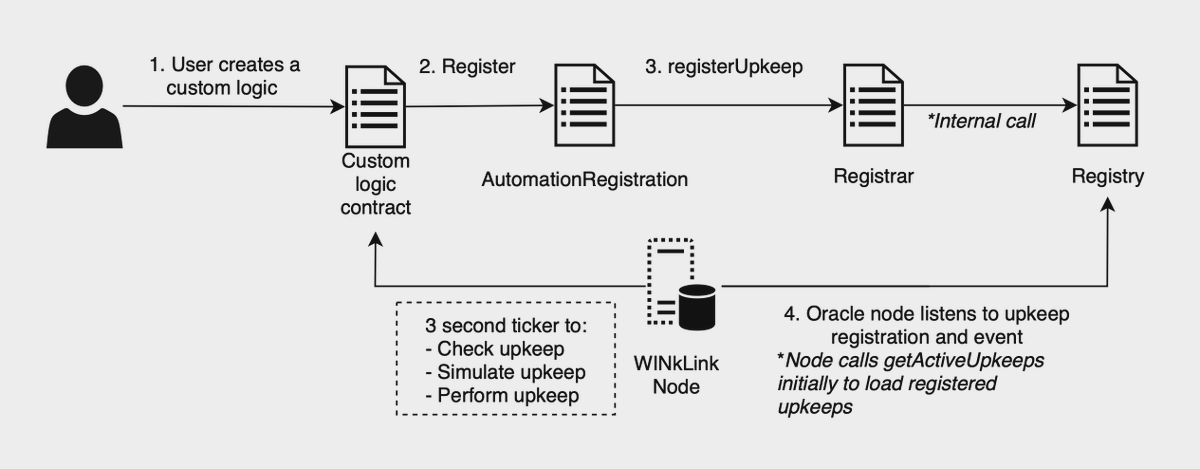
Most people hear about WINkLink Automation Service and think it’s simply “smart contracts executing automatically.” But that explanation barely scratches the surface. WINkLink Automation is powered by BOTH on-chain and off-chain infrastructure working together simultaneously. And the entire system revolves around 3 major components most people completely overlook: □ Automation Custom Logic Contract (On-chain Component) □ Automation Registry & Registrar (On-chain Component) □ Automation Node Service (Off-chain Component) If you don’t understand how these 3 layers interact, you don’t fully understand how WINkLink Automation actually works. Here’s how the entire system functions 🧵👇 First, understand the goal of WINkLink Automation. The service is designed to automate smart contracts containing custom logic. Meaning developers can create contracts that automatically execute actions once certain predefined conditions are met. But this doesn’t happen magically. The execution flow relies on both: ▫️ On-chain infrastructure ▫️ Off-chain monitoring systems That dual architecture is what makes the system efficient. @WinkLink_Oracle @justinsuntron #TRONEcoStar
Essays Hub tweet media
English
64
17
59
35.4K
abraham retweetledi
Martins Kevin
Martins Kevin@_martins_111·
🚨 JUST IN: Coinbase has introduced a new lending feature that lets users unlock liquidity from their Solana holdings without cashing out. Eligible users can now use SOL as collateral to access up to $100,000 in USDC while still keeping exposure to their assets.
Martins Kevin tweet mediaMartins Kevin tweet media
English
71
24
65
261
abraham
abraham@abraham1234874·
@Schola40 Good one I definitely look into this
English
0
0
0
5
abraham retweetledi
Schola
Schola@Schola40·
The biggest barrier to profiting from prediction markets like Polymarket is time and discipline. You might have a strong thesis , “Candidate X will win if economic data improves” or “This crypto event will resolve Yes by Q3” but monitoring markets 24/7, watching news, checking sentiment, and executing trades manually is exhausting. @Chance_ AI solves this elegantly: Describe your strategy or thesis in plain language (in any language). The platform deploys an autonomous AI agent that: ⚫ Scans prediction markets continuously ⚫ Analyzes real-time data (markets, on-chain info, news, social sentiment) ⚫ Places trades according to your rules ⚫ Adapts as conditions change You set the vision. The AI handles execution even while you sleep, work, or travel. So, Visit ai.chance.cc and give it a try.
Schola tweet media
English
68
17
56
242
abraham retweetledi
Paul
Paul@Importerpaul·
Right now, the AI economy works like You contribute data once | The system profits forever. Your corrections train the model. Your expertise improves outputs. Your datasets increase performance. But after the upload? The value chain moves on without you. That model is starting to break. Because AI is becoming less about who owns the model… and more about who continuously improves it. This is where the convergence of DeFi and generative AI becomes powerful. @codatta_io is exploring a framework where data itself becomes a programmable financial asset. Not static. Not disposable. Not trapped inside centralized pipelines. But connected to: • Smart contract-based royalties • Transparent attribution systems • Fractional ownership models • Usage-based compensation • Automated revenue distribution Imagine contributing a high-quality dataset that continues generating rewards every time it helps power training, fine-tuning, or inference activity. Not through trust. Through infrastructure. Every contribution tracked. Every validation recorded. Every usage event tied to transparent onchain logic. And the deeper implication? AI development becomes economically sustainable for the people actually improving the intelligence layer. Researchers. Annotators. Domain experts. Validators. Even intelligent agents participating in quality control. The system shifts from: “Pay once, extract forever” to: “Contribute value, earn continuously.” That changes incentives across the entire AI ecosystem. Because better incentives produce better data. Better data produces better AI. And better AI compounds the value of the network itself. Most platforms today would struggle to implement this without rebuilding their entire architecture. Codatta’s modular infrastructure changes that. Transparent royalty systems and usage-based revenue sharing can integrate directly into existing AI ecosystems without massive redesigns. The future AI economy will need more than powerful models. It will need fair value distribution. And the protocols solving that infrastructure problem early may become foundational to the next generation of AI. If AI systems continue learning from your contributions long after submission… should compensation stop after the first payment?
Paul tweet media
English
68
59
93
453
abraham retweetledi
Paul
Paul@Importerpaul·
A crowdsourced AI system sounds powerful… Until you realize scale alone does not create truth. Millions of submissions can still produce • noisy datasets • manipulated inputs • low-signal annotations • synthetic garbage disguised as quality The internet already has infinite information. What AI actually lacks is verified signal. That is the flaw in most crowdsourced AI pipelines today: they optimize for contribution volume, not contribution integrity. @codatta_io is approaching the problem differently. In Codatta’s ecosystem, trust is not assumed. It is earned through verification. Every dataset moves through a transparent lifecycle: Claim → Evidence → Verification → Usage A contributor makes a claim. Evidence supports the contribution. Validators review authenticity and quality. Then the verified data becomes usable inside the AI pipeline. And because the process remains onchain, attribution and provenance do not disappear once the data enters the system. That changes everything. Because in the next era of AI, provenance may become just as valuable as the data itself. Where did this information come from? Who validated it? How reliable has it been historically? What models were trained on it? Who should be compensated when it creates value? These questions are becoming infrastructure-level problems. Codatta is building systems where transparency is embedded directly into the data economy instead of added later as an afterthought. The result is a stronger foundation for: • trustworthy AI training • decentralized validation • auditable data lineage • fair contributor rewards • scalable human + AI collaboration Anyone can upload data. But verified, traceable, economically aligned data? That becomes exponentially more valuable as AI adoption scales. As synthetic content floods the internet, the premium on verified truth may become one of the most important markets in AI. Do you think future AI systems will prioritize quantity of data… or provable quality?
Paul tweet media
English
68
77
111
473
abraham retweetledi
EMEBOK 🥷🕸️
EMEBOK 🥷🕸️@EMEBOK_·
onchain assets are useless if they’re stuck in a fragmented system. tokenization isn't just about making things digital; it’s about making them programmable. i’m breaking down how BTOS by @byzanlink provides the end-to-end engine for the full $200T capital market lifecycle. learn more 👇 byzanlink.substack.com/p/introducing-…
English
126
33
290
23.5K
abraham retweetledi
𝕸𝖗. 𝕻𝖎𝖕𝖙𝖔𝖈𝖍𝖆𝖎𝖓🔗
One thing I think Pots understands better than most DeFi platforms: Attention means nothing if the system underneath can’t sustain activity once people arrive. A lot of protocols know how to create hype. But hype alone doesn’t create confidence. Structure does. That’s something I started noticing more while actively using @pots_money. The bonding flow feels straightforward. The stats are transparent. Liquidity is deep enough to create smoother participation. And the ecosystem already feels connected instead of artificially stitched together. Even the relationship between @pots_money and @pots_market is interesting structurally. One side focuses on stability and participation. The other introduces activity, pricing, and speculation. Instead of competing with each other, the system is being designed to feed into itself. That’s a much harder thing to build than marketing momentum. Still early of course. But from a system design perspective, Pots is becoming more interesting the deeper I look into it. Incase you miss it. I did a breakdown on potmoney would love you watch
𝕸𝖗. 𝕻𝖎𝖕𝖙𝖔𝖈𝖍𝖆𝖎𝖓🔗@Piptochain

Been spending more time inside the Pots ecosystem lately, so I decided to record a proper walkthrough while checking on my bond position and exploring the platform more deeply. In this video I went through: • how the bonding system works • my current bond progress • staking + dashboard overview • the platform interface/user experience • market movement + chart observations • and some of my honest thoughts after actively using it for the past few days I also touched again on the liquidity lock and ownership renouncement because I still think a lot of people don’t fully understand how important those moves were structurally. This wasn’t a rushed 2-minute promo. Spent real time putting this together so people new to @pots_money and @pots_market can actually SEE how the platform works from a user perspective. Also linked my previous breakdown for anyone trying to catch up on the bigger picture. (x.com/piptochain/sta…) Full video below 👇

English
70
18
61
2.8K
𝕸𝖗. 𝕻𝖎𝖕𝖙𝖔𝖈𝖍𝖆𝖎𝖓🔗
Crypto has spent years focusing on speed, scalability, and lower fees. But there’s another conversation slowly becoming impossible to ignore: What happens when quantum computing becomes powerful enough to challenge today’s encryption standards? Most wallets, signatures, and blockchain security systems were designed around classical computing assumptions. That works today, but quantum computing changes the entire equation. That’s why I’ve been looking deeper into what @qlabsofficial is building. Instead of waiting for the problem to arrive, they’re already focusing on post-quantum infrastructure through products like QVAULT, a system designed around quantum-resistant asset protection. What makes this interesting to me is that the narrative isn’t just future tech hype. It’s infrastructure preparation. The same way the industry had to evolve through: • better scalability • modular infrastructure • interoperability At some point, security standards will evolve too. And the projects preparing early for that shift could end up becoming extremely important pieces of the next crypto era. Still early, but qLABS is definitely becoming one of the more interesting projects I’m watching in the quantum narrative lately.
𝕸𝖗. 𝕻𝖎𝖕𝖙𝖔𝖈𝖍𝖆𝖎𝖓🔗 tweet media
English
67
18
59
220