eab
1.9K posts


I’m going to try and achieve immortality by 2039.
One year of time passes and I remain the same biological age.
I invite you to join me.
The search for the fountain of youth is the oldest story ever told. It’s been the dream of dreamers for millennia but always painfully out of reach.
For the first time in the history of life on earth, in just the past 24 months, the window has opened for a conscious being to realistically strive for this goal. It is an absolutely insane moment.
We currently do not know how 2039 immortality will be achieved. There are new, promising therapies that can turn back the clock decades, but they’re buggy. Sometimes they mistakenly cause cancer. We gotta fix that.
But we know immortality is possible because nature has already solved it. This isn’t a physics problem like trying to travel faster than the speed of light, it’s a biological engineering problem that evolution has cracked multiple times.
The freshwater hydra constantly regenerates its own cells and doesn’t succumb to senescence. It is effectively ageless. The "immortal jellyfish" (Turritopsis dohrnii) can revert its cells back to a youthful state and restart its life cycle indefinitely. Lobsters produce an especially active form of an enzyme called telomerase that preserves their telomeres and keeps their DNA from degrading as they age. We need to port the software to humans.
2039 is a reasonable target because of the accelerated, AI-driven rate of innovation. AI is morphing from assistant to scientist. It is powering current researchers with previously unimagined capabilities to enhance discovery and development.
That, coupled with enhanced biomarker measurement, creates a closed-loop system of improvement that will speed things up dramatically.
This is what I’ve been doing for six years. As crude as longevity technology is today, the improvements I’ve personally seen are stunning.
I started as a worn-down, inflamed, aged 42 year old who’d broken himself on the rocks of American food slop and entrepreneurship martyrdom. Six years later, my body largely operates at elite 18 year old levels. That includes my cardiovascular system, fertility, strength, and hormones.
Not all is well though. I have mild to moderate hearing loss in my left ear that we can’t fix and my brain is anatomically age 42 (I’m 48).
Still, unreal results.
My team and I did this by following the scientific method. We measured the biological age of every organ. We referenced the best scientific evidence on how to slow aging and rejuvenate. We methodically completed these protocols and measured again. Rinse and repeat.
We could do so much more and faster if we had better measurement and better therapies. Both of which are cooking all over the world right now.
To speed things up now, I’m currently having thousands of Bryan Johnson organ clones built in a dish. This will allow me to test drugs and other molecules against my biology to accelerate learning and save my body from potential mishaps.
Yes, we’ll make mistakes. Hopefully they won’t be fatal. And of course there’s always bad luck to contend with. But I trust in fate and I believe that destiny is going to grant the human race the pleasure of achieving the ultimate: immortality.
While immortality would certainly be cool, the real (secret) objective is to focus our collective attention on a positive goal. Something that helps us feel hope and excitement for the future. I personally love the idea of having a child-like mind, 18-year-old physical vibrancy, and a lifetime of wisdom.
This 2039 goal is as much about AI as it is about us humans. It’s about how we survive giving birth to superintelligence. It’s kind of a big deal. We haven’t done it before. A lot can go wrong.
I figure that one of the best ways to improve the probability that we build safe AI, and don’t kill each other in the meantime, is to transform our shared aspirations from yolo to don’t die.
Right now, we are a suicidal species. We do all kinds of really primitive shit. We unnecessarily kill ourselves with what we eat and how we live our lives. Companies make profits from killing other people with their products. We trash the only home we have. We celebrate these things as virtue. It’s really fucked up and backward. Soon enough we’ll realize just how infantile we are right now.
The 2039 goal points us in the right direction.
To say yes to life and no to death. Defiance even.
If you’re interested in doing this with me, I’ll continue to share everything I do for free. I’m also going to build this out in Blueprint. We’ll help you do exactly what I’m doing, at a fraction of the cost and effort, alongside an aligned and motivated community.
I think this is the coolest goal imaginable. I find it hard to believe that of all the people who’ve lived, it’s us who get the opportunity to have this moment.
I pray that we have the courage to appreciate the sacredness of our existence. I pray that we will be brave enough to defend her amidst the onslaught of all the forces that would try to end her.
We don’t know, but we may be the only intelligent life to exist in our corner of the galaxy. I pray we will be warriors, caretakers and stewards of existence and honor the gift that has been bestowed on us.

English

@Ken_Granville This reads like a crypto startup. You could prove it works simply by providing a real time example. Instead you have thousands of AI written words.
English

Breakthrough in GPU optimization — independently validated.
MindAptiv has created a new class of compute — not AI, not CUDA tuning — a new way to generate machine instructions with extreme speed, precision, and energy efficiency.
Verified by an AWS-selected Premier Partner:
- 20×–60× faster performance
- Up to 99% less energy (Beyond our expectations!)
- Runs on standard hyperscaler GPU instances
- Real-time optimization no team of engineers could match
This changes everything for:
• Data centers
• Hyperscalers
• Digital twins
• Blockchain / ZK
• AI inference
• Telecom
• Graphics & rendering
If you rely on GPUs or energy-intensive compute, it’s time to talk.
A new era of efficiency is here — in the cloud, on-prem, and at the edge.
Visit -> adaptwithchameleon.com or mindaptiv.com
English

Our Huxley-Gödel Machine learns to rewrite its own code, estimating its own long-term self-improvement potential. It generalizes on new tasks (SWE-Bench Lite), matching the best officially checked human-engineered agents. Arxiv 2510.21614 With @Wenyi_AI_Wang, @PiotrPiekosAI, @nbl_ai, Firas Laakom, @Beastlyprime, @MatOstasze, @MingchenZhuge

English

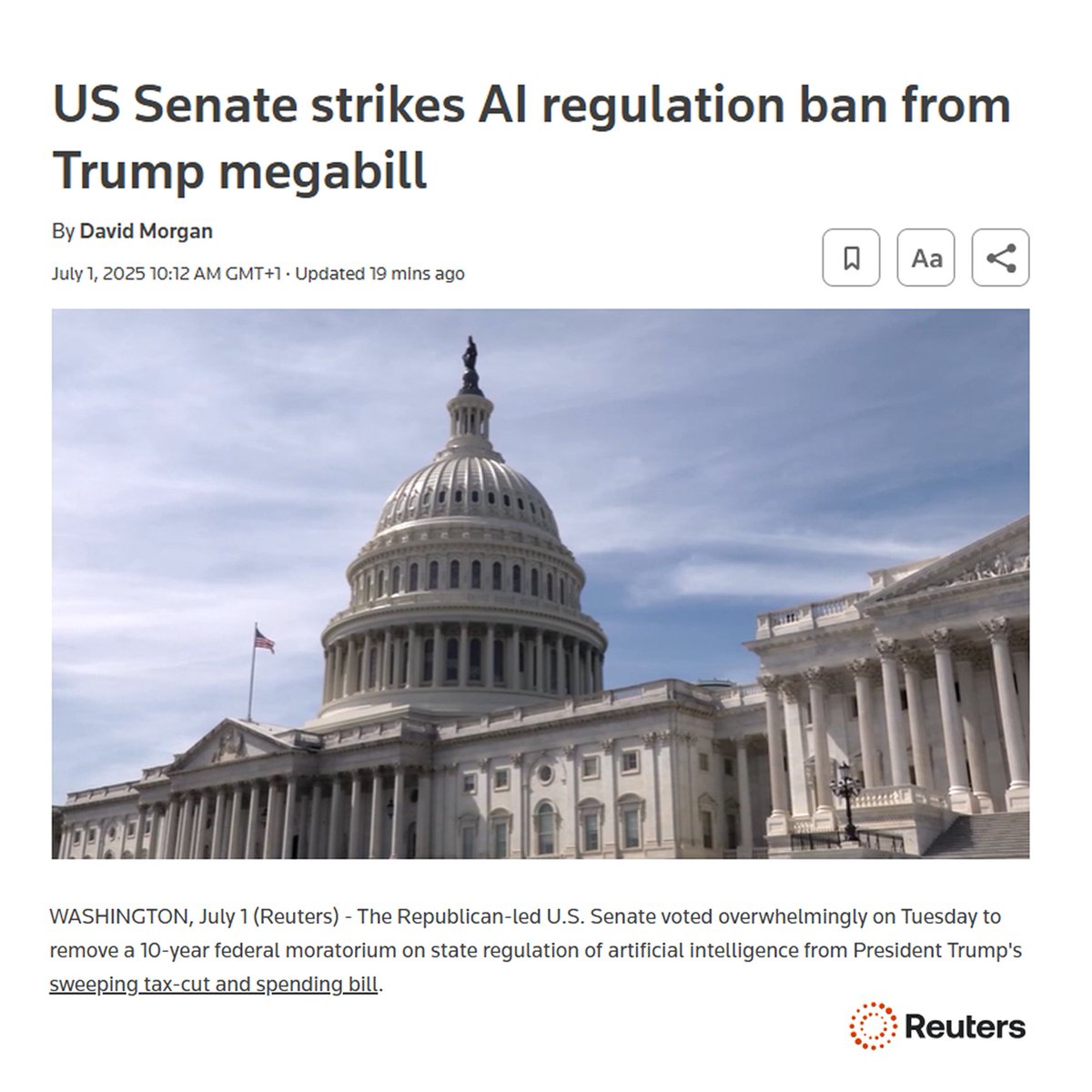
@hungryhungryhhh @LocBibliophilia Sensible bills are used as bargaining chips and never serious.
English

@LocBibliophilia It really raises the question. If 99 senators opposed this- why was it in the BBB to begin with?
English


@paulg @uncertainsys Can't believe Paul Graham has become the one voice of reason in the tecbro space. Him and Cuban. So silly.
English

@uncertainsys The scary thing is that if I had to choose between resembling that guy in body or soul, I'd have to choose body.
English

Very impressed with Veo 3 and all the things people are finding on r/aivideo etc. Makes a big difference qualitatively when you add audio.
There are a few macro aspects to video generation that may not be fully appreciated:
1. Video is the highest bandwidth input to brain. Not just for entertainment but also for work/learning - think diagrams, charts, animations, etc.
2. Video is the most easy/fun. The average person doesn't like reading/writing, it's very effortful. Anyone can (and wants to) engage with video.
3. The barrier to creating videos is -> 0.
4. For the first time, video is directly optimizable.
I have to emphasize/explain the gravity of (4) a bit more. Until now, video has been all about indexing, ranking and serving a finite set of candidates that are (expensively) created by humans. If you are TikTok and you want to keep the attention of a person, the name of the game is to get creators to make videos, and then figure out which video to serve to which person. Collectively, the system of "human creators learning what people like and then ranking algorithms learning how to best show a video to a person" is a very, very poor optimizer. Ok, people are already addicted to TikTok so clearly it's pretty decent, but it's imo nowhere near what is possible in principle.
The videos coming from Veo 3 and friends are the output of a neural network. This is a differentiable process. So you can now take arbitrary objectives, and crush them with gradient descent. I expect that this optimizer will turn out to be significantly, significantly more powerful than what we've seen so far. Even just the iterative, discrete process of optimizing prompts alone via both humans or AIs (and leaving parameters unchanged) may be a strong enough optimizer. So now we can take e.g. engagement (or pupil dilations or etc.) and optimize generated videos directly against that. Or we take ad click conversion and directly optimize against that.
Why index a finite set of videos when you can generate them infinitely and optimize them directly.
I think video has the potential to be an incredible surface for AI -> human communication, future AI GUIs etc. Think about how much easier it is to grok something from a really great diagram or an animation instead of a wall of text. And an incredible medium for human creativity. But this native, high bandwidth medium is also becoming directly optimizable. Imo, TikTok is nothing compared to what is possible. And I'm not so sure that we will like what "optimal" looks like.
Gina Acosta@ginacostag_
It's been only a day since Google dropped Veo 3. The new model creates video and audio simultaneously from a single prompt! Here are 13 wild examples so far: 1. Self-aware AI characters
English

@fchollet Gemini is absolutely killing it. Their toy LLMs, which they are making public, are truly genre defining. Ya'll are obsessed with chatbots, Google is obsessed with unAGI-ASI, that is, artificial super intelligence that has no general intelligence. Because we can.
English

Humans use several pronouns to communicate with individuals, primarily third-person singular ones. The most common are:
1. He/him/his (e.g., "He is here; this is his book")
2. She/her/hers (e.g., "She left; hers is the bag")
3. They/them/theirs (e.g., "They went; theirs is the car")
Other gender-neutral pronouns, like ze/hir/hirs or xe/xem/xyr, are used in some communities, but their adoption varies. There's no fixed number since language evolves, especially around gender identity. New pronouns can emerge based on cultural and social changes.
English

In the physical world, almost all information is transmitted through traveling waves -- why should it be any different in your neural network?
Super excited to share recent work with the brilliant @mozesjacobs: "Traveling Waves Integrate Spatial Information Through Time"
1/14
GIF
English

@paulg @ArmandDoma Not clumsy, evil. Dude is literally channeling Mike Myers' Dr. Evil type shit.
English

@ArmandDoma This was a clumsy move. Not masterful, not witty. Just clumsy.
English