Alexander Chen

145 posts

Alexander Chen

Alexander Chen

@ach2678

Katılım Şubat 2022
202 Takip Edilen87 Takipçiler
Sabitlenmiş Tweet
Alexander Chen
Alexander Chen@ach2678·
my story: - early 2025, decide to try out this funny-looking app called X - read about some guy named naval, who hasn't any association with the sea - read about some guy named david deutsch, who isn't german - wonder if everyone on X has pseudonyms and regret not choosing one for myself - read the beginning of infinity - feel inspired to learn about the universe (again), but probably would've gotten scared by the math and given up quickly (again) - try this chatGPT thing that even the boomers seemed to be using. feel inspired to understand how LLMs work, but probably would've gotten scared by the math involved and given up quickly - see some guy's post about his kids doing something called math academy. check it out; seems legit. - by this fateful syzygy, actually tackle math head-on this time: see other posts for more info about this. figured it'd take me most of the year to get back to high school level, and maybe a couple more to finish math academy's content. locking in. - finish MA much sooner than anticipated - feel a bit lost going forward, I plan to: - continue to learn more math till I hit my abstraction ceiling. - learn CS/coding->ML from scratch, although between the discrete math and the natural languages I've learned, I don't think I am starting this journey with extremely weak foundations like I did with math. I could be very wrong. - learn physics from scratch, probably when PhysicsGraph ships their Physics I course.
English

5
0
22
1.4K
Alexander Chen retweetledi
Asher Perlman
Asher Perlman@asherperlman·
Happy Father’s Day
Asher Perlman tweet media
English
31
2.2K
47.3K
603.4K
Alexander Chen
Alexander Chen@ach2678·
Reading math textbooks has altered how I read novels - at the first sign of narrative ambiguity, I feel compelled to check with AI whether my interpretation of events is the correct one. You know, so any errors of understanding don't compound as I keep reading. This of course can ruin the experience if the author had done it intentionally, perhaps to be made clearer later on in the novel. This urge can be resisted, of course, but it is an extra imposition. In the same vein, I seem to have become even more fastidious about looking up and memorizing a concrete definition for every unfamiliar word, even when I know that they're tangential. This isn't necessarily a bad thing, but does interrupt the flow of reading a novel, making it less immersive and more like reading a non-fiction work. Be careful out there folks!
English
0
0
0
15
Alexander Chen retweetledi
Brian Anderson
Brian Anderson@BrianAcity·
The philosopher Michel Serres, who taught at Stanford for many years and was close to Rene Girard, noted in a number of books that the doubling of lifespans, as occurred in the twentieth century, had seismic social consequences: marriage vows designed for a decade or two become 65-year contracts; inheritance arrives in your old age instead of your prime; the willingness to die for a nation becomes less prevalent when you have six decades of life ahead. The radical slowdown of aging that some say is on the horizon would invert every institution built on the assumption that the old will soon yield to the young.
John Robb@johnrobb

Think about how many assumptions underlying our personal and social decision making will fracture if a large subset of the population radically slows their aging.

English
41
223
1.8K
155.3K
Alexander Chen retweetledi
Eve Keneinan 𝛗☦️ن
Eve Keneinan 𝛗☦️ن@EveKeneinan·
Once upon a time, the people of a certain land were blessed with an oracle of uncanny precision and depth in its predictions and information. The people rose to prominence and prosperity thanks to consulting the oracle. However, the people were never allowed to consult the oracle directly, but only through the priests that carried their questions to it, and brought the oracle's responses back to them. Eventually, the priests began to confuse the virtues and gifts of the oracle as their own, and began no longer to bother asking the oracle questions before deciding on what "its" answers would be. Thus it transpired that, while the oracles was a reliable and beneficial as it ever was, since its true answers no longer reached the people, but merely the false and self-serving answers of the priests, the act of "consulting the oracle" became no longer beneficial. So people stopped consulting the oracle. The priests were mystified by this. "The oracle is as reliable as ever," they said amongst themselvs. "Why do the people then no longer trust it?" And yet they had done it themselves.
Roman Helmet Guy@romanhelmetguy

People haven’t lost trust in “science,” they’ve lost trust in a self-selected self-perpetuating academic priest class who rely on constant alarmism or revisionism to secure funding and who look upon dissent as heretical to an extent that would make the medieval church blush.

English
20
436
2.9K
47.4K
Alexander Chen retweetledi
Julian
Julian@julianboolean_·
legibility rules everything around me, part infinity
Julian tweet media
English
20
84
1K
34.1K
Alexander Chen retweetledi
Lloyd Blankfein
Lloyd Blankfein@lloydblankfein·
Was at the WH Correspondents dinner last night, a rare DC trip for me without a subpoena. On the positive side—was exciting, no one was killed, and ended early. I noted a new litmus for status among the gov’t elite—whether you were whisked away by secret service, or left to fend.
English
226
570
9.6K
1.4M
Alexander Chen
Alexander Chen@ach2678·
Update: After finishing math academy and then getting overwhelmed by Axler and to a lesser extent Abbott, I did all of Hammack's proofs book, which was a great experience. I attempted every question, and one-shot about 50%, comfortably grasped the solution (once seen) for 40%, and had to struggle to understand (even after seeing the solution) the hardest 10%. The difficulty overall was very suitable for me and I learned a lot. I was overawed by my sense that the author knew so much more math than he was letting on, but was tailoring the material for a small child such as myself, so as to be cheery and encouraging. Great book, would recommend. I then went back to Abbott. The first couple of chapters were similar to Hammack in terms of difficulty, but the scope was far wider, and the required level of understanding, deeper. To be able to answer the questions in the latter parts of the chapters required one to recall many of the little theorems from the whole chapter on demand, as well as general familiarity with math eg. being able to recall certain illustrative mathematical entities (functions, sets etc.) on demand. While a concept like convergence would be introduced using a definition or two, it felt like that to be able to really have mastered the chapter, one would need to have understood every possible implication of the theorems and to intuitively grasp every equivalent characterization of each definition. Online reviews talk about how Abbott is much more narrative than other analysis textbooks, but having done half of it, I feel that math simply doesn't lend itself to a narrative structure for pedagogy, unlike, say, history. Abbott introduces 'the basic topology of R' with the Cantor set, which, although fascinating, appears only intermittently thereafter as a way to demonstrate edge cases rather than as a means to teach the basic topology of R, which had to be done through boring examples of open/closed sets etc. My learning efficiency almost certainly dropped (it's hard to measure - I didn't feel much smarter after each chapter, but perhaps I gained 'mathematical maturity'. or maybe that's just cope). On good days, I'd sit there for hours, be immersed in the material, and feel like I had gained a deeper understanding of reality, but at other times, the prospect of floundering on a couple of pages of exercises became increasingly unpalatable and my lack of discipline resulted in shifting attention towards easier activities. For instance, while doing chapter 4, I managed to read the entirety of _Don Quixote_ (itself something I had avoided) before finishing chapter 4 lol. I did not have this problem with math academy, of course. Having blocks of under an hour to tackle Abbott became really inefficient - I felt like I needed a whole afternoon available to guarantee progress, as it took a lot of time to warm up ie. regain mental fluency and reload all the definitions into ST memory. I decided to start diff equations on math academy today, and an example will illustrate the very different approaches: one of the first sentences in the first lesson stated that differential operators take functions as inputs and return functions as outputs, and likened this to linear transformations in vector spaces. A few months ago, I would've accepted this and kept reading, knowing that it was simply setting the stage for some computations taking inputs (problems) and returning outputs (answers). However, having been accustomed to textbooks, I immediately alt-tabbed to ask Gemini: "if a differential operator can be characterized as something that takes a function as input and returns another function as output, can a differential operator itself be characterized as a function? what distinguishes a transformation from a function? indeed, what distinguishes an operator from these? how does the notion of mapping fit in with all this?" to which Gemini actually provided really great clarifiying info, explaining the different domains/codomains, function spaces etc. All great, except it's all probably unnecessary for doing the DE course on MA, and narrowly construed, is a giant distraction. By contrast, I feel that some of my best learning on real analysis involved just reading/watching videos/chatting with LLM about a single definition/concept, eg. compactness. @_MathAcademy_ tries to protect the user from getting nerd-sniped, whereas math textbook authors seem to expect and encourage it.😁 I can see the value of both approaches. Anyways, I look forward to feeling less stupid (I hope) while doing Diff Eq on MA before returning to Abbott for further testing of my mettle.
English
1
0
4
86
Alexander Chen
Alexander Chen@ach2678·
I think you're right. A child is a human agent capable of learning, just as adults are, and so should be experience the same amount of coercion ie. none. Still, I imagine this has limits when it comes to children. I bought _the sovereign child_ when it came out and I'm curious as to where that limit is, so maybe I'll read it next.
English
1
0
1
37
Mark Worrall
Mark Worrall@infinitehumanai·
Almost certainly they'd reject this framing. My take is they prize the "right epistemological model" above all is, even when that (i) contradicts established science and (ii) may cause harm to individuals. You can see this latter take in Aaron Stupple's writing that he was willing to let his child get sunburn vs. "coerce" them to wear sunscreen. I can't get on board with this binary framing (essentially, a false dichotomy) and ironically, it lacks the very same willingness to create new knowledge to solve the problems that they seem to revere so much.
English
1
0
1
34
Alexander Chen retweetledi
Conjecture Institute
Conjecture Institute@ConjectureInst·
"People wring their hands and say that there must be "better ways of finding solutions" than warfare. Of course there are. We have already found them. The nations and people of the West use them all the time. They are openness, tolerance, reason, respect for human rights — the fundamental institutions of our civilisation. But no way of finding solutions is so effective that it can work when it isn't being used. And when a violent group defines itself by its comprehensive rejection of all the values on which problem-solving and the peaceful resolution of disputes depend, and embarks instead on a campaign of unlimited murder and destruction, it is morally wrong as well as factually inaccurate to represent this as a case of our needing "better ways of finding solutions". That is why we have to insist, by force if necessary, that everyone else in the world also respect, and enforce, the minimum standards of civilisation and human rights. Western standards." ~Conjecture Institute Advisor @DavidDeutschOxf (2001)
English
9
92
458
22.5K
Alexander Chen
Alexander Chen@ach2678·
"Markets are highly dynamic, and, among other things, they function over time to take away the opportunity for unusual profits. Unskeptical belief that the silver bullet is at hand eventually leads to capital punishment." - Howard Marks What a capital pun.
English
0
0
0
31
Alexander Chen
Alexander Chen@ach2678·
A logical consequence of the modern belief that a) life has infinite value measured in money, and b) all lives are of equal value. Imagine a medieval peasant whose child had died of malnourishment, due to some bad harvests. This was presumably far more common than modern westerners dying of exotic cancers. The 'medicine' here is simply more food, which even to the peasant is not unfathomably expensive/inaccessible. Yet somehow I doubt this peasant would be "mad" in the way the person in your example would be. Upset of course, but not angry at the world or expecting that other families (eg. The king's) ought to empty their coffers to buy food for their starving child. A feeling of fatalism (it is simply a fact of life that some people eat well while others don't) rather than of injustice.
English
0
0
1
39
Hunter Ash
Hunter Ash@ArtemisConsort·
I think advanced medical options interact with our psychology in a weird way. If you tell a cancer patient “there’s nothing we can do” it’s of course tragic, but they can accept it. If you say “we have a treatment, but it costs $5,000,000” then people feel like an injustice has happened. Just the existence of the expensive option makes them mad. You can even stipulate an example where the expense is entirely direct, not to pay research costs. Imagine some cancer treatment that requires large hadron collider level machinery. The existence of this thing would make people feel like they’re being unfairly denied something. If it wasn’t an option for anyone they’d be happier.
English
88
43
1.1K
44.9K
Alexander Chen retweetledi
Anders K. Hvelplund
Anders K. Hvelplund@Falliblemusings·
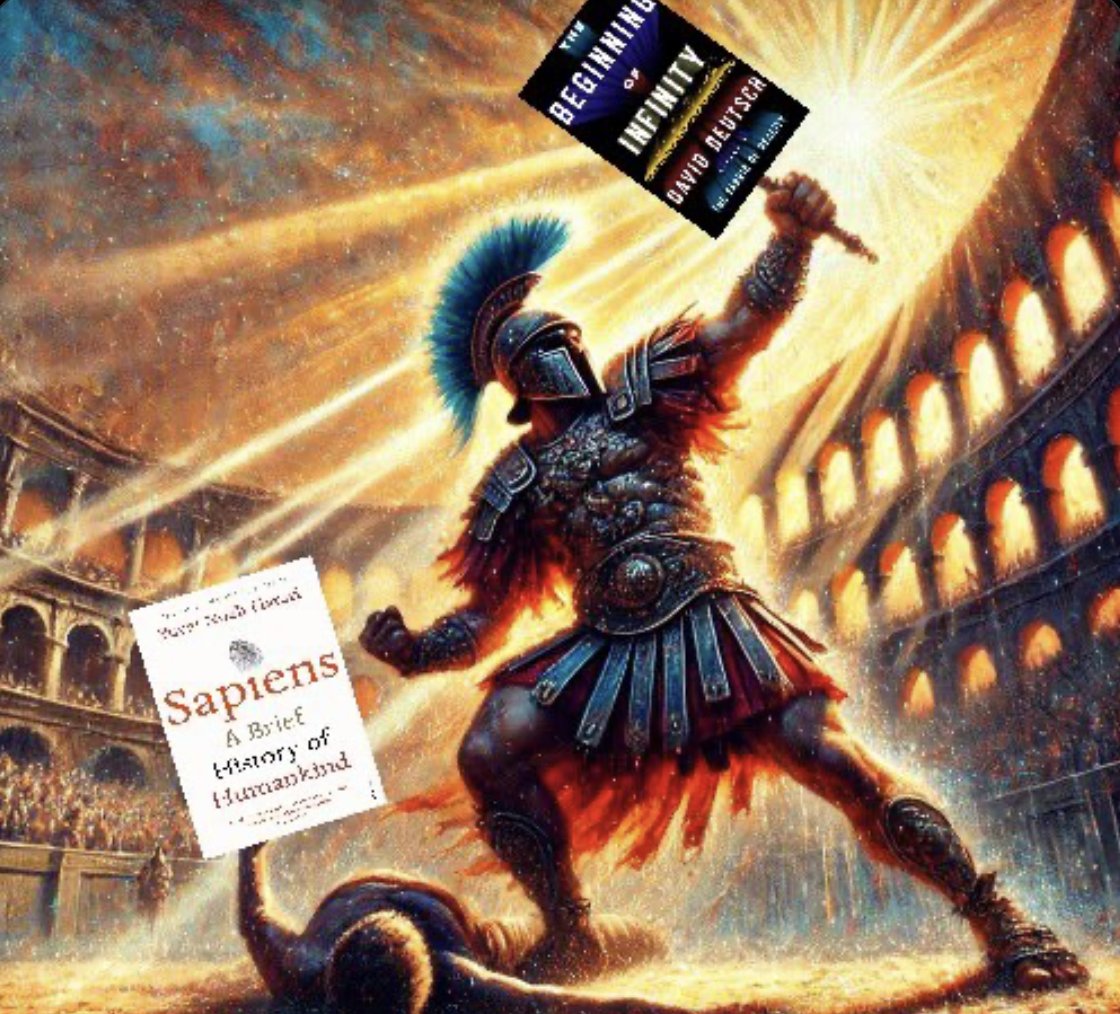
I used to think Sapiens was a great book. Sweeping, provocative, the kind of book that makes you feel like you finally understand the big picture of human history. It's on every CEO's bookshelf, assigned in universities, praised as a masterwork of synthesis. Yuval Noah Harari is treated as one of the serious thinkers of our time. But something nagged at me. Some passages felt off. Claims that human rights are just figments of our collective imagination, not real things, just stories we tell ourselves. That nations, laws, money, justice, doesn't exist outside our heads. That meaning itself is a delusion we've invented to cope. That we're far more powerful than ever before but not happier. That hunter-gatherers had it better because they had no dishes to wash, no carpets to vacuum, no nappies to change, no bills to pay. That sounded depressing to me, but was perhaps just the realistic scientific worldview? What it meant to see the world clearly, without comforting illusions. Then I read The Beginning of Infinity by @DavidDeutschOxf. Deutsch has a concept he calls 'bad philosophy.' Not philosophy that's merely false, but philosophy that actively prevents the growth of knowledge. Ideas that close doors rather than open them. That makes problems seem unsolvable by design. After soaking in Deutsch's framework (it's dense, a bit like digesting a delicious whale), it becomes clear: Harari's books are riddled with bad philosophy. They're smuggling nihilism in under the guise of scientific objectivity. Some examples: On meaning: "Human life has absolutely no meaning. Humans are the outcome of blind evolutionary processes that operate without goal or purpose... any meaning that people inscribe to their lives is just a delusion." On human rights: "There are no gods in the universe, no nations, no money, no human rights, no laws, and no justice outside the common imagination of human beings." On free will: "Humans are now hackable animals. The idea that humans have this soul or spirit and they have free will, that's over." On progress: "We thought we were saving time; instead we revved up the treadmill of life to ten times its former speed." The Agricultural Revolution? "History's biggest fraud." We didn't domesticate wheat, "it domesticated us." On our cosmic significance: "If planet Earth were to blow up tomorrow morning, the universe would probably keep going about its business as usual. Human subjectivity would not be missed." On the future: "Those who fail in the struggle against irrelevance would constitute a new 'useless class.'" Homo sapiens will likely "disappear in a century or two." This is bad philosophy. It tells us our problems are cosmically insignificant, our solutions are illusions, and that progress is neither desirable nor within our control. It's also perfect nonsense. No one would ever go back to being hunter-gatherers. Would you rather worry about your kid spending too much time on Roblox, or face the 50% chance she won't reach puberty? And our so-called "fictions"? They ended slavery. They gave women equal rights. They solved hunger. They eradicated smallpox. They turned sand into computer chips. They got us to the moon, and hopefully soon, to Mars and beyond. These "fictions" are already reshaping the universe, and over time they may become the most potent force in it. Now compare Deutsch: "Humans, people and knowledge are not only objectively significant: they are by far the most significant phenomena in nature." "Feeling insignificant because the universe is large has exactly the same logic as feeling inadequate for not being a cow." "Problems are soluble, and each particular evil is a problem that can be solved." "We are only just scratching the surface, and shall never be doing anything else. If unlimited progress really is going to happen, not only are we now at almost the very beginning of it, we always shall be." Where Harari sees a species of deluded apes stumbling toward obsolescence, Deutsch sees universal explainers, the only entities we know of capable of creating explanatory knowledge, solving problems, and potentially seeding the universe with intelligence. The difference isn't academic. Ideas shape action. If you believe life is meaningless, progress is a trap, and humans are hackable animals with no free will, how does that affect what you build? What you fight for? What you teach your children? Harari's books sell because they flatter a fashionable pessimism. They let readers feel sophisticated for seeing through the "delusions" everyone else lives by. That smug cynicism is corrosive. And it's everywhere: in schools, in media, in bestselling books. More than half of young adults now say they feel little to no purpose or meaning in life. This is what happens when you teach an entire generation bad philosophy. Less progress, less health, less wealth. Less flourishing. And ultimately, a higher chance that civilization and consciousness go extinct. Fortunately, there's another equally well-written, but much truer, account of homo sapiens, appropriately titled 'The Beginning of Infinity'. And this one smuggles no despair in by the backdoor. But let's give Harari credit where it's due. He is right about one thing: if planet Earth blew up tomorrow, we wouldn't be missed. Because there'd be no one left to miss us, just a careless universe, blindly obeying physical laws. We are the only ones who can miss, but we're not going to. We're going to aim, hit, and keep going. Full credit for the amazing meme to @Ben__Jeff
Anders K. Hvelplund tweet media
English
854
1.5K
9.1K
903K
Aryeh Kontorovich
Aryeh Kontorovich@aryehazan·
so now I've got Melinda B Chu on my back about this
Aryeh Kontorovich tweet media
Melinda B. Chu@MelindaBChu1

@aryehazan I don’t think you were being sarcastic. You said based on awards, Europe is essentially smarter than all of Asia which also includes Middlr East.

English
3
0
14
1K
Alexander Chen retweetledi
Phil Hoyeck
Phil Hoyeck@PAHoyeck·
Phil Hoyeck tweet media
ZXX
75
235
3.6K
93.9K
Alexander Chen
Alexander Chen@ach2678·
@3RenChengHu @_MathAcademy_ That's the one. Oh, I agree, and I think it's deeply problematic that the college admissions system (especially in Josiah's time) was so openly racially discriminatory, but I felt the sense of entitlement in that post undermines its message.
English
0
0
1
25
Against Narrative
Against Narrative@3RenChengHu·
@ach2678 @_MathAcademy_ Racial discrimination in college admissions actually is a pretty big issue in the US, but expecting tech companies to try to recruit you when you don't have the skills and don't bother to apply is just weird.
English
1
0
2
50
Against Narrative
Against Narrative@3RenChengHu·
This thread, and the ensuing kerfuffle, prompted me to sign up for @_MathAcademy_ to review high school and college math the next day. In less than 9 months, on top of a full-time job, I've relearned high school math, three semesters of calculus, linear algebra, discrete math, statistics, combinatorics, and intro to proofs, covering significantly more material than was covered when I took these classes at Georgia Tech ~25 years ago, even all those chapters at the back of the book that your teacher tells you not to worry about. With a time investment on the order of 500 hours, I now know significantly more math than I did when I graduated, after several years of using the "superior technology" of the class. @justinskycak wrote a whole book about why this works better than traditional classes, but in my opinion the thing that made the biggest difference was skipping the lecture. I never got much out of lectures, and did all my learning from the book, so lectures were basically dead time for me. Giving a text explanation and jumping straight into exercises is a huge time-saver. A while back I mentioned to @eduleadership that my experience was very different from his, and he conceded that the real issue was just that he had other demands on his time, and wasn't consistently working on it. This highlights what I think is the only real advantage that traditional classes have, which is accountability. You have to do homework and study for tests, or you get bad grades, and maybe your teacher calls your parents. But in terms of actual pedagogy, Math Academy's system is by far the superior technology. I couldn't have covered half as much material in two semesters of traditional classes.
Against Narrative tweet media
English
4
0
13
902
Alexander Chen
Alexander Chen@ach2678·
upon reflection, your generous interpretation is probably correct lol it reminds me of that tweet from josiah lippincott? from around the same time in which he claimed that the fact that even he couldn't get into a top tier college was ironclad proof of discrimination.
English
1
0
2
45
Against Narrative
Against Narrative@3RenChengHu·
@ach2678 @_MathAcademy_ People were interpreting it as an IQ issue, and he was kind of inviting that by acting like he was legitimately struggling, but I think he was just trying to hype up the benefits of traditional schools over accelerated learning platforms.
English
1
0
2
64
Alexander Chen
Alexander Chen@ach2678·
that it is permissible to cite exotic results that one could never prove for one's own simple proofs, and that simple proofs can utilize a result that has only been proven in my lifetime, is a cool aspect of math proofs.
Alexander Chen tweet media
English
0
0
1
90