

Arthur Cinader
2.4K posts

Arthur Cinader
@acinader
I’ll turn out the lights when I’m done
San Francisco Katılım Mayıs 2007
1K Takip Edilen408 Takipçiler

Mr. Bezos: Let's have that debate.
Under my 5% billionaires wealth tax, we'd:
-Give $12K to a working family of 4
-Expand Medicare for dental, vision, hearing
-Guarantee universal childcare
-Raise starting teacher pay to $60K
And you'd still be worth $269 billion after taxes.
More Perfect Union@MorePerfectUS
Jeff Bezos on CNBC: "If people want me to pay more billions, then let's have that debate, but don't pretend that that's gonna solve the problem. You could double the taxes I pay, and it's not gonna help that teacher in Queens.... Airbnb isn't causing high rents. What's really causing high rent is government intervention."
English

Very interested in what the coming era of highly bespoke software might look like.
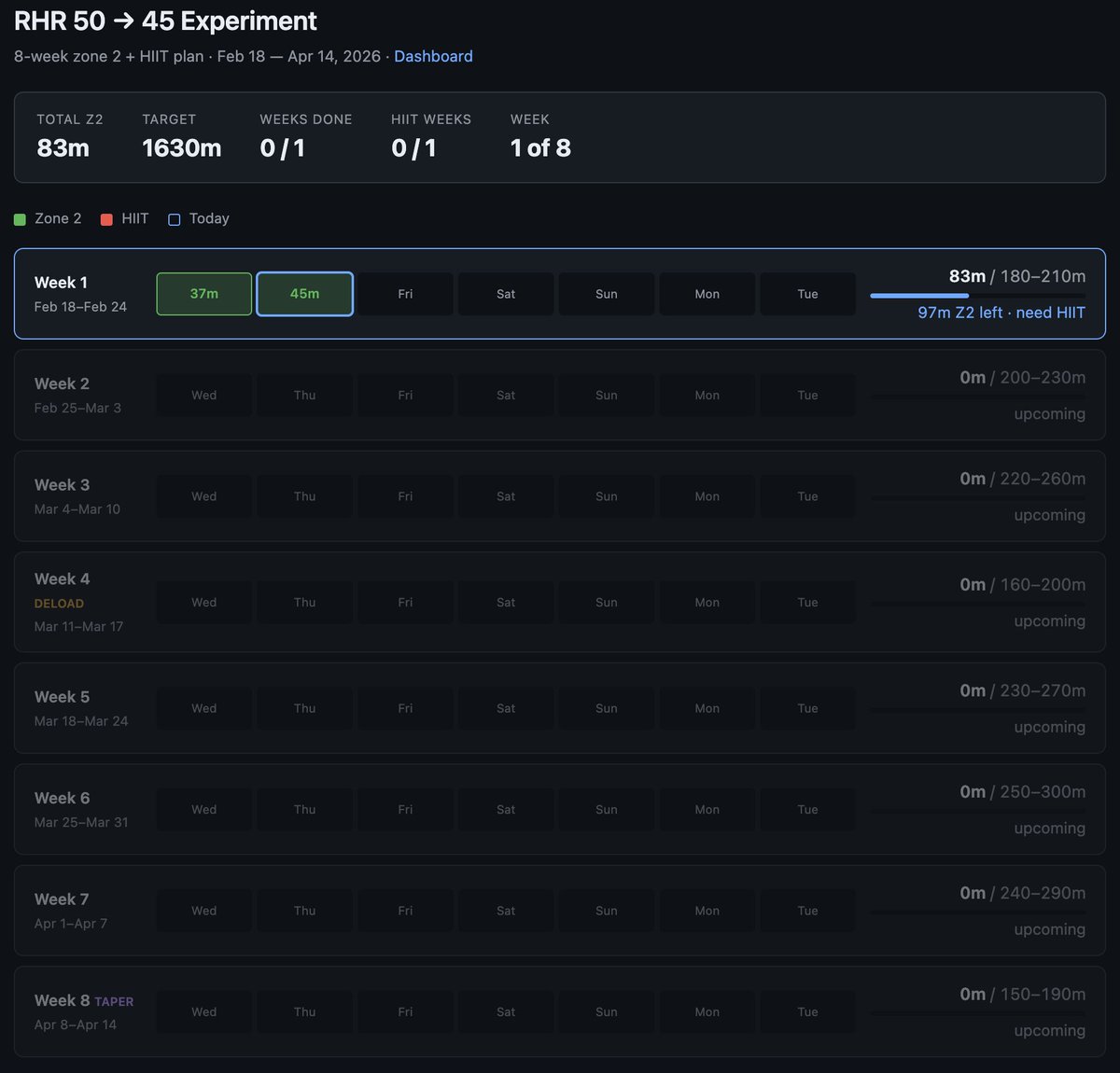
Example from this morning - I've become a bit loosy goosy with my cardio recently so I decided to do a more srs, regimented experiment to try to lower my Resting Heart Rate from 50 -> 45, over experiment duration of 8 weeks. The primary way to do this is to aspire to a certain sum total minute goals in Zone 2 cardio and 1 HIIT/week.
1 hour later I vibe coded this super custom dashboard for this very specific experiment that shows me how I'm tracking. Claude had to reverse engineer the Woodway treadmill cloud API to pull raw data, process, filter, debug it and create a web UI frontend to track the experiment. It wasn't a fully smooth experience and I had to notice and ask to fix bugs e.g. it screwed up metric vs. imperial system units and it screwed up on the calendar matching up days to dates etc.
But I still feel like the overall direction is clear:
1) There will never be (and shouldn't be) a specific app on the app store for this kind of thing. I shouldn't have to look for, download and use some kind of a "Cardio experiment tracker", when this thing is ~300 lines of code that an LLM agent will give you in seconds. The idea of an "app store" of a long tail of discrete set of apps you choose from feels somehow wrong and outdated when LLM agents can improvise the app on the spot and just for you.
2) Second, the industry has to reconfigure into a set of services of sensors and actuators with agent native ergonomics. My Woodway treadmill is a sensor - it turns physical state into digital knowledge. It shouldn't maintain some human-readable frontend and my LLM agent shouldn't have to reverse engineer it, it should be an API/CLI easily usable by my agent. I'm a little bit disappointed (and my timelines are correspondingly slower) with how slowly this progression is happening in the industry overall. 99% of products/services still don't have an AI-native CLI yet. 99% of products/services maintain .html/.css docs like I won't immediately look for how to copy paste the whole thing to my agent to get something done. They give you a list of instructions on a webpage to open this or that url and click here or there to do a thing. In 2026. What am I a computer? You do it. Or have my agent do it.
So anyway today I am impressed that this random thing took 1 hour (it would have been ~10 hours 2 years ago). But what excites me more is thinking through how this really should have been 1 minute tops. What has to be in place so that it would be 1 minute? So that I could simply say "Hi can you help me track my cardio over the next 8 weeks", and after a very brief Q&A the app would be up. The AI would already have a lot personal context, it would gather the extra needed data, it would reference and search related skill libraries, and maintain all my little apps/automations.
TLDR the "app store" of a set of discrete apps that you choose from is an increasingly outdated concept all by itself. The future are services of AI-native sensors & actuators orchestrated via LLM glue into highly custom, ephemeral apps. It's just not here yet.
English
this has aged well. :). no shade on the claw here.
Andrej Karpathy@karpathy
@stevedakh no i'm too scared, but i like the concept.
English

It would be hard to overstate how mind blowing learning how to use codex has been.
English
@PeterL4e Amazing! Congrats. I hope I have the opportunity to meet you in person.
English

I am thrilled to announce my return to a16z as a full-time General Partner. Having made a full recovery from cancer and navigated some of life’s most taxing personal hurdles, I am returning with a sharpened sense of purpose and a deep optimism for the future, both personally and professionally.
My time away reinforced that living to one's fullest capacity requires doing what you love with the people you trust. While I’ve continued to support my boards and founders, I’ve realized my greatest impact happens when I am 'all in.' I believe he current pace of innovation in infrastructure is unmatched, and I couldn't be happier to be back in the trenches with my colleagues and close friends on the a16z Infra team.
English
Arthur Cinader retweetledi

@IamSean90 @BillAckman It’s hard to fathom just how complete the transformation from city run hell hole to privately financed treasure. Wouldn’t believe it if I hadn’t seen it with my own eyes.
English

This is Central Park. Which was in such decay due to the City's horrible mismanagement that a non-profit took it over the 80s & the wealthy folks on the board did such an amazing job cleaning it up, that Low IQ posters like this enjoy it, without even understanding who to thank
nihal@nihalmehta
hmmm the taxes might be worth it?
English
@lost_nomad__ I was so shocked when I came here for the first time. The long island beaches I grew up on. Now that's a beach!
English

Sad to say, but unless you surf, California beaches are basically worthless compared to Florida or the Carolinas
Odd because they are so glamorized. My only attempt at an explanation is that CA is just where Hollywood is so they promoted their own beaches over elsewhere
Jared Hardin@JaredDHardin
Florida gulf beaches > California beaches Not even close
English
Ok, now I get the fantasy football draft thing...
Andrej Karpathy@karpathy
Personal update: I've joined Anthropic. I think the next few years at the frontier of LLMs will be especially formative. I am very excited to join the team here and get back to R&D. I remain deeply passionate about education and plan to resume my work on it in time.
English
@tomfgoodwin We’re doing both!
x.com/trungtphan/sta…
Trung Phan@TrungTPhan
The Boston Dynamics Atlas demos are always impressive but its current most useful robot isn’t humanoid. It’s prob their truck-unloading robot called “Stretch”, already operational with DHL (the logistics company has a deal for 1,000 of these to unload trailers). For DHL employees, moving 50lb boxes for hours on end in 100-degree trailers is a huge injury risk. DHL has already trained 100 remote operators and working with more to learn how to operate Stretch, which is made up of three main pieces: ▫️Base: Size of a pallet with wheels. ▫️Arm: For manipulation with a vacuum gripper with suction cups that can carry up to 50lbs. ▫️Perception mast: A visual system that recognizes different box sizes and shapes, which informs the AI algos what objects to grab and move. Stretch is ~$120k a pop. Can’t deadlift a fridge, bring it to a desk and deliver a single drink but still pretty useful. *** WSJ: wsj.com/business/logis… YouTube: youtube.com/watch?v=8WZoVJ…
English

I’m still confused as to why we’re making robots that look like people rather than making them far far far far better at doing the things we need them to do.
It’s like we’re making animatronic horses not cars with wheels
Eren Chen@ErenChenAI
2 people can’t physically hold back the Agibot A3 when it malfunctioned. Looks like a policy degradation under instability.
English

@levelsio yes, but google kind of fought back by showing how many reviews got removed
so the suppression itself becomes part of the public record

English

My gf is banned from reviewing places in Europe on Google Maps after she gave one restaurant in Portugal a 1-star review
When she reviews inside EU it gets auto rejected, outside EU she can review any place
Free speech in Europe has sadly died a long time ago
j.m. kettle@jmkettle
Giving a restaurant a three star review is illegal in Germany.
English
Arthur Cinader retweetledi

when electric motors arrived, the old mills installed them as drop-in replacements for water wheels — same overhead shaft, same belt-driven plant layout. they captured almost none of the productivity gains of electrification. the winners were the companies that rebuilt their floors around distributed motors and redesigned workflows. swap the wheel for a motor and you save a little. redesign the plant around what the motor lets you do and you win the century.
big companies need to figure out how to reorganize themselves for this new paradigm. but it isn’t entirely obvious how. organizational alignment, executive control, security and infrastructure among many other issues remain unresolved. Starbucks can’t let every barista vibe code changes to the POS (or can they?).
Dorsey just made this case publicly at Block. his framing is that corporate hierarchy has always existed to route information through organizations too big for any one person to see — middle management is the data layer. once an MCP and a swarm of agents can do that routing directly, you don’t need the layer that existed to solve it. Block went from ~10,000 to ~6,000 employees on that argument. the org chart stops being who-reports-to-whom and becomes who-orchestrates-which-swarm.
earlier today i tweeted this at the CEO of Brex: x.com/cliffordsosin/…
i’d love help from this crowd:
— if you run product or eng at a bigger company: have you actually restructured in the last 12 months, or are you still running the same org chart with Claude Code plugged in? how are big organizations going to manage this dynamism while preserving the right controls — and what are those controls anyway?
— solo builders: stack, harness, what broke, what worked
— examples of support-as-R&D or the tool-as-data-wedge pattern in the wild?
— how are you handling bad code shipped fast? review, tests, reversibility at 10x throughput?
— best thinkers on this i should be reading?
honest confession on why i’m asking: i’ve been losing sleep. in a great way. started as an experiment — can these tools help me understand investing better — and turned into an obsession. building with Claude feels like growing superpowers. can’t turn my brain off at night.
all examples welcome.
English
we are all developers now.
the user is the best author of the code. that one sentence collapses how software has been built for decades and reshapes how every company will be organized. huge investing implications.
you used to need a server to build software. AWS ended that. but you still needed tech skills, you still needed developers, and writing software still took forever. software was expensive and slow to build, but the deep challenge was never really the code — it was getting the user’s needs into the mind of the developer so they could build the right thing.
first we tried to close that loop with big dev specs. that became waterfall. took forever. always missed the evolving target of what users actually wanted.
so we collapsed into agile. cross functional teams, rapid delivery, tight testing loops. much better. but a week-long deployment cycle is still forever. and the person writing the code still struggles to deeply understand the user’s need. often the user struggles to understand what they want.
so most companies limped along on no software or shit software. most late-night fancies — the tool you sketched on a napkin, the workflow you wished you had, the feature you’d have built with a spare engineer — never made it from idea to live project.
well software is no longer precious. now with Claude, the whole loop closes. requirements, design, code, test, deploy — those aren’t sequential stages anymore. they’re a single fluid act, performed by the person who actually has the problem, and for cheap. software was eating the world. it just got much, much hungrier — we are going to build 100x, 1000x, maybe a million times more software than the old regime could ever produce.
but this is the start of the impact, not the end.
my friends at a startup called Try Commonplace used to look like every other small company — one room, functional leaders running customer service and marketing, one developer building whatever the CEO prioritized. a month or two ago they handed Claude to every functional leader and told them to build their own tools. the developers stayed, but only for shared infrastructure. the result — explosive improvements. and the savings weren’t just headcount. it was the translation loss that used to happen in every handoff.
this is how every startup and small business will look soon if it doesn’t already.
now here’s the part i can’t stop thinking about.
start mundane: tech support gets automated. fine.
but keep going. what if the system doesn’t just answer the ticket — it builds the feature the customer asked for? a flag-gated version shipped in minutes. if they use it, it rolls to similar users. if it works, it ships everywhere. support becomes R&D. every complaint is a pull request. the user is literally writing the roadmap.
keep going. once you’ve built a tool for yourself, externalizing it is a few prompts. list it, and your customers’ agents find you. forget sales, forget marketing, forget people. anyone can build what you’ve built, so you price a little above cost. but now you see how they use it. the commoditized micro-tool is a disguised data play — a wedge into something much bigger than the tool itself. you’re not selling software. you’re buying the right to watch how a market behaves.
and what if the user is the customer? wrap all of a company’s data — every transaction, every customer interaction, every outcome — in MCPs and connect them to teams of agents that generate and test hypotheses with a high degree of automation. now the software builds itself based on real-world data. and no hands can now do what whole teams used to do.
which brings us to the hardest question for every legacy organization.
English
Arthur Cinader retweetledi

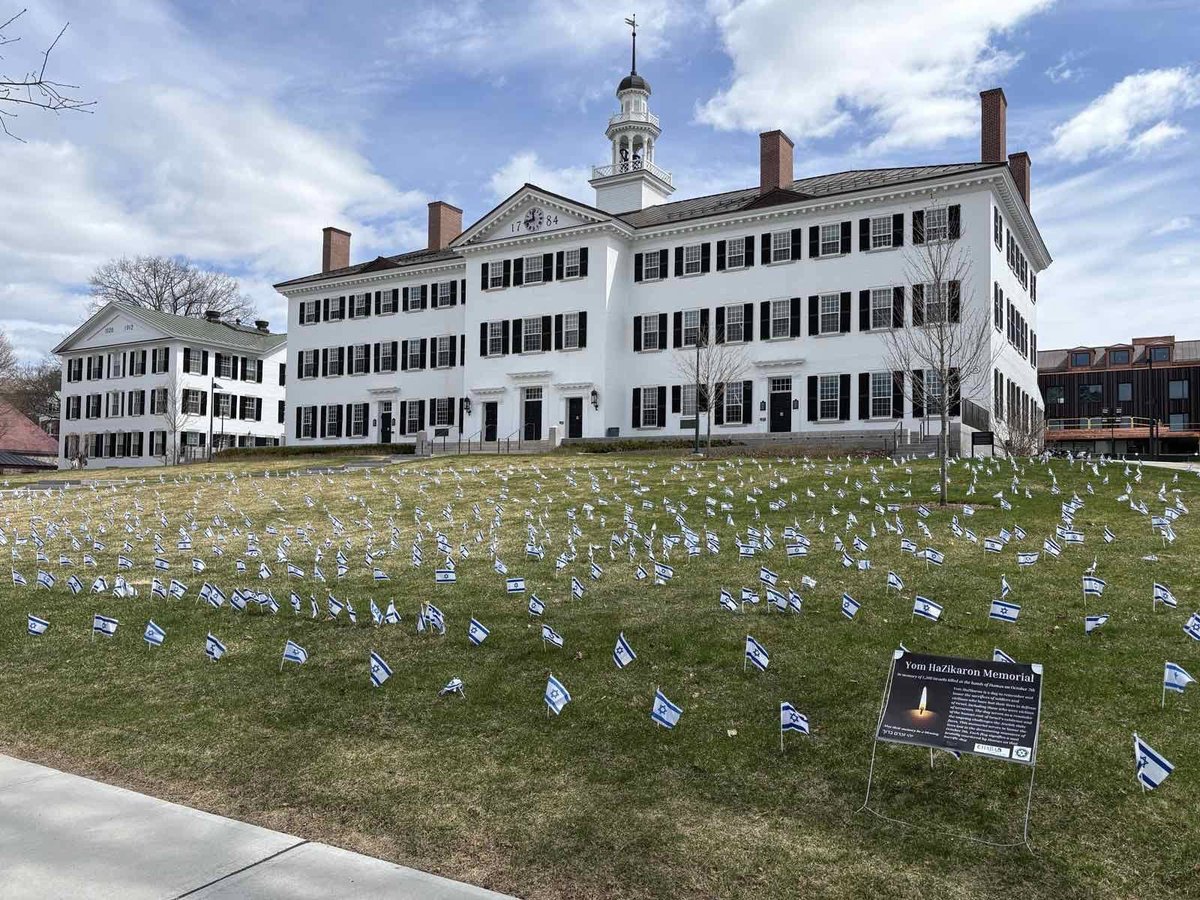
Kudos to @Dartmouth, a different kind of Ivy.
Israeli flags cover the lawn in front of Dartmouth Hall, the most central and visible place on campus, in honor of Yom HaZikaron, Israeli Memorial Day. Sponsored by Hillel and Chabad together.
English
Glad that the AI revolution is infecting your brain (sorry about the sleep).
When we moved to AWS in 2012, we could move faster. We didn't need to lease a new server, wait for it to arrive, and set it up before we could start doing application-specific work on it. Over the next few years, I realized that that wasn't the biggest benefit; three other benefits that I didn't anticipate: 1. It dramatically lowered the bar on experimentation. We didn't have to sign a multi-year lease for each server; we could switch them on, experiment, and turn them off. Amazing unlock. 2. It improved the quality of all of our systems because AWS had primitives that made it easy for us to implement failover, geographic redundancy, and sophisticated code roll-out. Among other benefits, this enabled much better A/B testing, making it much easier to test and iterate. 3. It gave us access to cutting edge technologies without having to master operating them: queues, notifications, dynamo db, kubernetes, etc.etc.etc. Also made operations much more secure and commercial-grade. Not directly relevant to the AI/Agent revolution that is happening now, but some form of Jevon's Paradox will certainly be at play where we do so much more because it is all so much easier.
I've been having fun playing with OpenClaw. I’m working on a skill to help me find important documents in my email attachments and put them in the right place in my files. Next up, file images of receipts and other things I snap pictures of that I want filed. After that, I plan to vibe code one or more personal dashboards.
The rate of development and improvement on the OpenClaw open source project is orders of magnitude greater than any other project I've ever seen, giving me my first real peek at what is actually happening with these tools.
English
If you haven't donated to Marie already, please do!
Marie Hurabiell for Congress@MHurabiell
URGENT: We need 250 more individual donors by end of day to reach the necessary threshold for the SF League of Women Voters Debate on 4/29. Please share this post and make a contribution of any size if you haven't already! secure.actblue.com/donate/marie-h…
English