Adam Baitch

239 posts

Adam Baitch banner
Adam Baitch

Adam Baitch

@adambaitch

I tweet, therefore I am

New York, USA Katılım Mayıs 2011
2K Takip Edilen279 Takipçiler
Sabitlenmiş Tweet
Adam Baitch
Adam Baitch@adambaitch·
There's a sign at Meta's headquarters in Menlo Park. On one side it says Meta. On the other, facing away from the road, it still says Sun Microsystems. When Facebook moved into the former Sun campus, Zuckerberg kept the old logo on the back of the sign as a reminder of what could happen if they stopped innovating. Last Friday, Salesforce announced that Heroku is entering "sustaining engineering." No new features, and no new contracts. Maintenance mode. We all know what that means. When I started in tech, Heroku was the platform you used to build new projects. Every startup, every hackathon, every bootcamp ran on Heroku. It was the obvious choice. What killed Heroku was getting acquired. More specifically, getting acquired by a parent company whose interests were not aligned with those of its customers. Salesforce bought Heroku in 2010 for $212 million. From the outside, it looked like game over for anyone building in the same space. Who competes with Salesforce's resources? The truth though, was that Salesforce bought Heroku as a cross-sell tool for their enterprise accounts. Tod Nielsen, Heroku's CEO from 2013 to 2016, said Salesforce "did a great job of expanding Heroku within corporates," but "what they gave up was all the 'cool kid' innovation." The small developer, the person who actually made Heroku what it was, stopped being the priority the day the deal closed. So the platform froze. Docker, Kubernetes, serverless, edge computing… all the latest advances in cloud. Heroku shipped none of it. Then in 2022, they killed the free tier. Every future engineering lead who would've discovered Heroku on a weekend project went somewhere else instead. Five years after the acquisition, Vercel was founded. Vercel built Next.js, an open-source React framework, then made the platform the natural place to run it. And they kept their free tier. All of the hobbyists, students, startups… Heroku handed them that entire pipeline. Vercel grew revenue 82% year-over-year through 2025 and recently raised at a $9.3 billion valuation. Over 40x higher than Heroku’s exit value. When the incumbent in your space gets acquired by a big enterprise company, you can often predict what comes next. The acquirer optimizes for enterprise revenue, the product freezes, the community drifts. And the acquirer doesn't notice for years because the sales machine allows enterprise contracts to keep growing... for a while. The unlimited resources come with new priorities, and those priorities will slowly pull them away from the thing that made them good. Heroku is now the logo on the back of the sign. Vercel is well on its way to IPO. If your biggest competitor just got acquired, it could end up being the biggest opportunity yet.

Adam Baitch tweet media
English
0
0
0
171
Adam Baitch retweetledi
Mason Capital
Mason Capital@mason__capital·
Underrated excerpt from $FIG earnings CFO - "We are also investing in first-party models trained on Figma's design corpus to improve performance on design-specific tasks while reducing cost." This is huge While the labs are all over the place, Figma has a chance to ship a frontier design-focused model
English
6
4
82
14.3K
Adam Baitch
Adam Baitch@adambaitch·
Adam Baitch tweet media
Adam Baitch@adambaitch

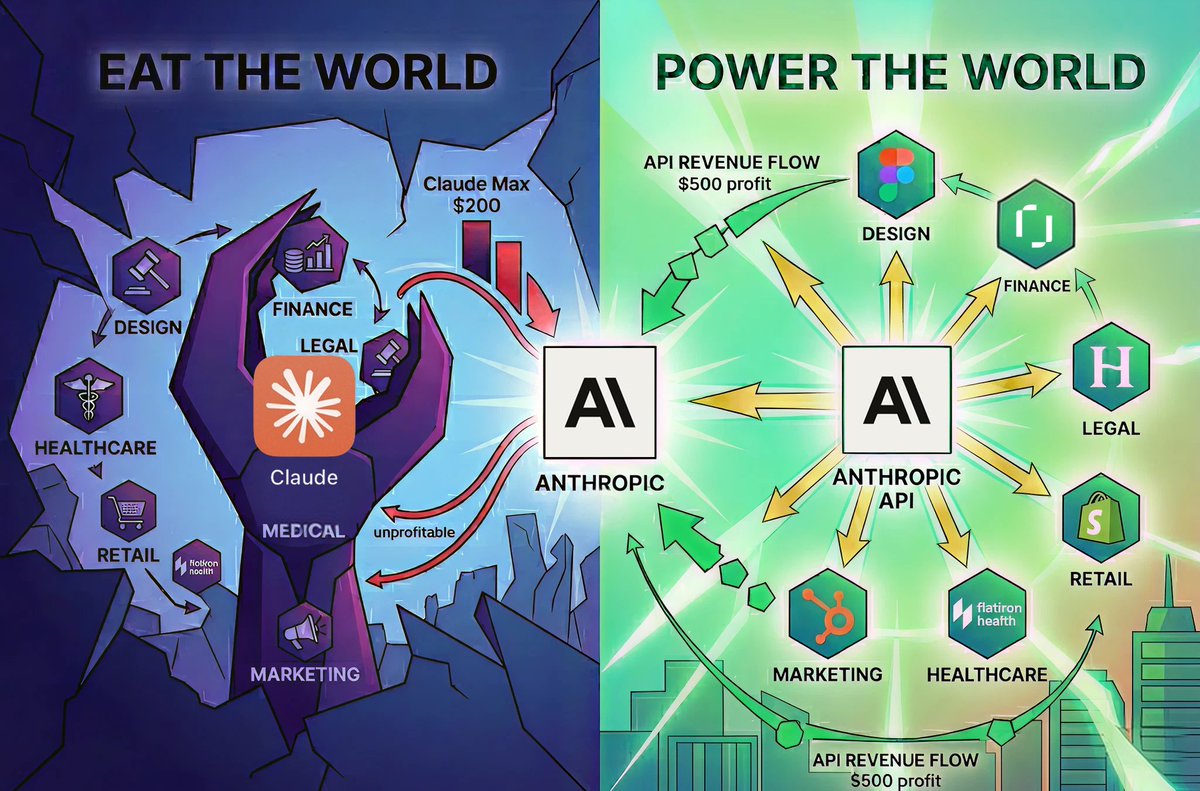
Each time Anthropic releases an industry-specific plugin for Claude, the market reacts violently. My conspiracy theory: this is a very intentional product strategy, but the point is not to replace SaaS companies with these plugins that “Sherlock” other products. I don’t think they expect, or even want, most consumers to seriously adopt Claude for everything. The point is to scare other companies into competing with Claude and building AI products as fast as possible. When Anthropic adds these proofs-of-concept to Claude, it demonstrates that Claude could absorb parts of other products. So, every software must rush to embed more AI into their workflows, agents, copilots, automations, etc. Which, conveniently, means spending more money on Anthropic API compute. And that is how Anthropic really makes their money. Consumer Claude is Anthropic's loss-leader. If it were to replace everything for users, compute costs per user would explode (even more than they currently are), and monthly prices would have to skyrocket to prohibitive levels in order to maintain Anthropic's business. But since Anthropic's API makes money on a usage basis, their revenue from other businesses' usage can scale much more smoothly. It's up to that other business to make their unit economics work. For other software companies, this may still be good news. It means that even though it may seem like Claude is trying to make them obsolete, they're likely to only go so far, leaving room to build a more tailored, complete product set for customers. So there is still a ton of room to win, especially if you operate in a compliance-heavy space like legal, healthcare, finance, etc. The challenge is still solving for what Claude won't solve, and doing so profitably. As for Anthropic, the strategy is brilliant. This is how they will absorb not only their own massive war chest of VC funding, but funnel everyone else’s back to themselves as well.

English
0
0
0
27
Adam Baitch retweetledi
Bilal Zuberi
Bilal Zuberi@bznotes·
I remind myself of this quite often.
Bilal Zuberi tweet media
English
84
457
6K
752.3K
Adam Baitch
Adam Baitch@adambaitch·
Each time Anthropic releases an industry-specific plugin for Claude, the market reacts violently. My conspiracy theory: this is a very intentional product strategy, but the point is not to replace SaaS companies with these plugins that “Sherlock” other products. I don’t think they expect, or even want, most consumers to seriously adopt Claude for everything. The point is to scare other companies into competing with Claude and building AI products as fast as possible. When Anthropic adds these proofs-of-concept to Claude, it demonstrates that Claude could absorb parts of other products. So, every software must rush to embed more AI into their workflows, agents, copilots, automations, etc. Which, conveniently, means spending more money on Anthropic API compute. And that is how Anthropic really makes their money. Consumer Claude is Anthropic's loss-leader. If it were to replace everything for users, compute costs per user would explode (even more than they currently are), and monthly prices would have to skyrocket to prohibitive levels in order to maintain Anthropic's business. But since Anthropic's API makes money on a usage basis, their revenue from other businesses' usage can scale much more smoothly. It's up to that other business to make their unit economics work. For other software companies, this may still be good news. It means that even though it may seem like Claude is trying to make them obsolete, they're likely to only go so far, leaving room to build a more tailored, complete product set for customers. So there is still a ton of room to win, especially if you operate in a compliance-heavy space like legal, healthcare, finance, etc. The challenge is still solving for what Claude won't solve, and doing so profitably. As for Anthropic, the strategy is brilliant. This is how they will absorb not only their own massive war chest of VC funding, but funnel everyone else’s back to themselves as well.
English
0
0
0
47
Adam Baitch retweetledi
PJ Ace
PJ Ace@PJaccetturo·
This is one of the best short films I've seen in years. Very soon, we'll stop calling it "AI film" and just call it film.
English
2.3K
6.3K
82.7K
13.6M
Adam Baitch
Adam Baitch@adambaitch·
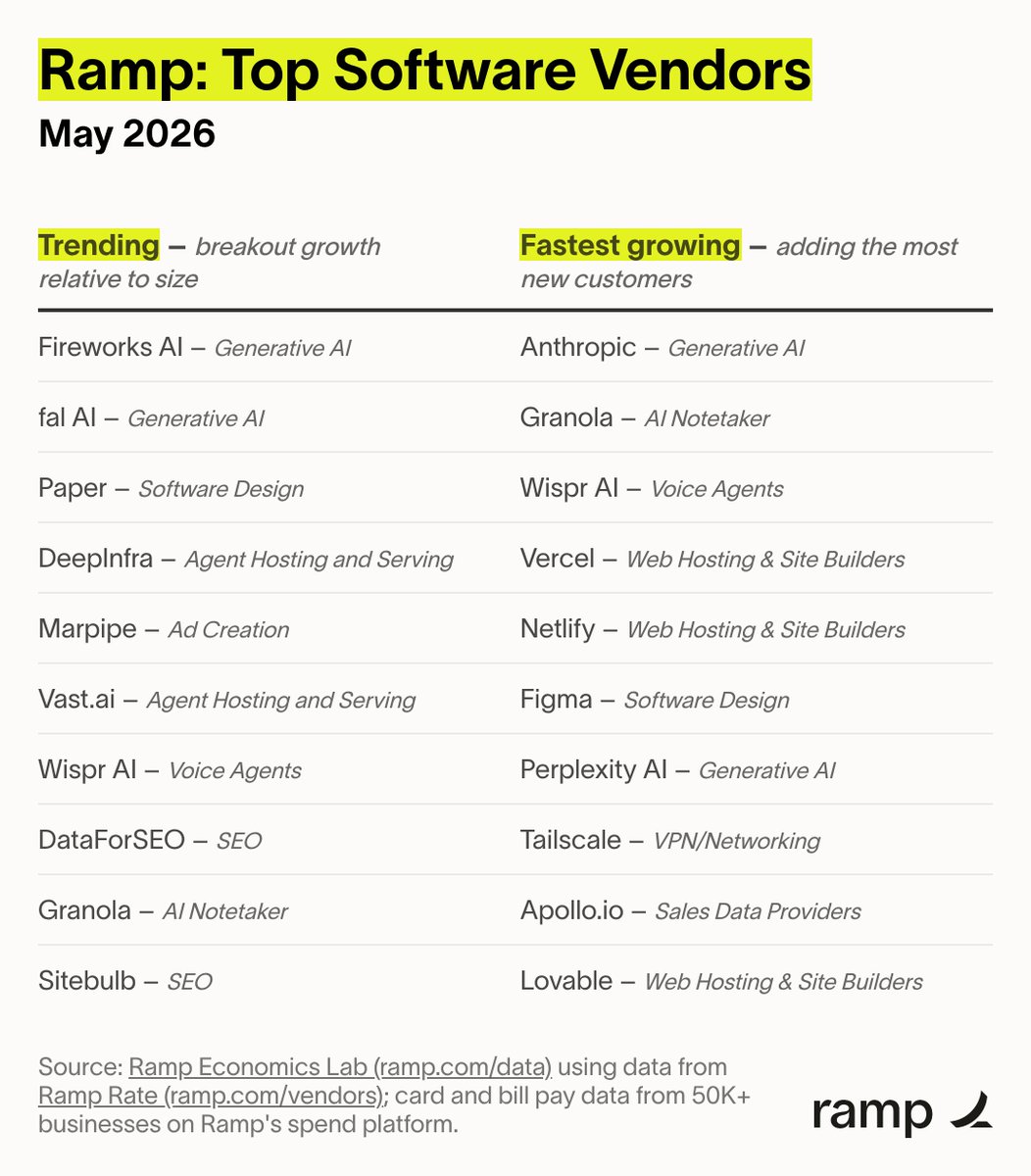
$FIG reports earnings on 5/15. It's down 90% since the high post-IPO, on a narrative of AI disruption. I'd imaging Ramp's data captures more of Figma's target market than other data sets. If this data is indicative, Figma is one of the fastest growing vendors out there, bucking the disruption narrative. @arakharazian it would be really cool to see fastest growing by spend! Not financial advice - DYOR
English
2
0
9
4.9K
Ara Kharazian
Ara Kharazian@arakharazian·
Ramp TOP SAAS VENDORS MAY 2026 @tryramp 1. FIGMA is a fastest growing vendor, and the only publicly traded company on our list. Now competing with Claude Design. 2. AI inference platforms grew as businesses opted for cheaper models to combat exploding token budgets. 3. It's a great time to be in web deployment (Vercel, Netlify, Lovable)
Ara Kharazian tweet media
English
22
22
210
216.3K
Alex Bouaziz
Alex Bouaziz@Bouazizalex·
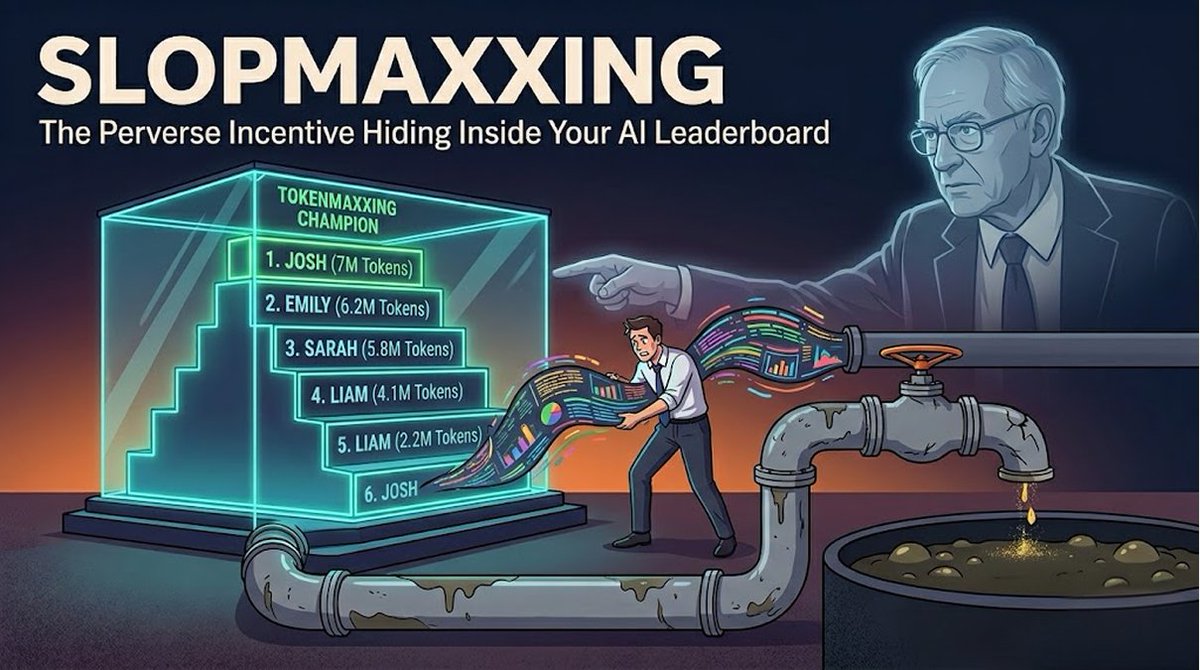
Token spend will be on your next performance review. Maybe not next quarter. But soon. Boards and CEOs are already asking. Everyone bought Claude Code, Cursor, and a dozen other AI tools. Nobody can tell you what came out of it. Adoption isn't proficiency, and most companies have zero idea who's actually getting value from any of it. Deel Engage closes that gap. We integrate with Anthropic and every major LLM. AI usage lands next to KPIs, feedback, and competencies in your reviews module. One view of AI maturity across every location, time zone, and employment type. No manual stitching. What we measure: token spend across every major LLM provider. Where direct data isn't available, we approximate from usage patterns. One number, consistent across every tool and team. Is it the whole story? No. It's gameable. Anyone can burn tokens to look busy. But it's a real signal in a space where most companies have zero. And as Anthropic and the other model providers ship deeper analytics, Engage absorbs them. Sharper signal, faster than you could build it. Your next review cycle is the test. Walk in with data, or walk in guessing. Deel Engage is the difference! Full article below
English
25
19
265
140.3K
Adam Baitch
Adam Baitch@adambaitch·
@arakharazian and the Economics Lab team at @tryramp have been publishing some awesome data lately. With 50k+ businesses on the platform, this data set serves as a sort of proxy for where business spend is going across the overall market. I built a little terminal dashboard on top of their public API! Play around with it here: rampdata.info/categories/gen… Some examples of what you can see: 1. How are the different AI providers' market share changing over time? 2. Which software vendors are growing the fastest? 3. Which vendors have the highest adoption and how is it changing? 4. Click or search for a vendor to see its statistics ...and much more!
Adam Baitch tweet media
English
0
0
2
63
Adam Baitch
Adam Baitch@adambaitch·
The way things are going, in a few years’ time, digital interfaces will streamed pixel by pixel directly from diffusion models. All code-based constraints on software will go away. Each individual will be able to access their own personal AI environment from basically any display on earth, streamed from the cloud in real time. There will not be as large a need for personal devices as they converge on simple portals to the hive mind. Hosted agents like Perplexity Computer are already heading this direction, and generative UX has been a hot topic for a while now. Frontier models can already write frontend code in real time to give users interactive elements to chat interfaces. But that’s just level 1. Fast, reliable, fully nondeterministic interfaces will be the next big unlock for software.
Zain Shah@zan2434

Imagine every pixel on your screen, streamed live directly from a model. No HTML, no layout engine, no code. Just exactly what you want to see. @eddiejiao_obj, @drewocarr and I built a prototype to see how this could actually work, and set out to make it real. We're calling it Flipbook. (1/5)

English
0
0
0
75
Adam Baitch retweetledi
Sterling Crispin 🕊️
Sterling Crispin 🕊️@sterlingcrispin·
The Plan? Start a VC fund for "everyone" but only invest in companies they've already missed at insane valuations deep into series G rounds. We'll charge them 3% for something they can't even sell. Think about it. Hedge fund fees for VC illiquidity with mutual fund marketing.
Sterling Crispin 🕊️ tweet media
Naval@naval

Introducing USVC - a single basket of high-growth venture capital, for everyone. No accreditation required, SEC-registered, and a very low $500 minimum. Includes OpenAI, Anthropic, xAI, Sierra, Crusoe, Legora, and Vercel. As USVC adds more companies, investors will own a piece of that too. Liquidity typically comes when companies exit, but we’re aiming to let investors redeem up to 5% of the fund every quarter. This isn’t guaranteed, but if we can make it work, you won’t be locked up like in a traditional venture fund. It runs on AngelList, which already supports $125 billion of investor capital. And I’ve joined USVC as the Chairman of its Investment Committee. — Go back to the 1500s, you set sail for the new world to find tons of gold - that was adventure capital. Early-stage technology is the modern version. It says we are going to create something new, and it’s risky. It’s daring. But ordinary people can’t invest until it’s old, until it’s no longer interesting, until everybody has access to it. By the time a stock IPOs, most of the alpha is gone. The adventure is gone. Public market investors are literally last in line. This problem has become farcical in the last decade. Startups are reaching trillion dollar valuations in the private markets while ordinary investors have their noses up to the glass, wondering when they’ll be let in. Investing in private markets isn’t easy. You need feet on the ground. You need judgment built over years. Most people don’t have the patience to wait ten or twenty years for an investment to come to fruition. But there is no more productive, harder-working way to deploy a dollar than in true venture capital. USVC enables you to invest in venture capital in a broad, accessible, professionally-managed way, through a single basket of innovation, focused on high-growth startups, at all stages. It is how you bet on the future of tech: the smartest young people in the world, working insane hours, leveraged to the max, with code, hardware, capital, media, and community. Your dollar doesn’t work harder anywhere. There is an old line - in the future, either you are telling a computer what to do, or a computer is telling you what to do. You don’t want to be on the wrong side of that transaction. USVC lets you buy the future, but you buy it now. Then you wait, and if you are right, you get paid. Get access here: usvc.com

English
67
102
2K
202.7K
Ara Kharazian
Ara Kharazian@arakharazian·
Ramp data is now available via API We built Ramp AI Index and Ramp Rate to better inform business decisionmaking. In the process, they became economic indicators in their own right. So, press, researchers, investors, policymakers, anyone trying to vibecode a bloomberg terminal >> it's free
English
7
9
158
36K
Ellen DaSilva
Ellen DaSilva@ellenjdasilva·
Extremely specific life advice: you can convert Fahrenheit to Celsius with the stops on the 6 train. 33 St =0° 42 St=5° 51 St=10° 59 St=15° Works to 96th St!
English
79
548
9.1K
512.9K