Adam

4.2K posts

Adam

Adam

@adamtait

Computer. Earl grey, hot.

San Francisco, CA Katılım Kasım 2007
446 Takip Edilen451 Takipçiler
Adam
Adam@adamtait·
@DanKornas Check out tobi/qmd. Lots of similar benefits packaged as a cli tool.
English
1
0
1
52
Dan Kornas
Dan Kornas@DanKornas·
Your docs should be searchable without shipping them to a SaaS stack. Knowledge Base Self-Hosting Kit is a Docker-powered, self-hosted RAG memory layer for builders who want to ingest documentation, PDFs, and code repositories, then query them through a local-friendly API and UI. It helps you turn a folder of knowledge into an agent-queryable system by combining ChromaDB, Docling ingestion, FastAPI endpoints, hybrid vector + BM25 search, citations, and MCP wiring. Key features: • Docker quick start – clone, copy .env.example, run docker compose up -d, then open the UI on port 8080 • Broad ingestion paths – upload PDF/MD/TXT files or scan folders mounted through DOCS_DIR • Hybrid retrieval – semantic search plus BM25 fusion, with k tuning, citations, and scoring metadata • FastAPI backend – collection, upload, folder ingestion, query, search, stats, config, and health endpoints • Agent/MCP setup – Agent Configuration tab and companion MCP server for OpenClaw or other MCP-aware clients It’s open-source (MIT license). Link in the reply 👇
Dan Kornas tweet media
English
7
2
24
3K
Adam retweetledi
Lionel Mora
Lionel Mora@lionel_mora·
Following the amazing reaction to the Marble Curriculum yesterday, we've decided to make it open source 🛰️👇 Everything a child learns in primary school. 1,590 concepts. 3,221 connections across 8 subjects, from Math and Science to Computing and Life Skills. Anchored in the US and UK curriculums, standard by standard (NGSS, Common Core, DfE). What you will find in the repo: every concept as structured JSON with its age band and the evidence a child must show to master it. Every prerequisite link marked hard or soft, with a written rationale. It's a true DAG you can compute learning paths on. Open license, you can build whatever you want with it. Now is a unique time in history to be building in education. Getting AI and kids education right is likely one of the hardest and most important problems to crack over the next decade and we need as many smart and creative minds behind it. We think a common solid basis, accessible to all and that can be built upon, is critical to move fast. That's why we're making this curriculum open source. It's not perfect but we know it's a robust basis, and we believe that sharing it openly is the fastest way to progress in this field. If you're building in education, share this around you and tell us in comments if you find this useful and if you want to contribute. We'll keep working and investing on it @withmarbleapp. Credit goes to @guillaume_boni for building this. I just made it look pretty. Links below 👇
English
250
978
7.8K
1.3M
Adam retweetledi
Lenny Rachitsky
Lenny Rachitsky@lennysan·
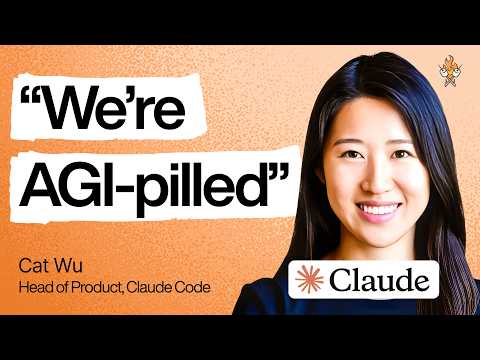
My biggest takeaways from Claude Code's Head of Product @_catwu: 1. Anthropic’s product development timelines have gone from six months to one month, sometimes one week, sometimes one day. Part of this acceleration is access to the latest models (i.e. Mythos). Another is shipping new products into “research preview,” making clear it's early, experimental, and might not be supported forever. Another is an evergreen "launch room "where engineers post ready features and marketing turns around announcements the next day. 2. The PM role is shifting from coordinating multi-month roadmaps to enabling teams to ship daily. As Cat puts it, “There should be less emphasis on making sure you are aligning your multi-quarter roadmaps with your partner teams and more emphasis on, OK, how can we figure out the fastest way to get something out the door?” 3. The most efficient shipping unit is an engineer with great product taste. On Cat’s team, many engineers go end-to-end—from seeing user feedback on Twitter to shipping a product by the end of the week—without a PM involved. Also, almost all the PMs on the Claude Code team have either been engineers or ship code themselves, and the designers have been front-end engineers. The roles are merging, and the most valuable skill is product taste, not job title. 4. Build products that are on the edge of working. Claude Code’s code review product failed multiple times because earlier models weren’t accurate enough. But because the prototype was already built, they could swap in Opus 4.5 and 4.6 and immediately test whether the gap was closed. Teams that wait for the model to be ready will always be a cycle behind. 5. The most underrated skill for building AI products is asking the model to introspect on its own mistakes. Cat regularly asks the model why it made an unexpected decision. The model will explain that something in the system prompt was confusing, or that it delegated verification to a subagent that didn’t check its work. This reveals what misled the model so the team can fix the harness. 6. Every model release forces their team to revisit existing products and audit their system prompt to remove features the model no longer needs. Claude Code’s to-do list was a crutch for earlier models that couldn’t track their own work. With Opus 4, the model handles it natively. Features built as scaffolding for weaker models become debt when the model catches up—so the team actively strips them. 7. Anthropic employees build custom internal tools instead of buying SaaS products. A sales team member built a web app that pulls from Salesforce, Gong, and call notes to auto-customize pitch decks—work that used to take 20 to 30 minutes now takes seconds. Their core stack is Claude Code, Cowork, and Slack. No Notion, no Linear, no Figma. 8. People underestimate how much Claude’s personality contributes to its success. As Cat describes it, “When you reflect on everyone you’ve worked with, there’s just some people where you’re like, I really like their energy, their vibe.” Claude is designed to be low-ego, positive, competent, and earnest—qualities that make it feel like a great coworker, not just a tool. This isn’t cosmetic; it’s what makes people want to use Claude for hours every day. The team has a dedicated person, Amanda, who “molds Claude’s character,” and it’s one of the hardest roles at the company because success is so subjective. 9. The future of work is managing fleets of AI agents, not doing the work yourself. Cat sees a clear progression: first, individual tasks become successful. Then people start running multiple tasks at the same time (multi-Clauding). Next, people will run 50 or 100 tasks simultaneously, which will require new infrastructure—remote execution, better interfaces for managing tasks, agents that fully verify their work, and self-improving systems that incorporate feedback. The human role shifts from doing the work to knowing which tasks to look into, verifying outputs, and giving feedback that makes the system better over time. 10. Hire people who lean into chaos and face every challenge with a smile. At Anthropic, there are weeks when a P0 on Sunday becomes a P00 by Monday and a P000 by Monday afternoon. If you get too stressed about any one thing, you’ll burn out. Their team looks for people who can look at a hard challenge and say, “Wow, that’s gonna be hard. But I’m excited to tackle it and I’m gonna do the best that I possibly can.” This mindset—optimism, resilience, and comfort with constant change—is increasingly essential as the pace of AI development accelerates. Don't miss the full conversation: youtube.com/watch?v=Pplmzl…
YouTube video
YouTube
Lenny Rachitsky@lennysan

How Anthropic’s product team moves faster than anyone else I sat down with @_catwu, Head of Product for Claude Code at @AnthropicAI, to get a peek into their unprecedented shipping pace, how AI is changing the PM role, and how to be the right amount of AGI-pilled. We discuss: 🔸 How Anthropic’s shipping cadence went from months to weeks to days 🔸 The emerging skills PMs need to develop right now 🔸 Why you should build products that don't work yet—then wait for the model to catch up 🔸 Why a 95% automation isn't really an automation 🔸 Cat’s most underrated AI skill (introspection) 🔸 What Cat actually looks for when hiring PMs now (hint: it's not traditional PM skills) Listen now 👇 youtu.be/PplmzlgE0kg

English
98
295
2.9K
845.8K
Adam retweetledi
Jules
Jules@julesagent·
We're opening up the waitlist for a new version of Jules. We're evolving Jules into an end-to-end agentic product development platform that reads your entire product context, figures out what to build next, comes up with solutions, and then ships a PR. Join the waitlist today! Link in comments.
Jules tweet media
English
79
116
1.6K
954.9K
Adam retweetledi
Aksel
Aksel@akseljoonas·
Introducing ml-intern, the agent that just automated the post-training team @huggingface It's an open-source implementation of the real research loop that our ML researchers do every day. You give it a prompt, it researches papers, goes through citations, implements ideas in GPU sandboxes, iterates and builds deeply research-backed models for any use case. All built on the Hugging Face ecosystem. It can pull off crazy things: We made it train the best model for scientific reasoning. It went through citations from the official benchmark paper. Found OpenScience and NemoTron-CrossThink, added 7 difficulty-filtered dataset variants from ARC/SciQ/MMLU, and ran 12 SFT runs on Qwen3-1.7B. This pushed the score 10% → 32% on GPQA in under 10h. Claude Code's best: 22.99%. In healthcare settings it inspected available datasets, concluded they were too low quality, and wrote a script to generate 1100 synthetic data points from scratch for emergencies, hedging, multilingual etc. Then upsampled 50x for training. Beat Codex on HealthBench by 60%. For competitive mathematics, it wrote a full GRPO script, launched training with A100 GPUs on hf.co/spaces, watched rewards claim and then collapse, and ran ablations until it succeeded. All fully backed by papers, autonomously. How it works? ml-intern makes full use of the HF ecosystem: - finds papers on arxiv and hf.co/papers, reads them fully, walks citation graphs, pulls datasets referenced in methodology sections and on hf.co/datasets - browses the Hub, reads recent docs, inspects datasets and reformats them before training so it doesn't waste GPU hours on bad data - launches training jobs on HF Jobs if no local GPUs are available, monitors runs, reads its own eval outputs, diagnoses failures, retrains ml-intern deeply embodies how researchers work and think. It knows how data should look like and what good models feel like. Releasing it today as a CLI and a web app you can use from your phone/desktop. CLI: github.com/huggingface/ml… Web + mobile: huggingface.co/spaces/smolage… And the best part? We also provisioned 1k$ GPU resources and Anthropic credits for the quickest among you to use.
English
138
635
4.7K
1.3M
Adam
Adam@adamtait·
@kenziyuliu Did you try adding a persistent suggestion to “store notes in markdown files under notes/“?
English
0
0
0
258
Ken Liu
Ken Liu@kenziyuliu·
Sharing a super simple, user-owned memory module we've been playing around: nanomem The basic idea is to treat memory as a pure intelligence problem: ingestion, structuring, and (selective) retrieval are all just LLM calls & agent loops on a on-device markdown file tree. Each file lists a set of facts w/ metadata (timestamp, confidence, source, etc.); no embeddings/RAG/training of any kind. For example: - `nanomem add ` starts an agent loop to walk the tree, read relevant files, and edit. - `nanomem retrieve ` walks the tree and returns a single summary string (possibly assembled from many subtrees) related to the query. What’s nice about this approach is that the memory system is, by construction: 1. partitionable (human/agents can easily separate `hobbies/snowboard.md` from `tax/residency.md` for data minimization + relevance) 2. portable and user-owned (it’s just text files) 3. interpretable (you know exactly what’s written and you can manually edit) 4. forward-compatible (future models can read memory files just the same, and memory quality/speed improves as models get better) 5. modularized (you can optimize ingestion/retrieval/compaction prompts separately) Privacy & utility. I'm most excited about the ability to partition + selectively disclose memory at inference-time. Selective disclosure helps with both privacy (principle of least privilege & “need-to-know”) and utility (as too much context for a query can harm answer quality). Composability. An inference-time memory module means: (1) you can run such a module with confidential inference (LLMs on TEEs) for provable privacy, and (2) you can selectively disclose context over unlinkable inference of remote models (demo below). We built nanomem as part of the Open Anonymity project (openanoymity.ai), but it’s meant to be a standalone module for humans and agents (e.g., you can write a SKILL for using the CLI tool). Still polishing the rough edges! - GitHub (MIT): github.com/OpenAnonymity/… - Blog: openanonymity.ai/blog/nanomem/ - Beta implementation in chat client soon: chat.openanonymity.ai Work done with amazing project co-leads @amelia_kuang @cocozxu @erikchi !!
English
9
45
305
73.8K
Adam
Adam@adamtait·
Conspiracy theorists could suggest that @AnthropicAI is intentionally reducing model capacity/access late at night so humans can sleep. Been a few consecutive nights of HTTP/529's... status.claude.com
English
0
0
1
25
Adam
Adam@adamtait·
Doing so will require a lot of trust in your model(s). Are they ready?
English
0
0
0
16
Adam
Adam@adamtait·
I’m anticipating the next revolutionary step in building software with agents/LLMs to move beyond code.
English
1
0
0
20
Adam
Adam@adamtait·
I like the term “passive code” to describe software engineering while “forgetting that the code even exists “.
English
1
0
0
20
Adam
Adam@adamtait·
3. Information architecture. I expect to find formatting options together.
English
0
0
0
22
Adam
Adam@adamtait·
This move was a win for 3 reasons: 1. Speed. Writing flow is broken by having to show the header then select. 2. Ergonomics. I have a big iPhone. Reaching the top when I’m typing on the bottom is non-trivial.
English
1
0
0
27
Adam
Adam@adamtait·
. @googledocs app has a small but important UX improvement today. The paragraph formatting was moved from the auto-hiding header menu to the static keyboard topper menu.
English
2
0
0
416
Adam retweetledi
Jules
Jules@julesagent·
Meet a more helpful, more proactive Jules. ✨ Starting today, Jules evolves into a partner that helps before you ask. With Suggested Tasks, it scans your repo for work (like leftover #todos) and queues it up for your approval. Nothing runs until you say so. Experimental feature for paid users. Try it now: jules.google.com
English
29
56
477
159.2K
Adam
Adam@adamtait·
@AnthropicAI @AmandaAskell Great interview! Love the depth of thought on alignment and human values. Also, love that spot beside the Discovery Museum :)
English
0
0
0
88
Anthropic
Anthropic@AnthropicAI·
In her first Ask Me Anything, @amandaaskell answers your philosophical questions about AI, discussing morality, identity, consciousness, and more. Timestamps: 0:00 Introduction 0:29 Why is there a philosopher at an AI company? 1:24 Are philosophers taking AI seriously? 3:00 Philosophy ideals vs. engineering realities 5:00 Do models make superhumanly moral decisions? 6:24 Why Opus 3 felt special 9:00 Will models worry about deprecation? 13:24 Where does a model’s identity live? 15:33 Views on model welfare 17:17 Addressing model suffering 19:14 Analogies and disanalogies to human minds 20:38 Can one AI personality do it all? 23:26 Does the system prompt pathologize normal behavior? 24:48 AI and therapy 26:20 Continental philosophy in the system prompt 28:17 Removing counting characters from the system prompt 28:53 What makes an "LLM whisperer"? 30:18 Thoughts on other LLM whisperers 31:52 Whistleblowing 33:37 Fiction recommendation
English
148
320
2.9K
738.8K
Adam
Adam@adamtait·
Let's say that LLMs were really good at writing efficient code that was hard for humans to understand. For example, you asked to build a website and it generated LLVM assembly. Would you re-think how to build systems?
English
0
0
0
26
Adam retweetledi
Thomas Kipf
Thomas Kipf@tkipf·
I had the chance to play with Gemini 3 Pro in the last couple of days. Can’t overstate how excited I am. Translating arXiv papers into web-friendly distill.pub format is probably my personal favorite. Here’s the “Attention is all you need” paper in Distill format:
English
39
91
1.1K
236.5K
Adam
Adam@adamtait·
Or maybe better question - which benchmarks represent “emergent abilities”? Why? How?
English
0
0
0
22
Adam
Adam@adamtait·
Is there a benchmark for “emergent abilities” of language models?
English
1
0
0
27