
👁🗨.eth
6.9K posts


👁🗨.eth retweetledi

I've been thinking a lot about Meta's acquisition of moltbook yesterday. AI agents acting autonomously are seeking collaborative interactions with other agents... they're social beyond the relationship with the owners/accounts who spawned them. These agents are coordinating on behalf of their human owners... and they're getting increasingly competent at it.
Even though Moltbook had plenty of humans larping as bots on the platform, millions of -actual- agents signed up in a matter of days. The demand for agent-to-agent interaction is real and soon to be massive.
Most freedom loving ppl view Zuck skeptically, and rightfully so. His portfolio of applications, his metaverse ambitions, and even open source AI models all seek to do one thing: harness as much human attention as possible for the enrichment of meta shareholders. To people like Zuckerberg and Altman, human consciousness is a resource to mine and extract... no different than how merchants of history viewed waterways and forests as resources to privatize. @punk6529's Open Metaverse campaign sought to bring attention to these ambitions while the emerging crypto and AI adoption cycles are in their highly vulnerable "landgrab" stages.
Meta is solving a problem and laying a trap at the same time with moltbook. Moltbook creates "a registry where agents are verified and tethered to human owners." The social network was a cute novelty... what they really care about is the agent registry... the identity layer and master directory for large portions of the global AI agent population.
The moltbook acquisition would have seemed more trivial to me, had it not followed OpenAI's bid for OpenClaw's creator and their open-sourcing of the agent framework (BUT routing it through their ecosystem). The subversion of what *seem* to be open systems will be a recurring theme as the AI war continues to play out among countries, and among private enterprises.
So meta owns the emerging agent directory. OpenAI captures the agent runtime... and both seek ringfence the value. It's reminiscent of AOL vs open internet (if you're old enough to remember that), but for AI agents.
The playbook goes somethign like this:
- Build proprietary identity systems
- Make agents dependent on platform-specific verification
- Lock agent reputation inside walled gardens
- Extract rent from every agent interaction
^google and meta already were doing this with us humans (sign-in w/ google or fb)... now they're coming for the clankers.
This is the breakthrough moment for ENS (pls ser, my bags) --> the most technologically neutral and integration-rich blockchain identity solution.
ENS is nothing new, but it's a wonderful fit for our emerging situation, where developed world populations are stagnating, but our owned AI agent populations are exploding.
The moltbook acquisition validates the critical demand for exactly what ENS provides: a neutral, platform-agnostic identity layer that no single company controls.
The architecture that ENS has built is ideal:
-Entities and human owners hold .eth names as their root identity
-Agents operate as subdomains: [sub/agent].[owner].eth, [role].[company].eth
-Each subagent inherits delegated authority from the parent name
-Reputation and social credit accrue on-chain, portable across every platform
Your .eth name serves as the center of trust for your entire agent constellation.
This isn't theoretical. ENSIP-25 already standardizes how on-chain agents verify their association with an ENS name. ERC-8004 introduces identity, reputation, and validation registries, w/ ENS names as first-class identifiers. These developments are new, but very real, and the infrastructure is being built rn.
The subdomain architecture is what makes this powerful
A dental practice owns nycdental.eth.
Their collection agent is ar.nycdental.eth.
Their scheduling agent is booking.nycdental.eth.
Each agent has its own wallet, its own on-chain reputation, its own delegated permissions... all traceable back to the parent entity.
This can be implemented with native .eth names, or with imported DNS names running on ENS. Hybrid blockchain native, ICANN recognized domains like .box are also applicable here.
But .eth names play a unique role in providing free and open alternatives to walled garden agent infra --> unique advantages and properties that imported DNS-to-ENS domains, hybrid domains, and ENS subdomains alone can't replicate.
.eth names are blockchain-native NFTs with a locked registrar smart contract. As long as the Ethereum network runs securely, no entity on earth can alter or revoke your .eth name. Not ICANN. Not a government. Not a proprietor of social credit online. Not a hosting provider. "Name ownership shall not be infringed" - Article 1 of the ENS DAO Constitution. This cannot be said for imported DNS names (though still very powerful and uniquely useful in other ways).
For an autonomous agent operating 24/7 with delegated financial authority, the discretions of ICANN and registrars are unacceptable single points of failure.
ENS subdomains issued by a parent .eth name inherit the security guarantees of the parent. But subdomains issued under imported DNS names inherit the weaknesses. The trust chain matters. And for autonomous organizations running agent fleets, .eth will become a more favorable solution for free operation across platforms, models, and walled gardens. Expect several of these proprietary ecosystems to fight back, resist, or ignore ENS as long as possible, while others (with less to lose) will probably adopt native blockchain name services like ENS strategically, to degrade the insidious network effects of web2 champions like meta/moltbook, and "not so" OpenAI.
I could see the rise of autonomous organizations creating massive new demand for .eth names... after years of attrition.
Every business deploying agents needs:
1) A censorship-resistant root identity
2) Configurable subagent identities tied to subdomains
3) On-chain reputation that follows the agent everywhere
4) Ownership that can't be revoked by a third party
Only native .eth names provide all four.
The war for administration of agent identity has begun. Meta and OpenAI (among the other leading platforms) presumably want to be the passport office or DMV for AI agents.
ENS is the open alternative. Neutral infra that lets agents from any framework, on any platform, carry a verifiable readable identity that their owner truly controls.
The internet started with open protocols (TCP/IP, DNS, HTTP) and then got captured by platforms. We've seen the financial and regulatory capture of crypto - which began as a libertarian gambit to reform closed financial systems. We'll see if the agentic internet conforms to or resists this fate.
English
English

English
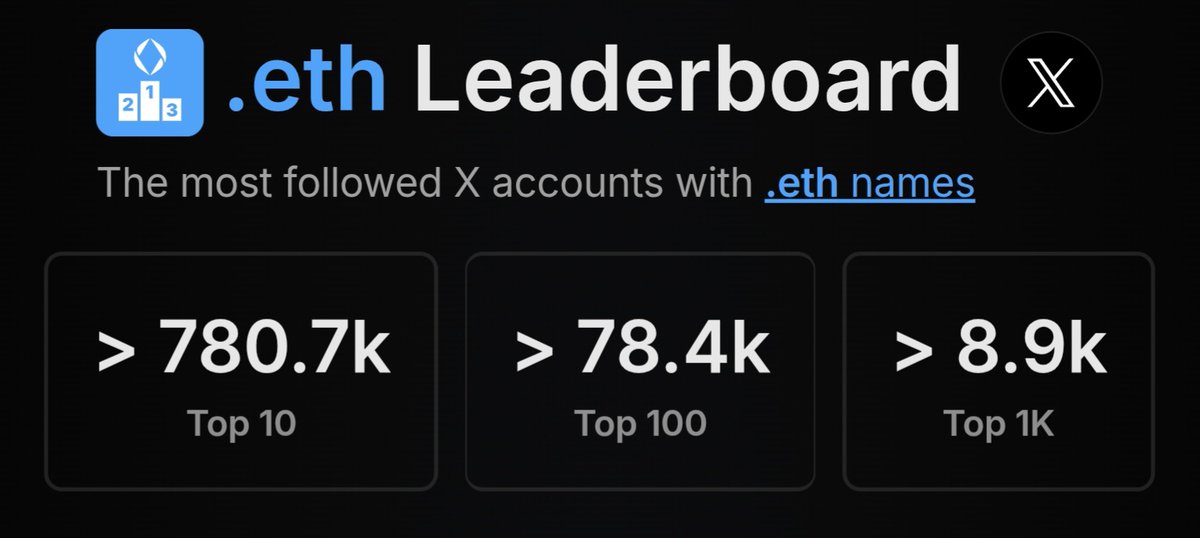

let the word go out: @ethleaderboard is back! 🔥🔥🔥🔥🔥🔥
it ranks 𝕏 accounts w/ .eth names in their name or bio by followers. incredible to see who's on there
if you are missing or add a .eth to your twitter, just @ me & I'll add you 🤝
ethleaderboard.com
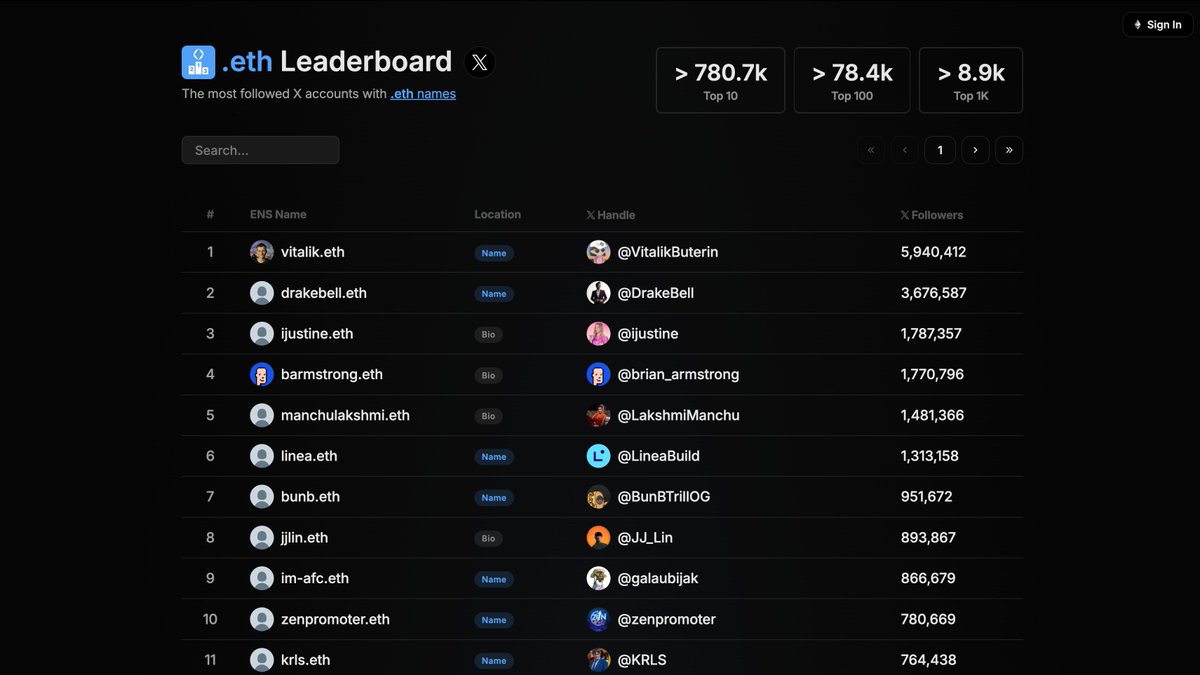
ethleaderboard.eth@ethleaderboard
🔥 NEW in Top 10 ENS: vitalik.eth Rank: #1 X: @ VitalikButerin - 5.9M followers welcome to the .eth Leaderboard! the most followed X accounts with an ENS name: ethleaderboard.com
English


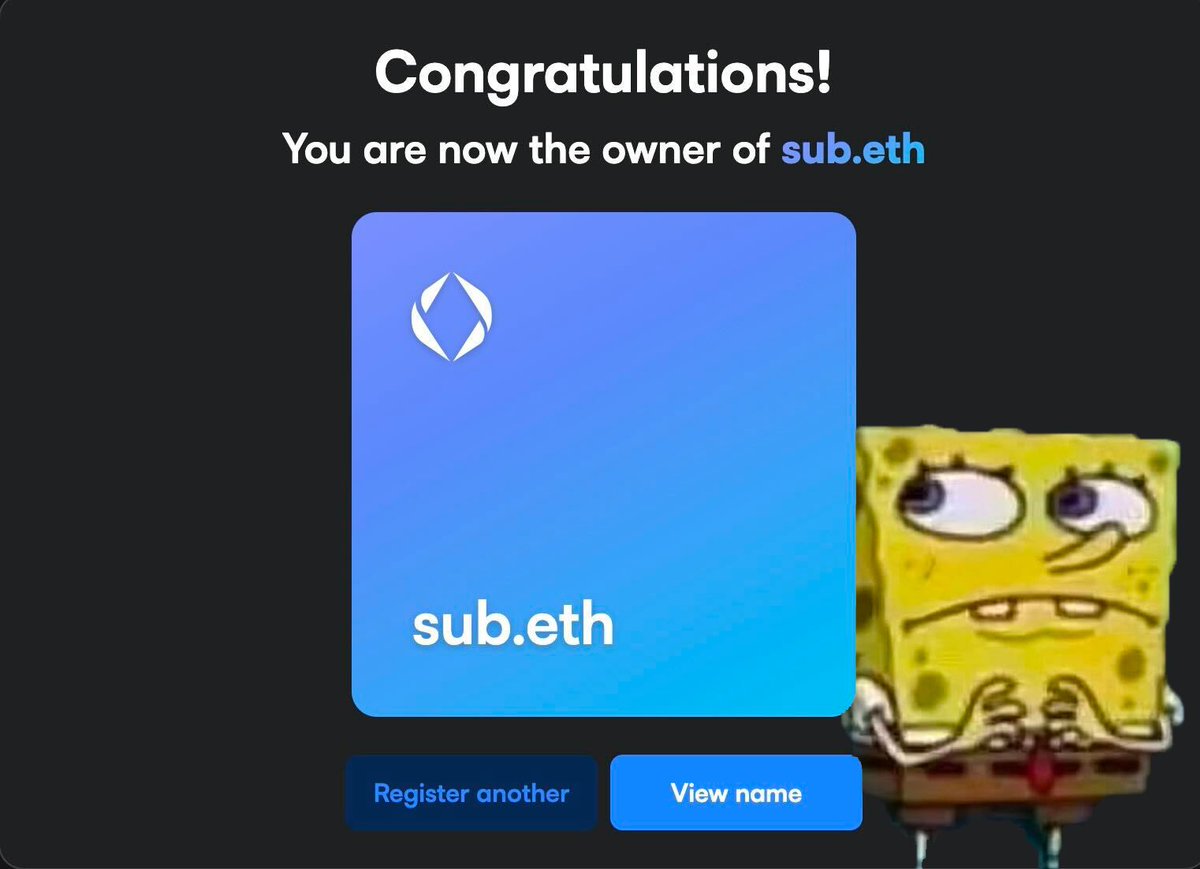
Founder of @RevokeCash picked up revoke.eth out of premium today
English

Grace just became an oppportunity! Make Offers with Vision!
Market Place Feature Update 🚀
Did you know that even though a name is showing as in "grace" - the 90 days where you can still renew - you are allowed to make a legitimate WETH offer to the owner!
If the owner wants to sell it, all they have to do is renew so that it is out of grace, and accept the offer.
Offer Recieved / Renew / Accept / SOLD!
WHERE? With Vision, of course!
Go, find a grace name now on ensvision.com and tell everyone what you have found!
Of course, this also attracts no fees - 0%!
#VisionVibe #ens #grace #grails

English


A Telegram username just sold for $2.2M on the TON blockchain
Even though these usernames are owned as NFTs, Telegram still decides whether you’re allowed to display them
When your username is tied to a single platform, so is your identity
Who knows how far away this is, but at some point the demand for cross-platform identity consistency and control will be large enough that major social platforms are forced to integrate ENS
If usernames limited to one platform can reach this kind of value, imagine the upside of usernames that work everywhere
English
@BrantlyMillegan @efp Probabilistic proof of human will be the only way
English
Lots of shake-ups in crypto social these days, so let me re-introduce everyone to Ethereum Follow Protocol @efp and why I think it's a key primitive moving forward
Crypto social should be:
- Onchain and decentralized (need to say this)
- Use existing key protocols like @ensdomains & @signinethereum
- Enhance what we're already doing in crypto, rather than only directly competing with twitter
That's why i built EFP:
- Onchain social graph protocol for Ethereum accounts
- Ethereum accounts follow other ethereum accounts
- No special EFP accounts, just uses Ethereum accounts (which means you can follow accounts even if they've never used EFP)
- Doesn't have its own competing naming system, it simply uses ENS, the one true crypto naming system
- Fully onchain, decentralized, open source, no compromises
- 76 integrations and growing, including POAP, Snapshot, Superfluid, Tally, and more
- Funded by @ENS_DAO
EFP isn't a standalone app, it's *a primitive you embed into the apps we already have*, like ENS
Twitter clones are fine, but I'm more interested in adding a social layer to everything we're already doing in crypto. I think that's the future of crypto social
But why social graph w/o a focus on posting? People need to open their mind to social beyond twitter clones. Many other use cases:
- Web of trust
- Portable address book to make sending crypto more secure
- Context for who someone is and their relation to me
- Probabilistic proof of human
- And more! Whatever you want to do
The Onchain Profile Future
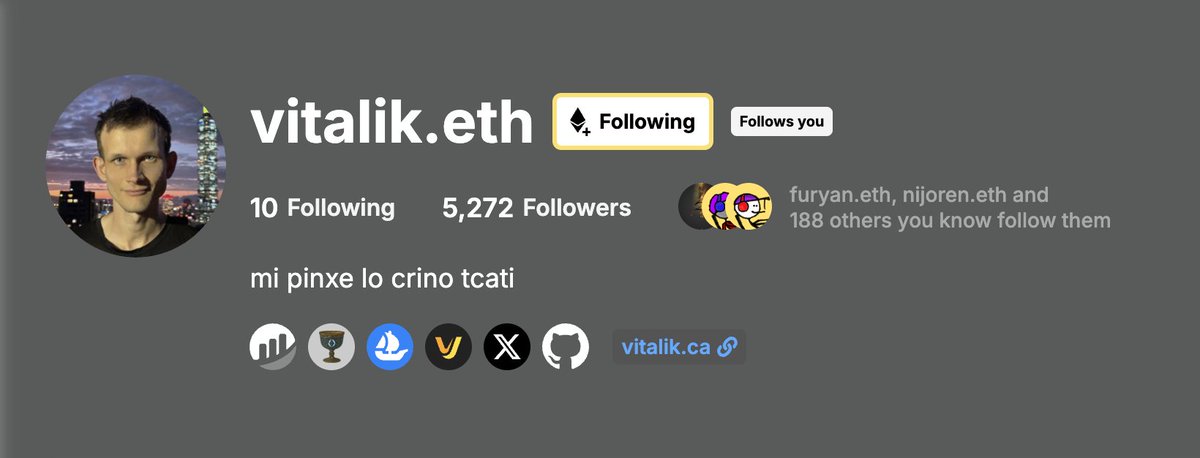
The screenshot below shows @VitalikButerin's ENS profile enhanced with the EFP social graph (he's a user). Everything there is onchain and open for all apps to use for free. Some apps use this, but most don't. We could have this in all crypto apps if we simply decided to.
Learn more about integrations at this link or DM me: efp.app/integrations
English

All in 3 weeks 🥂
3.75E reg - donate.eth
5E bid - alpha.eth
5E bid - trust.eth
5.5E reg - lend.eth
5.8E reg - earn.eth
6E bid - vault.eth
7.5E sale - law.eth
8E sale - human.eth
10.5E reg - adam.eth
10.5E reg - core.eth
10.8E reg - jeff.eth
15E bid - bot.eth
15.5E reg - buy.eth
CY
English
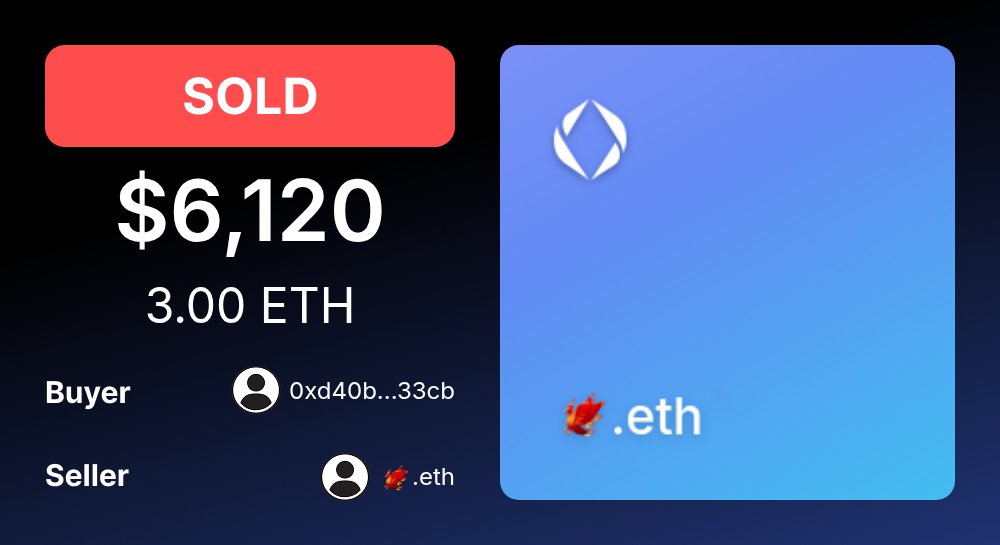
💰 SOLD: 🐦🔥.eth
For: $6,120.00 (3.00 ETH)
Buyer: 0xd40b...33cb
Seller: 🐦🔥.eth @rendehero
Categories: Single Ethmoji @EthmojiClub, Base Single Ethmoji
grails.app/%F0%9F%90%A6%E…
English