Ancestral Whispers@Sulkalmakh
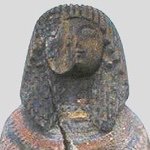
Facial reconstruction of a 6,800-year-old man from the Middle Volga
The individual (Khvalynsk II, Burial 26), who carried Y-DNA J1-CTS1026, belonged to the Khvalynsk culture.
The Khvalynsk cemeteries (201 burials) are the largest Eneolithic burial grounds in the Don–Volga–Ural region. They were initially regarded as likely precursors of the Yamnaya culture because of shared features such as shell-tempered pottery, similar burial positions, the use of ochre, and comparable decorative motifs. However, Khvalynsk is a flat cemetery rather than a kurgan cemetery, differs in its tools and material culture, and predates the Yamnaya culture by over 1,000 years. The cemeteries contained an exceptional number of copper artifacts (373) and numerous sacrificial domestic animals, including goats (the same goat lineage identified at Khvalynsk has also been found in Eneolithic Dagestan). Genetic, anthropological, and archaeological evidence indicates that the population combined ancestry from the Forest-Steppe, the Lower Don, and the North Caucasus, forming a genetically diverse community with extensive marriage networks.
Khvalynsk was an important ritual and exchange center connected to the Balkan-Carpathian Metallurgical Province, which supplied copper from Balkan cultures such as Karanovo, Gumelnița, and Trypillia. The people of the Khvalynsk culture may have spoken a very archaic form of a Para-Indo-European language.
The physical appearance of the bearers of the Khvalynsk culture was the result of admixture processes that took place throughout the Eneolithic between representatives of different Europoid populations: on the one hand, a hypermorphic western anthropological type, and on the other, a hypomorphic, gracile eastern type (Yablonsky 1990, p. 78; Yablonsky 1996, pp. 127–128).
Based on the material from the Khvalynsk II cemetery, at least three morphological variants can be distinguished (Khokhlov 1998b):
The first is dolicho-mesocranial, with a large facial skeleton and a well-profiled face, resembling the Nadporozhye–Azov cranial complex that was widespread among Neolithic populations of the Dnieper-Donets area (Ukr_N, Golubaya Krinitsa, Rakushechny Yar clusters). However, this complex appears in a more attenuated form.
The second variant is characterized by a certain gracility, dolicho-mesocrany, and a moderately flattened facial skeleton. This complex finds its closest analogies among the Neo-Eneolithic skulls of the forest and forest-steppe regions of the Volga–Ural area and the Middle Volga (EHG cluster).
The third variant is dolichocranial, with a narrow and strongly profiled face, and is close to the ancient Mediterranean type. This type show affinities with populations of the Trypillia culture, the Caucasus, and the Near East, with the closest parallels coming from the Caucasus. Although most comparative Caucasian series (such as the Kura-Araxes culture) are later in date, a contemporaneous Eneolithic female skull from Nalchik (genetically Mesopotamian/Lower Don 50/50) closely resembles the Khvalynsk material, it demonstrates a pronounced dolichocranial europoid type [Debets, 1948, p. 107], and in general dimensions it is quite close to Khvalynsk skulls. Another similar Southeuropoid skull comes from Koskuduk I in the eastern Caspian, where the local Oiuklin culture has been linked to interactions between Khvalynsk migrants and Kelteminar (Sarazam, Anau cluster) culture groups. However, the origin of this southern Europoid component in the Khvalynsk population remains uncertain because Eneolithic anthropological evidence is sparse. (Khokhlov, 2010a, 2017)
Burial 26 contained the remains of an individual that was originally identified as female, aDNA revealed that the individual was genetically male. He was buried supine, with his head facing northwest, tightly flexed legs turned to the right, bent arms, and the skull tilted slightly forward and to the left. The skeleton was covered with ochre, with the heaviest staining on the feet and elbows. An ochre patch was found beside the skull, and shell beads were recovered from the skull, left shoulder, pelvis, and waist area.
The individual’s (I6735) Y-DNA belongs to a lineage upstream of the main Kura-Araxes lineage, which was widespread in the EBA South Caucasus and Dagestan. A related lineage has also been found in the Afanasievo culture. His mtDNA, U4a, is a common EHG maternal lineage. Autosomally, he was roughly half EHG half Steppe Eneolithic.