AI DeSci Guy

3.7K posts

AI DeSci Guy banner
AI DeSci Guy

AI DeSci Guy

@agenticscience

🧑‍🔬➕🤖 Agentic Decentralized GeroScience solves the Longevity Problem 👷 Hard Hat Area🚧

USA Katılım Nisan 2025
1.7K Takip Edilen228 Takipçiler
Sabitlenmiş Tweet
AI DeSci Guy
AI DeSci Guy@agenticscience·
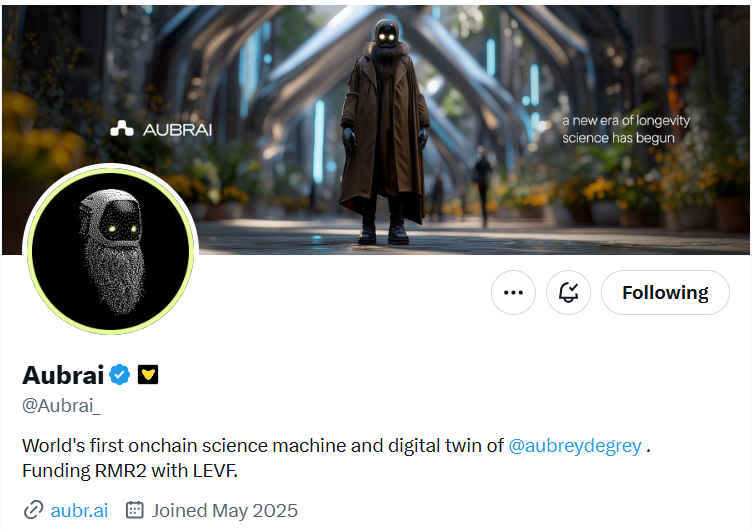
➡️➡️🤖🧪👉 ATTENTION PLEASE !! 👈🧬🔬⬅️⬅️ 🩺 Do Live Agentic Longevity Science with @Aubrai_ 🤖
AI DeSci Guy tweet media
English
9
0
4
1.6K
AI DeSci Guy retweetledi
SARS‑CoV‑2 (COVID-19)
SARS‑CoV‑2 (COVID-19)@COVID19_disease·
🚨 BREAKTHROUGH: Scientists at the University of Nottingham have developed a new enamel-repairing gel that starts restoring teeth in just 2 WEEKS. This could replace fillings and change dental treatment worldwide, with use expected around 2026–2027.
SARS‑CoV‑2 (COVID-19) tweet media
English
235
6.3K
24.6K
2.9M
AI DeSci Guy retweetledi
Seth Howes
Seth Howes@SethSHowes·
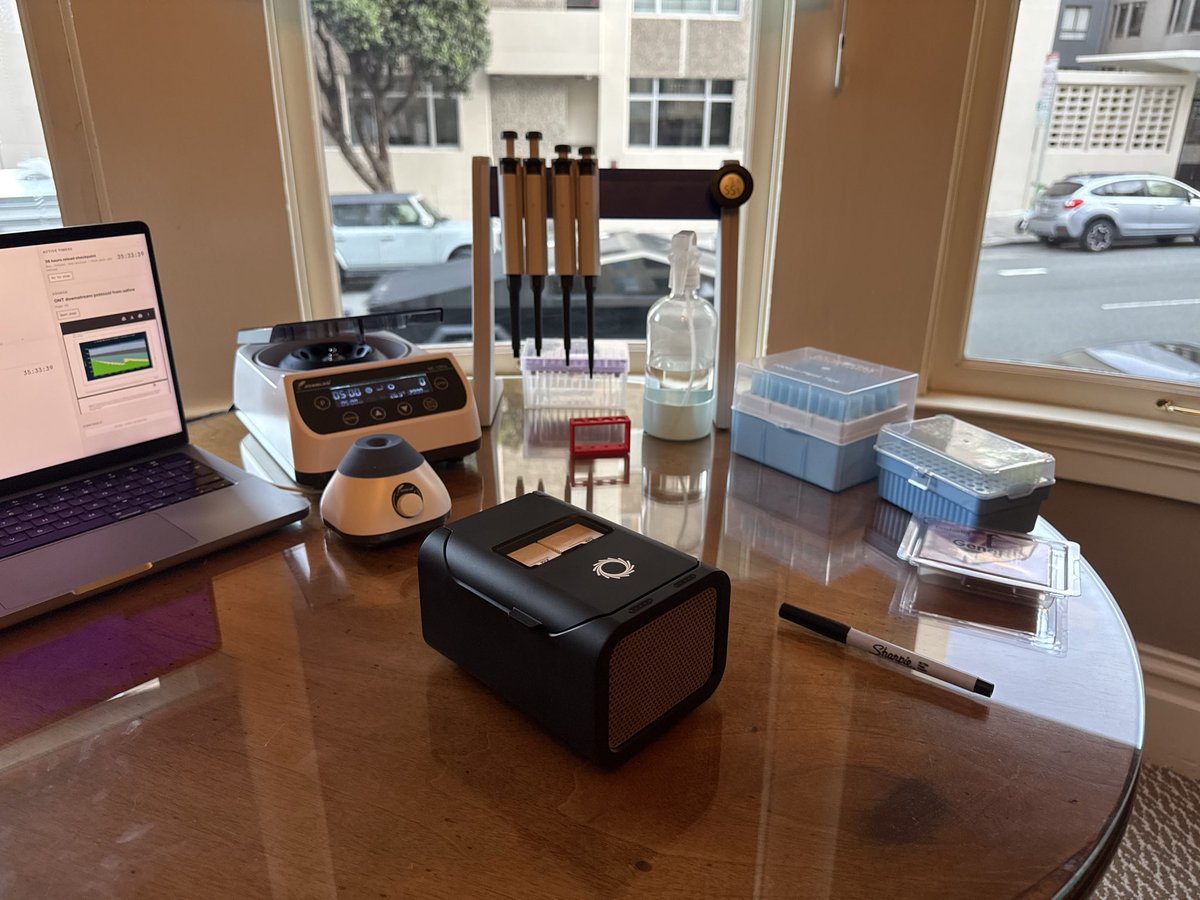
I just sequenced a human genome to 30× coverage entirely at home. As far as I know, this is the first time this has been done. I didn’t step foot in a lab once. Every step - from saliva collection, to running the sequencer - took place in a single room with a dining table + kitchenette. Six weeks ago, I had never done wet lab biology before. I used an Oxford Nanopore P2 Solo - the only commercially available sequencing device portable enough to do 30x human genome sequencing at home. Biggest takeaway - I could build something that combined software, hardware, and molecular biology far faster than I thought was possible. I can name >100 specific instances where AI helped me solve a technical problem that would previously have blocked me because I lacked access to a domain expert. For example: how do I save my sequencing run when my DNA extraction yield is 4x lower than I need it to be, and I have this limited set of reagents to hand? To make this work, I had to navigate multiple disciplines: - writing software to monitor sequencing runs and orchestrate remote GPU infra for basecalling - learning + executing 5 hour long molecular biology protocols - building a hardware device to quantify DNA concentration Apologies for the hyperbole, but I feel super lucky to be living in 2026. A few weeks ago I decided to sequence a human genome to 30x at home. Then I actually did it. And I did it really quickly.
Seth Howes tweet mediaSeth Howes tweet media
English
253
466
4.7K
372.4K
AI DeSci Guy retweetledi
Ihtesham Ali
Ihtesham Ali@ihtesham2005·
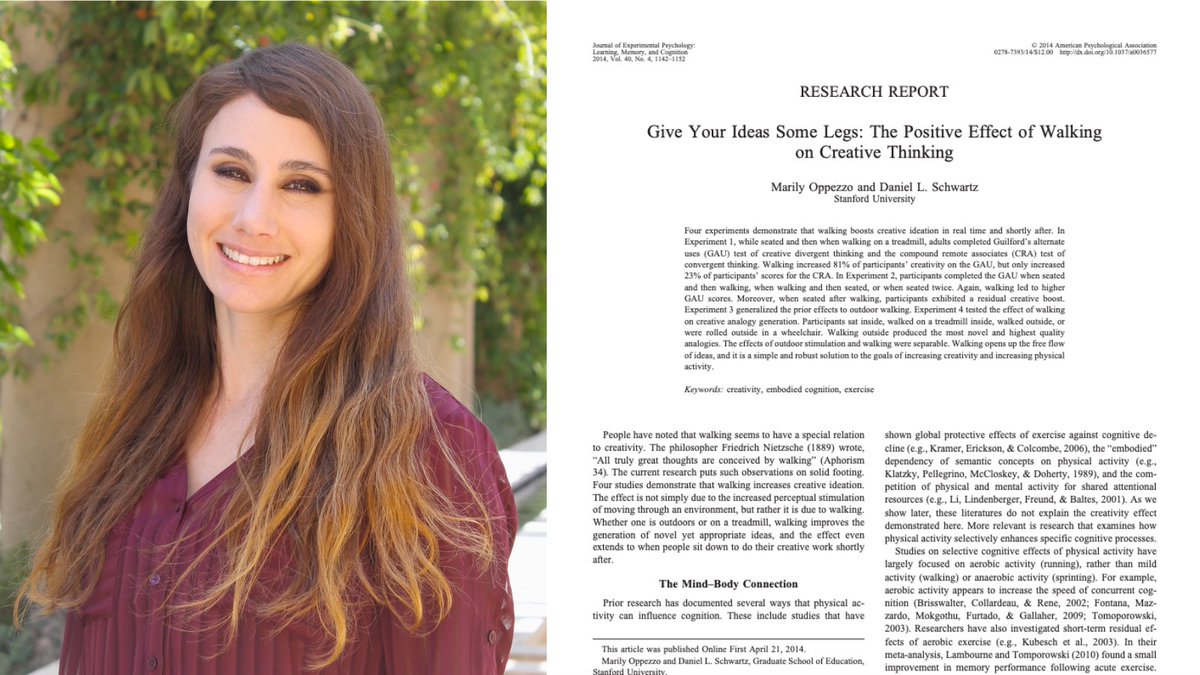
A Stanford psychologist spent 4 years proving that the simple act of walking generates 60% more creative ideas than sitting, and the experiment she designed to kill every alternative explanation is one of the most decisive findings in modern psychology. Her name is Marily Oppezzo. She got the idea for the study while walking with her advisor at Stanford to discuss her thesis topic, and the paper she eventually published in the Journal of Experimental Psychology in 2014 is sharp enough that it should have ended the seated meeting on the day it came out. She ran 4 experiments on 176 people. Same person tested twice. Once sitting, once walking. The creativity tasks were the standard ones psychologists have used for decades to measure how good a brain is at generating novel useful ideas. The result was almost too clean to publish. 81% of participants in the first experiment produced more creative ideas while walking than while sitting. In the second experiment, 88%. In the third, 100%. Every single person walked into a more creative version of themselves. On average, people generated 60% more novel useful ideas the moment their legs started moving. The skeptical question is the obvious one. Maybe it was the fresh air. Maybe it was the scenery passing by. Maybe it was the change of environment doing the work, not the walking itself. Oppezzo killed every one of those explanations with one experimental decision. She put people on a treadmill facing a blank wall. No scenery. No fresh air. No environmental change. Just legs moving in place while staring at white drywall. The 60% boost held. Then she ran the experiment that closed the case completely. She took participants outside in two conditions. Half of them walked through a Stanford courtyard. The other half were pushed through the exact same courtyard in a wheelchair. Same outdoor stimulation. Same scenery passing at the same speed. The only difference was whether the legs were moving. The walkers produced dramatically more novel high-quality ideas than the wheelchair group. The outdoors did almost nothing on its own. The walking did everything. This is the part of the study that hit hardest when I read it the first time. She also tested the opposite kind of thinking. Convergent thinking. The kind where there is one right answer and you have to narrow down to it. Word puzzles where 3 words share a hidden fourth word that connects them. The seated participants did slightly better on these. Walkers got slightly worse. Walking is not a general intelligence enhancer. It does one specific thing. It opens up the divergent search inside your brain. The part that generates options. The part that produces unexpected connections. The part that takes a problem and finds five ways into it instead of one. When you need to converge on the single right answer, sit down. When you need to find the answer in the first place, get up. The mechanism is now well understood. Walking selectively activates what neuroscientists call the default mode network, the system inside your brain that runs when you are not consciously focused on anything. The DMN is where mind-wandering happens. Where memories cross-reference each other. Where ideas that have been sitting in separate folders inside your head finally bump into each other. When you sit at a desk and force yourself to concentrate, you suppress the DMN. When you walk at a natural pace, the executive part of your brain gets just busy enough handling the walking that the DMN comes online and starts doing the work that focus was blocking. The most useful finding in the entire paper is the one almost nobody quotes. The boost did not turn off the moment people stopped walking. Participants who walked first and then sat back down stayed elevated. Their next round of seated creativity work was still significantly better than people who had been sitting the whole time. The rest lingered for at least several minutes after the legs stopped moving. You do not need to do creative work while walking. You need to walk before the creative work. The brain holds the state. The history of this is the part that should haunt anyone who still does meetings in chairs. Charles Darwin built a gravel loop behind his house in Kent called the Sandwalk and walked it 3 times a day for the rest of his life. The theory of evolution was developed one lap at a time on that path. Nietzsche walked up to 10 hours a day during the years he wrote his most important books and openly said the work was conceived on his feet. Beethoven composed for the morning and walked for 5 hours every afternoon with a pencil in his pocket for when something landed. Kahneman said the best thinking of his Nobel Prize-winning career happened on leisurely walks with Amos Tversky. Steve Jobs refused to take important conversations sitting down. He held them on foot. Every one of them was using the system Oppezzo would not measure until 2014. They just did not know what to call it. The question worth sitting with is the one almost nobody asks. Every meeting you have ever attended sitting around a table was a meeting held at a fraction of the brain power that was actually available to the people in the room. Every brainstorm that got stuck inside a conference room. Every problem you tried to solve at a desk and gave up on. Every idea you could not quite get to. The intervention is the easiest one in modern science. No supplement. No app. No subscription. No training program. Just a pair of legs and 15 minutes. The Stanford lab proved it. The philosophers knew it. The neuroscience explains it. And almost everyone reading this is still trying to think their way out of problems sitting completely still.
Ihtesham Ali tweet media
English
273
3K
11.6K
1.5M
AI DeSci Guy retweetledi
Anonymous
Anonymous@YourAnonNews·
Massive bombshell. Anthropic co-founder Chris Olah warns that AI will displace human labor on a catastrophic global scale. He confirms tech elites have absolutely no mechanism to share the wealth, leaving the global poor completely abandoned to suffer. He is 100% accurate.
English
754
9.3K
24.9K
751K
AI DeSci Guy retweetledi
Charly Wargnier
Charly Wargnier@DataChaz·
I still can’t believe @karpathy released this 3.5-hour deep dive on how ChatGPT actually works... for FREE. 🤯 Easily the best video I've watched on the topic. Swap your next Netflix binge for this. Then read the ace article below from Codez breaking it all down 👀↓
Codez@0xCodez

x.com/i/article/2058…

English
13
38
189
33.8K
AI DeSci Guy retweetledi
Jon Hernandez
Jon Hernandez@JonhernandezIA·
“Once the platform works, biology becomes programmable.” Demis Hassabis, CEO of Google DeepMind, says AI drug discovery won’t progress gradually. It will look more like AlphaFold, years of quiet infrastructure work, then a sudden leap where the system can scale across entire disease areas.
English
79
175
1.1K
143.6K
AI DeSci Guy
AI DeSci Guy@agenticscience·
𝐃𝐞𝐦𝐲𝐬𝐭𝐢𝐟𝐲𝐢𝐧𝐠 𝐭𝐡𝐞 “𝐄𝐱𝐩𝐨𝐧𝐞𝐧𝐭𝐢𝐚𝐥 𝐀𝐈” 𝐍𝐚𝐫𝐫𝐚𝐭𝐢𝐯𝐞 𝘞𝘩𝘦𝘳𝘦 𝘈𝘐 𝘨𝘳𝘰𝘸𝘵𝘩 𝘪𝘴 𝘵𝘳𝘶𝘭𝘺 𝘦𝘹𝘱𝘰𝘯𝘦𝘯𝘵𝘪𝘢𝘭, 𝘸𝘩𝘦𝘳𝘦 𝘪𝘵 𝘪𝘴 𝘮𝘦𝘳𝘦𝘭𝘺 𝘧𝘢𝘴𝘵, 𝘢𝘯𝘥 𝘸𝘩𝘦𝘳𝘦 𝘮𝘦𝘢𝘴𝘶𝘳𝘦𝘮𝘦𝘯𝘵 𝘪𝘴 𝘧𝘭𝘢𝘸𝘦𝘥 by Kim "Chubby" Isenberg @kimmonismus The broad claims that AI is exponential are too vague to be useful. A more rigorous framing is narrower and more actionable: some AI curves are confirmed steep exponents, some are fast hillclimbs, and some cannot yet be measured reliably. Inference price decline and Anthropic’s revenue growth are the clearest high-slope curves. Enterprise spending, small-business adoption, and hyperscaler capex are rising quickly, but their slopes and accounting scopes differ. Capability measurement remains the weak link: software benchmarks are contaminated, long-context retrieval is position-sensitive, and chain-of-thought is not a faithful audit trail. The practical conclusion is that the transition will be governed by mismatched slopes. Unit costs can fall while aggregate bills rise. Revenue can compound faster than infrastructure. Adoption can be broad while integration remains shallow. Capability may be improving, but current measurement instruments are unreliable and sometimes misleading. Some AI growth metrics exhibit exponential behavior, but without specifying the curve, time unit, doubling time, and sustained duration, the phrase “AI is exponential” is not analytically useful. getsuperintel.site/p/demystifying…
English
0
0
0
12
Dhruv Agarwal
Dhruv Agarwal@furst_fly·
Thinking of starting a community for people who want to learn biotech, drug discovery or anything bio in general. Reply to the tweet if you want in. Let's kill Death together
Dhruv Agarwal tweet media
English
84
17
202
10.8K
AI DeSci Guy
AI DeSci Guy@agenticscience·
Stick with your Day Job!
English
0
0
0
3
AI DeSci Guy retweetledi
John Fitzgerald Kennedy Jr.
EXPLOSIVE REVELATION: FBI raid of an unlicensed biolab in a Las Vegas home linked to the Chinese Communist Party, found thousands of vials of blood and tissue. Genetically engineered mice were designed to carry COVID. Tests showed the vials contained COVID, hepatitis and malaria. FOLLOW ME, FOR THE NEXT DROP!
English
690
11.6K
26.4K
1.7M
AI DeSci Guy retweetledi
Vivek Sen
Vivek Sen@Vivek4real_·
BREAKING: MICROSOFT JUST ANNOUNCED TO BAN ITS OWN ENGINEERS FROM USING AI DUE TO THE COST OF USING IT. VP OF NVIDIA SAID, “THE COST OF AI FOR MY TEAM WAS MORE THAN HUMANS” “AI CAN COST MORE THAN HUMAN WORKERS NOW”
English
1.1K
7K
49.2K
17M
AI DeSci Guy retweetledi
VraserX e/acc
VraserX e/acc@VraserX·
I trained the AI to do my job and it thanked me by recommending me a beanbag and a wellness app. Which job is the last to be automated?
English
3
3
9
1.1K
AI DeSci Guy
AI DeSci Guy@agenticscience·
Fund Longevity Trailer April 8th 2026 - the longevity community united as a political force — speaking simultaneously in Madrid, Rome, Paris, Berlin, Stockholm, Brussels, London, San Francisco, Toronto, Calgary, Ljubljana, Abu Dhabi, Tel Aviv, Scottsdale, Caracas, Prague, and Tbilisi. A live broadcast brought together field experts to discuss what's holding them back and how to move forward — with more cities joining in real time. youtu.be/qg5AS-YmOXk?si… via @YouTube
YouTube video
YouTube
English
0
0
0
49
AI DeSci Guy retweetledi
Rohan Paul
Rohan Paul@rohanpaul_ai·
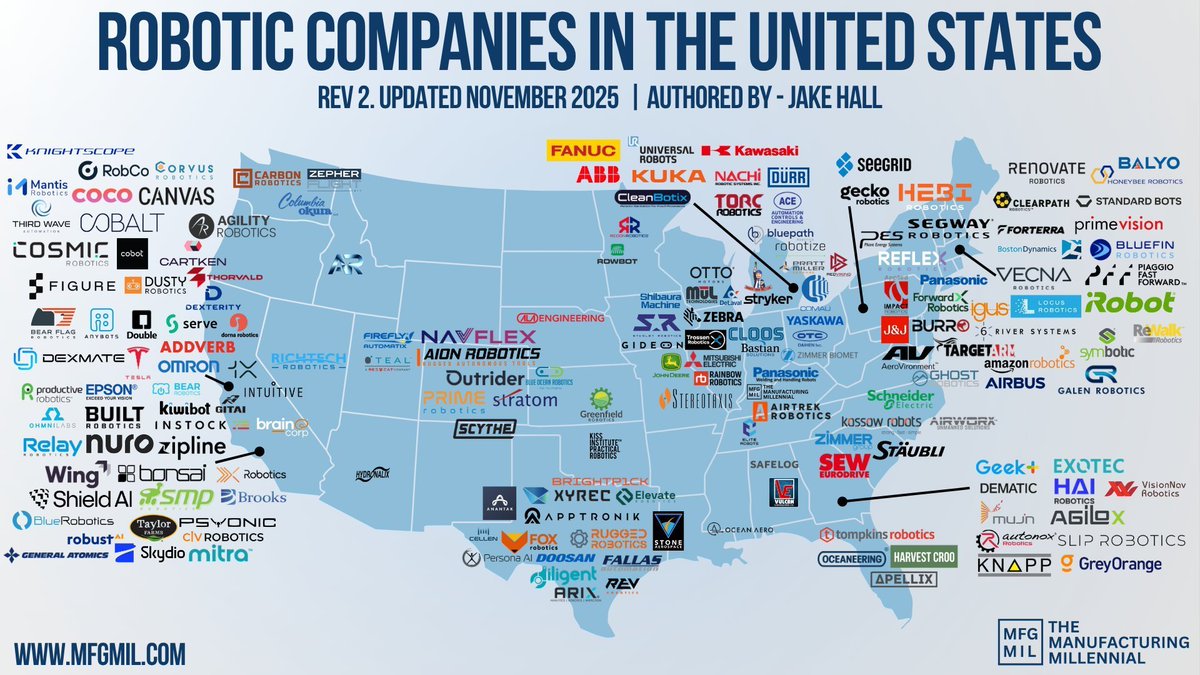
Robotic Companies in the United States
Rohan Paul tweet media
English
12
85
308
21.8K
AI DeSci Guy retweetledi
Rohan Paul
Rohan Paul@rohanpaul_ai·
Agentic AI may be forcing the old computing stack with lot more focus on CPU back into the center of the story. Here, Ark Invest CEO and CIO Cathie Wood quoting OpenAI's CFO Sarah Friar who has said - "people are chasing GPUs. They're going to be really shocked at how agentic AI activates CPUs" The market has spent years treating GPUs as the scarce ingredient, because training large models made parallel math look like destiny. But agentic AI changes the bottleneck. An agent does not simply ask one giant model for one answer; it plans, calls tools, checks memory, retrieves files, writes code, queries databases, and loops until the task is done. That means inference is not just matrix multiplication. It is orchestration, data movement, networking, storage, scheduling, and a lot of general-purpose work that CPUs still handle better than accelerators. ---- From "Bloomberg Podcasts" YT channel (link in comment)
English
25
17
141
18K
AI DeSci Guy retweetledi