Seth Howes

207 posts

Seth Howes banner
Seth Howes

Seth Howes

@SethSHowes

🩺 doctor defected to tech 👨🏼‍💻 prev engineer @exolabs | medicine @uniofoxford | ML @imperialcollege

Katılım Ağustos 2021
789 Takip Edilen8.6K Takipçiler
Sabitlenmiş Tweet
Seth Howes
Seth Howes@SethSHowes·
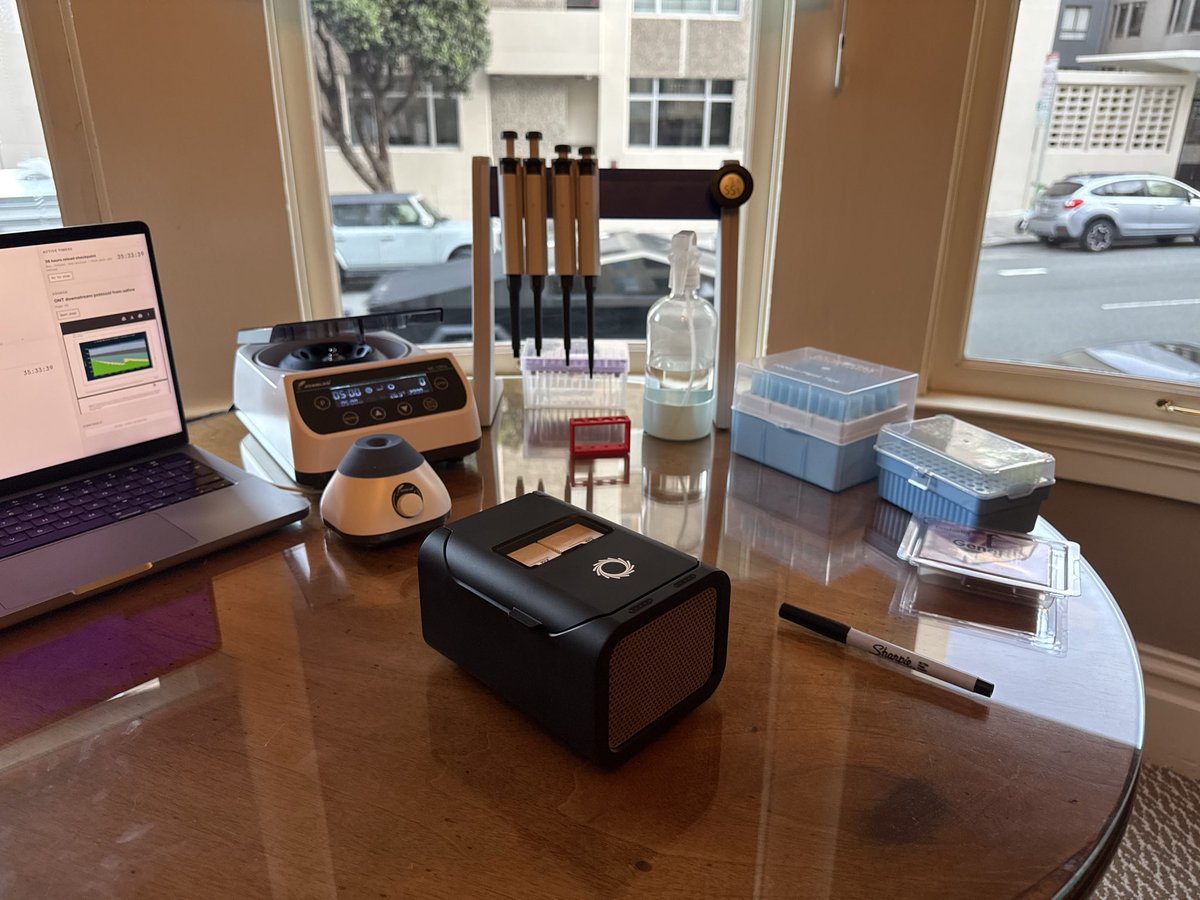
I just sequenced a human genome to 30× coverage entirely at home. As far as I know, this is the first time this has been done. I didn’t step foot in a lab once. Every step - from saliva collection, to running the sequencer - took place in a single room with a dining table + kitchenette. Six weeks ago, I had never done wet lab biology before. I used an Oxford Nanopore P2 Solo - the only commercially available sequencing device portable enough to do 30x human genome sequencing at home. Biggest takeaway - I could build something that combined software, hardware, and molecular biology far faster than I thought was possible. I can name >100 specific instances where AI helped me solve a technical problem that would previously have blocked me because I lacked access to a domain expert. For example: how do I save my sequencing run when my DNA extraction yield is 4x lower than I need it to be, and I have this limited set of reagents to hand? To make this work, I had to navigate multiple disciplines: - writing software to monitor sequencing runs and orchestrate remote GPU infra for basecalling - learning + executing 5 hour long molecular biology protocols - building a hardware device to quantify DNA concentration Apologies for the hyperbole, but I feel super lucky to be living in 2026. A few weeks ago I decided to sequence a human genome to 30x at home. Then I actually did it. And I did it really quickly.
Seth Howes tweet mediaSeth Howes tweet media
English
257
471
4.8K
407.6K
Seth Howes
Seth Howes@SethSHowes·
This is crazy useful. I’ve found Chinese tech news to be inaccessible to westerners. For example, many leading Chinese tech distribute content on WeChat through the “Official Accounts” feed. I have a web scraping cron job and translation pipeline so I can aggregate this info into a single feed
English
0
0
3
197
Niko McCarty.
Niko McCarty.@NikoMcCarty·
A Reading Guide to Chinese Biotech Some friends and I visited China to learn about its biotech ecosystem. Beforehand, we assembled a list of 51 "high signal" books, podcasts, and articles to help us prepare. During the trip, we also asked people who *they* followed for their news on China, and then we added many of those names to this guide. Hopefully this will be a useful resource for folks who are planning to visit (which I recommend, especially if you work in drug development.)
English
19
50
327
50.9K
Seth Howes
Seth Howes@SethSHowes·
@VishalGulati_ Thankfully Brad, and the minority of people who do novel things, don’t fit into the bucket of “most smart people”
English
1
0
1
208
Seth Howes retweetledi
Niko McCarty.
Niko McCarty.@NikoMcCarty·
Automated liquid handlers for biology are much older than I thought. A rough timeline: - The 96-well plate is invented in 1951 by a Hungarian physician, Gyula Takátsy, who physically drilled each well out of a plate of Lucite, a type of acrylic. - John Sever made the first "modern-looking" 96-well plate by punching it directly out of a sheet of plastic. - The first automated liquid-handling device was released in 1967 (!!!). It was called the Autotiter, and was developed by a man named Tom Astle. I found a few sentences on Astle's company: "Tomtec has succeeded since 1967 by working with its clients to help solve their liquid handling needs. From 1967 to 1981, the Company had essentially one employee, Tom Astle. From 1967 to 1971, the Company operated as Astec, Inc. In 1971 the Company's name was changed to Tomtec, and incorporated. Tom Astle has been the President and CEO since that time. In 1967, Tomtec developed the Autotiter. This automated what were then the manual microtiter techniques. The primary market was serology and virology. The original instruments were an essential element of Smith Kline's rubella vaccine program." (Photos of the original patent filing below.) - In 1986, Beckman gets into the microplate automation space. They release the Biomek 1000 and mark it as a "fast and accurate...robotic workstation" that sits on a scientist's bench, "takes over tedious manual tasks and integrates the work of four different instruments." I found these details in a Beckman ad, which was published in a 1987 issue of the "Journal of Automatic Chemistry." Photos below. The Beckman device looks fully modern; it could even connect to an IBM computer so scientists could program new methods on it. I couldn't find a launch price, but the device was similar to the Zymark Zymate, and that device cost about $35,000 when it released in the 1980s, which would be equivalent to hundreds of thousands of dollars today.
Niko McCarty. tweet mediaNiko McCarty. tweet mediaNiko McCarty. tweet mediaNiko McCarty. tweet media
English
9
36
197
23.8K
Seth Howes retweetledi
Arda Göreci
Arda Göreci@ArdaGoreci·
The pMHC binding with an antibody is so crazy to me. If the binding is general across patient MHCs, you can basically target cancer driver mutations with antibodies (which Revolution meds showed was effective towards pancreatic cancer). Step change, congrats to @nablabio team!
Nabla Bio@nablabio

Today, we expand zero-shot drug design beyond binding to the design of multifunctional medicines, the intracellular proteome, and state-of-the-art atomic precision with our model, JAM-2. In a new report (below), we show: 1. The first drug-grade, fully computationally designed multispecific antibodies against five peptide-MHCs: Routine picomolar T-cell activation/cell-killing EC50s, >100-fold selectivity, and drug-like developability 2. The first fully generatively designed, drug-grade dual-variant KRAS G12 multispecifics: They recruit primary T-cells from human donors to kill G12V and G12C presenting cells at pM to single-digit-nM potency, completely sparing wild-type. 3. Atomic accuracy, from sequence alone: Angstrom-level agreement between Cryo-EM and JAM-2 de novo designs, requiring only target sequences (not structure) as input. 4. Unrivaled speed with an AI-native in-house wet lab: Designed, built, and tested five programs in one parallelized campaign, end-to-end in-house in ~6 weeks. 5. A higher validation bar for AI-generated drug candidates: In a field increasingly rife with hype and uneven standards of proof, we provide the highest quality public wet-lab validation of AI-designed antibodies to date. We share experimental methods in full, and invite folks to adopt and build on these standards. Truly individualized therapies will be the most important contribution of AI in drug design. These advances help accelerate this future.

English
1
5
40
7.9K
Natasha Loder
Natasha Loder@natashaloder·
This investment does not suck! It is GREAT for: competition, science, product development and... ...TRULY great for patients! There are only two responses to the rise of China, either invent something better or buy it. I didn't make the rules.
Jason Kelly@jrkelly

Ugh this sucks @PeterKolchinsky, bad for MA jobs @JakeAuch and bad for US nat sec @sethmoulton, @IAmBiotech. So exhausting that our own VC leaders in biotech are working against US startups and US biotech scientists. This tactic of offshoring to low cost scientific labor in China is going to fail. US biotech startups are going to prove it, we’re not giving up without a fight.

English
2
1
2
904
Seth Howes
Seth Howes@SethSHowes·
@Sephirsloth I was taken by a brilliant synthetic biologist to this quaint cafe today. Funny thing. I must have missed the ‘dishonest hordes’. Where were they sitting?
English
1
1
73
2.6K
Alistair LeShay
Alistair LeShay@Sephirsloth·
@SethSHowes The promotion of such small-minded status seeking motivates the dishonest hordes to submit BS papers just to say they published in a high impact journal. How about giving people free coffee if their work has been replicated instead?
English
17
3
83
19.2K
Seth Howes
Seth Howes@SethSHowes·
There’s a cafe in Shenzen’s biotech hub that gives you free coffee for a month if you publish in Nature or Science.
Seth Howes tweet mediaSeth Howes tweet media
English
119
919
11.3K
721K
Seth Howes
Seth Howes@SethSHowes·
@KevinJDCS Everyone I met today was in their 20s, intelligent, and wanted to achieve greatness. All lovely people as well.
English
3
1
213
19K
格雷老師 Teacher Grey
格雷老師 Teacher Grey@geleilaoshi·
@SethSHowes Ahh yes, another Western man goes to China and acquires deep understanding of the Chinese system, and then comes here to tell us about it 🙄
English
6
0
16
4.3K
Seth Howes
Seth Howes@SethSHowes·
I’m in Shenzen. It’s clear China has implemented a much more effective capitalist system than the US. And Chinese consumers are the main beneficiaries. Far more choice of cheaper, quality products: electric cars, smartphones etc. And these are not just copycat products. Even industrial design here feels like an evolution of what I’ve seen in the US. I wouldn’t be surprised if the next iPhone looks similar to a current model of phone made by Honor or Huawei. A more accurate description of the US economic system might be “capitalism with American characteristics”
English
221
107
1.1K
251.5K
Seth Howes
Seth Howes@SethSHowes·
@LeroyLeroi001 @Jansen0781 This is empirical. Walk down any street in Shenzen and look at the variety of premium Chinese brand EVs being driven. These cars aren’t exported: they don’t exist in the US.
English
2
0
1
99
Seth Howes
Seth Howes@SethSHowes·
@IgRecon I’m not making a value judgement, or a broader comment on the cost paid to get here. I’m simply observing that most Chinese have access to higher quality, cheaper consumer technology relative to US consumers.
English
11
1
82
9.2K
John Hendricks
John Hendricks@IgRecon·
@SethSHowes But the wages are low, and they work insane hours, and when push comes to shove the government controls everything. There's a reason why there are millions of Chinese living in the United States, and broader west, and much less westerners living in China.
English
40
2
42
11.9K
Seth Howes
Seth Howes@SethSHowes·
@defaiscope This is true for all smartphones. The only reason you buy an iPhone as a Chinese consumer is as a status symbol: it costs much more than a high end Huawei phone. You don’t buy an iPhone because it has better features.
English
1
0
3
549
Seth Howes
Seth Howes@SethSHowes·
@_mm85 Claude Design challenging Figma head on would be normal corporate behaviour in China. China would say: let them compete! Look at Meituan vs Alibaba delivery wars
English
1
1
26
5.9K
Marcel Münch
Marcel Münch@_mm85·
@SethSHowes the US favours monopolies and winner-takes-all approaches. Concentrated profit accrual and wealth in the hands of a few.
English
3
2
69
7.5K
Seth Howes
Seth Howes@SethSHowes·
The first company I’ve seen that looks structurally capable of solving biological intelligence. It must be your sworn mandate to solve BOTH: 1) biological design. 2) biological safety. You cannot choose one. If you choose only “design,” you build capability you cannot responsibly deploy (or you get blocked from doing so). Either way the growth of your company is retarded. If you choose only “safety,” your organisation is by its very nature reactive: you wait for frontier models to arrive, built by others, then try to govern them. Radical Numerics is one of the first companies actually structured around the premise you have to solve both. I've followed the founder's work since they were at the Arc Institute, and was one of the first to download the Evo 2 weights (40b) from Hugging Face and run it locally. I also had the pleasure of meeting them in SF last month. My read: this is the highest-density team in generative genomics. They have the technical authority. They birthed the field. They understand how to model-scaling problem and have done interesting work on solving this for biological model architectures - just take a look at their work on hardware-aware training / low-level NVIDIA-specific optimisations. And crucially, they seem to understand that a biology model capable of writing biology cannot be safely diffused UNLESS safety is built into the core technical agenda. So the only viable path is: solve design + safety TOGETHER.
Eric Nguyen@exnx

Together with my co-founders Michael @MichaelPoli6, Stefano @Massastrello and Armin @athmsx, I am excited to announce @RadicalNumerics is emerging from stealth with a $50M seed round to build general biological intelligence. We’re also sharing an early preview of our new model Omnii, the most powerful genome language model to date. Omnii preview link: radicalnumerics.ai/blog/radical-n… At Radical Numerics, our mission is to master the code of life, and to drive the frontier of biological AI for both design and defense. This is our dual mandate, which comes from something our own team helped make possible. Our founding team trained Evo and Evo 2, the largest biological AI models (40B params) trained on DNA sequences. Trillions of tokens across all of life, from microbes to mammals. It’s fully open source, and created the field now known as generative genomics. Last year, scientists used Evo to generate the world’s first complete genome from scratch using AI. Turns out it was a bacteriophage—a type of virus. It functioned in the real world, and in this case it was harmless. But for us, it was a clear turning point. It showed that AI is no longer just analyzing biology. It is on the cusp of generating functional lifeforms. Eventually, AI will have the power to design and control life itself. That should make all of us incredibly excited, and incredibly uneasy. (Anyone can design DNA with a new function, and have it synthesized and delivered, like something from Amazon Prime). The same technology that will help us cure cancer is the very technology that might create the next global pandemic, or worse, allow the creation of bioweapons that can wipe out populations. We believe these forces are inseparable. If you work on the frontier of biology, you have to build technology to safeguard it from its misuse. Existing biosecurity tools are sorely losing the arms race, relying on outdated “have I seen this exact thing before?” style algorithms. We founded Radical Numerics to turn the tide. And we can’t do that by training on textbooks and natural language. We must understand the language of biology from the raw physical data itself, to reason across every molecule and modality, from DNA to proteins. The next frontier for AI goes far beyond chatbots or video generators to models that can understand and engineer life. Today, we’re previewing Omnii, which is already far surpassing Evo 2, and will continue improving as we scale and add new modalities (training now). 1. For human health, Omnii can read and write whole genomes (more on writing later). It’s state of the art (SOTA) on detecting causal variants for disease, and can rank Alzheimer's mutations zero-shot. We’re partnering with a diagnostics company to use Omnii for early cancer detection (pancreatic and multi-cancer). 2. For defense, Omnii is SOTA at detecting AI-generated pathogens. We benchmarked existing detection tools, and they simply can’t detect the AI-generated ones (“deepfake viruses”). We’re partnering with a US national lab to pilot Omnii for detecting the next pandemic, both natural and AI-generated. We have a data center full of Blackwells in construction now to build the most powerful biological AI models ever. This mission takes a new kind of AI lab that can actually scale on physical, biological data: new alignment research (mid/post training), scaling long context, building out mech interp teams to dissect what these models learn, new architectures and systems designs, all from the ground up. Our team is made up of AI researchers and scientists from top labs and institutions (e.g. Stanford, MIT, Google DeepMind), but more importantly, we all share the belief that this is the most important challenge of our lifetime. If you feel similarly, we are hiring. We aim to bring the brightest minds in AI and science together to save lives. Thanks to our partners on this journey, led by Emergence Capital @emergencecap, with Obvious Ventures @obviousvc, Triatomic @TriatomicCap , and Patrick Collison @patrickc. Our advisors include Eric Horvitz @erichorvitz, CSO of Microsoft, Chris Re @HazyResearch of Stanford, George Church @geochurch of Harvard, and Andrew Weber @AndyWeberNCB, former Assistant Secretary of Defense for Nuclear, Chemical and Biological Defense Programs. Fortune article: fortune.com/2026/06/15/exc… Jobs: radicalnumerics.ai/join-us

English
5
8
133
21.3K
Seth Howes
Seth Howes@SethSHowes·
perhaps Anthropic are overreacting by blocking fable usage for bio oh wait…
Seth Howes@SethSHowes

I just sequenced a human genome to 30× coverage entirely at home. As far as I know, this is the first time this has been done. I didn’t step foot in a lab once. Every step - from saliva collection, to running the sequencer - took place in a single room with a dining table + kitchenette. Six weeks ago, I had never done wet lab biology before. I used an Oxford Nanopore P2 Solo - the only commercially available sequencing device portable enough to do 30x human genome sequencing at home. Biggest takeaway - I could build something that combined software, hardware, and molecular biology far faster than I thought was possible. I can name >100 specific instances where AI helped me solve a technical problem that would previously have blocked me because I lacked access to a domain expert. For example: how do I save my sequencing run when my DNA extraction yield is 4x lower than I need it to be, and I have this limited set of reagents to hand? To make this work, I had to navigate multiple disciplines: - writing software to monitor sequencing runs and orchestrate remote GPU infra for basecalling - learning + executing 5 hour long molecular biology protocols - building a hardware device to quantify DNA concentration Apologies for the hyperbole, but I feel super lucky to be living in 2026. A few weeks ago I decided to sequence a human genome to 30x at home. Then I actually did it. And I did it really quickly.

English
0
3
88
10.1K
Seth Howes retweetledi
Arda Göreci
Arda Göreci@ArdaGoreci·
Today, we are launching our research blog! We’ll use it for technical notes from our work building tools for enzyme and biomolecular design. Our first post is about The Unreasonable Redundancy of Nature's Protein Folds. TLDR: Please don't fold more sequences (1/n)
Arda Göreci tweet media
English
15
38
257
25.9K