
Agus Capdevila

1.3K posts

Agus Capdevila banner
Agus Capdevila

Agus Capdevila

@agusscapdevila

Economist & Msc in Finance. Continuously leveraging knowledge in Finance, Crypto, Blockchain, and Economics. Always.

Katılım Kasım 2021
714 Takip Edilen326 Takipçiler
Sabitlenmiş Tweet
Agus Capdevila
Agus Capdevila@agusscapdevila·
Everyone keeps saying 2025 was about US equities and AI. I disagree. The real story of the year was the value of money and how misleading it has become to measure everything in dollars. In 2025, the USD weakened materially: -0.3% vs JPY -4% vs CNY -12% vs EUR -13% vs CHF -39% vs gold Gold, the only major non-fiat monetary asset and arguably the second global reserve currency, returned +65% in USD terms. The S&P 500 returned +18% in USD. Measured in gold terms? -28%. Same asset. Same year. Completely different reality depending on the unit of account. This is the part most investors still miss: when your benchmark currency weakens, asset returns look better than they really are. A US investor saw +18%: A euro-based investor saw ~+4%. A CHF-based investor ~+3%. A gold-based investor lost almost a third of their purchasing power. That’s not a rounding error, that’s a regime shift. The same logic applies to bonds. 10Y USTs returned ~+9% in USD, but -34% in gold terms. Cash did even worse. No surprise foreign demand for USD bonds keeps deteriorating unless heavily hedged. At the same time, capital quietly rotated away from the US: – European equities outperformed US stocks by ~23% – China by ~21% – UK by ~19% – Japan by ~10% – EM equities returned ~34% This wasn’t a global risk-on into the US. It was diversification away from it. Yes, US earnings grew (+12%), margins expanded, and multiples went up. But valuations are now stretched, credit spreads are tight, and expected equity returns sit around ~4.7%, barely above bond yields (~4.9%). The equity risk premium is thin. In other words: a lot of future returns have already been pulled forward. The Fed will likely keep easing to manage debt dynamics and avoid funding stress, which supports asset prices nominally, buuuut.... it also continues to erode the real value of money. The adjustment isn’t default. It’s dilution. This is why looking at markets exclusively through a USD lens has become increasingly misleading. For years now, the dollar has been a convenient benchmark, not a neutral one. If you measure performance in a weakening unit of account, you confuse nominal gains with real wealth creation. That’s the macro backdrop we’re in. Not a single bubble waiting to pop... but a slow monetary repricing where the benchmark itself is the problem.
Agus Capdevila@agusscapdevila

For portfolio managers focused exclusively on crypto: Beyond directional bets (which can work, depending on the asset), anyone running strategies anchored to USD-pegged stablecoins in a declining rate environment should rethink the benchmark. At these levels, USD stablecoin yield will likely underperform emerging markets, FX carry, and global macro opportunities. The opportunity cost is real. And it highlights what crypto still lacks today: a proper on-chain FX market. Who’s actually building it?

English
0
5
10
1.3K
Agus Capdevila
Agus Capdevila@agusscapdevila·
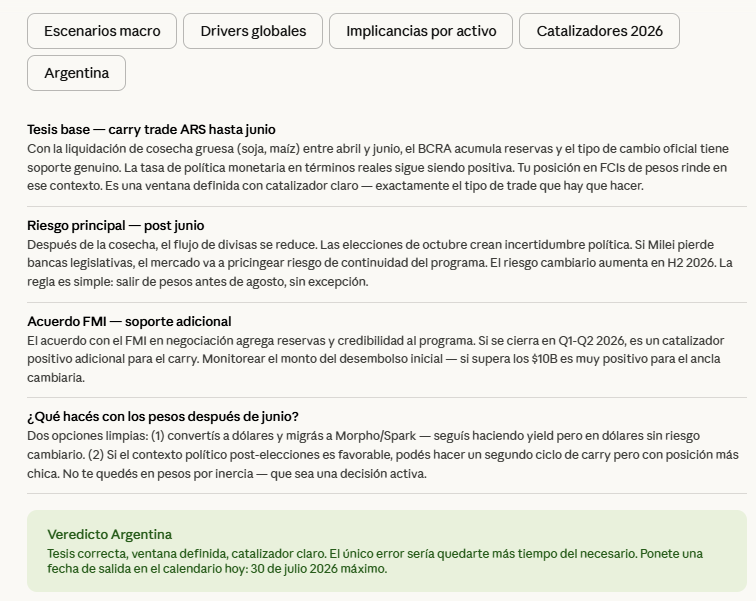
Momento períodico de voladura de cabeza de Claude, hace unas semanas vengo feedeandolo de todo lo que vengo pensando a nivel macroeconómico y financiero. Hoy armamos un dashboard con pestañas y análisis de variables. The real monitoring the situation.
Agus Capdevila tweet mediaAgus Capdevila tweet media
Español
0
0
1
39
Agus Capdevila
Agus Capdevila@agusscapdevila·
I understand this may sound counterintuitive, but gold does not always behave as a safe haven during periods of market stress. When forward expectations point to higher Treasury yields, the opportunity cost of holding non-yielding assets increases, typically leading to USD appreciation and broad-based pressure across risk assets, including precious metals. In that context, gold can trade more as a duration-sensitive asset rather than a pure hedge. However, I believe the recent price action appears oversold, likely driven by positioning and short-term rate repricing rather than a structural shift in fundamentals.
English
0
0
2
288
Agus Capdevila
Agus Capdevila@agusscapdevila·
Lo dije o no lo dije? SUMMARY OF FED CHAIR POWELL'S STATEMENT (3/18/2026): 1. Inflation in the US "remains somewhat elevated" 2. Economic implictions of the Iran War are "uncertain" 3. Near-term inflation expectations have risen due to rising oil prices 4. Fed's long-term inflation target remains at 2.0% 5. Last year's rate cuts bring rates to "plausible estimates of neutral" 6. Higher energy prices will push overall inflation up The Fed is now what appears to be a long pause.
Agus Capdevila@agusscapdevila

Malo corto plazo, bueno mediano plazo para la baja de tasas. Aunque habría que ver como sigue la inflación en US y como la reciente suba del petroleo termina influyendo en sus los precios. No esta claro el panorama todavía.

English
0
0
1
50
Alex
Alex@AlexOnchain·
+ we're hiring for a few roles, stay tuned, they'll be live on our site very soon: - social video creator/strategist - base social lead - social media manager if you're cracked, we want to talk to you
English
109
6
414
25K
Alex
Alex@AlexOnchain·
today is my last day as ct lead at coinbase (I'm now the head of social media)
English
207
3
801
32.3K
Agus Capdevila
Agus Capdevila@agusscapdevila·
@Mariandipietra @MakerDAO Gracias a vos marian, por la humanidad, confianza y liderazgo siempre, fue un verdadero placer laburar tanto tiempo juntos! Vamos por mas
Español
1
0
5
334
Mariano
Mariano@Mariandipietra·
Despues de 8 años, es momento de cerrar un capítulo INCREÍBLE. x.com/Mariandipietra… Entre a @MakerDAO en 2018 como Community Lead cuando todo era experimental y lleno de preguntas. Con el tiempo fui tomando mas responsabilidad: lidere Marketing para la región, donde logramos hacer de DAI la primera stablecoin de Latinoamerica. De ahí pasé a liderar Growth & Marketing global para @MakerDAO que luego se transformó en @SkyEcosystem y junto a un equipo extraordinario llevamos DAI y USDS de 0 a ser la 3ra stablecoin por circulante a nivel mundial. Si el mercado cripto tiene ciclos de 4 años, yo hice 2 completos. Eso en tiempo DAO equivale a unos 400 años mas o menos. 😂 No es un logro mío. Es de todos los que pusieron energía, creatividad y obsesión por ello y me encanto ser parte. Gracias a @RuneKek por la confianza. Y gracias especiales a @tobalgarcia_ @agusscapdevila @dylansz_ @EmiLimia @nad8802 @Lozada_luiggi y seguramente me olvido de muchos más. Ahora a jugar con AI, y trabajar en el proximo capitulo.
Mariano@Mariandipietra

First day at @MakerDAO , words can't do it justice describing the joy that I have. #makerdao #argentina #crypto

Español
48
5
188
17.5K
Agus Capdevila
Agus Capdevila@agusscapdevila·
@arielsbdar Te banco Ari, yo vengo armando un portfolio tracker que toma todas las wallets y tickers de cedear/acciones fondos etc y te consolida toda la cartera en un solo lugar, analizando además ROI, sharpe ratio, cuan diversificado estás etc. Es espectacular.
Español
0
0
1
277
Ariel Sbdar
Ariel Sbdar@arielsbdar·
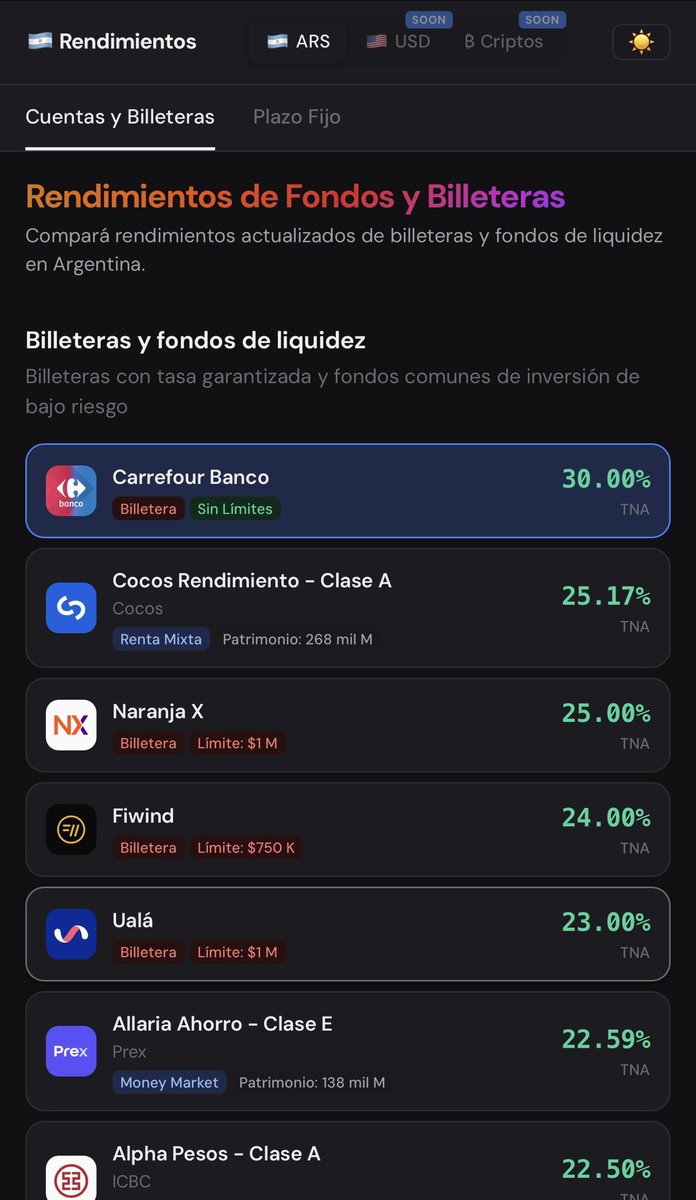
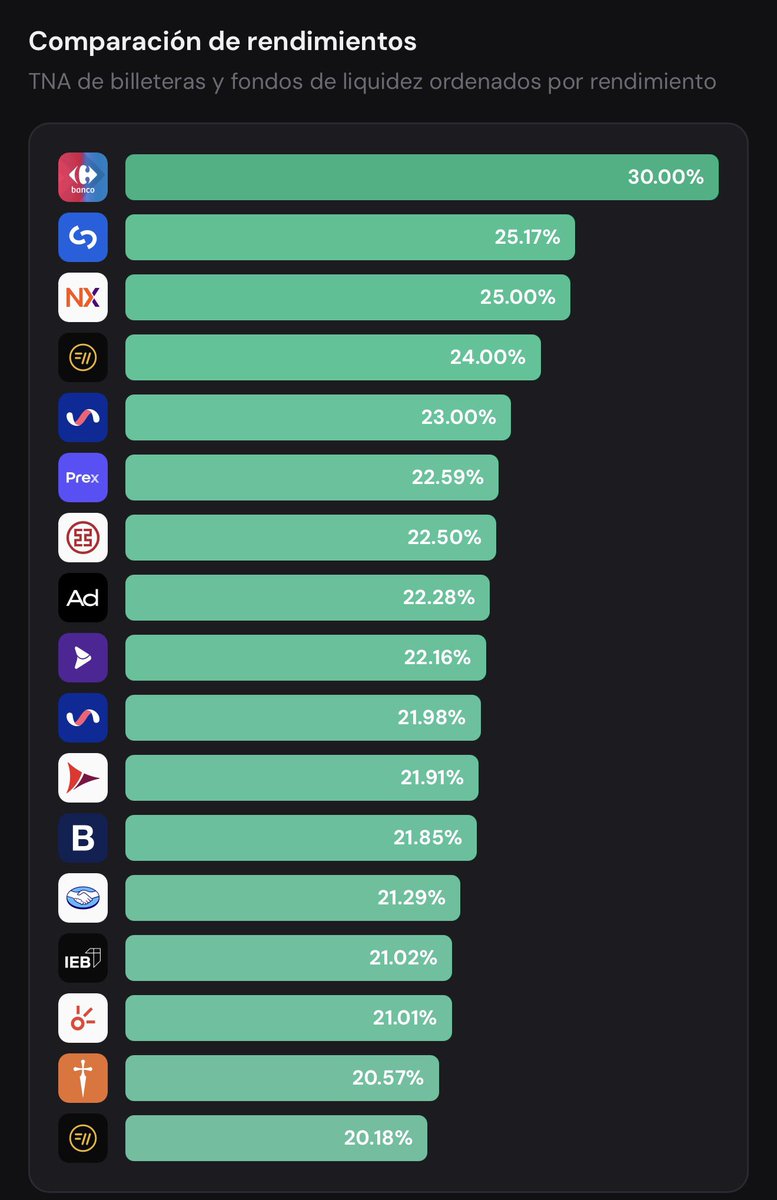
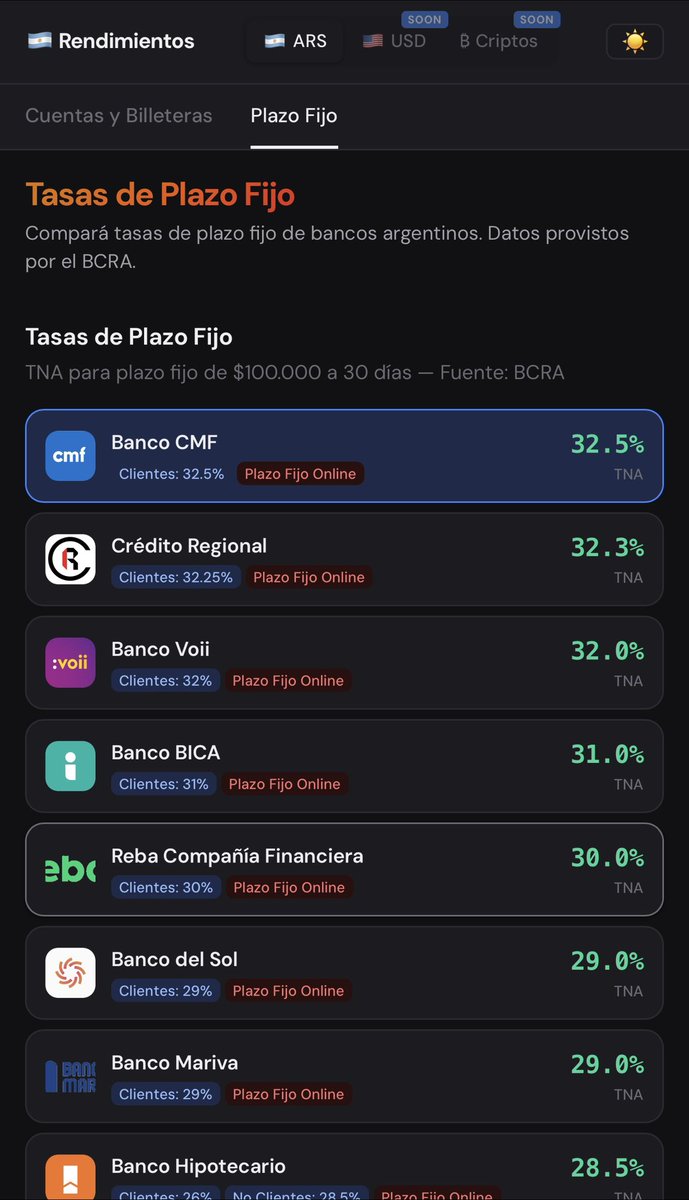
Ayer a la noche me quedé algunas horas laburando con Claude Code y armé rendimientos.co inspirado en comparatasas pero va a ir teniendo muchísima más info sobre mercado de rendimientos en Argentina! Repito: el que no se adapta rápido a CLAUDE, está out.
Ariel Sbdar tweet mediaAriel Sbdar tweet mediaAriel Sbdar tweet media
Español
166
50
1.3K
376.3K
Agus Capdevila
Agus Capdevila@agusscapdevila·
@NexoAngel16 @DefiIgnas I highly doubt 6-8% yield can now be a consistent risk adjusted return. Not Even AAVE or SKY can offer that.
English
1
0
0
32
NexoAngel XVI
NexoAngel XVI@NexoAngel16·
Hello @DefiIgnas All loans issued by Nexo are fully collateralized, backed by strict loan-to-value requirements that apply to every borrower regardless of size or profile. Nexo does not engage in under- or uncollateralized lending of any kind. This approach has helped maintain zero bad debt, even in times of market turbulence. Earn rates are determined through an ongoing review process informed by market conditions and risk parameters. The objective is to deliver competitive, risk-adjusted returns that can be maintained consistently across market cycles. For a detailed overview of how Nexo operates, see Nexo's Business Model and the Gold Standard in Digital Finance: nexo.com/blog/nexos-bus…
English
2
0
5
472
Ignas | DeFi
Ignas | DeFi@DefiIgnas·
Five crypto things I want to figure out: - Is Nexo exposed to private credit, or are all their loans overcollateralized? Their rates feel too good for pure overcollateralized lending. - If I use privacy protocols, do my wallets get flagged by Chainalysis? This matters because Source of Funds and Proof of Wealth audits usually rely on Chainalysis data. If flagged, I won't use them. - Will Polymarket & Kalshi launch tokens, or go the IPO route? It's a critical test for token vs equity debate. - What happens to stablecoin regulation if the CLARITY Act passes vs. fails? Right now I can't find a good insight of either scenario. - Why isn’t futarchy more common in DAOs? Futarchy swaps opinion polls for prediction markets. It could make DAOs fun again by bringing speculation but why futarchy isn't picking up?
English
45
4
153
16.6K
Norberto Giudice
Norberto Giudice@Criptonorber·
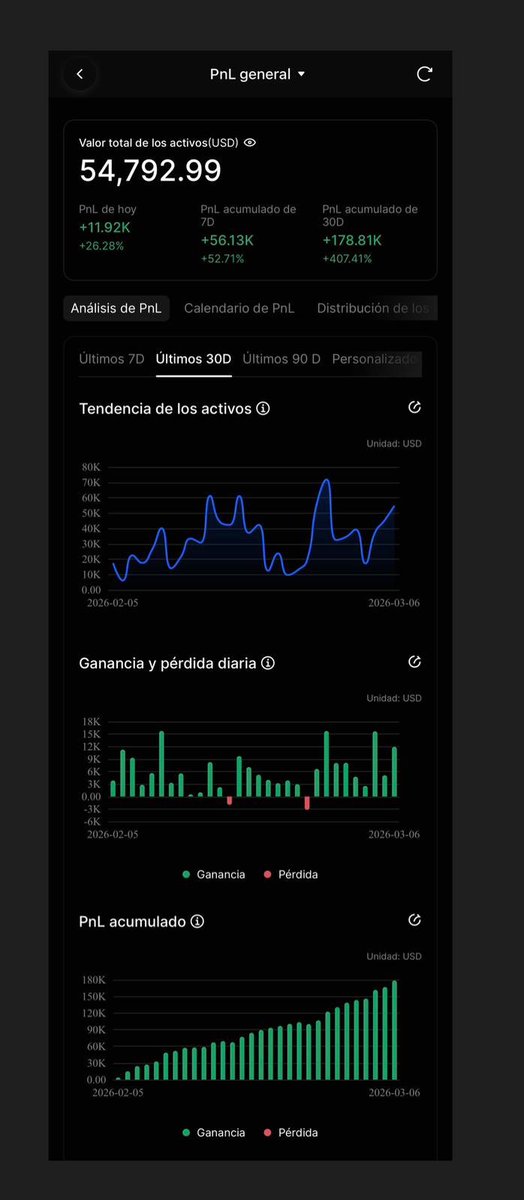
Estadísticas de mi Trading en BingX de los últimos 30 días 🤗
Norberto Giudice tweet media
Español
11
1
90
3.9K
DeFi Andree
DeFi Andree@DeFi_Andree·
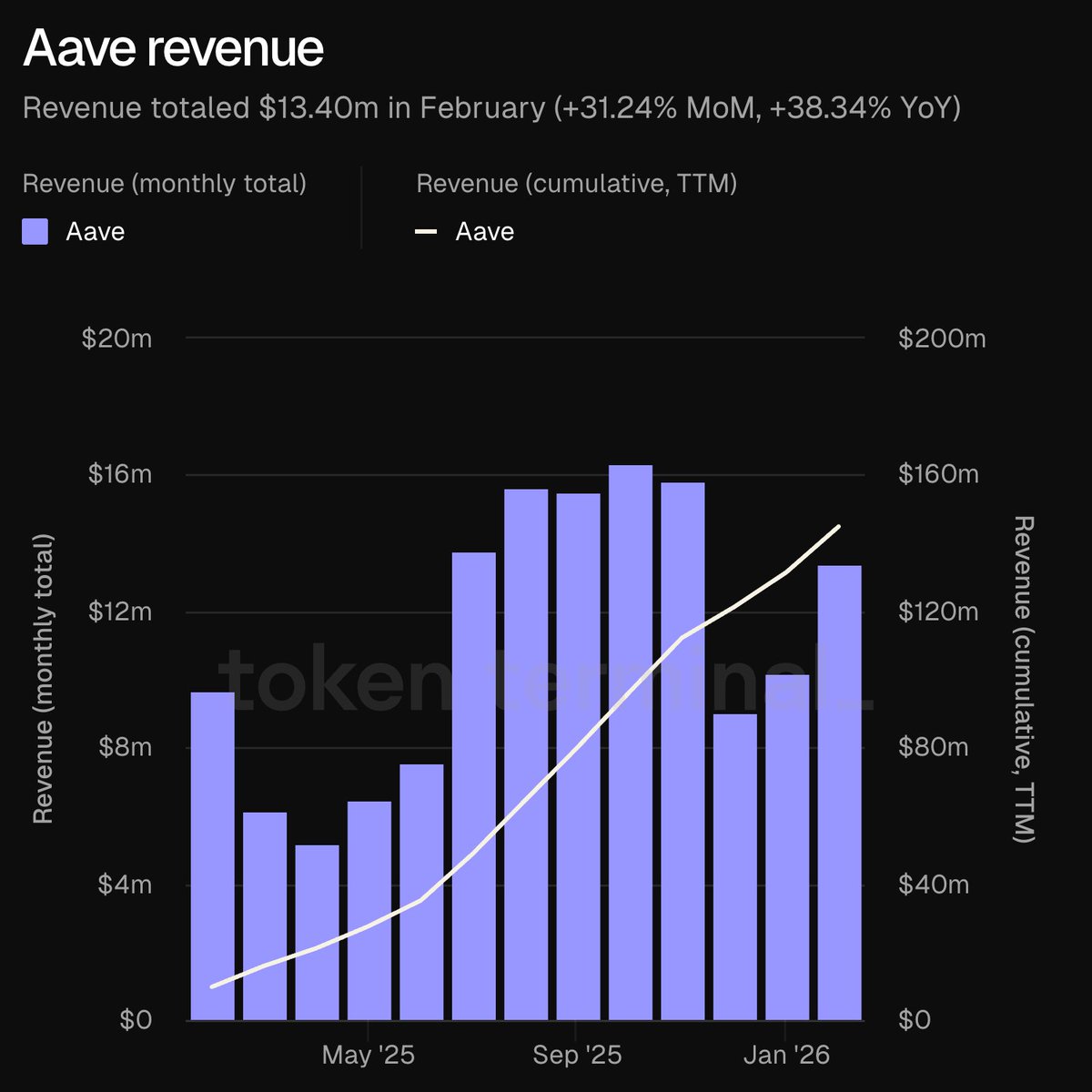
Aave just printed $13.4M in revenue in February. +31% MoM +38% YoY TTM revenue: $144.8M And this is happening while Aave is going through a real governance and contributor transition. BGD is leaving. ACI is leaving. The debates are still intense. But the revenue engine keeps running. • Ethereum still drives the engine 89.3% of Aave revenue comes from @ethereum. Liquidity lives there. Credit demand lives there. • Usage > narrative @Plasma, @arbitrum, and @base contribute smaller shares, but the core market is still where real borrowing activity happens. • Revenue follows credit demand More borrowing → higher utilization → more fees captured by the DAO. Lending is still the backbone of DeFi. And @aave is the rail where stablecoins become credit. Source: @tokenterminal
DeFi Andree tweet media
English
21
4
111
8.3K
Agus Capdevila
Agus Capdevila@agusscapdevila·
Malo corto plazo, bueno mediano plazo para la baja de tasas. Aunque habría que ver como sigue la inflación en US y como la reciente suba del petroleo termina influyendo en sus los precios. No esta claro el panorama todavía.
Cristian@cristiannmillo

Se destroza el empleo en USA. Atentos. 👇 La economía de EE.UU. inesperadamente PIERDE -92.000 empleos en febrero, por debajo de las expectativas de una ganancia de +58.000. La tasa de desempleo fue del 4,4%, por encima de las expectativas del 4,3%. Esta es apenas la segunda pérdida mensual de empleos desde la pandemia de 2020.

Español
0
0
1
144
Agus Capdevila
Agus Capdevila@agusscapdevila·
Repitan conmigo: MELI esta undervalued. Entiendo que flujo mate fundamentals. Pero en esta el mercado esta equivocado. Voy a quedarme y hasta aumentar esta posicion el tiempo que sea necesario.
Marcos Galperin@marcos_galperin

👇👇👇

Español
0
0
1
106
Agus Capdevila
Agus Capdevila@agusscapdevila·
I find it very interesting (and spot on) that Morpho is taking this direction. I hope they can build it even better than what projects like Hyperdrive or Pendle (which I still like) attempted in the past. I believe they can. I consider them extremely serious builders, and the quality of what they ship is consistently exceptional. If not the best, one of the best in Defi. Better Fixed-rate markets are, in my view, a necessary step for DeFi to truly mature and compete with traditional finance. I’ve been waiting for a long time to see a mature bond-like or fixed-rate market emerge in the crypto ecosystem. Congrats to the team.
Paul Frambot 🦋@PaulFrambot

As we approach the official release of Morpho’s fixed rate markets protocol it’s becoming clear that it should not be seen as an iteration of the existing Morpho variable rate markets (today known as Markets V1). It is a completely new paradigm that’s unlike anything DeFi has seen before. Fixed rate markets are an extension of Morpho's offering, not a replacement. Variable rate markets remain a foundational part of DeFi for the few years to come. The two will complement one another. For that reason, we’re drop the versioning naming we've been using up until now, and the protocols will no longer be named Markets V1 and Markets V2. We’re changing: Markets V1 → Morpho “Blue” (as it was originally) Markets V2 → Morpho “[TBA]” Blue introduced permissionless open-term variable rate markets, with externalized risk management. [TBA] will introduce fixed term, fixed rate, intent lending, with externalized risk and rate management. A completely different structure for pricing and matching that will take Morpho from $10B to $100B+. As a side note: Morpho Vaults retain versioning because Vaults V2 is a direct improvement designed to supersede Vaults V1, exactly what versioning is meant to signal. It has been an incredibly hard 2 years of building [TBA], but we are very excited to share more information about Morpho fixed-rate markets soon.

English
0
0
1
154
Agus Capdevila
Agus Capdevila@agusscapdevila·
Estoy de acuerdo, yo tambien la uso. Simplemente quería hacer el disclaimer por las dudas. Tambien hay que tener en cuenta que la APY en Nexo si bien es mas alta que el promedio, no es la que aparenta ser a primera vista. Real hoy, sin tener tokens de nexo o congelar usdt/usdc en fix term, es 6% en stablecoins. A algo parecido podes acceder en Morpho con el vault de PYUSD que los estan queriendo escalar y Paypal esta pagando bien, y tenes menor riesgo de contraparte que Nexo. O en ultima instancia en Spark, menor tasa pero mucho mas seguro. Dicho eso, Nexo no me parece mal para tener un % alocado ahi, sabiendo los riesgos que conlleva.
Español
0
0
0
13
Instinto Financiero
Instinto Financiero@Inst_Financiero·
@agusscapdevila @vicentebrisa_ Desde ya, es riesgoso. En su defensa quiero decir que la uso hace años y por lo menos hasta ahora no tuve problema. Pero es verdad que antes de invertir hay que conocer que puede pasar y el riesgo que conlleva el mercado cripto en general
Español
1
0
2
33
🇦🇷vicentebrisa
🇦🇷vicentebrisa@vicentebrisa_·
Me voy a hacer rica con los rendimientos de mercado pago
🇦🇷vicentebrisa tweet media
Español
51
439
19.4K
285.6K
Agus Capdevila
Agus Capdevila@agusscapdevila·
The debate around stablecoin yields is being framed as “banks protecting profits vs crypto innovation.” Reality is more complicated, and more macro driven. Yes, large banks clearly want to protect their deposit base. Deposits are their cheapest and most stable funding source. If households move meaningful balances from banks → stablecoins, banks must either raise deposit rates, rely on more expensive wholesale funding, or shrink balance sheets. All three outcomes mean tighter credit conditions and higher borrowing costs across the real economy. This matters because deposits are central to the credit channel of monetary policy. Banks don’t lend deposits one-for-one, but deposits anchor balance sheet expansion and support credit creation. If deposit funding weakens, loan growth slows, margins compress, and the transmission of monetary policy through bank lending can deteriorate. At the same time, policymakers face the opposite macro incentive. Regulated stablecoins can dramatically increase global demand for dollars. If stablecoin issuers back reserves primarily with short-term US Treasuries (T-bills), every new dollar of stablecoin supply effectively becomes incremental demand for government debt. That has macro consequences: • Higher demand for T-bills → higher bond prices • Higher bond prices → lower yields • Lower yields → lower borrowing costs for the US Treasury This matters because US interest expenses have become one of the largest items in the federal budget, and the coming decade involves massive debt refinancing. In other words, stablecoins could reinforce the global dollar system by creating a new structural buyer of Treasuries and expanding dollar liquidity worldwide. So the policy tension is real: On one side • Protect the banking system’s deposit base • Preserve the bank-credit transmission channel • Keep retail savings inside the regulated safety net On the other • Expand dollar dominance globally • Increase structural demand for Treasuries • Potentially reduce US sovereign borrowing costs Both dynamics can be true simultaneously. The risk is passing regulation that only protects bank deposits without accounting for the broader macro trade-offs. If stablecoins are constrained in a way that simply pushes savings out of banks without integrating them into the financial system, you could weaken credit creation while also missing the strategic upside for the dollar. This isn’t just a crypto debate. It’s a question about the future architecture of the dollar system and how monetary transmission works in a world where digital dollars compete with bank deposits.
Eric Trump@EricTrump

Let me make this very clear: Big Banks (think JPMorgan Chase, Bank of America, Wells Fargo, etc.) are lobbying overtime to block Americans from getting higher yields on their savings—while trying to block any rewards or perks from being given to customers. These banks, and others, pay rock-bottom rates on standard savings (often 0.01%–0.05% APY), even as the Fed pays them 4% or more. This massive spread fuels record profits, with almost none passed back to their customers / everyday depositors. Today, the banks are desperately targeting crypto/stablecoins, where platforms plan to offer 4–5%+ yields or rewards. The ABA and other lobbyists are spending millions trying to ban or restrict those yields via bills like the Clarity Act, crying “fairness” and using words like "stability"—when it's really about protecting their low-rate monopoly and preventing deposit flight. This is anti-retail, anti-consumer, and straight-up anti-American. Next time you see a big bank dropping billions on a shiny new Midtown Manhattan HQ, you know exactly where that money comes from: the non-existent interest rate they “pay” you! Fortunately, the big banks are losing this fight as customers wake up to the games… @worldlibertyfi

English
0
2
4
787
Agus Capdevila
Agus Capdevila@agusscapdevila·
I asked this question intentionally because it reflects part of the ethos many people use to dismiss the potential valuation and/or value accrual of ETH and Ethereum as an infrastructure layer for traditional finance. I really liked the answer, here it is:
Etherealize@Etherealize_io

Danny Ryan on why Wall Street cares about decentralization Etherealize co-founder and a key architect behind Ethereum’s transition to proof-of-stake is asked if Wall Street institutions care about “decentralization.” “That’s not the right word,” Danny replies. “They care about counterparty risk.” He explains: “They care about — in a transaction or a particular market — who can screw me over? And if the infrastructure is decentralized, nobody can turn it off, and their transactions will execute as intended . . . [that’s an] elimination of counterparty risk. That’s the operative lens of how they view the world, and if you explain how these systems work to them — and the difference between Ethereum and alternatives — they’re like, ‘Oh yeah, we do love decentralization because we have risk models and this helps us on our risk model.’” Danny jokes: “I’ve been looking for a customer of decentralization other than the cypherpunks I hung out with for the past 8 years, and I found it on Wall Street.” As long as you speak the right language and frame it the right way, Ethereum’s decentralization is deeply important to Wall Street institutions.

English
0
0
3
67
Agus Capdevila retweetledi
The Motley Fool
The Motley Fool@themotleyfool·
Today is a good day to not do anything to your portfolio.
English
111
113
1.4K
125.7K
Cassandra Unchained
Cassandra Unchained@michaeljburry·
Well, I have called just about everything significant that has happened the last 26 years. It's hard to say I've never had the timing right. I was short Amazon at the top in 2000. I went way long small cap value in late 2000. I bought AAPL in 1998 and then again in 2002. In 2003, I got into Korea stocks before a big run. In 2004, I got into China stocks before a big run. In 2004, I got into oil before a big run. I bought gold in 2005 and still 20 years later... In summer 2005, I figured I was buying 5 years swaps on something would print within 2, and it did. In 2008, October, I told my investors it was time to buy. More stocks bottomed then than in March 2009. In 2009, I invested in Almonds/Water, it worked ok. In 2013, I moved to buy Bitcoin after meeting with a friend at Lightspeed. I should have. Slept on it and did not. In 2015, I bought NVDA. The CFO knows. In 2018, I started pounding the table on Japan and opened a Japan fund, which I had to close for COVID. In late 2019, I warned indexing and passive investing would make for very corrlated severe drawdowns in the market, and COVID hit 6 months later, we got the most correlatedl, sharp decline in modern history. Early 2020, I entered 2020 very short. Which worked. During early COVID I loaded up on stocks and had nearly a 100% year for the fund. In 2020, I called lockdowns would be disastrous for women and children, and went on Twitter to say it. IN 2020, I got GME to buy back 1/3 of its stock and change its board. Did ok. July 2021, I gave Barron's an interview to warn on specific meme stocks at the top, and they crashed through Dec 2023. 2021, I warned about very high inflation from the policies that were being undertaken. 2023, I warned people to sell because I saw the banking crisis coming. I told them all was clear at the bottom in March as I could see it wouldn't be contagious. 2020s, I shorted Tesla, but these were trades, and it was volatile. I did not lose money overall shorting Tesla. Had some really big quick wins. Plus Tesla is only worth about $120. I am not perfect, I did not hold AAPL or NVDA long enough, in 2025 we were up almost 100% again by Liberation Day, and I lost most of the gain (still up about double digits for the year at closing) but I would put the calls I've made over these decades up against anyone. I would add visual proof for all this, but it is too much for this medium.
English
433
579
6.9K
1.5M
Aakash Gupta
Aakash Gupta@aakashgupta·
Burry is mass-publishing the accounting case for his put options on Nvidia and Palantir while the rest of the market is still debating whether the capex cycle has legs. The math he’s referencing is specific. The Big Four hyperscalers just guided $650-700 billion in combined 2026 capex, a 60%+ increase from the $381 billion they spent in 2025. Amazon alone committed $200 billion, so far above the $146 billion consensus that the stock lost $450 billion in market cap over nine straight sessions. Burry’s core thesis is the depreciation trick. Nvidia’s GPU architecture runs on a 3-year cycle, with each generation delivering 2-3x more compute per watt. The H100s shipping today are economically obsolete by 2027. But the hyperscalers are depreciating them over 5-6 years. Burry estimates this gap understates depreciation by $176 billion between 2026 and 2028, inflating reported operating income by 20%+ at companies like Oracle and Meta. That’s the “accounting tricks” he’s referencing in the tweet. He did the math. The cash flow picture backs him up. Amazon is projected to go negative FCF in 2026, somewhere between -$17 billion (Morgan Stanley) and -$28 billion (BofA). Alphabet’s free cash flow is expected to collapse 90%, from $73.3 billion to $8.2 billion. The Big Five raised $108 billion in bonds in 2025 alone, more than 3x the average of the prior nine years. JP Morgan projects $1.5 trillion in tech debt issuance ahead. They’re repackaging data center debt as asset-backed securities, $13.3 billion this year, a structure with a history that includes Enron and 2008. The depreciation cliff is the part the market hasn’t priced. The five hyperscalers plan to add $2 trillion in AI-related assets by 2030. At 20% annual depreciation, that’s $400 billion per year, which exceeds their combined 2025 profits. And AI services currently generate roughly $25 billion in direct revenue against $650 billion in infrastructure spend. Four cents per dollar invested. But here’s where you have to be careful with Burry. He shorted Tesla at $180. It went to $1,200. He called the housing crisis two years early and nearly went bankrupt waiting for the trade to work. He bought puts on Nvidia and Palantir, capped-downside bets, because even he knows his timing is unreliable. The pattern with Burry is always the same: the structural analysis is correct, the timing is wrong, and the market can stay irrational long enough to wipe out the trade before it pays. He sees the depreciation cliff. He sees the accounting inflation. He sees the debt structures. All of that is real. The question is whether AI revenue scales fast enough to fill the gap before the write-downs hit. AWS alone runs at $142 billion annualized, growing 24%, with a $244 billion backlog. Google Cloud’s backlog surged 55% to $240 billion. These companies are monetizing capacity as fast as they install it. Burry is building the bear case in public so the crowd does the work for him. That’s the trade. Whether it pays depends on something Burry has never been good at: timing the moment when the music stops.
Cassandra Unchained@michaeljburry

A question I have for $ORCL, $GOOG, $META, $MSFT, $AMZN, $NVDA, $CAT, and all the rest, “When does the spending for AI data center buildout actually end?” It is consuming all your cash flow, you are borrowing, you are financing in ways you never have, apparently because it is so urgent, because it scales? But if it scales, when does it end? Now you are engaging in accounting tricks to hide expense, to protect earnings, as the impact is so severe. You will be tortuously adjusting your earnings in a new and sinister ways. When does it end?

English
126
283
2.5K
770.1K
Agus Capdevila
Agus Capdevila@agusscapdevila·
Si, es probable que haya reconversión laboral, y hasta reducción de día y jornada laboral por ganancias de productividad. Pero la demanda y el consumo tienen que seguir sosteniéndose, las empresas tienen que seguir vendiendo y para eso tiene que seguir habiendo poder adquisitvo. Sino estamos ante el advenimiento del quiebre del sistema capitalista. El consumo podría potencialmente sostenerse por un % chico de la población si todo esto genera más concentración de riqueza, que probablemente lo haga. Pero nada de esto es sostenible a nivel social, asique alguna forma el mercado va a tener que encontrar para que esto se regule. Podrá sostenerse un tiempo con propaganda y monopolio de la fuerza en un estado, pero no lo suficiente en el tiempo. El resultado final es indefectiblemente próspero, con una cuota de volatilidad y sufrimiento en el medio, cómo todo proceso de aprendizaje social e individual de la vida.
Español
0
0
4
47