
aiplanner

464 posts

aiplanner banner
aiplanner

aiplanner

@aiplanner

Tweets by the instructors of the AI Planning MOOC

Edinburgh, UK Katılım Temmuz 2012
3 Takip Edilen922 Takipçiler
aiplanner retweetledi
AAAI
AAAI@RealAAAI·
Proceedings of the Fortieth AAAI Conference on Artificial Intelligence are now available to review online. The proceedings have been published in 48 consecutive issues which are all available here: aaai.org/proceeding/aaa…
AAAI tweet media
English
0
14
55
3.8K
aiplanner retweetledi
Subbarao Kambhampati (కంభంపాటి సుబ్బారావు)
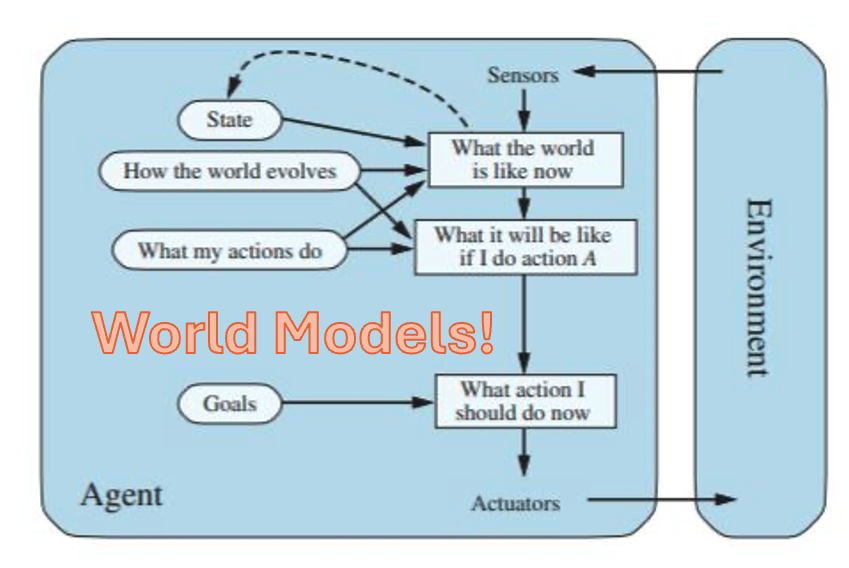
World Models: The old, the new and the wishful #SundayHarangue There is a lot of chatter about world models of late--even more than can be explained by Yann betting his entire new enterprise on it. I was going to comment on this clamor in my class this week, and thought I will preview it here first.. 😋 World Models are of course by no means new--whether learned or provided, they have been the backbone of decision making problems--be it control theory or #AI--for nearly a century. Russell & Norvig's Intro to AI text book *starts* with world model as an integral part of an agent architecture (see below). A fortuitous by-product of the focus on world modes is the crash course post-#alexnet #ML young'uns maybe getting to core #AI concepts: how hierarchical models of the world and mental simulation at differing abstractions help with long range planning.. Because the current world model craze has generally been ahistoric, it confounds multiple things, IMHO. Resolution vs. Abstraction: Perhaps the most important is on their intended purpose. Are they meant to "construct" believable synthetic worlds--thus requiring be CGI-level high fidelity Or are they meant to help the agent to efficiently mentally simulate evolution of its world--conditioned on its own and other agent's actions--to support long range planning and decision making. A large part of the current work on world models--especially that based purely on video and sensory data--seems to conflate it. While it may seem that having a high fidelity world building model should also help in long range decision making, it is quite likely that the computational tradeoffs--between hi-res and abstraction tend to make them of questionable use for long range planning. Faster roll out (mental simulation) and higher resolution are quite often at loggerheads.. Disjunction and Abstraction: Having mentioned "hierarchy" and "abstraction" multiple times, I feel it is worth pointing out that at its core abstraction is a form of disjunction. An agent reasoning with the abstract models is basically reasoning over a disjunction of many distinct concrete futures--that are all roughly equivalent from the point of view of the goals of the agent. The connection to disjunction and abstraction is a powerful one that is not often acknowledged. An abstract action is a disjunction over concrete courses of action--thus leading to a disjunction of world states. A learned latent variable has similar disjunction semantics. For example, in a transformer-like architecture, a latent variable can be seen as a distribution over concrete tokens. Role of language and Symbolic abstractions: While in theory it is possible to learn world models with hierarchical abstraction (e.g. with latent variable models), ignoring the linguistic data--which is after all the corner stone of human civilization--fails to leverage the abstractions we humans have developed over the millennia. Planning, of the kind I am fond of, is possible because the models are at a significantly higher level of abstraction than pixels, or even any latent variable learned models can provide in the near future. While the planning models of yore were written by humans, there is a way of avoiding that bottleneck. Our linguistic data already sort of captures of humanity's abstractions over video data--or what I like to call "space time signal tubes" (c.f. x.com/rao2z/status/1… & x.com/rao2z/status/1… ). So, as much as I agree with the argument that language may not by itself lead to effective world models, I also equally believe that getting to the right level of abstraction from pixel stream data--while theoretically possible (in that we the humanity and evolution seem to have done it), is going to be awfully slow--especially when we have the human abstractions, however imperfect, are readily available in the language data. A powerful way, it seems to me, is to complement these symbolic and pixel level WMs.. The tradeoff is either "important parts only, but can do long range prediction" vs. "full resolution, but not long enough range". Humans seem to use language vs. visual priors for these two, which argues for an approach that uses both types of data in learning world models. Internal Abstractions and Alignment Problem: Even if the efficiency is not an issue, another critical concern about learning purely from sensory data aligning the agents using those models to humans. There is no a priori reason that the abstractions learned internally from the sensory data by an agent would have any natural correspondence to those that humans use. To the extent we want artificial agents with learned world models to be easily aligned to us humans, taking the inductive biases present in the linguistic data seems like a smarter move (c.f. x.com/rao2z/status/1…). LLMs and Symbolic World Models: While there is a lot of evidence that LLMs may not be directly encoding (symbolic) world models, it has also been known that we can learn such symbolic models from LLMs. Indeed, one of our earliest works on the role of LLMs in Planning was to extract symbolic planning models from them (c.f. arxiv.org/abs/2305.14909). There has been significant additional work since then--with some of it trying to combine sensory and linguistic data in learning world models. Verifiers and Simulators are related to World Models: A lot of the improvement in LLM reasoning models has come from post-training phase that uses LLMs as generators of plausible solutions, and checking their correctness with the verifiers or simulators that are available externally (c.f. x.com/rao2z/status/2…). The critical importance of the availability of such verifiers/simulators for LLM post-training has become so clear that there is a clamor of the so-called "RL Environments"--which basically are RL engines coupled to verifiers or simulators standing in for the "environment." Acknowledging this connection would make "world model learning" as a general version of "verifier/Simulator learning". Learning from your experience vs. other's experience: One important distinction in world model learning is whether you are learning them by doing things in the world yourself and observing/feeling the consequences (which is pretty much what kids do), or whether you are trying to learn them from other people's collected experience (which is what most of the current post-LLM research on World Models does). The big difference tends to be causality.. when you generating your own experiences, you have the ability to do arbitrary causal intervention experiments, something that is hard when you are only learning from others' experience. The difficulty of gaining your own experience of course is that (a) it is time consuming and (b) possibly unsafe. Not surprisingly, notwithstanding Sutton's OAK proposal, most ongoing work on world models is based on the agent learning from others' experience. On the Irony of learning world models for synthetic worlds: A lot of the work on world models seems to be quixotically based on virtual worlds--such as video games. This seems quite ironic. Since these are made by us, the whole point of learning world models seems to be sort of "reverse engineering" what we (the humanity) already know. In this era of LLMs where everything that humanity knows is already fodder for training LLMs, what is the deeper reason as to why learning virtual worlds (rather than just stealing the program running the virtual world) is a legitimate long term research direction? (I am fine with playing with virtual worlds as a training wheel for the "real world" that we didn't engineer.. but am a little mystified by video games as the be all and end-all. Come to think of it, this irony is also present for the original Atari Game suite that pushed a lot of deep RL research: The game engine converts a compact RAM state to a video frame so the humans can "play" and the DRL algorithms try to reverse engineer the logic from this video frame.. Since the time of the Atari Games benchmark, any illusory need for such reverse engineering has largely disappeared, IMHO).
Subbarao Kambhampati (కంభంపాటి సుబ్బారావు) tweet media
English
7
27
110
13.8K
aiplanner retweetledi
Rodney Brooks
Rodney Brooks@rodneyabrooks·
Just published my annual predictions update, tracking from Jan 1st 2018, with new commentary and new ten year predictions. It is long. rodneybrooks.com/predictions-sc…
English
7
29
120
30.8K
aiplanner retweetledi
Andrew Ng
Andrew Ng@AndrewYNg·
I recently received an email titled “An 18-year-old’s dilemma: Too late to contribute to AI?” Its author, who gave me permission to share this, is preparing for college. He is worried that by the time he graduates, AI will be so good there’s no meaningful work left for him to do to contribute to humanity, and he will just live on Universal Basic Income (UBI). I wrote back to reassure him that there will still be plenty of work he can do for decades hence, and encouraged him to work hard and learn to build with AI. But this conversation struck me as an example of how harmful hype about AI is. Yes, AI is amazingly intelligent, and I’m thrilled to be using it every day to build things I couldn’t have built a year ago. At the same time, AI is still incredibly dumb, and I would not trust a frontier LLM by itself to prioritize my calendar, carry out resumé screening, or choose what to order for lunch — tasks that businesses routinely ask junior personnel to do. Yes, we can build AI software to do these tasks. For example, after a lot of customization work, one of my teams now has a decent AI resumé screening assistant. But the point is it took a lot of customization. Even though LLMs can handle a much more general set of tasks than previous iterations of AI technology, compared to what humans can do, they are still highly specialized. They’re much better at working with text than other modalities, still require lots of custom engineering to get it the right context for a particular application, and we have few tools — and only inefficient ones — for getting our systems to learn from feedback and repeated exposure to a specific task (such as screening resumés for a particular role). AI has stark limitations, and despite rapid improvements, it will remain limited compared to humans for a long time. AI is amazing, but it has unfortunately been hyped up to be even more amazing than it is. A pernicious aspect of hype is that it often contains an element of truth, but not to the degree of the hype. This makes it difficult for nontechnical people to discern where the truth really is. Modern AI is a general purpose technology that is enabling many applications, but AI that can do any intellectual tasks that a human can (a popular definition for AGI) is still decades away or longer. This nuanced message that AI is general, but not that general, often is lost in the noise of today's media environment. Similarly, the progress of frontier models is amazing! But not so amazing that they’ll be able to do everything under the sun without a lot of customization. I know VC investors who are scared to invest in application-layer startups because they are worried that frontier AI model companies will quickly wipe out all of these businesses by improving their models. While some thin wrappers around LLMs no doubt will be replaced, there also remains a huge set of valuable applications that the current trajectory of progress of frontier models won’t displace for a long time. Without accurate information about the current state of AI and how it is likely to progress, some young people will decide not to enter AI because think think AGI leaves them no meaningful role, or decide not to learn how to code because they fear AI will automate it — right when it is the best time ever to join our field. Let us all keep working to get to a precise understanding of what’s actually possible, and keep building! [Original text: deeplearning.ai/the-batch/issu… ]
English
147
550
2.5K
302.5K
aiplanner retweetledi
AAAI
AAAI@RealAAAI·
Proceedings from AAAI-25 are now available to view here: bit.ly/43QmOKm
English
0
14
51
6K
aiplanner retweetledi
Subbarao Kambhampati (కంభంపాటి సుబ్బారావు)
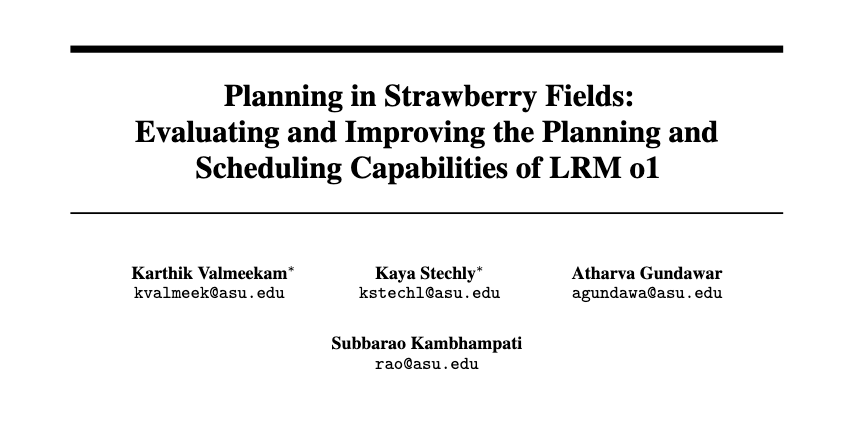
All this and more is discussed in our latest report on Planning in 🍓 Fields (👉arxiv.org/abs/2410.02162). This report also extends the evaluation of o1 models to scheduling benchmarks (since much of what goes under "planning" in LLM benchmarks--such as Travel Planning, Trip Planning, Meeting Planning etc. are really scheduling problems reducible to canonical CSP instances, rather than the more general planning problems reducible to graph search). (It also includes our speculations on o1's internal operations as an added bonus appendix.. 😋 x.com/rao2z/status/1…) (Work lead by @karthikv792 & @kayastechly -- with help from @21stwarlock) 2/
Subbarao Kambhampati (కంభంపాటి సుబ్బారావు) tweet media
English
3
3
9
6.6K
aiplanner retweetledi
Austin Tate
Austin Tate@batate·
Use of £100s millions for LLM training is simply adding to the ubiquitous short lived set of such models and most likely going to fund cloud computing outside the UK. A better use of funds is support to the development of foundational AI techniques used alongside LLMs in future.
English
0
1
2
58
aiplanner retweetledi
RAEngGlobal
RAEngGlobal@RAEngGlobal·
Would you like to be part of a peer support network of “International Associates” to facilitate international cooperation and support Academy activities related to artificial intelligence? Apply to Distinguished International Associates programme now - for more details: raeng.org.uk/dia
RAEngGlobal tweet media
English
0
4
2
2.3K
aiplanner retweetledi
IJCAIconf
IJCAIconf@IJCAIconf·
Fantastic work by the #IJCAI2026 team, setting the stage for the IJCAI 2026 in Bremen, Germany!
English
0
3
3
1.8K
aiplanner retweetledi
Beq
Beq@BeqBeqBeqBeq·
Want to test/experience PBR in @secondlife with @PhoenixViewerSL ? Join the Phoenix-Firestorm Preview group. Our alpha 7.1.1 aligns us with the LL release of PBR, and we've added a few of our fixes, including performance fixes for NVidia cards on Windows and Linux #Metaverse
English
0
7
7
791
aiplanner retweetledi
Austin Tate
Austin Tate@batate·
Planning is hard :-)
English
0
1
1
112
aiplanner retweetledi
Royal Academy of Engineering
Royal Academy of Engineering@RAEngNews·
What are experts' hopes and fears for generative AI? We spoke to six people with detailed knowledge of the technology as part of a new series on engineering responsible #AI. Read the full interviews on our website: raeng.org.uk/engineering-re…
Royal Academy of Engineering tweet media
English
1
9
18
8.3K
aiplanner retweetledi
Webots
Webots@webots·
A very nice introduction to robotics and Webots on Coursera from Prof. Nikolaus Correll at the University of Colorado Boulder: coursera.org/specialization…
Webots tweet media
English
1
5
28
2.8K