aki

607 posts

aki banner
aki

aki

@aki11a

~{. ;; ^_^ — $$&&#}.\\—•^~^{===}!!.•~

Katılım Kasım 2023
1.1K Takip Edilen385 Takipçiler
Sabitlenmiş Tweet
aki
aki@aki11a·
trading is 95% a relative internal sport, much like archery on a moving boat. my focus has been on personal conflicts & sizing w/conviction points vs. other's sizes & allowing externalities to affect my sizing. to each all may wins vary, but to yourself; the prerequisite of being grateful for any/every experience must exist. 負けは教訓、勝利は祝福
English
1
1
11
1.5K
aki retweetledi
Skely
Skely@123skely·
Here’s the open secret to life bros. No one knows wtf they are doing. No one. That smart investor guy. Retarded. That cool edgy VC “degen” yep also retarded. The professor of math PHD big shot. Yep. Retarded. There are only two classes of people. Those who DO and those who “wait and see”. That’s it. Get out of the life-cuck-chair. Stop watching and start doing. Anything. Just DO stuff.
English
28
49
500
20.3K
aki
aki@aki11a·
Now with Claude, everyone’s building custom onchain tooling. Next steps>> running validators/nodes for optimal data collection and pipelining. Not sure how I feel about the market in selling packaged data or “calculated endpoints” for others to build upon because anyone can just copy their calculations. The question is how deep and intricate will people go to get the “most edge data”. I see this as the level to which one formulates a thesis. Thesis based off tweet = bad. News based. Why? The main route here for trading with AI: News based HFT -> increases volatility, fastest bots wins, nobody will hodl. I think that onchain trading will get very hard at least in developing an eye for catching something that’ll stick. Because if the bot is profitable, it’ll just sell and take the money. That’s what everyone is selling rn on the timeline: automated trading bots. The thing that’s hard to develop per algo in crypto is how long to hold per potential narrative. And imo, crypto is all about the 100x riches, not the 30% profit per trade. Those are the dinner stories that attract normie capital. Pumps to avoid buying into now: news based pumps, tweet induced, whale wallet induced.
English
0
0
0
53
aki
aki@aki11a·
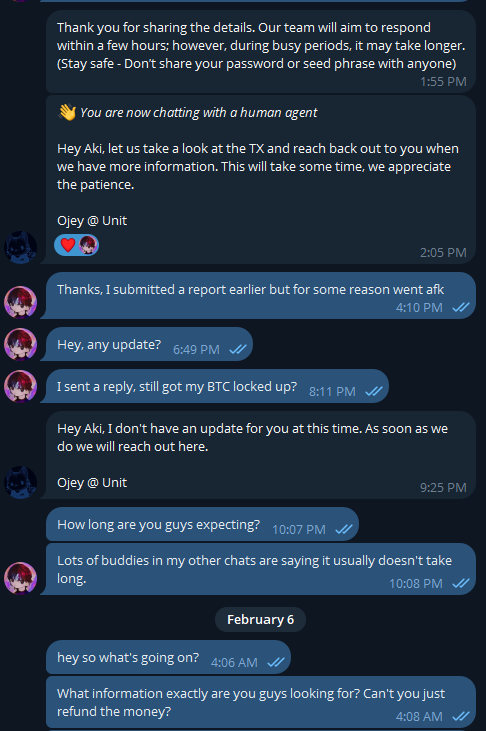
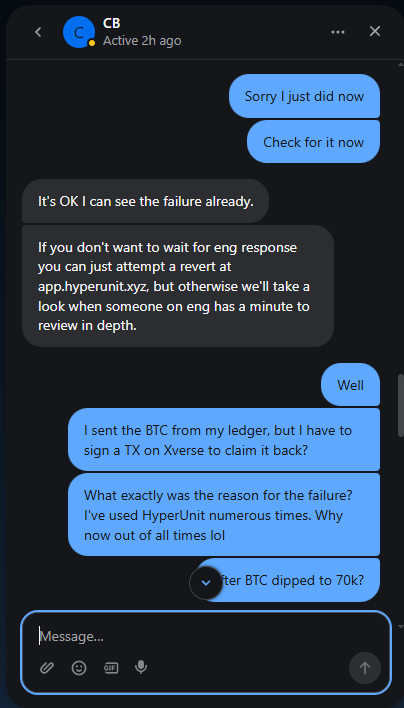
UPDATE: It's been ~4 days since Hyperunit has held my BTC hostage from me. Situation still unsolved. Not able to get my $70k USD back. Support is still being super slow.
aki@aki11a

I really did not want to post this but @unitxyz aka Hyperunit has been holding my 0.9255 $BTC ($71,078.4 USD @ time of deposit) hostage for 2 days now after this -15% drawdown. They refuse to refund & even the support agent said "the revert is fairly quick"? I've been using them for months and all of sudden they decide to mark my deposit as "failed" with no actual responses on TG support or web support. I really supported @sershokunin but this type of thing cannot be happening during a time like this. Posted below are the responses from TG, Web Support, and the transaction failure. Would not use them right now, big chance they're not able to fulfill withdrawals.

English
0
1
1
350
aki
aki@aki11a·
@RaAres @unitxyz the classic: "we can take ur btc during this dip, but we cannot give you custody"
English
0
0
1
166
aki
aki@aki11a·
I really did not want to post this but @unitxyz aka Hyperunit has been holding my 0.9255 $BTC ($71,078.4 USD @ time of deposit) hostage for 2 days now after this -15% drawdown. They refuse to refund & even the support agent said "the revert is fairly quick"? I've been using them for months and all of sudden they decide to mark my deposit as "failed" with no actual responses on TG support or web support. I really supported @sershokunin but this type of thing cannot be happening during a time like this. Posted below are the responses from TG, Web Support, and the transaction failure. Would not use them right now, big chance they're not able to fulfill withdrawals.
aki tweet mediaaki tweet mediaaki tweet mediaaki tweet media
English
6
0
15
1.1K
aki
aki@aki11a·
@unitxyz Much respect to the guys there and what they've accomplished, but this cannot be happening during a time like this.
English
0
0
1
227
aki
aki@aki11a·
The overhead here now is with this little liquidity, the J shaped runners now will most likely not be found by following popular fomo wallets. If it is, then all the followers (copytraders) of per wallet must be washed out with a -80% retrace. Also the way they structure the leaderboard should be based off percentages. Size players can rise to the top easily.
English
0
0
0
110
aki
aki@aki11a·
There are decades where weeks happen, then there are weeks where decades happen
English
0
0
0
107
aki
aki@aki11a·
tired of people taking the exact footsteps as other people thinking it's gonna work for them. And the worst part is, if it does work, it's because 90% of it was unrecognized luck and it'll always catch up later. Focus on edge
English
0
0
1
90
aki retweetledi
Hyperliquid
Hyperliquid@HyperliquidX·
Hyperliquid is built on a foundation of onchain transparency. A recent article made several claims that are factually incorrect: + Solvency: Every dollar is accounted for; the author failed to count native HyperEVM USDC. + Integrity: Testnet functions are exactly that - testnet only for testing. They cannot be executed on mainnet. + Transparency: Hyperliquid is more transparent and decentralized than all other major venues for perps trading. The entire state is independently maintained by a permissionless validator set and verified through BFT proof-of-stake consensus by each node. Every order, trade, and liquidation is available in real time during execution. Anyone can run a node and index the chain’s state and transitions. No major perps platform comes close to this guarantee for users. See our response to the writer’s individual points below. Claim: The system is undercollateralized by $362M False: The Hyperliquid blockchain state is fully and verifiably solvent. The author excluded the HyperEVM USDC (a publicly announced and much anticipated integration), which exists in parallel to the Arbitrum bridge. Every USDC in circulation on HyperCore is accounted for transparently, by summing up the balances of arbiscan.io/address/0x2df1… and hyperevmscan.io/address/0x6b9e…. At the time of writing, this amounts to 3.989B + 362M = 4.351B USDC on HyperCore. USDC on the HyperEVM can be computed by subtracting 362M from the 421M on the HyperEVM USDC contract (hyperevmscan.io/token/0xb88339…), totaling another 59M USDC on HyperEVM. The sum of the Arbitrum bridge and native USDC balances can be compared against the sum of user balances on HyperCore. As highlighted in the introduction, this exercise of verifying complete system solvency against user balances is uniquely possible on Hyperliquid compared to competitors. The current Arbitrum bridge was an important stepping stone in bootstrapping the Hyperliquid network and will be deprecated as the migration to native USDC is complete, bringing Hyperliquid to parity with other major L1s. Claim: There is retroactive volume manipulation via TestnetSetYesterdayUserVlm False: This is a testnet-only function to allow for comprehensive testing. The author states that “the function’s presence is the problem…capability alone violates the trust model.” Testnet-only features that enable more rigorous testing of edge cases do not undermine the chain’s integrity. The fee schedule on Hyperliquid interacts in a complex way with inputs: user volume, aligned quote token status, maker vs taker, HIP-3, etc. It’s important to test these interactions on testnet, and therefore the testnet chain has a set of admin testing functions that do not exist on mainnet. The related TestnetAddMainnetUser action is to mark a testnet user as having corresponding mainnet state, to avoid DDOS and other attacks that are “free” on testnet. None of these functions are callable on the mainnet state. While the execution source is not available, anyone can verify every trade onchain by running a node, and sum up the values to confirm that volume numbers are reflected accurately in onchain state. Similar to onchain solvency verification against the sum of all user account values, this is possible on Hyperliquid but not on most competitive platforms. Given that this code path is entirely unreachable on mainnet, future development work will entirely compile out this testnet-only logic on mainnet nodes to avoid any possible misunderstanding or misinterpretation. Claim: Some users have special privileges such as fee exemptions or retroactive volume manipulation used to influence the airdrop False: Like system solvency, user balances, and individual trades, the fees paid by any address is available onchain. Each trade along with its fees paid or rebates received are transparently indexed by nodes, API servers, and third party analytics providers. There are no such mechanisms to distort fees, and no such mechanisms could have influenced the HYPE airdrop. Furthermore, the genesis distribution of HYPE is fully available onchain, and users can verify the historical behavior of every such address. Claim: “CoreWriter” godmode can mint tokens, move user funds without signatures, crash random validators and basically do whatever it wants False: The CoreWriter spec is fully documented here hyperliquid.gitbook.io/hyperliquid-do… and replicable in the open source HyperEVM execution. CoreWriter is a way for smart contracts on HyperEVM to send HyperCore actions as part of HyperEVM block execution. It supports various actions that are normally sent by EOAs such as staking and placing orders, but has no such features to “mint tokens, move user funds without signatures, crash random validators and basically do whatever it wants.” This is a fundamental misunderstanding of how HyperCore interacts with the HyperEVM. Claim: Chain can freeze via governance, and no undo function exists Misinterpreted: The chain freezes during network upgrades. There is no undo function because the validators adopt a new binary at that height. This is analogous to how other networks perform hard forks at future heights determined by social consensus. Suspicious activity on POPCAT in Nov 2025 did not cause the L1 to freeze, nor were any user funds frozen. The L1 was entirely operational, and any observer can see the blocks that were produced during this time. The Arbitrum bridge was automatically locked after the incident due to abnormal variation in account balances. As explained above, the Arbitrum bridge is not as secure as natively minted USDC, and therefore requires several conservative automated locking mechanisms as safeguards. The Arbitrum bridge’s locking mechanism is audited and open sourced, and the bridge is being deprecated with the transition to native USDC. Claim: A single private key can set any oracle price instantly: no timelock, no limits Misinterpreted: The author is likely mistaking the HIP-3 oracle updater logic with the validator-operated perps. HIP-3 oracle updates are indeed set by a single address, but this is up to the deployer to configure. The updater address need not be an EOA. For example, current HIP-3 deployers use a combination of MPC and CoreWriter architecture. For validator-operated perps, multiple validators can submit oracle price updates. The final prices are a robust weighted median across major centralized exchanges. There is no timelock and no limits explicitly because these limits make the system less, not more, safe. The events of 10/10 show the danger to solvency if ADL is not accurately triggered in a timely manner during high volatility. Hyperliquid was one of the only venues without performance degradation or a network outage during this time. If Mango Markets or a similar protocol with oracle rate limits were active during 10/10, they would have likely accrued bad debt. Further decentralization will involve other validators actively running independent and open-sourced oracle update binaries. Claim: 8 undisclosed addresses control all transaction submission False: Some transactions are already sent directly from the validators. Some such as orders are not, in order to minimize MEV, but a future upgrade will incorporate this logic for all transactions in a mechanism that is both MEV- and censorship-resistant. The careful consideration of MEV is in response to trader and researcher feedback based on predatory behavior observed on other chains. There is almost unanimous agreement that toxic transaction ordering degrades the end user experience. Ultimately, the validator set is permissionless, and there is no guarantee that validators in the mainnet set are always fully aligned with the ecosystem. A major milestone in decentralization will be solving this problem, including a multiple-proposer block building setup. Claim: There is a liquidation cartel with unfair advantages Misinterpreted: Only HLP may backstop liquidate users, and HLP subvaults are the only addresses in this set. However, depositing into HLP is permissionless, so HLP is a community-owned liquidity vault supporting the protocol. The fact that HLP has privileges is no different from other protocol liquidity vaults. Relatedly, all liquidations are first attempted against the order book, which handles the vast majority of liquidated positions without backstop liquidation. This allows users to keep any remaining collateral, and allows all other users to compete in providing the best price to the liquidation flow, benefitting the liquidated user. Claim: There is a hidden lending protocol with $1M+ supplied and no documentation False: Portfolio margin, borrow lend, and the HLP supplied value were all publicly announced and are currently in pre-alpha rollout. The current documentation can be found at hyperliquid.gitbook.io/hyperliquid-do… and has been progressively fleshed out over the past several weeks. Claim: ModifyNonCirculatingSupply allows changes to token supply False: The full supply of HIP-1 tokens on HyperCore is fixed at deployment. The non-circulating supply is a purely informational number that can optionally mark addresses as “non-circulating” for display purposes. Whether an address is marked as “non-circulating” does not affect execution. This is an example of onchain information that might make more sense offchain, but is not a vulnerability. Thank you to the author for spending the time to verify the execution of Hyperliquid. The fact that this investigation could be done at all proves the transparency and decentralization that Hyperliquid has already achieved. Concretely, Hyperliquid is the only major perps venue where the entire state and every input diff is transparently available to anyone running a node. A similar analysis on any of the other top perp DEXs is impossible. For example, Lighter uses a single centralized sequencer whose execution logic and ZK circuits are unavailable. Aster uses centralized matching and even offers dark pool trading, which is only possible with a single centralized sequencer without verifiable execution. Other protocols with some open source contracts do not have a verifiable sequencer. On Binance, Lighter, Aster, or similar exchanges, it is impossible for anyone other than the sequencer to see a full snapshot of onchain state including order books, positions, and other user information. The centralized sequencer can also upgrade its software without any constraints. On Hyperliquid, the entire state is onchain, which means there are 24 validators executing the same state machine under BFT consensus rules. There is plenty left to do on the journey towards greater decentralization, but it’s important to highlight just how far Hyperliquid and its ecosystem have come compared to competitors. Decentralization is progressive, and Hyperliquid will ultimately be fully open sourced. Hyperliquid is the most transparent of all major venues, even though this leaks advantages to competitors (all of whom are closed source), who can copy Hyperliquid’s innovations more easily. We think this is the correct tradeoff to balance value accrual to the community, speed of innovation, and upholding the values of defi. The HyperEVM execution is open source, and Sprites, an independent community member, maintains a full archival node that powers many important integrations. HyperCore will follow the same path as soon as it reaches feature completion.
English
438
465
2.5K
771.2K
aki
aki@aki11a·
Flash news: There is no "alt season", just circles getting smaller & more competitive. Tired of people thinking alt season is easy money. In 2019, the people who made money are dumbass XRP sheep and presale Unc's. 2021, 30 y/o DeFi chads. 2024 18 y/o Fortnite Trenchers. Circle is getting younger and younger. Adapt or die. Which circle is gonna get rich next
English
1
0
2
152
aki
aki@aki11a·
Escapism is the act of seeking distraction and relief from everyday stress by immersing oneself in alternative activities like hobbies, entertainment, or fantasy. While healthy escapism can provide temporary relief and help reduce stress, it can become detrimental if it leads to avoidance of responsibilities, impacts relationships, or turns into addiction, as seen with things like drugs, alcohol, or excessive social media use.
English
0
0
2
81
aki
aki@aki11a·
gm
QST
1
0
3
119
aki retweetledi
Ash
Ash@ahboyash·
Two OGs, two new DeFi primitives @CurveFinance's founder @newmichwill is shipping @yieldbasis (a no-IL BTC AMM liquidity platform); while @yearnfi’s founder and god of DeFi @AndreCronjeTech is building @flyingtulip_ (unified AMM+CLOB exchange). Different bets on the same problem - make on-chain liquidity actually work: • Yield Basis ($YB): A Curve-native AMM that removes impermanent loss (IL) for BTC LPs by holding constant 2x leverage in a BTC-crvUSD (LP tracks BTC 1:1 while earning fees). You mint ybBTC (yield-bearing BTC) • Flying Tulip ($FT): A unified on-chain exchange (spot + lending + perps + options + structured yield) built on a volatility-aware hybrid AMM + CLOB, slippage-aware lending, and ftUSD (a delta-neutral USD-equivalent) as the incentive flywheel - - - - - Yield Basis • Classic AMMs make BTC LPs sell into strength (when price goes up) or buy into weakness (√p exposure), causing IL that often is more than the fees earned while LPing • Saving a longer post for Yield Basis, but essentially users deposit BTC into the platform → protocol borrows equal crvUSD and forms a 50/50 BTC-crvUSD Curve LP at 2x compounding leverage • A re-leveraging AMM + virtual pool keeps debt ≈ 50% of LP value; arbitrageurs get paid to keep leverage constant • This results in LP value moving linearly with BTC and earns trading fees • LPs hold ybBTC, a yield-bearing BTC receipt token that auto-compounds BTC-denominated trading fees • There is also the governance token $YB, that can be locked for veYB to vote (gauges, pool emissions) • Yield basis is basically for BTC holders that want to unlock productive BTC in a protocol that solves the IL problem and earn fees Flying Tulip • Legacy DEX UX and risk settings are static. FT tunes the AMM curve to volatility and the lending LTVs to real execution/slippage → goal is to bring CEX-level tooling on-chain • Their AMM adapts curvature to measured vol (EWMA) → i.e. flatter (near constant-sum) in calm regimes to compress slippage/IL, more product-like in high vol to avoid depletion • ftUSD is produced by tokenized delta-neutral LP positions and is used for da flywheel, incentives/liquidity programs across the exchange • There is the platform token $FT, where revenue could be potentially reserved for buybacks/ incentives/ liquidity programs • The DeFi super-app: one exchange for spot, lending, perps, options • Execution quality depends on accurate vol/impact signals and robust risk circuits during stress - - - - - Yield Basis wants to become the venue for BTC liquidity; while Flying Tulip aims to be the venue for everything trading-native on-chain. In the era of a Perp Dex meta, this comes in a timely manner for Flying Tulip to launch. Tbh, Flying Tulip could even route future BTC flow to YB-like pools if that produces best execution. If Yield Basis delivers, ybBTC becomes the “stETH-for-BTC” primitive: BTC exposure + LP trading fees, without IL. While Flying Tulip has the potential to ship its integrated stack, to allow users to get CEX-level tools; a “one exchange, all of DeFi” attempt. Remain cautiously optimistic for the 2 projects, while you do not want to fade the OGs and tier 1 founders, both are untested and the founders have other protocols to also take care of (Curve, Sonic).
Ash tweet media
English
34
39
282
69.3K
stew
stew@stewxbt·
@Cbb0fe otherwise known as “we ate off that twin”
English
1
0
24
15.5K
CBB
CBB@Cbb0fe·
By far the best farming ever for us Glad to live this with my brother and friends Trillions
CBB tweet media
English
600
77
3.2K
542.6K
aki retweetledi
Wu Blockchain
Wu Blockchain@WuBlockchain·
Hyperliquid Founder on How Eastern and Western Values Shape Entrepreneurship Jeff Yan noted that his parents are Chinese immigrants and that growing up between Eastern and Western cultures has benefited him greatly. He believes Hyperliquid's success is partly due to drawing on the strengths of both value systems. He explained that the individualism and "change-the-world" ethos prevalent in the United States and the West are crucial for entrepreneurship and help explain why many major startups are born in America. At the same time, Chinese culture emphasizes humility, less talk and more action, and a strong work ethic—qualities shaped by the older generation—which have informed his approach to building and working. In his view, these Eastern and Western values complement each other and together have propelled Hyperliquid's development. Source: youtube.com/watch?v=M0CluQ…
YouTube video
YouTube
English
27
41
354
40.8K
aki retweetledi
shat
shat@shatmypants10x·
I remember when i was new to the trenches someone would say "China is about to wake up" on a 150k market cap memecoin telegram and it would really give me hope
English
203
162
2.7K
174.1K