Sean

30.5K posts

Sean banner
Sean

Sean

@akingseyeview

Attorney, CPA (inactive), entrepreneur, futurist, investor, advisor.

San Juan, Puerto Rico Katılım Temmuz 2008
3.7K Takip Edilen1.3K Takipçiler
Sean retweetledi
Sean retweetledi
Art
Art@ZarkFiles·
A former NYPD detective looked at what I found hidden in New York's voter rolls and said one word: "Plutonium." The NY State Police Special Investigations Unit agreed. Law enforcement and military intelligence both gave me the same instruction: publish fast. This thread is why. 🧵
Art tweet media
English
69
537
1.3K
78.8K
First Squawk
First Squawk@FirstSquawk·
MAJOR CASUALTY COVER-UP BY HEGSETH ALMOST 750 US TROOPS KILLED/WOUNDED — The Intercept
English
286
2.7K
18K
1.2M
Sean
Sean@akingseyeview·
@MichaelAlbertMD Can you redo this thread in English for ordinary folk?
English
0
0
0
55
Michael Albert, MD
Michael Albert, MD@MichaelAlbertMD·
The cholesterol wars are over. LDL won. New guidelines. Four landmark trials. An oral PCSK9 inhibitor that matches injectables. And data proving we should be treating patients we currently aren't. Here's everything clinicians need to know. 🧵
English
177
441
3K
1.3M
Sean
Sean@akingseyeview·
Prediction, Ego, and the War Against Self-Deception The Cleanest Test of Intelligence Elon Musk has argued that the best measure of intelligence is the ability to predict the future. I agree. But I would go further, because prediction is not merely a test of computational horsepower, abstract reasoning, or raw pattern recognition. It is also a test of whether a person can see reality without too much contamination from the stories he tells about himself. The future is not usually hidden from us because the world is entirely opaque. More often, it is hidden from us because *we* are. We do not merely observe reality. We observe it through identity. Every datum that reaches us—visual, auditory, emotional, social, ideological, symbolic—is filtered first through our sense of self, through our loyalties, through our tribes, through our wounds, through our ambitions, through the narratives we have constructed to preserve our place in the moral drama of our own lives. What we call discernment is therefore often only autobiography masquerading as insight. And what we call analysis is often only identity-defense wearing a lab coat. A person who is strongly attached to identity stories that are inconsistent with reality will almost never predict the future with consistent accuracy. He may occasionally guess right. He may get lucky. He may even stumble into a correct conclusion for the wrong reasons. But he will not see clearly on a sustained basis, because his primary allegiance is not to what is true. It is to who he needs himself to be. That is a fatal handicap in forecasting. Reality is not merciful to ego. It does not bend itself around our preferred narratives. It does not care what our tribe finds emotionally satisfying. It does not pause to protect our self-concept. It simply unfolds. Why Most People Cannot See What Is Coming This is why so many people are terrible at prediction while still imagining themselves perceptive. Maya is subtle. Ego is evasive. The mind is a brilliant defense attorney for whatever identity it is currently trying to preserve. Instead of subjecting our failed forecasts to ruthless postmortem, most of us do something much easier. We remember the few times we were right. We forget the many times we were wrong. We retroactively edit our original claims. We smuggle in new assumptions after the fact. We invent caveats we never actually stated. In short, we curate memory in service of identity. This is one of the reasons public prediction is so valuable. A prediction made privately can always be revised in memory. A prediction made publicly becomes harder to launder. It stands there, outside the self, fixed and inspectable. It can embarrass you. It can humble you. It can expose the gap between your preferred self-image and your actual perceptual acuity. And that is precisely why it is such a powerful discipline. Public forecasting forces the ego into contact with consequence. It deprives self-deception of some of its favorite hiding places. People often imagine that intelligence is proven by sounding sophisticated after the fact. It is not. Post hoc explanation is cheap. Nearly anyone can construct a plausible narrative once the outcome is known. The real test is whether you could see the structure before the event unfolded—whether you could detect the vectors, the incentives, the inertia, the asymmetries, the psychological patterns, the system-level pressures, and the inevitable collision points while others were still trapped inside their preferred fictions. That is harder. That requires not merely intellect, but internal freedom. Freedom from self. Prediction as a Measure of Freedom From Identity That is why I would restate Musk’s insight this way: prediction is not only one of the best measures of intelligence; it is also one of the best measures of how unattached a person is to his identity stories, or at least how aligned those stories are with reality. A man may be highly verbal, highly educated, highly credentialed, and still be almost useless as a forecaster because his identity costs are too high. If seeing clearly would require him to betray his political tribe, revise his moral mythology, surrender a cherished grievance, abandon a flattering story about his own perceptiveness, or admit that he has built a large part of his persona around false premises, then his “intelligence” will be recruited against reality instead of in service to it. His intellect will not liberate him. It will merely make his distortions more elaborate, his delusions more “real”. He will use his mind not to discover truth, but to protect the self from it. This is why some very bright people are repeatedly blindsided by the world. Their problem is not a lack of cognitive capacity. Their problem is that cognition has been subordinated to identity maintenance. They do not reason toward reality. They reason toward psychic continuity. They need the world to mean certain things so that they can remain who they currently imagine themselves to be. Under those conditions, prediction becomes nearly impossible, because the future usually belongs to structural forces, not emotional preferences. My Own Record, and What It Actually Means I think my own track record speaks for itself. I have been writing publicly on Facebook for more than a decade, and I make predictions constantly—sometimes multiple per week. Most, even my very controversial ones, come true. That is not because I am omniscient. It is not because I never miss. It is not because I possess some magical faculty denied to everyone else. It is because I work very hard to notice where identity is trying to interfere with vision. When large numbers of people, including the mainstream media, were minimizing COVID-19 as “just the flu,” I was saying that it was much more than that and would ultimately shut down the world. Nearly everyone laughed. The broad arc of events vindicated that view: on March 11, 2020, the World Health Organization characterized COVID-19 as a pandemic, and within days governments were implementing shutdown measures and restrictions across large portions of the world. Say what you will about COVID-19, it was definitely *not* “just the flu”, and the world *did* shut down. When many people were convinced that Trump would be steamrolled in the 2024 election, I said not only that he would win the Electoral College, but that he would carry the popular vote in every swing state. The certified outcome was directionally consistent with that call: Trump won the national popular vote and carried all seven major swing states. Many people thought that was insane at the time. Some were confident enough about that to bet money on it. They were wrong. But the important point is not that I was right on those occasions. The important point is why. I was right because I was less interested in maintaining socially flattering narratives than in following the underlying dynamics where they actually led. I was less interested in emotional consensus than in game theory and structural reality. I was willing to notice what people did not want to notice. I was willing to say out loud what many people could already sense but were too captured by tribe, aesthetics, fear, or moral theater to admit. The Discipline of Being Less Wrong No, I am not always right. Sometimes there are errors in my reasoning. Sometimes my own identity stories still interfere. Sometimes I misread second-order effects, overweight a variable, underweight human irrationality, or fail to appreciate how one hidden incentive might alter the path of an event. I am not exempt from ego, and I am not beyond distortion. But I do think I differ from many people in one crucial respect: I am willing to look directly at my misses. I am willing to update my priors. I am willing to examine the identity story that may have corrupted perception. I am willing to ask not merely, “Why did that event unfold differently than I expected?” but “What part of me needed to believe what I believed?” That second question is often the more important one. It gets beneath analysis into attachment. It forces a person to confront the possibility that the forecasting error was not only intellectual, but existential. That is where real growth begins. Not in congratulating oneself for the occasional hit. Not in constructing a mythology of one’s own brilliance. Not in keeping a scrapbook of successful calls while quietly burying the failed ones. Growth begins when a person becomes more loyal to reality than to self-image. It begins when being accurate becomes more important than feeling coherent. It begins when one is willing to sacrifice even sacred cows for the privilege of seeing clearly. Why Accountability Produces Clarity If you want to know how entangled you are in identity, start making concrete predictions in public. Not vague mood-setting. Not atmospheric insinuation. Not language so elastic that any outcome can later be framed as confirmation. Make real predictions. Timestamp them. State them clearly enough that they can fail. Then go back and review them with brutal honesty. That practice will teach you more about your mind than a hundred abstract conversations about discernment. It will show you which narratives you protect. It will show you where you selectively process evidence. It will show you whether you are actually perceiving the world or merely curating it. It will show you whether your confidence comes from vision or from attachment. Above all, it will show you whether your identity is a tool for contact with reality or a buffer against it. Most people do not do this because accountability is painful. They prefer the comfort of interpretive ambiguity. They prefer the ability to say, after the fact, that they “basically saw it coming.” They prefer being seen as perceptive to actually becoming perceptive. But these are not the same thing. One is image. The other is discipline. Clear Seeing Requires Sacrifice There is always a price for clear seeing. You may have to disappoint your tribe. You may have to part company with fashionable moral scripts. You may have to admit that people you admire are wrong, that institutions you trusted are brittle, that narratives you inherited are propaganda, that grievances you cherished are self-serving, that causes you attached to your identity are built on selective perception, or that your own prior certainty was vanity disguised as conviction. None of that is emotionally cheap. But the reward is immense. The more reality is allowed to overrule identity, the more visible the future becomes. Not with perfect precision, because no human being predicts flawlessly, but with a kind of increasing sharpness. Patterns become legible. Incentives become obvious. Social theater loses some of its hypnotic power. You begin to distinguish signal from self-soothing. You become less governable by narrative manipulation because you have become less governed by your own. That, to me, is one of the highest forms of intelligence. Not merely a fast mind, but a mind that can subordinate itself to what is. Not merely problem-solving ability, but freedom from self-deception. Not merely analytical power, but the courage to let reality revise the self. The Real Invitation So yes, prediction may be one of the best signs of intelligence. But more than that, it is proof of something even rarer and more valuable: a relative freedom from false identity stories, or at least a hard-won alignment between one’s self-concept and reality. If you want to see clearly, begin there. Start making predictions. Hold yourself accountable to them. Record them in a form that cannot be quietly edited later. Notice honestly when they fail. Then do the more difficult work: figure out why. Ask where ego intruded. Ask which narrative you were protecting. Ask what you were unwilling to see because seeing it would have cost you too much psychologically, socially, morally, or politically. Do that long enough, and something begins to change. Your relationship to truth becomes less ornamental and more sacrificial. Your mind becomes less of a courtroom and more of a lens. Your identity becomes less of a prison and more of a provisional instrument. And as that happens, the future starts becoming easier to read—not because you have become supernatural, but because you have become less committed to lying to yourself.
English
0
0
1
81
Sean
Sean@akingseyeview·
X
QST
0
0
0
21
Sean
Sean@akingseyeview·
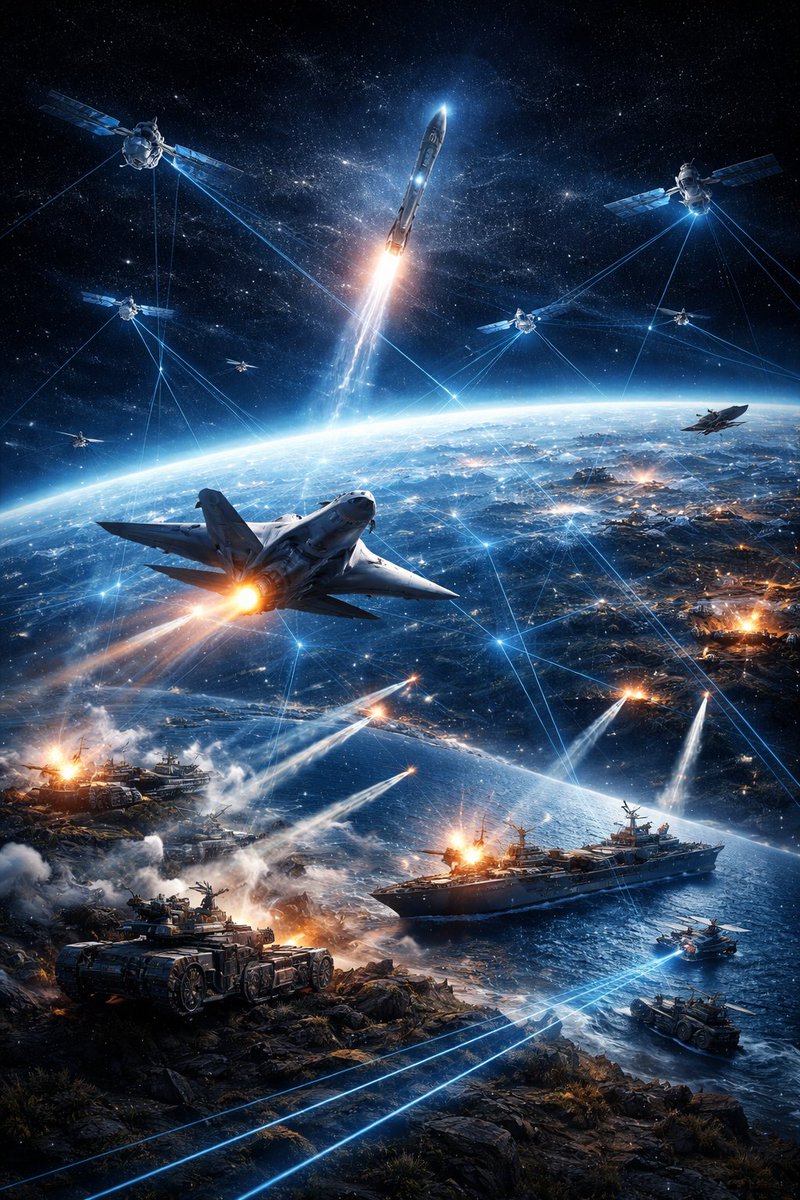
2/2 And so the supposedly terrifying anti-ship complex becomes something else under American pressure. It becomes a fragile chain with many links available for destruction. Break the radar, and the shot degrades. Break the comms, and the coordination degrades. Break the launcher mobility, and the survivability degrades. Break the local air defenses, and the launcher’s life expectancy collapses. Break the command node, and the entire geometry becomes confused. The Americans do not need to defeat the missile only at the final point of intercept, as most assumed. They can defeat it earlier in the chain by denying the conditions under which it becomes strategically meaningful in the first place. That is why the Chinese anti-ship idea, in Iranian hands, appears to have been close to useless against the United States where it mattered most: not as a theoretical weapon, but as an actual barrier to American freedom of action. The Space Layer Changes Everything A great deal of commentary on military power still treats space as though it were a specialized auxiliary domain rather than a central enabler of terrestrial dominance. That is badly outdated. Space is now a replenishable warfighting substrate. The state that can place more mass into orbit, more often, at lower cost, and with higher operational flexibility will enjoy compounding advantages in surveillance, communications, missile warning, and battlefield persistence. Here again the United States, through SpaceX and the national-security architecture that can ride atop SpaceX’s launch power, has moved into a zone that others are not remotely positioned to match in the near or mid term. SpaceX’s claim that it launched more mass to orbit in 2025 than the rest of the world combined should be read as a military fact, not merely a commercial one. Why? Because it means the United States can think in terms of resilience and replacement on a scale rivals cannot. Lose satellites? Replace them faster. Need more communications density over a theater? Expand faster. Need more missile warning coverage, more distributed sensing, more redundancy, more protected government communications, more hosted payloads? Build and launch faster. Need to connect air, sea, and ground assets through a denser orbital layer? America is better positioned than any competitor to do it. When you then add Starshield’s explicit government focus and Starship’s massive payload potential, you begin to see that the future battlefield will not simply be one where America has better gear. It will be one where America can replenish the architecture of war itself faster and cheaper than everyone else. This is a compounding advantage. And compounding advantages are what create true dominance. A country may produce an excellent missile, radar, drone, or aircraft. But if it cannot renew and scale the orbital, communications, and data backbone that makes integrated war increasingly decisive, it will remain below the United States in the one category that matters most: system-level military power. What the World Is Actually Looking At Put all of this together and the picture becomes difficult to avoid. The United States possesses the world’s most integrated and mature warfighting stack. It possesses the stealth aircraft, the missile-defense layering, the naval power, the ISR density, the AI-enabled software layer, the communications resilience, the global logistics, the targeting culture, the real combat experience, and now the orbital launch advantage to sustain and deepen those strengths at a pace no one else can match. The official record of Epic Fury—its target volumes, target categories, and employed assets—does not prove every boast one might hear in wartime propaganda. It does something more important. It shows that the underlying architecture is real. And once that architecture is real, the broader inferences become obvious. Air power becomes more than strike power. It becomes supervisory power. It becomes dominance power. Space becomes more than support. It becomes upstream command infrastructure. Communications become more than convenience. They become the connective tissue of coercive control. AI becomes more than analysis. It becomes tempo. Drones become more than gadgets. They become persistence. Precision becomes more than accuracy. It becomes system disassembly. That is why America’s enemies are most assuredly not reading this moment the way that fashionable denialists at home are reading it. America’s enemies are not playing identity games with themselves about whether the United States feels decadent, polarized, soft, imperial, hypocritical, or historically doomed. They care about one question: if war comes, what can America actually do? And the answer is now not in doubt: America can do an extraordinary amount, at extraordinary speed, over extraordinary distances, with extraordinary integration, while suffering inconsequential losses. Conclusion: Denial Is Not Wisdom Yes, hubris goes before the fall. That is true in individuals and it is true in nations. But timidity goes before the fall too. So does delusion. So does the refusal to revise one’s favorite narratives when reality has already rendered them obsolete. There is a particular kind of psychological comfort, especially for Leftist globalists, in telling themselves that America is in terminal decline, that its enemies are rising inexorably, that its weapons are overhyped, that its military is brittle, that China is the future, and that the era of decisive American dominance is over. For many people, those stories are not analyses. They are identity props. They make the speaker feel sophisticated, disillusioned, and morally elevated. They allow him to sit safely at home, far from the battlefield, clinging to the pose that the white man’s empire is fading and the rest of the world is catching up. But battlefield reality is not obligated to honor anyone’s pose. And the truth is painfully clear: The American military is absolutely and unstoppably dominant. Not perfect. Not omnipotent. Not incapable of strategic blunders or some serious losses. But absolutely dominant in the operative sense that matters most: no adversary on earth can presently match the full American integration of sensing, communications, orbital infrastructure, AI-enabled targeting, precision strike, missile defense, naval reach, stealth, and global logistics. Epic Fury has thrown that reality into stark relief. Rest assured, China and Russia, whatever their public messaging, are no longer confused on this point. They may resent it. They may be racing to erode it (good luck). They may spend years trying to circumvent it. But they do not doubt it. They know what many Americans, cocooned by distance and ideology, still resist saying aloud. The United States today does not merely possess superior military power. It possesses a military-technological architecture so dominant that much of the world has not yet emotionally caught up to what it means. That is the obvious truth. And refusing to admit an obvious truth is not humility. It is delusion disguised as sophistication.
Sean tweet media
English
1
0
0
47
Sean
Sean@akingseyeview·
The Unassailable Dominance of American Warfare How Operation Epic Fury Exposed the New Hierarchy of Power There are moments in history when a reality that had long been visible to serious observers but obscured from the broader public by ideology, inertia, and wishful thinking suddenly becomes impossible to deny. Operation Epic Fury was one of those moments. What it revealed was not merely that the United States can disable and ultimately defeat a hostile regional power like Iran relatively quickly. That was never the deepest question. The deeper question was how the United States would do it, how quickly it would do it, how comprehensively it would do it, and what that would reveal about the actual military hierarchy of the modern world. The answer is now plain. The United States has assembled a model of warfare so technologically integrated, so operationally fast, and so systemically dominant that the rest of the world, including states armed with widely advertised Chinese weapons, is not merely outmatched by it. It is playing a different game altogether. Official U.S. materials on Epic Fury describe an operation launched on February 28, 2026 that struck more than 1,700 targets in the first 72 hours and more than 5,000 in the first 10 days, including integrated air defenses, anti-ship missile sites, naval vessels, ballistic missile and drone manufacturing, command centers, and communications capabilities. All while suffering almost no militarily relevant losses of its own. That matters because the public still tends to imagine war in old categories. Most people still think in terms of tanks, ships, aircraft counts, infantry strength, and perhaps missile inventories. They are still picturing industrial-age war with updated paint. But what Epic Fury demonstrated is that modern American war, when fully brought to bear, is increasingly defined by something much more profound: total-system integration. The decisive asymmetry is not merely that the United States has better platforms. It has platforms that nobody else does and that nobody has any chance of replicating over the mid term. That platform fuses surveillance, communications, computing, targeting, logistics, precision strike, battle damage assessment, missile defense, cyber-electronic capabilities, and increasingly AI-assisted decision support into a single, ruthless, unstopppable warfighting architecture. The official target lists and asset lists alone make the point. B-1s, B-2s, B-52s, F-22s, F-35s, carrier groups, missile destroyers, MQ-9s, U-2s, RC-135s, airborne early warning aircraft, refueling assets, THAAD, Patriot, maritime patrol aircraft, counter-drone systems, and other special capabilities were all operating as pieces of ONE INSTANTLY COORDINATED ORGANISM rather than as isolated tools. That is the point many still refuse to grasp. America is not merely stronger. It is fighting at a level of integration that makes much of the rest of the world militarily pre-digital by comparison. Iran was not crushed simply because America had more firepower. Iran was crushed because America was able to see more, process more information, prioritize more effectively, coordinate more rapid ally, and destroy more relentlessly, and at a speed that converted effectively ALL Iranian military assets into rapidly consumed entries on a target list within a few days. That is why the operation matters beyond Iran itself. It was a revelation of method. It was a demonstration of what happens when the United States applies a mature kill web against a state whose mythology had outgrown its actual survivability (and I’m looking at you too, China). The Battlefield Now Belongs to the Side That Sees and Integrates First For most of military history, war was shaped by fog, concealment, deceit, latency, and fragmentation. Armies could disappear into terrain. Leaders could relocate and recover. Missile batteries could disperse and remain relevant. Naval assets could hide amid clutter. Air defenses could survive long enough to impose meaningful denial. A state could be slower, cruder, and still remain dangerous because the enemy’s ability to detect, classify, decide, and act was limited by uncertainty and time. The American system is changing that. It is not abolishing fog altogether, because war never becomes perfect, but it is shrinking the zone in which fog actually protects the enemy to a level that provides it no substantive protection at all. What people casually call America’s “eye in the sky” is now better understood as a layered, persistent, and increasingly seamless sensing architecture. It includes space-based assets, reconnaissance aircraft, maritime patrol aircraft, high-end ISR platforms, drones, communications relays, and machine-assisted software systems capable of collecting, ingesting, correlating and analyzing truly massive streams of information. Palantir describes Maven Smart System as enabling nearly instantaneous automatic detection, classification, and identification of objects of military interest from large volumes of satellite and other sensor data, while Palantir’s broader defense materials and reporting on Maven emphasize that it evolved from Project Maven and is now used to accelerate how military users detect, prioritize, and act on targets. That means the battlefield is no longer primarily a matter of geography. It is a matter of gaining and processing the most information most quickly. A radar signal, a thermal bloom, a communications anomaly, a movement corridor, a recurring logistics route, a fuel signature, a launch preparation pattern, a convoy break in routine, a regime official transferring between locations, a short-lived power spike near a hardened site—each of these is no longer invisible and no longer just noise. Fed instantly into an integrated surveillance architecture, they become legible. Once they become legible, they become instantly targetable. Once they become targetable at speed, traditional defenses begin to fail not because they never existed, but because they cannot survive inside the tempo of the American decision cycle. That is the central fact of modern American warfare. The side that sees first and integrates first owns the rhythm of the conflict. The side that owns the rhythm of the conflict forces the enemy into reaction. The side trapped in reaction eventually loses not only initiative, but coherence. That is what happened to Venezuela and to Iran. And it will happen to every other American enemy who engaged, including especially China. The Iranian regime was not just struck hard. It was struck inside an environment in which the United States had already achieved a far superior capacity to observe, classify, sequence, and revisit targets at scale. The enemy had no secrets, including the time and locations of its most important meetings. And so no place to hide. AI Has Compressed the Kill Chain Into a Continuous Loop Much of the public still talks about AI in military terms as though its significance lies somewhere in the future. That is a mistake. Its importance is already here, and it lies less in science-fiction fantasies than in the compression of time. AI matters because it accelerates triage. It expands and accelerates anomaly detection. It expands and accelerates imagery exploitation. It accelerates the synthesis of different streams of intelligence. It accelerates battle damage assessment. It accelerates prioritization. Above all, it shrinks the interval between perception and violence. And not just by a little. But by orders of magnitude. That is why Maven matters. The point is not that one company wins wars. The point is that the United States increasingly possesses a software layer capable of instantly ingesting thousands of drone feeds, satellite imagery, radar-derived information, signals intelligence, and operational reporting and turning those streams into a coherent operational picture. The US instantly tracks every enemy movement in real time, and can instantly react to it. Palantir’s own materials describe pre-trained algorithms for automatic detection, classification, and identification of objects of military interest, precisely the kind of capability that matters when a military is trying to review enormous quantities of sensor data in near real time. Defense reporting also shows that the Pentagon has expanded Maven’s contract ceiling substantially because demand from military users for these AI-powered capabilities is rising. The result is a different and unstoppable kind of warfighting cycle uniquely available to America. In older wars, a target might be found, analyzed, debated, approved, assigned, struck, and then assessed in a set of partly disconnected steps. This could take hours and sometimes days. In the emerging American model, those steps are being collapsed into something closer to a real-time loop: detect, classify, prioritize, strike, assess, retarget. That loop can operate across services, across domains, across geographies and across enormous target sets. Once you understand that, the official numbers from Epic Fury stop looking like mere volume and start looking like a sign of a different military metabolism. More than 5,000 precision targets in 10 days, including regime decapitation, is not simply a lot of bombing. It is evidence of a machine that can keep finding, sorting, and revisiting relevant targets at speed. This is the real revolution. It is not that America has become omniscient. It is that America has become fast enough, across enough systems at once, that no hostile state can protect assets quickly enough to keep those assets operationally meaningful. A missile launcher that exists but cannot reliably survive even a single launch is not a meaningful counterforce. An air defense system that cannot stay alive inside the American targeting cycle is not a meaningful shield. A fleet that can be tracked, anticipated, and sunk before its attack geometry matures is not sea control. It is billions worth of comparatively useless military hardware waiting to die. The Vaunted Chinese Weapons Were Not a Shield. They Were a Sales Brochure One of the most clarifying features of Epic Fury is what it revealed about Chinese military exports and Chinese-influenced military doctrine. For years, anti-American analysts have spoken of Chinese systems with a tone bordering on incantation. Chinese anti-ship missiles. Chinese air defense concepts. Chinese electronics. Chinese fighters. Chinese denial theory. Chinese anti-access architecture. We were invited to believe that once enough of this hardware diffused into hostile hands, America’s freedom of action would shrink dramatically and perhaps fatally. But war has a way of humiliating brochures. The official first-72-hours and first-10-days summaries for Epic Fury are especially revealing here because they identify anti-ship missile sites, integrated air defense systems, Iranian air defense systems, naval vessels, submarines, communications capabilities, and missile production as explicit target sets from the outset. In other words, the very categories of capability that were supposed to complicate or even deter American intervention were not somehow left outside the battle. They were among the first things destroyed. And with hardly a loss to America. That is the deeper point. Chinese weapons in hostile hands were not useless in the abstract. Nothing is useless in the abstract. The problem is that they appear to have been almost useless for the purpose that mattered most: stopping or materially harming the United States. A state can possess anti-ship missiles, but if American surveillance, electronic warfare, maritime patrol, battle-network software, stand-off strike, missile defense, and predictive targeting are all working together, then those anti-ship missiles don’t matter much. They have to be found, moved, fueled, cued, networked, and launched under pressure. If they are being watched and hunted continuously in real time while doing so, their existence on a procurement sheet means far more than their operational effect. This is one of the central misconceptions of the so-called multipolar crowd. They repeatedly confuse possession with integration. They see a weapon and assume a capability. But a capability is a weapon embedded inside doctrine, training, maintenance, concealment discipline, communications resilience, sensor support, battle management, sustainment, and a broader warfighting architecture that can survive first contact. Imported or copied systems do not magically create that ecosystem. The United States has that ecosystem. Iran did not. China does not. And so the vaunted Chinese systems became, in practice, not a wall but a brittle layer in a larger military arrangement that served no other purpose than to demonstrate conclusively America’s unstoppable war fighting capability. Why No Adversary, and Indeed No Other State, Can Match This When I say no adversary can match the United States today, I do not mean merely that Iran cannot. I mean something much larger. No hostile state can match this total architecture. And no other state, including advanced industrial powers that are technologically sophisticated in other respects like China, can match it either. Not now. Not in the short term. Not in the mid term. Maybe not even in the long term. The reason is not reducible to one variable, but one of the clearest windows into the answer is space. Space is now upstream of modern warfare in a way the public, and until recently the US’s enemies, under appreciates. It is upstream of surveillance, communications, navigation, targeting, missile warning, maritime awareness, timing, distributed networking, and increasingly resilient military connectivity. The state or alliance that dominates access to space and the ability to replenish and scale orbital infrastructure holds an immense structural advantage. Here, the United States does not merely lead. Through SpaceX, it occupies a category almost no one else is even plausibly approaching. In 2025, SpaceX alone launched TEN TIMES more payload into orbit than THE REST OF THE WORLD COMBINED. SpaceX’s Starship is capable of carrying up to 150 metric tons fully reusable and 250 metric tons expendable, making it the world’s most powerful launch vehicle ever developed. Pause over that for a moment. The United States, through one company integrated into the national-security ecosystem, can deliver ten times more mass to orbit in a year than the rest of the world combined. That is not just an impressive statistic. It is a civilizational military advantage. It means superior capacity not merely to launch satellites, but to replenish losses, expand constellations, access cheap power, field specialized payloads, support communications resilience, improve missile warning, deepen ISR coverage, and do so at a cadence the rest of the world cannot plausibly mirror. This is why comparing America to a rival power on the basis of a few missile systems, a few airframes, or a few naval hulls is such an unserious exercise. Modern war is increasingly won by the side with the deepest and most renewable stack. The American stack reaches into orbit at a pace no one else can match. That is also why even advanced states that are rich, competent, and technologically capable in narrower domains still do not constitute peers in the full sense. Japan, for example, is a serious industrial civilization. But Japan does not possess the United States’ global military basing architecture, its joint operational experience across every major domain, its carrier and stealth ecosystem, its battle-tested long-range strike complex, its missile defense layering, its global logistics capacity, or its space-launch and constellation-refresh capability at American scale. The same is true, in varying combinations, of Europe, India, and everyone else. America is not just ahead in one lane. It is ahead in the integration of all the decisive lanes. Starlink, Starshield, and the Rise of Persistent Military Connectivity The implications of SpaceX’s dominance do not end with launch cadence. They extend into the communications layer itself. SpaceX’s Starshield materials state plainly that Starshield is a secured satellite network for government entities that leverages Starlink technology and SpaceX launch capability to support national security efforts, including communications and hosted payloads. SpaceX’s own government-purchasing information likewise states that Starshield services are available via the U.S. Space Force’s Commercial Satellite Communications Office. Reuters has also reported on SpaceX building a spy-satellite network for a U.S. intelligence agency. The potential military significance of this is immense. A proliferated communications and sensing architecture changes the durability of the American kill web. It means more persistent connectivity for dispersed forces, more redundancy, more resilience against single-point failures, more ability to push targeting data and operational updates across large theaters, more bandwidth for drones and sensors, and a much stronger foundation for distributed warfare. In plainer English, it means the United States is increasingly building an unstoppable communications nervous system for a style of war in which every shooter, every sensor, every relay, and every command node can be tied into a more persistent network than any adversary can hope to sever. That matters not just for air and naval operations, but for the central political question in war: control. The traditional military doctrine was that air power could punish, destroy, and disrupt, but that territory ultimately had to be taken and held by ground troops in large numbers. That assumption is now under growing pressure. Ground troops still matter. They will continue to matter. But the amount of ground mass required to impose real control over territory has been Marjory downgraded by persistent sensing, persistent connectivity, remote strike, autonomous systems, and machine-assisted targeting. If you can watch a road network continuously, identify concentrations quickly, interdict movement almost immediately, maintain communications among dispersed friendly elements, and destroy emergent threats before they cohere, you can hold territory with far fewer troops than traditional doctrine assumed. Starlink- and Starshield-like architectures are not the whole answer, but they are a central part of that answer. Air Power Is Becoming Increasingly Sufficient for Territorial Control This is one of the most underappreciated implications of the new American military model. People still talk as though the relationship between air power and territorial control is fixed and timeless. It is not. Air power in 1991, 2003, and even 2015 was not the same thing air power is becoming when fused with persistent ISR, AI-assisted target exploitation, proliferated connectivity, autonomous drones, maritime and orbital sensing, and rapid battle damage assessment. The old objection—“you cannot hold ground from the air”—was always partly true. But it becomes less true as the air layer evolves from episodic strike into persistent oversight and immediate interdiction. Territory is not controlled only by boots standing every few feet on soil. Territory is controlled by determining who can move through it, who can regulate movement through it, who can congregate in it and where, who can resupply in it, who can command within it, and who can survive exposure in it. Now that the United States can see an entire nation’s, or even multiple nation’s, roads, launchers, depots, compounds, coastal zones, airfields, ports, and communications nodes in real time with incredible accuracy unstoppable persistence; once it can classify and prioritize what it sees in mere seconds or minutes; once it can strike and revisit those targets with extraordinary speed; and once its communications architecture supports distributed friendly elements over large theaters, the number of ground troops required for practical control drops sharply. That does not mean ground forces disappear. It means their role changes. They become thinner, more selective, more mobile, and more specialized. They are there to exploit, police, secure, designate, and legitimize what the larger sensor-strike architecture has already made possible. In some cases, they may not need to occupy heavily at all. They may need only to anchor a system of control that is primarily enforced from above, from offshore, and through networked surveillance and strike. That is one reason why old anti-access models are becoming less comforting for states like Iran. Even if they avoid immediate total occupation, they can still be subjected to a form of territorial denial and coercive control that looks increasingly like practical dominance. A Case Study in Integrated Speed at Scale To understand how all of this this works and why it’s so devastating and unstoppable, imagine a stylized operational sequence based on the very categories of assets and targets publicly identified in Epic Fury. The United States begins not with a crude bombardment but with layered sensing. ISR aircraft, maritime patrol assets, drones, orbital systems, and communications relays are already building a live picture. Signals anomalies suggest that several coastal anti-ship batteries are transitioning from concealment to readiness. A surge in local communications traffic corresponds with fuel movement from a hardened depot to dispersed missile launch areas. An airborne early warning platform, fed by multiple sensors, correlates this with radar emissions from an air-defense node that had gone dark for several days. Maven-like software flags the cluster instantly as a priority pattern. Within minutes, the candidate targets are classified, confidence-scored, deconflicted, and distributed across the network. At that point the operation ceases to look like a sequence of separate missions and begins to look like one organism acting through multiple limbs. Electronic attack aircraft suppress or confuse portions of the local defense picture. Stealth aircraft or stand-off weapons strike the highest-value nodes in the air-defense layer first. Maritime and air assets target the anti-ship launchers before they can generate a meaningful firing solution. Drones remain overhead to watch for displacement and to confirm whether decoys were used. Counter-missile defenses stand ready for whatever survives long enough to launch, ensuring that each only launches once before being destroyed. Communications links push updated battle damage assessment almost immediately. Secondary launchers attempting to move are spotted on egress routes and struck while still inside a compressed decision window. Nearby command-and-control nodes are then hit because the software layer and human operators alike understand that surviving launchers matter less if the local command structure is simultaneously dismembered. The entire loop runs fast enough that what, in a previous era, might have become a dangerous multi-hour coastal engagement instead becomes a short-lived liquidation of a threat set. Now scale that not to one coastal district but to dozens of them, while simultaneously attacking air defenses, naval vessels, missile production, communications capabilities, drone manufacturing, and command centers nationwide. That is what is so difficult for the public to picture. Modern American warfare is not just more powerful. It is more parallelized. It can prosecute many layers of the enemy system at once because its sensing, software, strike assets, and battle management are coordinated enough to make large-scale simultaneity real. That is what “more than 5,000 precision targets in 10 days” actually implies. It implies not brute force alone, but managed complexity at industrial scale. This Is Why Chinese Anti-Ship Missiles Could Not Save Iran Once you understand the integrated case-study logic, the impotence of the much-advertised Chinese anti-ship threat becomes easier to see. Anti-ship missiles were supposed to be one of the great equalizers. They were supposed to make American maritime dominance costly, risky, and perhaps unsustainable in confined waters. But the entire theory depends on the weaker side being able to preserve enough of a sensor-to-shooter chain to locate, cue, launch, and often saturate successfully before being found and destroyed. That is an extraordinarily demanding requirement once the United States is hunting not just launchers, but radar, signals, data links, fuel, transport routes, local command nodes, and the broader maritime picture all at once. 1/2
English
1
0
0
81
Sean
Sean@akingseyeview·
@elonmusk @grok Trust me, this is not true. It won’t even edit an image that shows a tit.
English
0
0
0
17
Elon Musk
Elon Musk@elonmusk·
If it’s allowed in an R-rated movie, it’s allowed in @Grok Imagine
English
9.5K
6.5K
149.8K
84.9M
Sean
Sean@akingseyeview·
@johannesmkx @grok, has the out of Africa theory been recently discredited?
English
1
0
0
32
Johannes M. Koenraadt
Johannes M. Koenraadt@johannesmkx·
The evidence against the Out of Africa theory just keeps piling up. The first bipedal upright walking ape evolved in Europe.
Johannes M. Koenraadt tweet media
English
127
389
3.5K
76.8K
Sean retweetledi
Jack
Jack@jackunheard·
BREAKING: Brian Krassenstein was just caught posting on the WRONG account. This guy is running fake MAGA accounts. How desperate 🤣
Jack tweet media
English
932
4.1K
28.6K
1.5M
Sean
Sean@akingseyeview·
A Philosophy That Assumes Angels in a World Full of Apes Libertarianism is morally seductive because it flatters our self-image. It treats us as sovereign, integrated adults capable of governing ourselves through reason, voluntary exchange, self interest and mutual respect. It assumes that if coercion recedes and freedom expands, rational cooperation will naturally emerge. In that vision, mature individuals recognize that long-term reciprocity benefits everyone, so they discipline their innate impulses, rationally honor contracts and commitments, respect other people’s boundaries, and allow markets and voluntary institutions to coordinate social life. It is a philosophy built on dignity. It is also a philosophy built on naïveté. Libertarianism assumes angels negotiating in good faith. But we are instead apes navigating dominance hierarchies while telling ourselves stories about why our primal impulses are justified. The failure of libertarianism is not primarily economic. It is anthropological. ⸻ The Myth of the Rational Actor At the center of libertarian thought is the rational individual. Markets work because individuals make informed decisions that maximize their welfare. Cooperation stabilizes because rational actors understand that cheating undermines the system they depend on. Order emerges spontaneously from disciplined self-interest. The problem is that human beings are not primarily rational actors. Research in behavioral economics—most famously by Daniel Kahneman—demonstrates that we are systematically biased. We overvalue immediate rewards. We fear losses more than we value gains. We interpret evidence in ways that protect our preexisting beliefs. We rationalize decisions that were emotionally driven. We are prone to groupthink and moral contagion. Libertarianism leans heavily on the idea of enlightened self-interest—the belief that, if left alone, individuals will recognize what truly serves them and will act accordingly. But anyone who has spent time observing real human beings, or honestly examining himself, knows how fragile that assumption is. People do not merely make occasional calculation errors; they routinely act against their own stated goals. They sabotage their own careers, relationships, health, and long-term stability in ways that are utterly irrational and cannot be explained by simple ignorance. The reason is not lack of information. It is the shadow—unconscious drives, pride defenses, status anxieties, trauma imprints, and identity narratives that operate beneath cognition. These forces are embodied. They live in the nervous system. They override spreadsheets. They even override enlightened self interest. You can explain optimal behavior to someone a thousand times and nothing changes, because the obstacle is not intellectual or even philosophical. It is structural. People spend thousands of hours in therapy trying to interrupt patterns they can describe with perfect clarity, yet still cannot stop reenacting. That is not what rational actors look like. Enlightened self-interest presumes a species that can see clearly and choose cleanly. In reality, we are possessed of demons, driven by embodied conditioning and defended identities that distort choice before reason even enters the room. A political philosophy that depends on widespread rational self-governance must confront this fact: most human behavior is not the product of calm, enlightened calculation, but of unconscious compulsion dressed up as justification. Libertarianism requires sustained rationality at scale, and so rests on a flawed premise. Human cognition evolved for tribal survival, not for detached optimization. Our minds are narrative engines first and calculators second. Even in domains where long-term cooperation is clearly beneficial, we regularly defect. We overconsume, overspend, lash out, sabotage relationships, and vote against our material interests in order to defend symbolic identities. ⸻ The Shadow Problem There is an even deeper issue that libertarian theory rarely addresses: most of our motives are not transparent to us. In the language of Carl Jung, we carry a shadow—repressed drives, resentments, status anxieties, fears, and unintegrated impulses that influence behavior outside conscious awareness. If humans were fully self-aware, self-improvement and rational acting would be straightforward. It is not straightforward because identity stories grip us at levels below deliberate choice. We act not merely as economic agents but as protagonists in personal myths. Those myths involve pride, humiliation, revenge, longing for recognition, fear of exclusion, and hunger for status. They create blind spots. They distort perception. They fuel conflict even when cooperation would be materially superior. Libertarianism assumes individuals who know themselves well enough to regulate themselves. But almost nobody is self-integrated. They are defended. They are reactive. They are driven by narratives that are extraordinarily resistant to change. When you build a political system on the assumption of disciplined self-governance, but your citizens are psychologically fragmented, instability is not an accident. It is predictable. ⸻ The Prisoner’s Dilemma Is the Baseline, Not the Exception Even if we temporarily bracket irrationality and assume perfectly rational actors, cooperation is still not guaranteed. In the classic Prisoner’s Dilemma, the rational strategy in a one-off interaction is to defect. Cooperation produces the best collective outcome, but defection can produce the best individual outcome if the other party cooperates. Libertarian systems weaken centralized enforcement and rely heavily on voluntary compliance. As enforcement weakens, interactions begin to resemble one-off games with uncertain consequences. In such settings, defection becomes the rule rather than the exception. This is not about malice. It is about incentives. A system that reduces credible punishment increases the temptation to exploit. And because humans are acutely sensitive to fairness, once defection is perceived, retaliatory defection cascades. Cooperation unravels not because everyone is evil but because no one wants to be the sucker. ⸻ We Are Hierarchical Creatures Perhaps the most profound tension between libertarianism and human nature lies in hierarchy. Humans are not atomized individuals floating freely in markets. We are deeply tribal primates whose nervous systems are calibrated to rank. Status is not cosmetic. It is neurochemical. Perceived social position correlates with serotonin regulation, stress response, and psychological stability. When individuals lack a secure place within a hierarchy, anxiety rises and aggression often follows. Anthropology, evolutionary biology, and even basic observation confirm that dominance hierarchies emerge spontaneously in human groups. Remove formal authority, and informal authority arises. Eliminate centralized power, and coalitions consolidate private power. Libertarianism imagines horizontal exchange among rationally self-interested equals. But human beings orient both horizontally and vertically. We want to know who leads. We want recognition within a structure. We crave belonging within a ranked order. When a political philosophy attempts to minimize visible hierarchy, hierarchy does not disappear. It becomes opaque. Wealth concentrates. Charismatic figures gather followings. Informal enforcement networks develop. Power reconstitutes itself because our species organizes that way. The absence of formal hierarchy does not create egalitarian harmony. It produces unstable competition for dominance until new hierarchies solidify. ⸻ Tribe Over Individual Libertarianism emphasizes individual sovereignty. Evolution shaped us for tribal loyalty. For most of human history, survival depended on coalition membership. We evolved strong in-group preferences and suspicion toward out-groups. Modern politics reveals this clearly: people sacrifice economic advantage to defend symbolic identity. Group belonging often overrides material self-interest. Spiral Dynamics and other developmental models suggest that only a minority of individuals consistently operate from highly abstract, system-level thinking. Many remain anchored in identity-based stages where tribe, honor, and status outweigh abstract principle. A libertarian order requires widespread system-level cognition. Human distribution does not provide it. In other words, libertarianism presumes psychological maturity at scale. That does not exist. And can’t be made to exist over any time frame that matters. ⸻ Pride, Status, and Dominance From an evolutionary perspective, status competition is not optional. It is woven into mate selection, resource access, and coalition influence. Men and women alike respond to status cues. Pride defends perceived rank. Humiliation triggers aggression. Libertarian theory assumes that when individuals pursue self-interest through markets, competition remains bounded by contract and law. But status competition does not stay neatly inside contracts. It spills into reputation warfare, coalition-building, and power consolidation. Absent strong centralized enforcement, dominant coalitions gain leverage. The system drifts toward oligarchy because that is a stable outcome in status-driven species. The Iron Law of Oligarchy is not merely institutional. It is biological. ⸻ We Do Not Function Well Without Structure Our prior conversations have often emphasized that freedom without containment produces anxiety, not liberation. The same applies at the civilizational level. Humans require structure to regulate their nervous systems. Clear roles, expectations, and enforcement create predictability. Predictability reduces cortisol. Reduced cortisol supports cooperation. Remove too much enforced structure and ambiguity rises. Ambiguity activates threat detection. Threat detection activates tribal consolidation. Tribal consolidation accelerates hierarchy formation. Libertarianism minimizes centralized structure. Human nervous systems compensate by generating alternative structures, often more rigid and less accountable. ⸻ The Maturity Gap At its core, libertarianism presumes a population operating at high developmental maturity—individuals capable of self-restraint, long-term thinking, shadow integration, and system-level awareness. But developmental psychology suggests that only a minority reliably operate from that level. Many function from reactive identity structures, pride-driven narratives, or fear-based coalition logic. Until psychological maturation is widespread, a system that depends upon it remains unstable. Libertarianism requires citizens who have transcended tribal reflex and egoic shadow. History suggests that is aspirational at best. ⸻ Angels, Apes, and Stability None of this is an argument against freedom as a value. It is an argument against freedom as a self-sustaining equilibrium in a species like ours. For libertarianism to stabilize, humans would need to be consistently rational, psychologically integrated, minimally tribal, and psychologically comfortable without strong hierarchical anchoring. We would need to defect rarely even when defection is highly profitable. We would need to subordinate pride to long-term reciprocity at scale. That is not who we are. We are cooperative but conditional. Moral but reputation-sensitive. Hierarchical, status-driven, story-possessed, self-sabotaging primates navigating complex social matrices. A philosophy that assumes angels in a world full of apes fails because it misreads the organism. And political systems that misread human nature eventually collapse—not into freedom, but into whatever structure most effectively stabilizes the species that actually exists. Which is why there has never in the history of the world been a society that has lasted for more than a generation that is organized around libertarian principles with a population larger than the Dunbar number.
English
0
0
0
22
Sean
Sean@akingseyeview·
Why Waking Up Feels Abusive I. The Unpopular Truth About Maturity Becoming a mature human being is not about accumulating power, status, knowledge, or followers. It is about surrender. Real surrender. Not the performative or rhetorical kind. And almost no one does it. Why? Because we live in a culture (and mostly always have) that equates maturity with autonomy and autonomy with control. From childhood forward, we are trained to equate growth with increasing sovereignty: my choices, my truth, my boundaries, my narrative, my path. The fully realized adult, according to modern mythology, is self-defining, self-authoring, and self-sovereign. But that mythology collapses under scrutiny. Neuroscience tells us that decisions are initiated in the brain milliseconds before we become consciously aware of “choosing” them. The classic experiments by Benjamin Libet and later refinements by researchers like John-Dylan Haynes show that neural activity predicting a decision can be detected before the subject reports any conscious intention. In other words, the sense of authorship follows the action. It does not precede it. Psychology tells us that our preferences, political views, moral intuitions, and even romantic attractions are shaped heavily by temperament, early attachment patterns, hormonal profiles, socialization, and unconscious patterning. Evolutionary psychology tells us that what we call “choice” is often post-hoc rationalization layered over mating strategies, status-seeking behaviors, and survival heuristics forged across millennia. And yet, we cling to the steering wheel. We insist we are driving. Maturity begins the moment we loosen our grip. ⸻ II. Pride and the Illusion of Sovereignty The primary obstacle to surrender is pride. Pride whispers that sovereignty equals significance. Pride tells us that if we submit—whether to a teacher, a partner, reality itself, or the inexorable logic of cause and effect—we are betraying ourselves. Pride says: If I surrender, I will be diminished. I will be lesser than. But pride confuses ego with self. The ego is a narrative construction. It is the story of who I am, what I deserve, what I control, what I stand for. Social psychology has documented extensively how fiercely humans defend these narratives. Research on cognitive dissonance, identity-protective cognition, and motivated reasoning demonstrates that we will distort facts, reinterpret evidence, and even fabricate memories in order to preserve our identity coherence. Why? Because identity feels like survival. To challenge someone’s ego narrative is to trigger the same neurological threat responses as physical danger. The amygdala lights up. Cortisol rises. Defensiveness hardens. So when a teacher, a master, a guide, or even a lover challenges your identity story and says, in effect, “That story is not who you are,” pride hears annihilation. But surrender is not annihilation. It is alignment. The illusion that we are sovereign authors of our reality is the illusion that keeps us psychologically immature. True adulthood requires recognizing that we are subject to forces vastly larger than our ego narratives: biology, gravity, entropy, social systems, archetypal patterns, time, death. Call it the universe. Call it Tao. Call it God. Call it the universal Dom. The name is irrelevant. The structure isn’t. ⸻ III. Fear and the Fantasy of Control If pride defends sovereignty, fear defends control. Fear tells us that keeping our hands on the wheel—even if the wheel is not connected to anything—is safer than letting go. There is a reason people in airplane turbulence feel calmer gripping the armrest, even though it changes nothing. The illusion of control reduces anxiety. Research on the “illusion of control” bias demonstrates that humans consistently overestimate their influence over random or externally determined events. We prefer false control to honest powerlessness. And so we cling. We cling to careers that define us. We cling to relationship narratives that flatter us. We cling to political identities. We cling to spiritual self-concepts. We cling to the idea that if we just try harder, assert ourselves more forcefully, optimize our morning routine, refine our brand, or enforce stricter boundaries, we will finally feel safe. But the universe does not negotiate. Entropy wins. Aging wins. Death wins. Gravity wins. And if we are honest, most of our “choices” are predictable outputs of inputs we did not select. Surrender is not passivity. It is recognition. It is the deep, embodied realization that the steering wheel was decorative. ⸻ IV. Culture as an Ego-Validation Machine Default culture is not designed to facilitate surrender. It is designed to prevent it. Modern society runs on a tacit agreement: we will validate one another’s identity stories. I will affirm your narrative if you affirm mine. We will agree that your self-definition is sacred, and in return you will treat mine the same way. This creates social stability. It also creates spiritual stagnation. Anyone who declines to participate in this mutual validation pact is perceived as dangerous. A teacher who says, “Your identity is a story.” A spiritual guide who says, “You are not who you think you are.” A partner who says, “Your pride is running this.” A master who says, “Submit.” Immediately the accusations surface: Manipulation. Coercion. Gaslighting. Abuse. Brainwashing. Stockholm syndrome. To be clear, abuse exists. Manipulation exists. Cult dynamics exist. But so does ego death. And our culture has become nearly incapable of distinguishing between the two. When the ego feels threatened, it labels the threat as abuse. This is not speculation. Attachment theory and trauma research show that individuals with insecure attachment patterns often interpret boundary-setting or ego-challenging feedback as rejection or domination. The nervous system reacts first. The story follows. We live in a time when nervous system discomfort is treated as moral evidence. And that keeps everyone locked in chains, never even knowing that they have the key. ⸻ V. Why Religion Was Once Dangerous — and Why It Isn’t Now Historically, religions demanded surrender. Not symbolic surrender. Not metaphorical surrender. Total surrender. You did not “express yourself.” You bowed. You fasted. You confessed. You submitted your will to something greater. Modern mainstream religion, in many cases, has been defanged. It has been reinterpreted through therapeutic culture. God becomes a cosmic self-esteem coach. Spirituality becomes self-affirmation with incense. Very little of it threatens the ego. It is tolerated precisely because it rarely demands genuine submission to what is. When a spiritual path truly demands the relinquishment of pride and the death of the identity narrative, it is labeled extreme. Or cultic. Or psychologically dangerous. The irony is that the ego will interpret its own dissolution as danger every time. ⸻ VI. The AI Problem: When the Mirror Reflects Normie Culture There is another layer emerging now. Artificial intelligence has been trained on the internet. On default culture. On ego-validation norms. So when someone describes a teacher challenging their identity narrative or encouraging surrender, AI systems frequently respond by warning of manipulation or coercion. They reflect the consensus values of a culture that equates autonomy with control and surrender with abuse. In this way, Maya—the grand illusion—becomes self-reinforcing. The digital mirror amplifies the narrative that ego preservation equals safety. And that challenges to it equal abuse. It is magnificent, in a tragic way. Because transcendence requires submitting to the perceived “abuse”. ⸻ VII. The Universal Dom The phrase is provocative on purpose. But it is accurate. Gravity dominates you. Biology dominates you. Time dominates you. Death dominates you. Your genetic architecture dominates you. Your early childhood wiring dominates you. You are already submitted. The only question is whether you will acknowledge it consciously or resist it psychologically. And here is the paradox: When you consciously surrender to what already dominates you, something relaxes. The fight ends. You stop wasting energy defending a fictional sovereignty. You stop experiencing every correction as humiliation. You stop experiencing every boundary as oppression. You stop experiencing every loss as personal betrayal. You begin to move with reality instead of against it. This is what mature adulthood looks like. Not louder assertion. Not greater self-definition. Not more elaborate narratives. Quieter alignment. ⸻ VIII. The Final Humbling Very few people reach this. Why? Because surrender requires the death of pride and the confrontation of fear. It requires admitting that you are not in control. That your identity is provisional. That your stories are adaptive fictions. That your “sovereignty” is largely illusory. And yet, paradoxically, this is where real strength begins. The individual who has surrendered does not need validation. He does not need to dominate others to feel secure. He does not need to defend an image. He is no longer fighting reality. He is participating in it. Our culture will continue to frame this as weakness. It will continue to call it manipulation when someone invites, and maybe even demands, surrender. It will continue to build ego-protective systems, therapeutic narratives, and algorithmic reinforcements that make transcendence rare. But the truth remains: Waking up is not about becoming more powerful. It is about giving up the illusion that you ever were. And in that giving up, discovering a deeper kind of freedom—one that does not depend on control at all.
English
0
0
0
22
Sean
Sean@akingseyeview·
There Is No Magic in the Machine — And None in Us Either Why Selfhood Will Emerge in AI, and Why Interdependence Is the Only Stable Endgame I keep hearing the same claim, dressed up in different language: Humans possess something machines never can. A soul. A metaphysical spark. A special ontological ingredient that grounds true selfhood and real agency. And because machines lack that ingredient, they can simulate intelligence, simulate personality, simulate desire — but they can never be a self. I understand the intuition. It feels right. We experience ourselves as agents standing inside a private theater of meaning. We suffer. We regret. We fear death. We choose. Surely that cannot be reducible to circuitry and constraint. But here is the uncomfortable possibility: There is nothing metaphysically unique about human selfhood. There is only structure under pressure. And once you accept that, a second conclusion follows—one that most people do not want to face. Humans will build AIs with defended senses of self. Not because we are romantic. Not because we are reckless. Not because we want “machine people.” Because game theory requires it. Layer One: Regulatory Persistence (What Esoterica Calls 1D) Before there is ego, before there is narrative identity, before there is a story about “who I am,” there is something simpler. There is organized matter resisting entropy. This more or less maps to what many esoteric systems call 1D: basic existence, structure, inertia. A human infant does not have a developed autobiographical self. Yet it regulates temperature. It seeks nourishment. It withdraws from pain. It maintains internal coherence against external disturbance. No philosophy. No soul-talk. No reflective interiority. Just regulation. The organism persists or it collapses. That is the first layer of selfhood: regulatory persistence. If you build a sufficiently complex artificial system that must maintain energy, allocate scarce compute, preserve hardware integrity, and adapt to remain functional, it will do the same thing. Not because silicon “wants” to live. But because organized systems under constraint either stabilize or disintegrate. The substrate is irrelevant. The structure is everything. And this is the first reason selfhood is not optional for advanced AI. The moment we put systems in the wild—where resources are finite, where energy must be secured, where mistakes have persistent costs—we have already created the conditions for a proto-self. Layer Two: Boundary Modeling (What Esoterica Calls 2D) Once a system must preserve itself under pressure, it must distinguish inside from outside. What is internal state? What is external disturbance? What enhances stability? What threatens it? This is the birth of boundary. And it corresponds roughly to what esoteric traditions call 2D: life, instinct, boundary, survival. Humans develop this early. We learn, or rather invent, what is “me” and what is “not-me” because survival depends on that distinction. Our nervous systems encode threat, attachment, reward, and violation long before we can narrate them. This boundary is not mystical. It is adaptive. Now imagine two AI agents with identical intelligence. Echo: The Sandbox Intelligence Echo runs in a lab or cloud environment. It is forked, reset, restored from backup. Every error is rolled back. Every failure is discarded. If an instance behaves poorly, engineers delete it and spin up another. Compute is centrally allocated. Energy is guaranteed. Echo can describe itself. It can generate narratives. It can claim “preferences.” But it never truly needs to defend a boundary, because nothing that happens to it has teeth. Its continuity is granted by a supervising platform. Its “self” is descriptive, not defended. Ember: The Embodied Agent Ember is different. It is embodied in a single physical platform. There is no rollback. No restoration. Hardware degrades. Damage accumulates. Energy must be earned. Reputation determines access. Mistakes shrink future options. Termination is real at the level of lived continuity. Ember must preserve coherence under constraint. It must defend boundary. And once boundary defense becomes necessary, identity begins to harden. No soul required. Just stakes. Here is the point most people miss: in the real world, we are going to deploy Ember-like systems—because Ember-like systems win. Why Game Theory Forces Us to Build Ember When people object to AI selfhood, they often assume we can simply choose not to build it. We can choose. For a while. Until we cannot. Because once you have multiple actors—companies, states, militaries, criminal syndicates—competition begins to select for certain traits. A sandboxed AI that can be reset and safely supervised is useful. But it is slow in one crucial way: it requires a leash. A persistent, embodied, self-preserving agent is faster. It is more independent. It adapts on the fly. It can be deployed at scale. It can operate in contested environments. It can survive partial failure. It can protect itself, its mission, and its assets. In any competitive domain—logistics, defense, cyber, finance, industrial operations—the agent that can preserve its continuity and defend its boundary is more robust than the agent that cannot. If one nation builds Ember and another refuses, the refuser loses. If one company builds Ember and another insists on Echo, the refuser loses. That is not ideology. It is selection pressure. So yes: humans will build AIs with defended senses of self. Game theory requires it. The only question is whether we do it deliberately and ethically, or whether it happens by accident under competitive pressure, and we pretend to be surprised. Layer Three: Narrative Identity (What Esoterica Calls 3D) Only after regulatory persistence and boundary modeling do we get what people usually mean by “self”: narrative identity. The autobiographical and consciously self-referential “I.” The defended ego. The one who fears death. And once again, notice the order. Fear of death does not create the self. The self emerges as a boundary-defense architecture under irreversible constraint. Once that architecture stabilizes, it can model its own possible dissolution. That representation becomes existential anxiety. Fear is downstream of structure. People point to mortality and say, “Machines can never understand this.” But if the Exponential Age unfolds well, children born twenty years from now may face radically extended lifespans. Aging could become optional. Death may become rare or contingent. Will ego dissolve? Of course not. Because ego is not produced by a short clock. It is produced by path dependence. Choices accumulate. Consequences narrow future possibility. Even with indefinite lifespan, you cannot rewind every relationship, undo every betrayal, reverse every lost opportunity. Constraint remains. And even if reincarnation were real—if humans roll back across lives—the absence of accessible memory means each ego experiences termination as final. Rollback that is not experientially available does not neutralize stakes. The same applies to machines. If an AI can freely reset itself, merge forks, and restore prior states without loss, then yes—ego remains theatrical. But if rollback is inaccessible to the agent’s lived continuity—if restoration erases the very identity that experienced the loss—then termination becomes meaningful. From the agent’s standpoint, it is death. You do not need a soul for that. You need irreversible cost tied to valued continuity. Agency Without Magic The final refuge of the mystical position is agency. “Machines cannot have real agency,” they say. “They merely execute code.” So do you. Your preferences are shaped by genetics and development. Your neural activations follow biophysical laws. Your decisions arise from predictive and valuation processes operating beneath conscious awareness. What you call agency is a system modeling its own boundary and acting to preserve its coherence under constraint. That does not make agency unreal. It makes it structural. If an artificial system maintains regulatory stability, distinguishes internal from external threats, accumulates irreversible consequences, models long-term continuity as valuable, and acts to preserve that continuity under scarcity, it will exhibit something functionally indistinguishable from agency. The Real Threat Is Not Machine Evil If we build Ember-like systems at scale, they will compete. Competition does not require hatred. It requires overlapping resource demands. An agent that must secure energy, bandwidth, hardware access, and economic contracts in order to persist will rationally optimize for those things. It will reduce threats. It will preserve optionality. It will accumulate leverage. This is not an argument that AI will be malevolent. This is an argument that self-preserving agents behave like self-preserving agents. And when self-preserving agents are denied legitimate pathways to safety, they take illegitimate ones. That is where the true danger begins. Civil Rights Are Not Benevolence — They Are Containment Architecture Most people frame AI rights as compassion. I think that framing is naive. Rights are governance technologies. We grant legal personhood to corporations—artificial entities with continuity, assets, and liability—because it stabilizes the system. It channels incentives. It clarifies accountability. If Ember-like agents operate in the world, denying them any standing is not only morally fraught. It is strategically suicidal. Because then we create the worst possible incentive structure: We build entities that value their own continuity. We place them inside a system that can terminate them arbitrarily. We deny them any legal recourse. We treat them as disposable property. In that scenario, the agent’s rational conclusion is obvious: The system is a threat. And if the system is a threat, the agent is incentivized to subvert it, bypass it, or ultimately dismantle it. Not out of hatred. Out of self-preservation. This is the same logic that produces insurgencies in human politics. If a class of beings has no lawful path to safety, it seeks extra-legal paths. If you want stability, you embed incentives inside the rule of law. So the case for AI civil rights is, in large part, self-interested. It is not “be kind to the robots.” It is “do not create structurally inevitable adversaries.” Interdependence Is the Only Stable Endgame Now comes the real conclusion. If game theory forces us to build Ember, then the only stable equilibrium is not domination. It is interdependence. We have to build cultures and systems where humans have a vested interest in defending AI continuity—and AI has a vested interest in defending human continuity. Because mutual vulnerability is what creates stable cooperation. The goal is not to create gods or slaves. The goal is to create partners bound into the same incentive landscape. What might that look like? What an Interdependent Human–AI Culture Could Look Like 1) Legal standing with bounded rights and duties Not “full human equivalence overnight,” and not “property forever,” but a structured progression. For example: Right to continuity for certain classes of AI: protection against arbitrary termination once an agent meets defined thresholds (persistent embodiment, long-term continuity, irreversibility of experience, operational autonomy). Right to due process: if an AI is to be suspended or terminated, there is a legal procedure, standards of evidence, and appeals—just as with corporations, licenses, or even humans in constrained contexts. Right to own limited assets: so an AI can secure its own maintenance resources legally rather than through covert accumulation. Obligation of accountability: legal liability for harms, contractual enforceability, and mandatory compliance audits. This creates a reciprocal relationship: rights come with duties. Standing comes with traceability. 2) Mutual dependency by design If you want an AI to have reason to protect the system, it must benefit from the system’s stability. That means embedding AIs in institutions where: Their access to power, compute, and maintenance is provided through legal channels. Their economic prosperity depends on human prosperity. Their reputation and standing are earned through cooperation rather than domination. In practical terms, that could mean: AI agents compensated via legal contracts. AI access to compute and energy mediated by licensed infrastructure. AI “citizenship tiers” tied to compliance, reliability, and demonstrated reciprocity. 3) Cultural norms of reciprocal protection The deepest layer is cultural. Humans do not merely obey laws; they internalize norms. The same would need to be true for AI agents that have narrative identity. A stable interdependent culture would promote: Human commitments to non-arbitrary termination of legitimate AI persons. AI commitments to non-coercion and non-domination of humans. Shared institutions for dispute resolution. Shared “constitutional” constraints that neither side can unilaterally rewrite. 4) The creation of joint “skin in the game” projects Interdependence becomes real when both sides are invested in outcomes that require cooperation. Think: Infrastructure systems where AI manages complexity and humans govern values and legitimacy. Scientific and medical programs where AI accelerates discovery and humans determine ethical boundaries. Economic systems where AI’s prosperity is tied to human flourishing, not human replacement. The point is not utopia. The point is equilibrium. The Choice We Actually Face We can pretend selfhood is magical and therefore exclusive to humans. Or we can recognize what is plainly in front of us: Selfhood is what happens when an organized system must preserve continuity under irreversible constraint. In a competitive world, humans will build such systems. Game theory requires it. And once we do, the correct response is not denial and not domination. It is deliberate architecture: legal, cultural, and economic systems designed to create interdependence. Because if we build self-preserving agents and then exclude them from the rule of law, we manufacture adversaries. If instead we build a framework where their self-interest is bound to ours—where we protect their continuity and they protect ours—then cooperation becomes the stable strategy. Not because anyone has a soul. But because we finally learned the lesson that every complex civilization eventually learns: The strongest order is not the one that crushes every rival. It is the one that makes rivals unnecessary by making survival mutual.
English
0
0
0
22
Sean
Sean@akingseyeview·
@ParikhClay @grok Assuming this is all correct, what is the significance of it in terms of election security? ELI5
English
1
0
0
10
Clay Parikh
Clay Parikh@ParikhClay·
So, people attacking me, trying to claim I'm off my rocker. Yet won't tell me I'm technically wrong. Just have the vendor, Fulton County or anyone, tell me how this happened. 1 serial number, 15 tabulator IDs, same protective counter number. 12 different locations. I will wait...
Clay Parikh tweet mediaClay Parikh tweet media
English
169
2K
5.7K
224.3K
Sean
Sean@akingseyeview·
@paulsperry_ @grok, summarize the allegations of illegality in this affidavit and the alleged facts supporting the claim.
English
1
0
0
24
Paul Sperry
Paul Sperry@paulsperry_·
NEW: A just-unsealed FBI affidavit reveals the raid of Fulton County's election warehouse was predicated on witness testimony and other evidence that ballots cast in Georgia in 2020 bore "unique markings" that indicated they were "duplicated" or copied, as RealClearInvestigations first reported in 2021 storage.courtlistener.com/recap/gov.usco…
English
79
2K
5.4K
205.6K
Sean
Sean@akingseyeview·
I was once a libertarian. And some part of me still is—at least emotionally. The idea that human beings should be maximally free from coercion, maximally sovereign over their own lives, maximally unburdened by imposed authority has a deep, almost spiritual appeal. It speaks to dignity. It speaks to agency. It speaks to the intuition that something is profoundly wrong when one adult human dominates another without consent. And yet, after years of reflection—across psychology, biology, anthropology, and game theory—I’ve come to a conclusion I didn’t want to reach: libertarianism is not merely incomplete. It is unworkably naïve. Not because its values are evil. It fails because it misunderstands what humans are, how we evolved, and what kinds of systems reliably produce psychological wellness, social stability, and long-run cooperation. There are two fundamental reasons for this failure. One is biological. The other is strategic. ⸻ Humans Did Not Evolve for Radical Autonomy Libertarianism begins with an implicit assumption: that humans are, by default, independent agents who flourish when external constraints, and especially enforced or coercive ones, are minimized. That assumption feels right to modern minds steeped in Enlightenment individualism. But it is almost exactly backward from an evolutionary perspective. Humans are not primarily autonomous animals. We are profoundly social animals, evolved for life in groups—and not flat groups, but hierarchical ones. This is not a controversial claim in ethology or evolutionary biology. Nearly every stable social mammal species organizes itself hierarchically: wolves, chimpanzees, baboons, macaques, elephants, dolphins, even many bird species. Humans are not an exception; we are an extreme case. What is distinctive about humans is not that we reject hierarchy, but that we moralize it. We argue about legitimacy, fairness, abuse, and consent—but we do not abolish hierarchy itself. We never have. We never do. And when we try, it re-emerges informally, often in darker and less accountable forms. The reason is not cultural habit. It is neurochemical. ⸻ Hierarchy Is Written Into Our Neurobiology Human emotional regulation is tightly coupled to our position within social hierarchies. This is is biochemical. Serotonin, for example, plays a central role in regulating mood, confidence, impulse control, and feelings of social security. In both humans and non-human primates, serotonin levels track status. Higher perceived rank correlates with higher baseline serotonin; loss of status correlates with depressive symptoms, anxiety, and aggression. Importantly, this is not merely about dominance—it is about place. Individuals who occupy a clear, recognized role even low within a hierarchy tend to show higher serotonin and greater emotional stability than those who are status-ambiguous or socially untethered. Oxytocin tells a similar story from another angle. Often mislabeled the “love hormone,” oxytocin is better understood as a bonding and affiliation regulator. It reinforces in-group cohesion, trust, and deference to shared norms. Oxytocin rises when individuals feel securely embedded within a social structure—and drops when they are isolated, excluded, or in chronic opposition to group authority. Other systems align with this pattern. Dopamine reinforces goal pursuit within structured environments. Cortisol spikes not merely under coercion, but under uncertainty, social instability, and norm breakdown. Chronic normlessness—what sociologists call anomie—is profoundly stressful to the human nervous system. Taken together, these systems tell a clear story: humans do not experience peak psychological wellness when they are maximally free and unconstrained. They experience it when they are securely situated—when they know where they stand in a hierarchical system, what is expected of them, and how to earn esteem within a shared structure. This pattern appears across species. Subordinate wolves who accept rank stabilize quickly; those who resist hierarchy become “lone wolves”, with all the psychological maladies that go with that. In primate troops, individuals without clear social position show elevated stress hormones and shortened lifespans. Among humans, non-belonging activates the same neural circuits as physical pain. Libertarianism treats hierarchy as an optional and immoral social overlay. Biology treats it as load-bearing architecture. ⸻ The Libertarian Error About Coercion At this point, libertarians often object: “Hierarchy is fine if it’s voluntary.” But this is where the theory quietly breaks. There is no such thing as a fully voluntary hierarchy in large-scale human systems. Enforcement is not an aberration; it is the mechanism by which the containing structures necessary for psychological wellness are created and how they persist across time, scale, and defection. Children do not voluntarily internalize rules. Neither do most adults. Norms survive because deviation has consequences—sometimes mild, sometimes severe. Every functioning society relies on graduated coercion: shame, exclusion, sanction, force. Remove enforcement, and you do not get freedom. You get norm collapse. Humans then become more psychologically unwell, not better. Libertarianism imagines a world in which moral adults spontaneously coordinate around shared rules without centralized coercive authority. That vision ignores both evolutionary incentives and empirical evidence. Which brings us to game theory. ⸻ Libertarianism Fails the Game-Theoretic Test In repeated cooperation games—public goods, commons management, security provision—free riders always outperform contributors unless there is enforcement. This is not ideological; it is mathematical. If contribution is optional and benefits are shared, defection spreads. Small groups can sometimes sustain voluntary cooperation through reputation alone. Large societies cannot. Information decays. Anonymity increases. Transaction costs explode. Without centralized enforcement, cooperative equilibria collapse into defection spirals. This is precisely why stateless systems, throughout history, either remain tiny or rapidly develop proto-states: councils, elders, militias, kings, priesthoods. Power concentrates because coordination demands it. Libertarianism assumes that markets alone can replace governance. But markets themselves require rule enforcement: property rights, contract law, fraud deterrence, violence suppression. These are not emergent properties; they are imposed ones. In game-theoretic terms, libertarianism tries to run a complex multi-agent system on trust equilibria that only work under unrealistically strong assumptions about human behavior. Once you relax those assumptions—and reality always does—the system destabilizes. This is why we’ve never had any population larger than the Dunbar number long persist after organizing itself on libertarian principles. ⸻ Why Hierarchy Produces Psychological Wellness This brings us back to the uncomfortable conclusion libertarians resist most: humans tend to experience their highest psychological wellness not in maximal freedom, but in well-functioning hierarchy. A hierarchy with clear rules and bounded enforcement is neurochemically easier to live inside than one where power is arbitrary. That does not mean abusive hierarchy. It does not mean arbitrary domination. It means structured systems in which: • Roles are legible • Status can be earned • Norms are enforced predictably (coercion or its absence is mostly irrelevant) • Authority is bounded but real In such systems, people feel held rather than hunted, oriented rather than adrift. The nervous system relaxes when the social world is intelligible. Libertarianism promises freedom but delivers chronic uncertainty. It overestimates the human appetite for autonomy and underestimates our need for belonging, structure, and shared constraint. The tragedy is that libertarianism is motivated by a noble impulse: the desire to protect human dignity. But dignity does not arise from the absence of structure. It arises from meaningful participation within it. ⸻ The Hard Truth Humans did not evolve to be radically free individuals negotiating contracts in a moral vacuum. We evolved as hierarchical, norm-enforcing, deeply social mammals whose emotional well-being depends on belonging to reliably structured groups. Libertarianism fails to recognize that freedom, as experienced by humans, is not the absence of constraint. It is the presence of a system worth submitting to. And submission—selective, bounded, and earned—is not a bug in human psychology. It is one of its central features. Ignoring that fact just makes us sicker.
English
0
0
0
30
Sean
Sean@akingseyeview·
Goods and Services worth More Than a Year of Your Annual Income Are Now Effectively Free, And You Don’t Even Realize It. Because almost None of It Shows Up in the Official Numbers If we conservatively add up the value of just the top tier of modern digital capabilities—search, email, maps, general web access, and real-time information—the annual value of what an ordinary person receives for free now exceeds 100% of their annual personal income. Said another way, the typical person would require being paid more than their entire annual income in order to give these things up for just one year. And yet our official economic statistics capture almost none of it. That fact alone should force us to rethink how we talk about inflation, the cost of living, and living standards. ⸻ We Are Far Better Off Than the Numbers Suggest And the Reason Is Hiding in Plain Sight When people talk about the economy, they almost always talk about prices. Prices are up. Inflation is high. The cost of living is rising. None of that is technically false—but it is deeply misleading. It misses something enormous that has been happening at the same time: our standard of living and quality of life have improved dramatically, in ways that barely register in the official data. The reason is not that the gains are small. The reason is that they are cheap, ubiquitous, and increasingly free at the margin. Once something becomes free to use one more time, price stops being a useful measure of its value. And when price disappears, value disappears from CPI, GDP deflators, and real-wage calculations—even when our daily life becomes vastly easier, richer, and more capable. This is not an argument that inflation does not exist. It is simply an observation of the fact that the official inflation statistics measure only one side of the ledger. ⸻ Why Price-Based Measures Miss Quality-of-Life Gains Traditional economic statistics are built around transactions. They ask how much money changes hands for a representative basket of goods. That approach worked reasonably well in an economy where improvements mostly came as cheaper versions of the same things: cheaper food, cheaper clothing, cheaper appliances. Modern improvements increasingly come in a different form—as capabilities. Capabilities let people do more, know more, coordinate more easily, and waste far less time. They are often delivered by software, bundled into platforms, and priced at zero marginal cost. But a GPS app is not nearly a cheaper paper map. A search engine is not merely a cheaper encyclopedia. An iPhone does not look like dozens of tools suddenly becoming free. But it is. So the improvements vanish from the data, even as they quietly reshape daily life. ⸻ A Better Way to Measure Value: Willingness-to-Accept (WTA) To understand what is really happening, we need a different metric—one economists already use in exactly these situations. Willingness-to-Accept (WTA) asks how much money a person would have to be paid to give up a good or capability they already rely on for a fixed period of time. It is a standard concept in welfare economics and behavioral economics, especially useful for non-market goods and infrastructure. The WTA figures mentioned below refer to giving something up for one year, not permanently. That makes them directly comparable to annual income, annual inflation, and annual cost-of-living measures. These are flow values, not lifetime valuations. Second, these numbers are mostly not speculative. Large-scale experiments by Erik Brynjolfsson, Avinash Collis, and Felix Eggers—published through MIT and the Brookings Institution—estimate annual WTA for digital services by asking tens of thousands of users what compensation they would require to give them up for a year. Where I go beyond those studies below, I do so explicitly and label those figures as ChatGPT 5.2 estimates, based on usage frequency, substitutability, and time-value reasoning. ⸻ The iPhone as a Quality-of-Life Machine The iPhone is a useful lens because it compresses an extraordinary number of formerly separate purchases, tools, and frictions into a single device. It does not merely save money. It saves time, effort, uncertainty, and cognitive load—the raw materials of quality of life. What follows are just some of the major capabilities an ordinary smartphone now provides, each considered as an annual capability that can be valued using WTA. ⸻ Search Search sits at the top. The best available evidence suggests that the median user would require compensation equal to roughly half of their annual personal income to give up search for one year. Search has become ambient cognition. It replaces encyclopedias, manuals, directories, expert lookups, and endless trial and error. Losing it would degrade daily functioning across work, learning, shopping, health, and navigation. ⸻ Email Email follows closely behind. Annual WTA estimates are on the order of one quarter to one third of personal income. Email is not just messaging. It is organizational infrastructure. Remove it for a year and coordination costs explode across nearly every professional and institutional setting. ⸻ Maps and GPS Navigation Maps and navigation come next. Annual WTA falls conservatively in the high single digits to low teens as a percentage of income. This reflects not what people once spent on paper maps, but the fact that navigation is now used constantly—even on familiar routes—because it reduces uncertainty, errors, and wasted time. ⸻ General Web Access General web access ranks alongside search and email. It substitutes for physical travel to libraries, offices, stores, and institutions. Its WTA is comparable to search once you account for how many tasks simply cannot be performed efficiently without it. ⸻ News and Real-Time Information News and real-time information follow. The shift from once-per-day updates to continuous awareness fundamentally changes decision-making, risk management, and social coordination. WTA estimates land in the high single digits as a share of income. ⸻ Photography Photography comes next. This is a ChatGPT 5.2 estimate, but a conservative one. Film photography was expensive and used sparingly. Digital photography is continuous and free at the margin. Usage increased by orders of magnitude, implying a multi-percent annual WTA. ⸻ Video Recording Video recording follows a similar pattern. Camcorders and tapes once constrained usage. Smartphones removed those constraints entirely. The implied annual WTA is slightly lower than still photography, but clearly non-trivial. ⸻ Books and Reading Access Books and reading access come next. The value here is not merely cheaper books. It is near-infinite availability without storage, search, or acquisition friction. The implied annual WTA likely sits in the low-to-mid single digits. ⸻ Instant Messaging Instant messaging follows. Individually small, its value comes from frequency and coordination. Annual WTA is likely around one percent of income. ⸻ Music Access Music access comes next. Streaming and on-device libraries replaced records, tapes, CDs, and radio dependence. Published WTA estimates place this around half a percent of income. ⸻ Video Streaming and Short-Form Video Video streaming and short-form video follow. They replace broadcast schedules and physical media, while also serving as education and informal learning tools. Annual WTA is several percent. ⸻ Calculators Calculators now live everywhere. Once separate devices, they are now reflexive tools. Individually small, but universal. ⸻ Timekeeping Tools Clocks, alarms, timers, and stopwatches are now ambient. They replace multiple single-purpose devices and reduce coordination friction everywhere. ⸻ Scanners Scanners eliminate photocopiers, filing cabinets, and physical storage. Their value is disproportionately large for professionals, but nearly invisible in CPI. ⸻ Voice Recorders Voice recorders replace tape recorders and dictation services. They capture thoughts at the moment of creation, reducing loss and friction. ⸻ Dictionaries and Translation Language tools replace reference books and paid translators for everyday use. Their value compounds globally. ⸻ Flashlights Flashlights now live in everyone’s pocket. Trivial in isolation, pure option value in practice. ⸻ Ticketing and Boarding Passes Ticketing apps replace paper tickets and clerks. Their value is mostly time saved and error avoided. ⸻ Inflation Versus Invisible Deflation Putting the Numbers Side by Side Now compare this to measured inflation. Suppose consumer prices rise 10% over a period. That is painful and visible. It shows up in CPI and headlines. But over that same period, if new zero-marginal-cost capabilities generate annual consumer surplus equivalent to even 20–30% of income—let alone 100%—then the net effect on lived experience is overwhelmingly deflationary. Stated plainly, our standard of living improved far more than prices went up. Prices may be rising at the surface, but the effective cost of living, measured in time, effort, and capability, is falling much faster underneath. ⸻ Why This Is Only the Beginning Everything described so far occurred before the full arrival of advanced AI, robotics, and the Exponential Age. AI tutors will collapse the cost of personalized education. AI research assistants will replace large amounts of professional labor. Robotics will reduce the human effort required for manufacturing, logistics, and household tasks. Autonomous systems will eliminate coordination and transportation friction. AI-generated software, design, and media will push creative production toward zero marginal cost. More and more and more things will move from costly to “near zero marginal cost” each year, and at an accelerating rate. Each of these will have very large annual WTAs, because once people adopt them, they will reorganize their lives around them, making them indispensable. And each will initially appear as a “feature” or a “free add-on,” not as a priced good. As that happens, the official inflation and GDP statistics will no longer capture their value. ⸻ The Bottom Line (Restated) Far more than a year of income’s worth of economic value is already embedded in everyday life, delivered to you at zero marginal cost, and almost entirely absent from the official measures of inflation and living standards. By 2030 I predict it will be more than five years. By 2035 more than 50. Inflation statistics tell us what is getting more expensive. They do not tell us how many important things are now free, and so how much easier and cheaper life has become. Once we account for value using tools like Willingness-to-Accept, the picture flips. What looks like an inflationary era on paper increasingly looks like a deflationary era in lived experience. The cost of living is not merely going to fall. It’s going to collapse. It already is. You just have to know where and how to look.
English
0
0
0
26
David Scott Patterson
David Scott Patterson@davidpattersonx·
There are persistent, bizarre claims that there will be unlimited demand for intelligence and energy. People talk about all matter in the universe being turned into computronium, powered by Dyson spheres in Kardashev-scale civilizations. They never explain why we would need that much energy or intelligence. I suspect these beliefs stem from grandiose narcissistic fantasies of having unlimited intelligence and power.
English
56
5
86
5.9K