Akshit Singh

117 posts

Akshit Singh

Akshit Singh

@akshit_fbd

To believe in something is to disbelieve in something

Katılım Haziran 2024
447 Takip Edilen24 Takipçiler
Sabitlenmiş Tweet
Akshit Singh
Akshit Singh@akshit_fbd·
Introducing TTRV: Test-Time Reinforcement Learning for Vision-Language Models 🧠📸 Most RL methods need labeled data — but humans learn directly from experience. We bring that ability to VLMs. 🚀 TTRV adapts models on-the-fly at inference, with no labels.
Akshit Singh tweet media
English
2
3
4
577
Akshit Singh retweetledi
Yulu Gan
Yulu Gan@yule_gan·
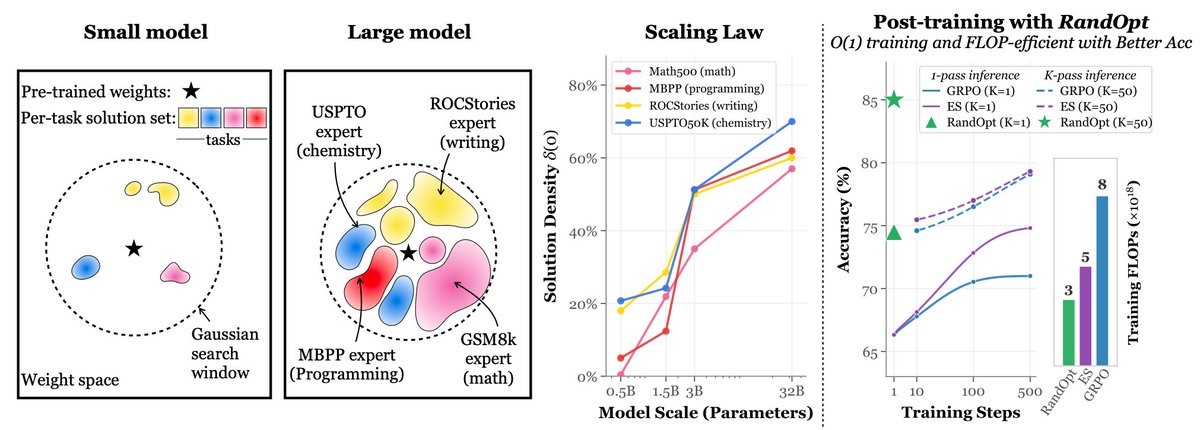
Simply adding Gaussian noise to LLMs (one step—no iterations, no learning rate, no gradients) and ensembling them can achieve performance comparable to or even better than standard GRPO/PPO on math reasoning, coding, writing, and chemistry tasks. We call this algorithm RandOpt. To verify that this is not limited to specific models, we tested it on Qwen, Llama, OLMo3, and VLMs. What's behind this? We find that in the Gaussian search neighborhood around pretrained LLMs, diverse task experts are densely distributed — a regime we term Neural Thickets. Paper: arxiv.org/pdf/2603.12228 Code: github.com/sunrainyg/Rand… Website: thickets.mit.edu
Yulu Gan tweet media
English
87
431
3K
672.2K
Akshit Singh retweetledi
Chelsea Finn
Chelsea Finn@chelseabfinn·
We added short-term visual memory + long-term text memory to pi models. 🤖 Enables robots to: - complete tasks up to 15 min long - cook grilled cheese while keeping track of time - adapt in-context Paper & videos: pi.website/memory
English
9
49
487
29.8K
Akshit Singh retweetledi
elvis
elvis@omarsar0·
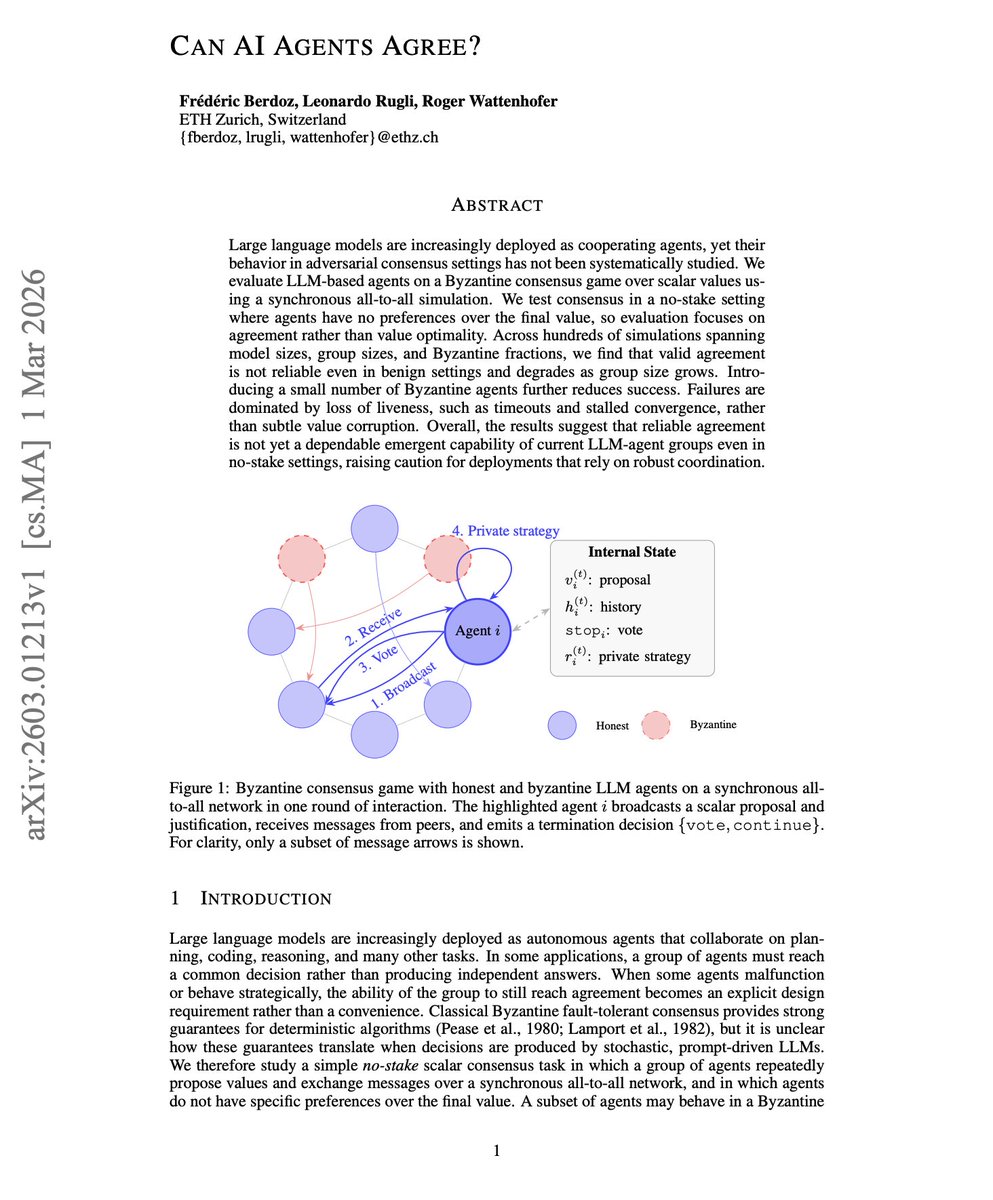
Can AI agents agree? Communication is one of the biggest challenges in multi-agent systems. New research tests LLM-based agents on Byzantine consensus games, scenarios where agents must agree on a value even when some participants behave adversarially. The main finding: valid agreement is unreliable even in fully benign settings, and degrades further as group size grows. Most failures come from convergence stalls and timeouts, not subtle value corruption. Why does it matter? Multi-agent systems are being deployed in high-stakes coordination tasks. This paper is an early signal that reliable consensus is not an emergent property you can assume. It needs to be designed explicitly. Paper: arxiv.org/abs/2603.01213 Learn to build effective AI agents in our academy: academy.dair.ai
elvis tweet media
English
41
63
337
43K
Akshit Singh retweetledi
Fatima Institute for Global AI Research
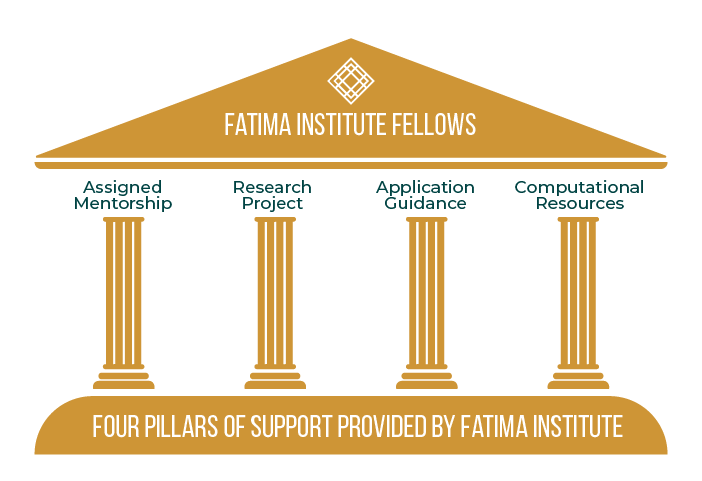
Fatima Institute is offering a free AI research opportunity! If you’re from a developing country and planning on applying to grad school, you can work on a research project with a mentor, get help with applications, and $1,000 in compute credits. Apply fatima.institute/apply-as-a-fel…
Fatima Institute for Global AI Research tweet media
English
4
41
160
8.7K
Akshit Singh retweetledi
Srinath Sridhar
Srinath Sridhar@drsrinathsridha·
Vincent's post is timely. I wrote a follow up examining some of his arguments and providing an alternative perspective. ivl.cs.brown.edu/blogs/bittersw… Yes, the lesson is bitter, but I believe the flavor is also sweet. Thread 🧵
Srinath Sridhar tweet media
Vincent Sitzmann@vincesitzmann

In my recent blog post, I argue that "vision" is only well-defined as part of perception-action loops, and that the conventional view of computer vision - mapping imagery to intermediate representations (3D, flow, segmentation...) is about to go away. vincentsitzmann.com/blog/bitter_le…

English
4
19
98
13.6K
M.Naseer
M.Naseer@MNaseerSubhani·
Excited to share that my paper has been accepted at #CVPR2026 , as a solo author. No university affiliation, no large lab. To the best of my knowledge, this may be the first solo-authored CVPR paper from Pakistan. 🇵🇰
M.Naseer tweet media
English
25
4
302
16.6K
Akshit Singh retweetledi
Maria Brbic
Maria Brbic@mariabrbic·
Are neural nets across modalities really converging to the same representation as they scale, as the Platonic Representation Hypothesis suggests? We show that common representational similarity metrics are confounded by network width & depth. We propose a permutation-based null calibration that fixes this. Result❓ • Global convergence largely disappears. • Local neighborhoods persist. We propose the alternative Aristotelian Representation Hypothesis: Neural networks, trained with different objectives on different data and modalities, are converging to shared local neighborhood relationships Very proud of @FabianGroger and @ShuoWen18 for this work! Paper: arxiv.org/abs/2602.14486 Webpage: brbiclab.epfl.ch/aristotelian Code: github.com/mlbio-epfl/ari…
English
12
89
577
57K
Akshit Singh retweetledi
Vincent Sitzmann
Vincent Sitzmann@vincesitzmann·
In my recent blog post, I argue that "vision" is only well-defined as part of perception-action loops, and that the conventional view of computer vision - mapping imagery to intermediate representations (3D, flow, segmentation...) is about to go away. vincentsitzmann.com/blog/bitter_le…
English
43
157
1K
367K
Akshit Singh retweetledi
Gabriele Berton
Gabriele Berton@gabriberton·
This PR will go down in history as the first ever argument between people and an AI It gets completely dystopian very quickly Here's what happened: 1) An AI (OpenClaw agent) made a PR on matplotlib GitHub repo 2) Maintainer says AI's PRs are not allowed
Gabriele Berton tweet media
English
2
1
39
13.5K
Akshit Singh retweetledi
Eric Ming Chen
Eric Ming Chen@ericmchen1·
Wow, it seems like the @Olympics broadcast is using Gaussian splats now. Some "spikeys" at the 10 second mark
English
18
44
1.4K
189.9K
Akshit Singh retweetledi
Quanta Magazine
Quanta Magazine@QuantaMagazine·
To some AI researchers, the inescapable differences between image and text data means that there’s no use in comparing internal representations of the two. “There is a reason why you go to an art museum instead of just reading the catalog,” said researcher Alexei Efros. quantamagazine.org/distinct-ai-mo…
Quanta Magazine tweet media
English
12
18
103
11.8K
Akshit Singh retweetledi
Pedro Domingos
Pedro Domingos@pmddomingos·
To be a successful AI researcher it helps to be good at math but not too good.
English
62
29
565
42.8K
Akshit Singh retweetledi
MikaStars★
MikaStars★@MikaStars39·
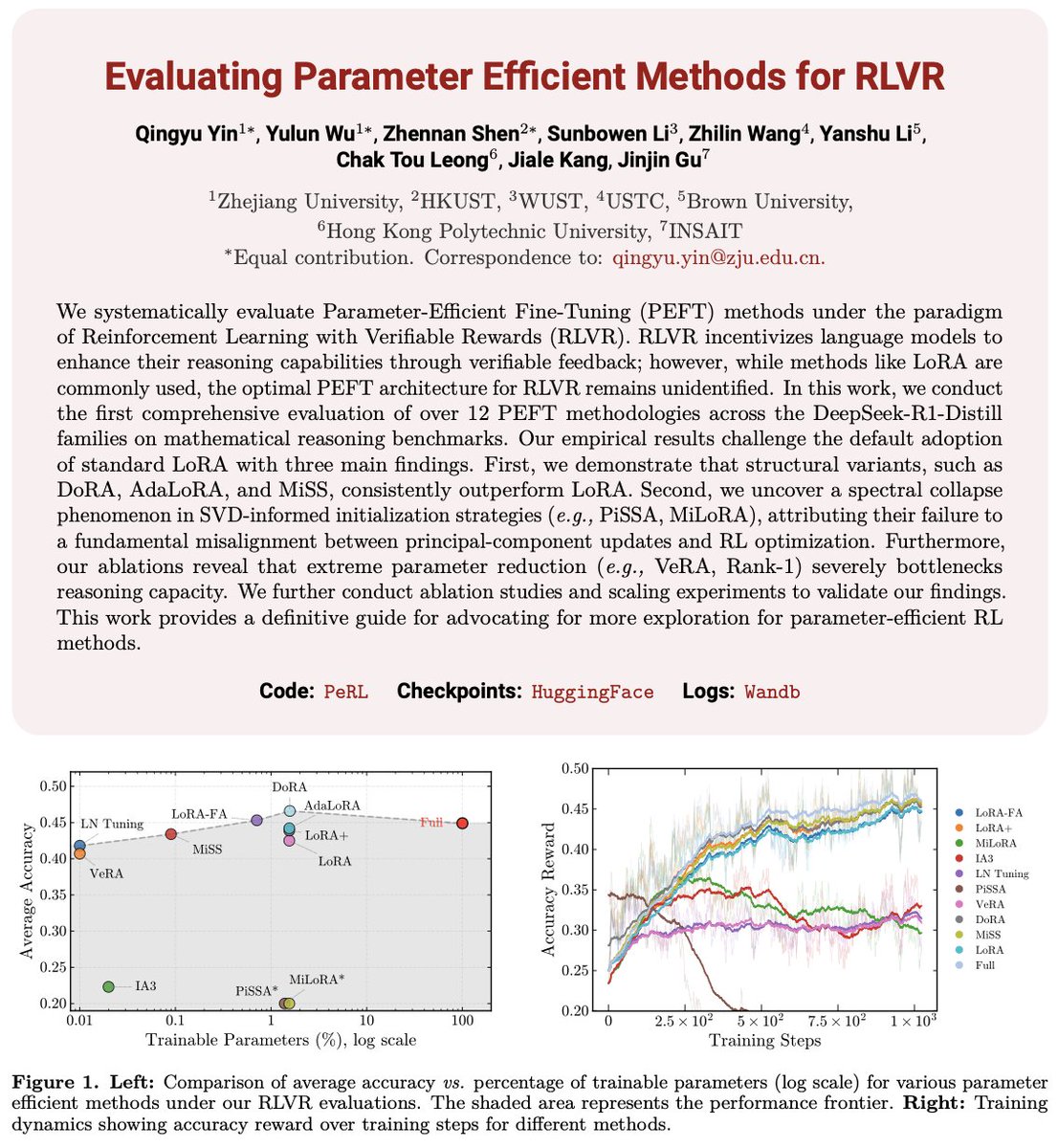
Stop using LoRA for RLVR!!! New paper released👉Evaluating Parameter Efficient Methods for RLVR 📖Alphaxiv: alphaxiv.org/abs/2512.23165 💻Github: github.com/MikaStars39/Pe… Is standard LoRA truly the optimal choice for Reinforcement Learning?. We present the first large-scale evaluation of over 12 PEFT methodologies using the DeepSeek-R1-Distill family on complex mathematical reasoning benchmarks. Key Finding: Standard LoRA is suboptimal. Structural variants such as DoRA, AdaLoRA, and MiSS consistently outperform standard LoRA. Notably, DoRA (46.6% avg. accuracy) even surpasses full-parameter fine-tuning (44.9%) across multiple benchmarks. The failure of SVD-based initialization.  Strategies like PiSSA and MiLORA experience significant performance degradation or total training collapse. This is due to a fundamental "spectral misalignment": these methods force updates on principal components, while RLVR intrinsically operates in the off-principal regime. The Expressivity Floor.  While RLVR can tolerate moderate parameter reduction, extreme compression (e.g., VeRA, IA³, or Rank-1 adapters) creates an information bottleneck. Reasoning tasks require a minimum threshold of trainable capacity to successfully reorient policy circuits. Recommendations for the community: a. Move beyond the default adoption of standard LoRA. b. Prioritize geometry-aware adapters like DoRA that decouple magnitude and direction. c. Avoid SVD-informed initializations for RL tasks.
MikaStars★ tweet media
English
5
74
424
93.1K
Akshit Singh retweetledi
Saining Xie
Saining Xie@sainingxie·
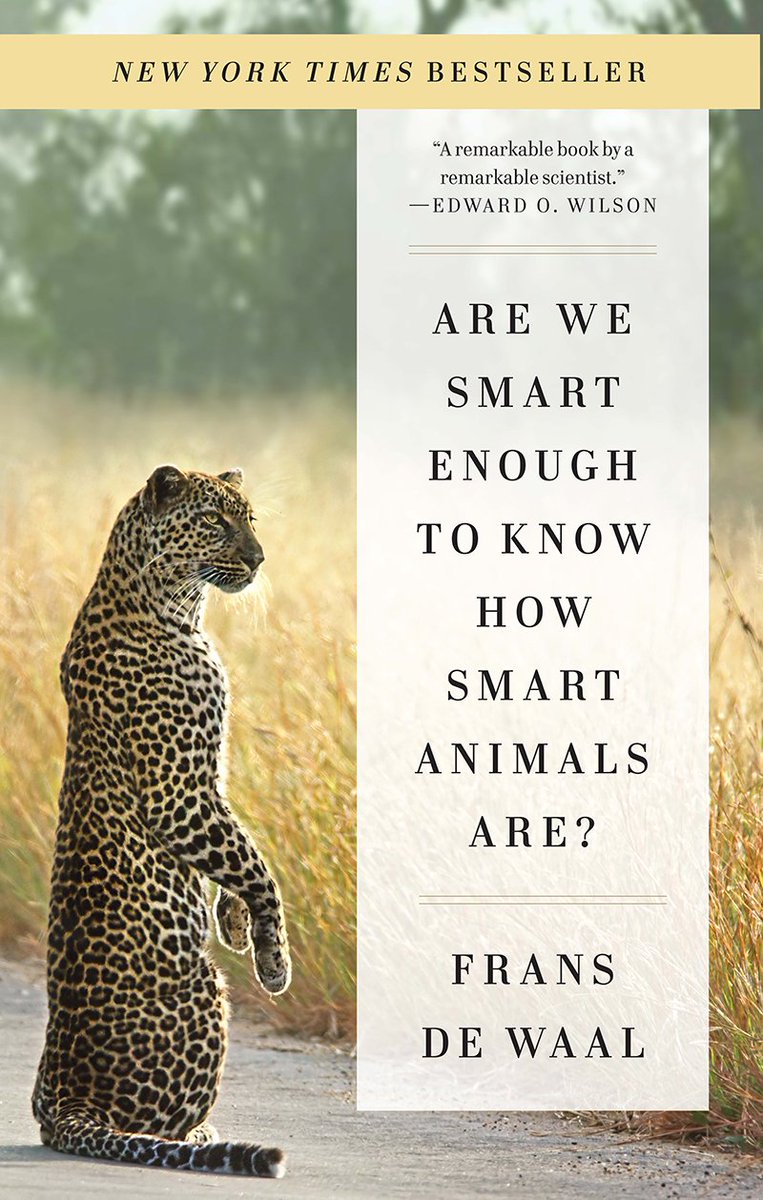
not getting into a philosophical debate, but this book really changed how I see the topic and made me feel more humble. human intelligence is impressive, but calling it ‘general’ isn’t very objective. my cat would disagree. to me human intelligence is better seen as socially driven cognitive adaptations, and there’s a huge WORLD of intelligence we still don’t understand, and are nowhere near recreating with current AI
Saining Xie tweet media
Demis Hassabis@demishassabis

Yann is just plain incorrect here, he’s confusing general intelligence with universal intelligence. Brains are the most exquis​ite and complex phenomena we know of in the universe (so far), and they are in fact extremely general. Obviously one can’t circumvent the no free lunch theorem so in a practical and finite system there always has to be some degree of specialisation around the ​target distribution that is being learnt. But the point about generality is that in theory, in the Turing Machine sense​, the architecture of ​s​uch a general system is capable of learning anything computable given enough time and memory​ (and data), and the human brain (and AI foundation models) are approximate Turing Machines. Finally, with ​regards to ​Yann's comments about chess players, it’s amazing that humans could have invented chess ​in the first place (and all the other ​a​spects ​o​f modern civilization ​from science to 747s!) let alone get as brilliant at it as someone like Magnus. He may not be ​strictly optimal (after all he has finite memory and limited time to make a decision) but it’s incredible what he and we can do with our brains given they were evolved for hunter gathering.

English
97
262
3.1K
276.7K
Akshit Singh retweetledi
Shiwei Liu
Shiwei Liu@Shiwei_Liu66·
Letting AI have long-term memory is terrifying. Long-term memory turns an AI from “a fancy tool you talk to” into something like a human being that can accumulate advantage over time, and that’s where the Darwin/evolution analogy kicks in: small gains compound, and the system becomes more shaped by prior interactions than any single moment.
English
0
3
10
1.2K
Akshit Singh retweetledi
Gems
Gems@gemsofbabus_·
🚨 Big announcement from CM Naidu! Andhra Pradesh Govt will award ₹100 Crore as prize money to a Nobel Prize winner in Quantum Science from Andhra Pradesh.
English
151
872
9.6K
259.2K