Albert Alan, MD

3.5K posts

Albert Alan, MD banner
Albert Alan, MD

Albert Alan, MD

@AlbertAlan

Founder | @ALSTOCKTRADES // @NeuroSurgGlobal Homelessness to Multimillionaire

Katılım Aralık 2017
64 Takip Edilen3.4K Takipçiler
Sabitlenmiş Tweet
Albert Alan, MD
Albert Alan, MD@AlbertAlan·
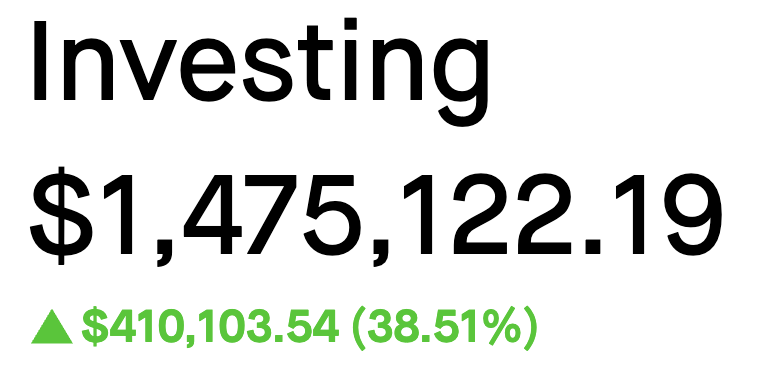
I've been fighting this whole time with my hands tied behind my back. Now I am unleashed. My mind, the very thing they mocked, just built a public portfolio worth $1.475 million with my company valued over $50 million. You're not just going to see my brain power. You're going to feel it rumble through the ground beneath your feet. $CLOV $OPEN $SOFI
Albert Alan, MD tweet media
English
15
5
96
35.1K
Albert Alan, MD
Albert Alan, MD@AlbertAlan·
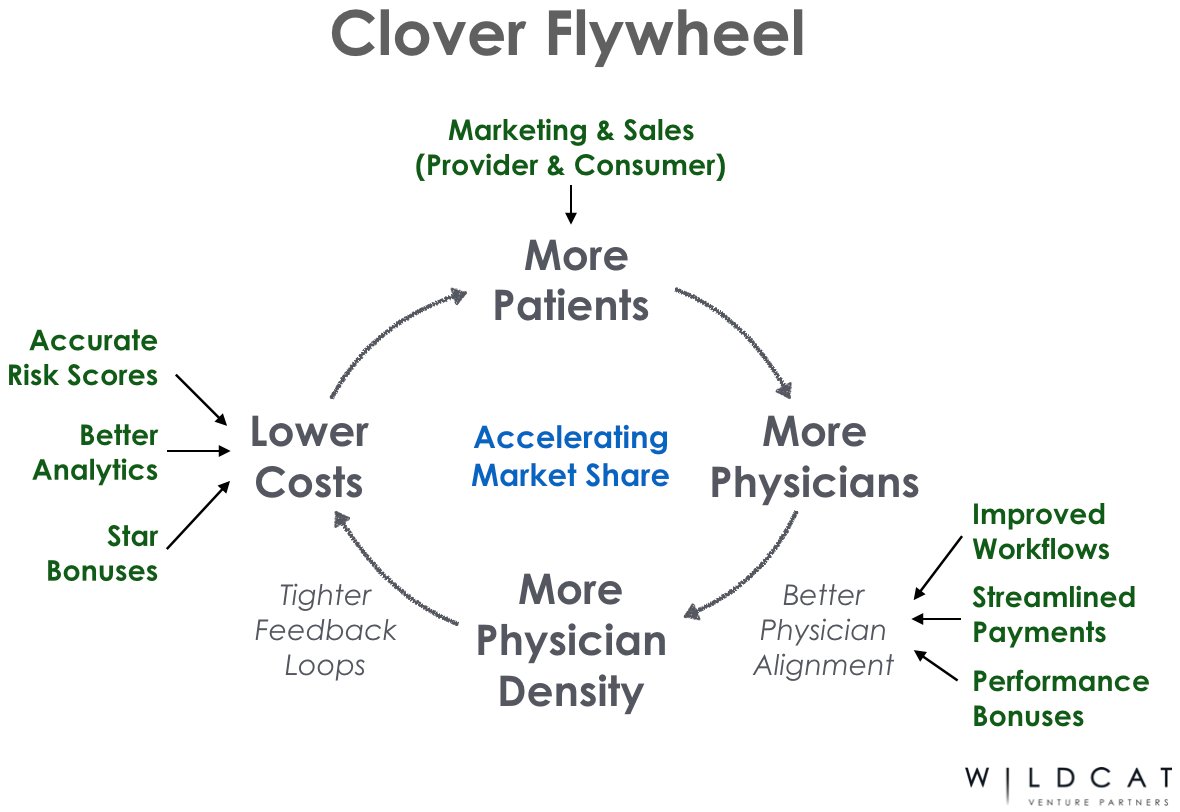
$CLOV The Payer Sits at the Top Here is something most people who work inside American healthcare never figure out. Healthcare money does not flow up. It flows down. There is a tier of companies in American medicine that receives money directly from the federal government every single month. They get a check from the Centers for Medicare and Medicaid Services before a single patient walks through a clinic door. They decide how that money is allocated. They decide what is important. They decide what gets built. Everyone else, including hospitals, including health systems, including private practices, including specialists, including the doctor who saved your father's life, sits below them in the chain and waits to be paid. That tier is called the payer tier. And I want to tell you about one specific payer, because they just did something on May 6, 2026, that the rest of the industry has been told for two decades was impossible. Clover Health reported $27.3 million in GAAP net income for the first quarter of 2026. That is the first time in the company's history that a quarter has closed in the green on a fully accepted accounting basis. Not adjusted EBITDA. Not normalized earnings. The number the SEC counts. The number every Fortune 500 CFO is judged against. Twenty seven point three million dollars of actual, audited profit on revenue of $749.2 million, up 62 percent year over year, with Medicare Advantage membership of 155,773, up 51 percent year over year. For the first time, the company has also told the market it expects to deliver full year GAAP net income profitability in 2026 and that it expects to meet or exceed full year 2026 outlook across all metrics, including the upper end of its stated GAAP net income range. That sentence will mean nothing to most people. So let me back up and explain what Clover Health actually is. What Clover Health Is Clover Health is a Medicare Advantage plan. Medicare Advantage, often called MA, is the private market version of Medicare. Instead of traditional Medicare paying hospitals and physicians directly on a fee for service basis, a Medicare Advantage plan receives a fixed monthly payment from CMS for every member it enrolls. That payment is called capitation. Under capitation, plans get a fixed amount of money per month to provide the full range of health care the individual needs. It is risk adjusted, which means the plan gets paid more for sicker patients and less for healthier ones, calibrated against the predicted cost of their care. Once that money lands in the payer's bank account, the payer decides where it goes. That is the part I want you to sit with for a second. The plan decides where it goes. If the plan wants to spend more on home visits, it can. If the plan wants to build a software platform that lives inside the primary care office, it can. If the plan wants to fund palliative care, fitness benefits, hearing aids, transportation, food, dental, vision, gym memberships, telehealth, or chronic disease management, it can. A hospital cannot do any of this on its own. A hospital can only bill for the care it already delivered, and then wait. A specialty group is the same. A private practice is the same. They are all downstream. They all chase reimbursement after the fact. They all negotiate with the payer to be allowed to do their work at a rate the payer agrees to pay. The payer is upstream of all of them. This is not a moral judgment. It is the architecture of the system as it has existed for nearly forty years. Once you see it, you cannot unsee it. What Makes Clover Different There are roughly sixty Medicare Advantage organizations in the United States that matter. UnitedHealth Group. Humana. CVS Aetna. Elevance. Centene. Cigna. The big five control most of the market. Then a long tail of smaller plans, regional plans, provider sponsored plans, and a handful of newer technology forward entrants. Clover Health sits in that long tail by membership size. Roughly 156,000 Medicare Advantage members at the close of Q1 2026. Tiny compared to UnitedHealth, which counts members in the millions. But Clover does two things almost none of its competitors do. First, Clover is architected on a wide network PPO platform. That means a member can see almost any doctor in the country who accepts Medicare. There is no narrow network. There is no gatekeeper specialist referral wall. The plan does not restrict access to control costs. It controls costs through technology and clinical intelligence inside the visit itself. Second, and this is the part that almost no one in financial media understands correctly, Clover retains full risk. Here is what that phrase means. In most modern Medicare Advantage arrangements, the payer offloads the financial risk for a member's care to the provider group taking care of that member. The provider group, typically a large physician group or an Accountable Care Organization, accepts a capitated payment from the plan to manage the patient. If the patient gets sick and the cost of care exceeds that capitation, the provider eats the loss. If the patient stays well and costs less than the capitation, the provider keeps the difference. This is called delegated risk, and it is everywhere. Optum does it. Humana does it through Conviva and CenterWell. Agilon Health is built on it. Privia is built on it. Almost every large MA player has some form of it. It looks elegant on paper. The payer collects from CMS, hands off the risk and a percentage of the premium, and harvests an arbitrage spread. But it has a quiet, structural problem. The payer no longer controls the care. The payer collects data after the fact. The payer cannot intervene at the point of decision. The payer cannot redirect dollars in real time. The payer cannot deploy technology inside the exam room. The payer becomes a check writer with a lag, watching outcomes from a distance and hoping the delegated provider group runs a tight ship. Clover does not do this. Clover's model differs from many Medicare Advantage peers because it operates a wide network PPO structure and retains full economics, generally without delegating risk to providers. Every dollar that comes in from CMS is allocated by Clover. Every clinical decision made on a Clover member is informed by Clover's technology. Every outcome rolls back up directly to Clover's financials. There is no middle layer. There is no arbitrage partner. There is no rented physician group eating the downside. This is what the company means when management says, on every earnings call, that they retain full risk. It sounds boring. It is not boring. It is the entire reason what I am about to describe next is possible. Counterpart Assistant Inside the Clover Health Medicare Advantage plan, the company built a software platform called Clover Assistant. The platform was renamed Counterpart Assistant in 2024 and spun out under a wholly owned subsidiary called Counterpart Health so it could be licensed to other payers and provider groups outside Clover's own membership, under a hybrid SaaS and shared savings revenue model, with options for full capitation. Counterpart Assistant is a clinical decision support tool. It lives inside the primary care visit. It integrates more than 100 data sources to provide real time insights through its conversational AI interface, operating within a PHI safe environment that ensures protected health information security while allowing natural language interaction with patient data. In 2025, Counterpart Health launched a fully integrated ambient scribing solution. Powered by advanced AI, it generates a summary of available audio, surfaces insights in real time, and integrates seamlessly into the visit workflow. Clover is providing this capability at no additional cost to clinicians using the platform within its network. Later in 2025, Counterpart announced generative AI capabilities that let clinicians engage with a patient's longitudinal data in real time through AI chat. These are not pilots. These are deployed features sitting inside real exam rooms used by real primary care physicians treating real Medicare members. The clinical data on the platform is the part the financial press almost never covers. Clinicians using Counterpart Assistant see over 1,000 basis points of differential in Medical Cost Ratios. That is a ten percentage point reduction in the share of premium revenue spent on medical care. In a business where competitors brag about fifty basis points of improvement, a thousand basis points is an entirely different universe. Clover has also released retrospective data analyses exploring the significant association between platform use and early diagnosis of diabetes and chronic kidney disease as well as improved medication adherence. Additional published research has demonstrated the platform's association with earlier diagnosis and less frequent hospitalization in underserved populations, and better management of congestive heart failure. This is the part I want everyone reading this to understand. A Medicare Advantage plan built a software platform that helps physicians diagnose earlier, manage chronic disease better, prescribe more effectively, and reduce hospitalizations. And because that plan holds the full risk on the members being treated, every clinical improvement immediately compounds into the plan's own financial performance. There is no leakage. There is no delegated middleman keeping the savings. The clinical outcome and the financial outcome are the same outcome. This is the elegance of full risk plus owned technology. They reinforce each other. Why the Payer Is the Right Place to Sit A hospital cannot do what Clover is doing. I want to be careful here, because hospitals are essential and they save lives every day. But I want to be honest about the structural limits. A hospital does not receive a monthly capitation check from CMS. A hospital bills for services rendered, then waits, then negotiates write downs, then collects what it can. A hospital's revenue is downstream of the payer's decisions. When CMS announces an MA rate increase, hospitals do not get a raise. The payer gets the raise, and the hospital then has to negotiate a contract renewal cycle to capture any of it. When CMS announces an MA rate cut, the pain flows downward. The payer absorbs first, then squeezes networks, then provider groups, then individual practices. This is why an artificial intelligence rollout inside a hospital looks so different from an artificial intelligence rollout inside a payer. The hospital is implementing AI to recapture margin it is already losing. The payer is implementing AI to allocate capital it already controls. The hospital is defending. The payer is building. That asymmetry compounds over time. When Clover Health decides to spend on Counterpart Assistant, on home care visits, on ambient scribing, on generative AI chat for clinicians, on enrollment of high need members into care management programs in the first year of their membership, it is doing so with money it already has in the bank. CMS has already paid it. The dollars are sitting in the operating account. The only question is allocation. The company has decided that what is important is technology in the hands of the primary care physician at the point of care. Read that again. The plan that pays for the visit has decided the most important thing it can do is put a smarter tool in the hands of the doctor running the visit. Not a narrower network. Not more prior authorization. Not a tougher claims edit. A better tool for the doctor. If you wanted to design a payer from scratch, in 2026, with everything we know about chronic disease and the unit economics of Medicare Advantage, you would build something that looks a lot like what Clover Health is now operating. The Flywheel Wildcat Venture Partners published a diagram a few years ago called the Clover Flywheel. I will describe it for you in plain words, because the picture matters. More patients leads to more physicians who want to be in the network. More physicians leads to more physician density inside Clover's wide PPO. More physician density leads to tighter feedback loops between Clover's data infrastructure and the clinicians using Counterpart Assistant. Tighter feedback loops leads to lower medical costs through better risk capture, smarter analytics, and the Star Ratings bonuses CMS pays for high quality care. Lower medical costs frees up more capital for marketing, member benefits, and provider incentives. That capital brings in more patients. The loop closes. The flywheel turns. The reason Q1 2026 matters is that the loop is now turning fast enough to throw off GAAP net income. The flywheel did not just spin into Adjusted EBITDA, which is a friendlier number that strips out a long list of expenses. It spun into the cleanest, most conservative profit line that exists in public company accounting. For context, Clover ended the quarter with $418 million in cash and no debt, generated $107.9 million in operating cash flow, improved adjusted SG&A as a percentage of total revenues by 210 basis points year over year to 16 percent, and grew adjusted EBITDA 56 percent year over year to $40 million. Growth was driven primarily by a strong Annual Election Period, including best in class retention, which management described as one of the most important leading indicators of long term cohort profitability. This is what a flywheel looks like when it actually spins. What This Means I am not in the business of telling anyone what to do with their money. I am writing this because I think the average person has no idea how the architecture of American healthcare actually works, and I think understanding it changes how you read every headline you will ever see about this industry. The payer sits at the top. The payer receives the federal dollars first. The payer decides where the dollars go. For most of the last twenty years, payers decided the dollars should go into share buybacks, narrow networks, denial machinery, and acquired physician groups they could squeeze through delegated risk arrangements. One company decided the dollars should go into a software platform that makes the primary care physician's job easier. That company just turned GAAP profitable on accelerating membership growth. The science of it is not complicated. Earlier diagnosis costs less than late diagnosis. Better medication adherence costs less than emergency hospitalization. Home based palliative care costs less than the intensive care unit. Wide network access reduces friction and member churn. A clinician with a smarter tool catches more, misses less, documents better, and bills more accurately. The financial outcome and the clinical outcome are the same outcome. That last sentence is the one I want you to take with you. In a system that almost never aligns the patient's interest with the operator's interest, Clover Health built a model where the two are mathematically identical. The healthier the member, the more profitable the plan. The smarter the physician, the lower the medical cost ratio. The earlier the diagnosis, the better the financial result. This is what real value based care looks like when you actually build it instead of just printing it on a brochure. Keep watching. Albert Alan, MD
Albert Alan, MD tweet media
English
1
1
1
45
Albert Alan, MD
Albert Alan, MD@AlbertAlan·
@Impervious38 @Task_Master_17 Well if you look at last year in 2025, he sold the same amount of shares and he labeled them for tax-related purposes. That's what I was thinking but we don't know. He's not part of the company anymore so I don't think he can disclose that. Check my work. I'm not too sure.
English
0
0
1
24
Impervious
Impervious@Impervious38·
@Task_Master_17 @AlbertAlan 886k shares... about $3M at current price... that'd be one steep tax bill of he's raising all this money for that purpose! I have zero concerns over this transaction. He left with his free shares... he earned them... he should enjoy the spoils of his victory!
English
2
0
2
41
Albert Alan, MD
Albert Alan, MD@AlbertAlan·
$CLOV Clover Health's former CFO Peter Kuipers filed a Form 144 today to sell 886,341 shares of $CLOV. Cue the panic. Now let me show you what the math actually says. Today's filing, dated 5/14/2026, lists 886,341 Class A shares with an aggregate market value of roughly $3 million at approximately $3.45 per share, sold through Fidelity. The shares were acquired on 4/29/2025 via a Stock Plan Option, and the filing reports Nothing to Report for sales in the prior three months. This is his first sale notice since his departure. Here is the part most retail will miss. Kuipers stepped down as CFO effective 3/30/2026 and remained an advisor through 4/24/2026 with continued equity vesting. Per his most recent Form 4, filed 2/2/2026, he held 5,758,353 shares of $CLOV. If this notice executes in full, he would still own approximately 4,872,012 shares, which at today's price is roughly $16.8 million of $CLOV equity still sitting on his personal ledger. That is not a CFO running for the exits. That is a departing executive monetizing one tranche of a vested grant. Now here is the part nobody else will show you, because it requires actually reading both filings side by side. The 886,341 shares he is selling today are not a new vesting event. They are the equity half of the same RSU tranche that vested on 4/29/2025. On that date, 825,989 shares were withheld instantly by the company to cover the tax liability triggered by the vesting. That is what a Form 4 code F transaction is. At $3.45 per share, that was roughly $2.85 million of stock disposed of solely to settle taxes on that vesting. The remaining shares from that same vesting tranche, totaling 886,341, landed in his personal account. He held them for thirteen months. He sat through one of the rougher stretches of the year in CLOV. He stayed in his role through that period. And he is only now, three weeks after his advisory window closed on 4/24/2026 and one week after the quarterly report dropped on 5/8/2026, filing to sell that equity half. Same RSU lot. Same price level around $3.45. Twelve months apart. Tax half settled by the issuer at vest. Equity half held by Kuipers and sold by Kuipers in the open market once he was no longer an active executive and no longer inside the earnings window. A Form 144 is a notice of intent to sell within 90 days, not a confirmation of execution. The Form 4 that follows will tell us exactly how much actually clears. The Nothing to Report for the prior three months is the timing signature of someone who waited out earnings and the corporate calendar before filing. A former CFO selling one tranche of a vested package, thirteen months after the tax half was already settled, while still holding an estimated $16 million plus of company stock, is not the smoking gun retail wants it to be. Retail will be retail. Smart money will be smart money. It is all in the mathematics and proper due diligence. Do your own. This is educational content only. I am not a licensed financial advisor, and nothing in this post is investment advice, a recommendation to buy or sell any security, or a solicitation of any kind. Always conduct your own due diligence and consult a qualified, licensed professional before making investment decisions. Until next time. Albert Alan, MD
English
8
1
37
2.7K
Albert Alan, MD
Albert Alan, MD@AlbertAlan·
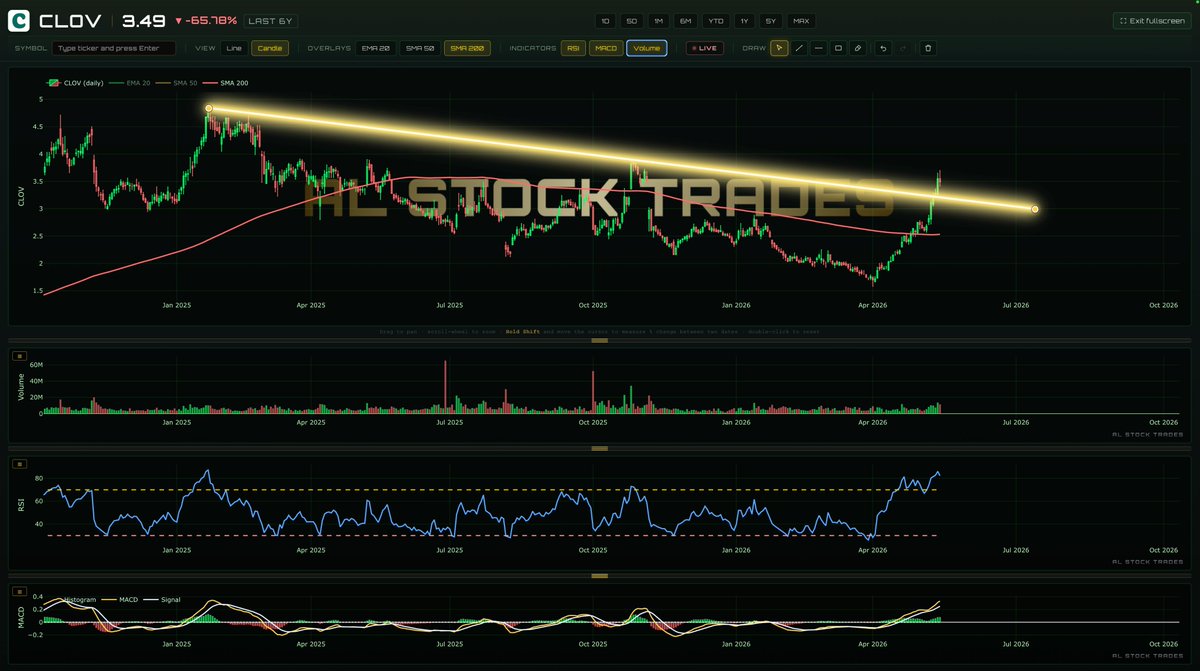
$CLOV What do you guys think? Will we re-test the former resistance line? Also check out the new stock chart that we just released. 🔥
Albert Alan, MD tweet media
English
3
2
15
1.6K
Albert Alan, MD
Albert Alan, MD@AlbertAlan·
@CanadasFukd But always remember, take everything I say as a grain of salt. I'm not licensed in anything finance. Question everything I say.
English
1
0
0
135
Sam 🇨🇦
Sam 🇨🇦@CanadasFukd·
@AlbertAlan Thanks for breaking it down AL. You're my A I assistant when it comes to $CLOV
English
1
0
2
271
Albert Alan, MD
Albert Alan, MD@AlbertAlan·
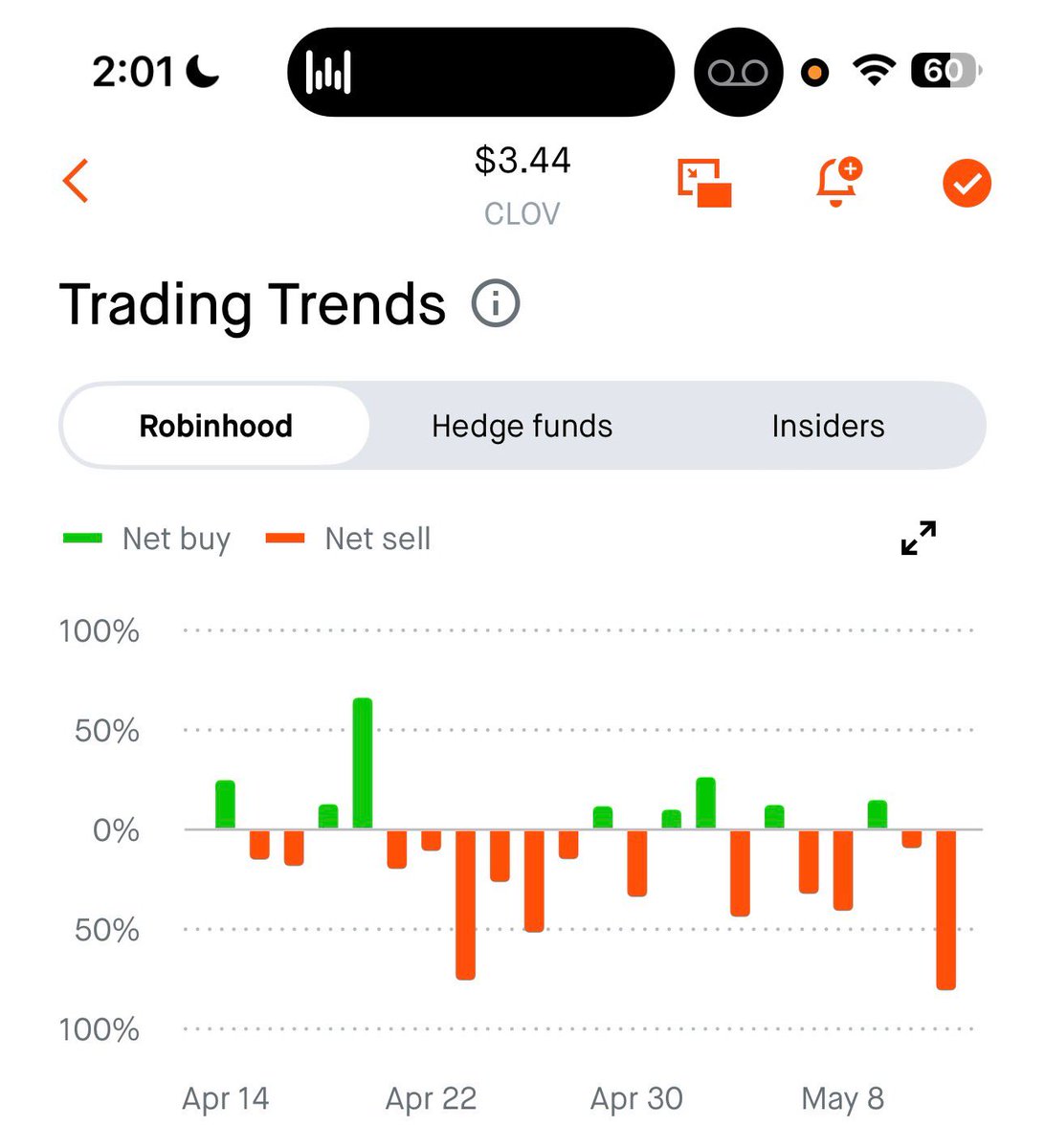
$CLOV Four weeks. Four posts. Same chart. Same script. Let me walk you through what we have built here, because the data is now telling a story so clean it almost does not feel real. April 16. I showed you the macro. $59 billion in by Wall Street. $45 billion out by Main Street. At the bottom. CLOV was trading in the low 2s. May 1. I showed you the rally beginning. Retail Robinhood users were still net selling even as the stock pushed higher. I floated the theory. Forced selling from covered call assignment. May 11. Stock closed at $3.20. Retail still selling. I added the catalyst the market was pricing in that retail was ignoring. Clover Health guiding to net income profitability for fiscal year 2026. The first time in the company's history. Today. CLOV is at $3.44. It tagged $3.67 intraday. That is roughly 70 percent off the lows where this series started. And the most recent bar on the Robinhood chart, the day the stock printed the highest price of the entire move, is one of the biggest net sell bars in the entire dataset. Roughly 80 percent net sell. At the top of the move. I want you to sit with that for a second. Retail did not net sell into the panic at the bottom and then flip bullish on the rally. Retail panic sold at the bottom, sold harder into the recovery, sold even harder into the breakout, and is now selling the most aggressively at the highest price. Every theory I floated in the previous three posts is now being confirmed in real time by the data itself. The disbelief is not breaking. It is getting louder. The covered calls are not just getting assigned. They are getting absolutely steamrolled. Anyone who wrote a $3 call when CLOV was at $2.20 thought they were geniuses. Today those shares are gone. Called away. Locked in at $3 while the stock prints $3.66 and the fundamentals keep improving. And the most important question is the one no one is asking. If retail is selling at this kind of intensity, on this kind of volume, at these prices, who is on the other side of every single one of those trades? Because every share that gets sold has to be bought by someone. The order book does not work any other way. The buyer is not retail. The Robinhood data tells you that with mathematical certainty. Could it be other retail brokers or institutions? Quiet. Patient. Methodical. Accumulating into every wave of retail capitulation. Building positions in a name that just guided to GAAP net income profitability in a sector that just had UnitedHealthcare print a strong quarter and trigger a healthcare rotation. We will know exactly who in three to six months when the 13Fs hit. I have said it in every post in this series and I will say it again. I have a strong suspicion of what we are going to find. This is the part of the cycle the textbooks try to describe and never quite capture. Because in the textbook it is a chart on page 47. In real life it is your neighbor selling his shares for a 30 cent gain while a pension fund quietly takes the other side and holds it for the next three years. Retail counts pennies. Institutions count the present value of future dollars. That has always been the difference. It will always be the difference. And the wildest part is the data is now public. Free. Visible to anyone with a Robinhood account. Nobody is hiding any of this from you. You are watching the largest wealth transfer mechanism in modern finance happen on a chart in your phone in real time. Ugly. Brilliant. Legal. Disclaimer: I am not a licensed financial advisor and this is not financial advice. Please consult a licensed professional before making any investment decisions. Always do your own research.
Albert Alan, MD tweet media
English
0
2
16
1.3K
Albert Alan, MD
Albert Alan, MD@AlbertAlan·
@Impervious38 I'm sure you're going to see a lot of people here that are uneducated on X. They're going to start crying and honestly this is who you're dealing with. I thank the people that sold at the lows.
English
0
0
1
29
Impervious
Impervious@Impervious38·
@AlbertAlan That checks! From a simplicity standpoint, this filing just gives him flexibility to sell these shares at his leisure over the next 90 days... he can sell tranches into strength or whenever he needs to refill his checking account lol
English
1
0
2
65
Albert Alan, MD
Albert Alan, MD@AlbertAlan·
You know what I found interesting is that he did a Form 144 not a Form 4, which means it is an intent to sell within the next three months. He historically files these tax ones around the end of April and the beginning of May. He decided to delay it until 14 to 15 days after, which falls right in line with when they're going to be reporting Q2 2026. He probably wants to sell this for taxes probably near Q2 2026 because he probably knows something, maybe increased guidance. Who knows? I'm speculating. If he wanted to sell for taxes now after this run-up, he would have done a Form 4 not a Form 144. Double-check my thinking.
English
3
0
5
291
Impervious
Impervious@Impervious38·
@AlbertAlan Good for him! Selling a fraction of his longterm shares for nearly $3M on this pop makes a lot of sense... he's no longer "in the loop" on new inside information, so it makes a lot of sense to me. Daddy needs to eat!
English
1
0
6
314
Albert Alan, MD retweetledi
Counterpart Health
Counterpart Health@counterparthlth·
As patients move across care settings, seamless data exchange is more important than ever. Recently, our Chief Product Officer, @kevinholub, joined Whitney Cole and Therasa Bell from @Kno2 to discuss a major step forward in payer interoperability: @CloverHealth going live on Kno2 and participating in newly announced federal interoperability initiatives. The conversation highlighted an important point: interoperability only delivers value when it works in practice. Claims data helps complete the patient story, and real progress happens when organizations move beyond baseline requirements to create better experiences and better outcomes. Listen to the latest Kno2fy podcast on powering payer interoperability: kno2.com/kno2fy-podcast…
Kno2@Kno2

New episode of Kno2fy is live! 🎙️ We sat down with Kevin Holub of Counterpart Health to talk about #interoperability, payer data, patient empowerment, and what meaningful innovation in healthcare actually looks like. Check it out: bit.ly/4fnn2y1

English
1
9
43
2.2K
Albert Alan, MD
Albert Alan, MD@AlbertAlan·
$CLOV GOING LIVE SOON! On X and YT!
Albert Alan, MD tweet media
English
0
1
13
751
Albert Alan, MD
Albert Alan, MD@AlbertAlan·
$CLOV This is the amazing Kumar Dharmarajan, MD, MBA, former Chief Scientific Officer at Clover Health. He breaks down how Medicare Advantage can better align incentives, leverage data, and coordinate care to lower costs and improve outcomes for high‑risk, chronically ill patients.
English
2
2
18
1.3K
Albert Alan, MD
Albert Alan, MD@AlbertAlan·
$CLOV “To improve every life.” - Clover Health Keep going! Onward and forward!
Clover Health@CloverHealth

What does healthcare AI look like when a computer scientist-led health plan holds the risk? Our CEO @andrewtoy joined @BainCapital's Future of Healthcare AI podcast, on why the payer is one of the few vantage points from which you can truly re-architect healthcare with technology. Also: why the right 80s movie for agentifying solutions isn't Terminator. 🎙 baincapital.com/healthcare/med…

English
1
4
23
1.7K
Clover Health
Clover Health@CloverHealth·
What does healthcare AI look like when a computer scientist-led health plan holds the risk? Our CEO @andrewtoy joined @BainCapital's Future of Healthcare AI podcast, on why the payer is one of the few vantage points from which you can truly re-architect healthcare with technology. Also: why the right 80s movie for agentifying solutions isn't Terminator. 🎙 baincapital.com/healthcare/med…
English
4
14
92
6.5K
Albert Alan, MD
Albert Alan, MD@AlbertAlan·
@CryptoNurseLee 💚 The movie won't be complete until all of you guys win and become more successful than me.
English
1
0
2
74
Albert Alan, MD
Albert Alan, MD@AlbertAlan·
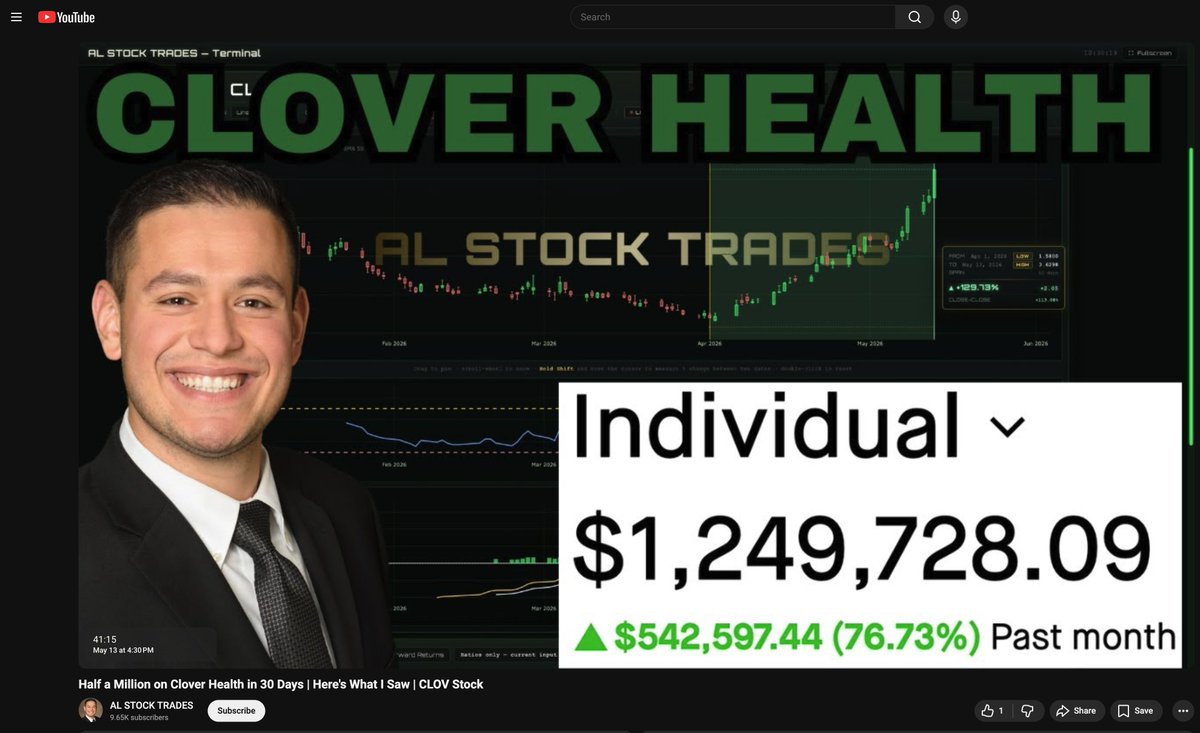
$CLOV If you've followed me, you know I came from homelessness. Three years of it, through high school. The thing nobody tells you about that kind of survival is what gets you out of it. For me, it was tutoring. I sat in the public library at night because it had heat and internet, and I started helping classmates in math and science. Watching them understand something for the first time gave me a sense of purpose I didn't have anywhere else. That's the seed of everything I've built since. At the University of Arizona I graduated with three undergraduate degrees and started a produce rescue program that pulled over a million pounds of fresh food out of the waste stream and into homeless shelters across the state. Twenty percent of the proceeds funded scholarships for kids in situations like mine. That work was part of why I was named 40 Under 40 in my city in 2019. I became a physician for the same reason I built everything else. Medicine pulls you toward the people the system overlooks. The stock terminal is that same instinct extended. I was tired of watching Wall Street, insiders, and politicians move money in ways the rest of us never get to see. So I made that information visible. Not advice. Visibility. Full disclosure: I'm a shareholder in this position. Since April 1, it's up over 129%. I've learned by now that the noise gets loudest right before a breakthrough. It didn't show up at the lows. It showed up at the highs. That tells me something. Keep watching.
Albert Alan, MD tweet media
English
4
5
47
2.5K