
Ali Asaria

886 posts

Ali Asaria banner
Ali Asaria

Ali Asaria

@aliasaria

Co-Founder of @transformerlab ex CEO of https://t.co/DmXFPG0eoN, https://t.co/lHotbCJJGI. Engineer at heart.

Toronto, Ontario Katılım Aralık 2007
2.1K Takip Edilen4.2K Takipçiler
Ali Asaria
Ali Asaria@aliasaria·
The startup world has a specific performance: The Absolute Voice. No one is born this way, but if you're in startups you learn to act this way quickly. You state every opinion with 100% certainty because it wins you funding, virality, and celebration from peers. I’ve watched many CEOs go from zero to billions and, along the way, the performance becomes the personality. They aren't acting anymore—they’ve developed Terminal Main Character Syndrome. They become high-frequency know-it-alls who are physically incapable of being unsure, which makes them completely impossible to be around.
English
0
0
6
99
Ali Asaria
Ali Asaria@aliasaria·
"what I felt was wonder mixed with a profound sadness. There’s something deeply disorienting about watching the pillars of your professional identity, what you built and how you built it, get reproduced in a weekend by a tool that doesn’t need to eat or sleep." Everyone I know experiencing this.
Aditya Agarwal@adityaag

x.com/i/article/2031…

English
2
0
13
1.8K
Ali Asaria
Ali Asaria@aliasaria·
Weird changes I didn’t expect when heavily coding using agents: mornings are the most productive (by afternoon it’s hard to maintain ability to control more than one agent), working from home is now invaluable — distraction is 3x more painful now, and you need a huge monitor.
English
2
1
8
450
Ali Asaria
Ali Asaria@aliasaria·
I'm an old man, but I had my most productive coding day today, working hard to push the agents to their limit, while adapting my workflow and ability to manage them all.
Ali Asaria tweet media
English
1
0
15
409
Ali Asaria
Ali Asaria@aliasaria·
@cjwestland @tobi @globeandmail Agree. I can't see AI as public infrastructure working. But I also agree that this is the most powerful technology of our time, and we can't be 100% dependent on a few US companies. More open source AND more researchers AND more private AI has to all happen in Canada.
English
0
0
1
21
Ali Asaria
Ali Asaria@aliasaria·
@hisham Our team is using a lot of the tools (Codex, Claude Code, Gemini-cli, amp) but personally I'm getting the best results from using ampcode (which behind the scenes uses a blend of models)
English
1
0
1
79
Ali Asaria
Ali Asaria@aliasaria·
@_kelindi Yes exactly the kind of thing we’re trying to figure out as well
English
0
0
1
20
Kelindi
Kelindi@_kelindi·
ACI is also about whether agents can boot your app in the cloud and iterate without you. After building a Mac app this past year and now a Swift iOS app, I keep wondering: am I missing out on true autonomous agents because I can’t fully test them in cloud vms? Feels like we need to optimize our stacks around ACI.
English
2
0
1
71
Ali Asaria
Ali Asaria@aliasaria·
"The 830 unicorns holding $3.9t in aggregate post-money valuation cannot all exit through IPOs. The math doesn’t work. At 2025’s pace of 48 VC-backed IPOs, clearing the unicorn backlog would take seventeen years."
Tomasz Tunguz@ttunguz

For the first time in venture history, three distinct channels share the liquidity burden roughly equally. A decade ago, secondaries barely registered. They accounted for roughly 3% of exit value in 2015. Today they claim 31% : nearly $95b in the trailing twelve months. The shift accelerated after 2021’s IPO bonanza. When public markets closed their doors in 2022, investors found alternative routes. Secondaries absorbed demand that would have flowed to traditional exits. When Goldman Sachs acquired Industry Ventures, the transaction signaled secondaries have arrived. Morgan Stanley followed with EquityZen, then Charles Schwab announced its acquisition of Forge Global. Wall Street recognized the structural change before most of venture did. This matters for founders & investors. When IPOs dominated exits, fund models assumed a small number of public offerings would generate the bulk of returns. Now liquidity arrives through multiple doors. A founder might sell secondary shares to patient capital while the company remains private. A GP might move positions through continuation vehicles. An LP might trade fund stakes on an increasingly liquid secondary market. The 830 unicorns holding $3.9t in aggregate post-money valuation cannot all exit through IPOs. The math doesn’t work. At 2025’s pace of 48 VC-backed IPOs, clearing the unicorn backlog would take seventeen years. Secondaries provide a release valve that traditional exits cannot. Companies like OpenAI have embraced this reality, running employee tender offers while voiding unauthorized secondary transfers. The largest private companies now manage their own liquidity programs rather than waiting for public markets. Today, secondary liquidity concentrates in the top 20 names. SpaceX, Stripe, OpenAI. For the founder of company #50, the secondary market remains largely theoretical. For secondaries to succeed as a broad asset class, buyers must underwrite positions in companies without household recognition. As the market grows, this coverage gap becomes opportunity. For LPs starved of distributions since 2022, the expansion of secondary channels offers hope. The $169b in cumulative negative net cash flows needs somewhere to go. More exit paths mean more opportunities to return capital. When a Series B employee asks about liquidity today, the answer isn’t “wait for the IPO.” It’s “we’re planning a tender offer next year.” A decade ago, secondaries were a footnote. Now they’re infrastructure. Liquidity flows where it can, not where tradition suggests it should. tomtunguz.com/a-third-a-thir…

English
2
0
3
472
Ali Asaria retweetledi
Tomasz Tunguz
Tomasz Tunguz@ttunguz·
For the first time in venture history, three distinct channels share the liquidity burden roughly equally. A decade ago, secondaries barely registered. They accounted for roughly 3% of exit value in 2015. Today they claim 31% : nearly $95b in the trailing twelve months. The shift accelerated after 2021’s IPO bonanza. When public markets closed their doors in 2022, investors found alternative routes. Secondaries absorbed demand that would have flowed to traditional exits. When Goldman Sachs acquired Industry Ventures, the transaction signaled secondaries have arrived. Morgan Stanley followed with EquityZen, then Charles Schwab announced its acquisition of Forge Global. Wall Street recognized the structural change before most of venture did. This matters for founders & investors. When IPOs dominated exits, fund models assumed a small number of public offerings would generate the bulk of returns. Now liquidity arrives through multiple doors. A founder might sell secondary shares to patient capital while the company remains private. A GP might move positions through continuation vehicles. An LP might trade fund stakes on an increasingly liquid secondary market. The 830 unicorns holding $3.9t in aggregate post-money valuation cannot all exit through IPOs. The math doesn’t work. At 2025’s pace of 48 VC-backed IPOs, clearing the unicorn backlog would take seventeen years. Secondaries provide a release valve that traditional exits cannot. Companies like OpenAI have embraced this reality, running employee tender offers while voiding unauthorized secondary transfers. The largest private companies now manage their own liquidity programs rather than waiting for public markets. Today, secondary liquidity concentrates in the top 20 names. SpaceX, Stripe, OpenAI. For the founder of company #50, the secondary market remains largely theoretical. For secondaries to succeed as a broad asset class, buyers must underwrite positions in companies without household recognition. As the market grows, this coverage gap becomes opportunity. For LPs starved of distributions since 2022, the expansion of secondary channels offers hope. The $169b in cumulative negative net cash flows needs somewhere to go. More exit paths mean more opportunities to return capital. When a Series B employee asks about liquidity today, the answer isn’t “wait for the IPO.” It’s “we’re planning a tender offer next year.” A decade ago, secondaries were a footnote. Now they’re infrastructure. Liquidity flows where it can, not where tradition suggests it should. tomtunguz.com/a-third-a-thir…
Tomasz Tunguz tweet media
English
22
43
204
54.7K
Ali Asaria
Ali Asaria@aliasaria·
@ttunguz This is cool. BTW the blog post mentions RLLM but the link is broken. I think it is supposed to link to here and change the text to say that it is not from huggingface: github.com/agentica-proje…
English
0
0
0
82
Tomasz Tunguz
Tomasz Tunguz@ttunguz·
9 observations from a year building AI agents : 1. Prototype with the Best When the input is unpredictable—email parsing, voice transcription, messy data extraction—reach for state-of-the-art. Figure out what works with the best models, then specialize over time. 2. Polish Small Gems I fine-tuned Qwen 3 for task classification. The 8B model beats GPT 5.2 zero-shot prompting & runs locally on my laptop. Fine-tuning shines when the task is well-defined & the input distribution is stable. 3. Use Built-In Spell-Check Static typing forces the AI to face a compiler. Ruby let agents hallucinate valid-looking code that failed at runtime. Rust checks code's grammar. One-shot success rates improve substantially. 4. Cajole your Team of Agent Rivals Build your agentic braintrust. Ask Claude to create a plan. Then prod Gemini & Codex to critique it. Claude addresses the critiques & implements the code. Agents are great micromanagers. 5. Put All the Clay in One Pot Building an agent is an exercise in Play-Doh. I'd like all the tools in one place : manage my memory, manage my prompts, capture my logs. It's all a single closed loop. Prompt → Output → Evaluation → Optimization → Prompt. 6. Recognize The iPhone 15 Era of AI Qwen 3, GLM, DeepSeek V3, & Kimi K2.5 deliver strong performance at a fraction of the cost. The models are now strong enough for workflow tool calling that more intelligence may not matter. We're comparing them on cost rather than accuracy. 7. Document FTW As Harrison Chase put it : "in software, the code documents the app; in AI, the traces do." Our system runs nightly prompt optimization. It collects the last 100 conversations, extracts failures, & generates improved prompts using an LLM-as-judge. 8. Prompt Musical Chairs We can't bring the system down for new prompts. The agents watch a prompt file & reload it automatically when it changes. This separates deployment from experimentation & enables DSPy-style optimization to run automatically. 9. Who Do You Work For? Skills are for interactive conversations. Code is for agents. When a skill fails, you know exactly where to look. When an agent chains ten function calls & the output is wrong, you're hunting through logs. What have you learned? tomtunguz.com/9-observations…
Tomasz Tunguz tweet media
English
17
10
70
12.7K
Ali Asaria
Ali Asaria@aliasaria·
@hashtagcoder We're just following the same rules as though a human fully wrote the code: all PRs are reviewed by at least one other developer before they are merged. google.github.io/eng-practices/… You have to tweak how much your team is biased to quality vs speed depending on lots of things.
English
0
0
1
16
Ali Asaria
Ali Asaria@aliasaria·
In all the hype around how software development is changing because of LLMs, something that gets lost is HOW MUST MORE FUN IT IS to build software now. You can do so much in a single day and avoid so many boring steps.
English
1
1
5
286
Ali Asaria
Ali Asaria@aliasaria·
@hashtagcoder Our team can do so much more per day than we could before. We balance that with strict code reviews. In the end our goal is to have written the same quality code with or without LLMs. Requires experience.
English
1
0
0
9
Sha Alibhai | Director of Engineering
@aliasaria What's your take on the cost of software development though? AI tools are basically pay-as-you-go, so you end up creating a lot more disposable code that is cheaper in one way and more expensive in another and iteration cycles are much shorter.
English
1
0
0
7
Ali Asaria
Ali Asaria@aliasaria·
I try hard to notice common questions with poor answers. A few I hear: - What’s the actually optimal way to donate money? - What should we tell our kids to focus in the AI age? - Why can’t we build more housing? What are q's in your world that don't get answered well?
English
2
0
2
424
Ali Asaria
Ali Asaria@aliasaria·
All I want is a simple startup that will listen all day to my private conversations and then send me targeted ads while I watch videos online. Why can't anyone make this?
English
0
0
12
404
Ali Asaria
Ali Asaria@aliasaria·
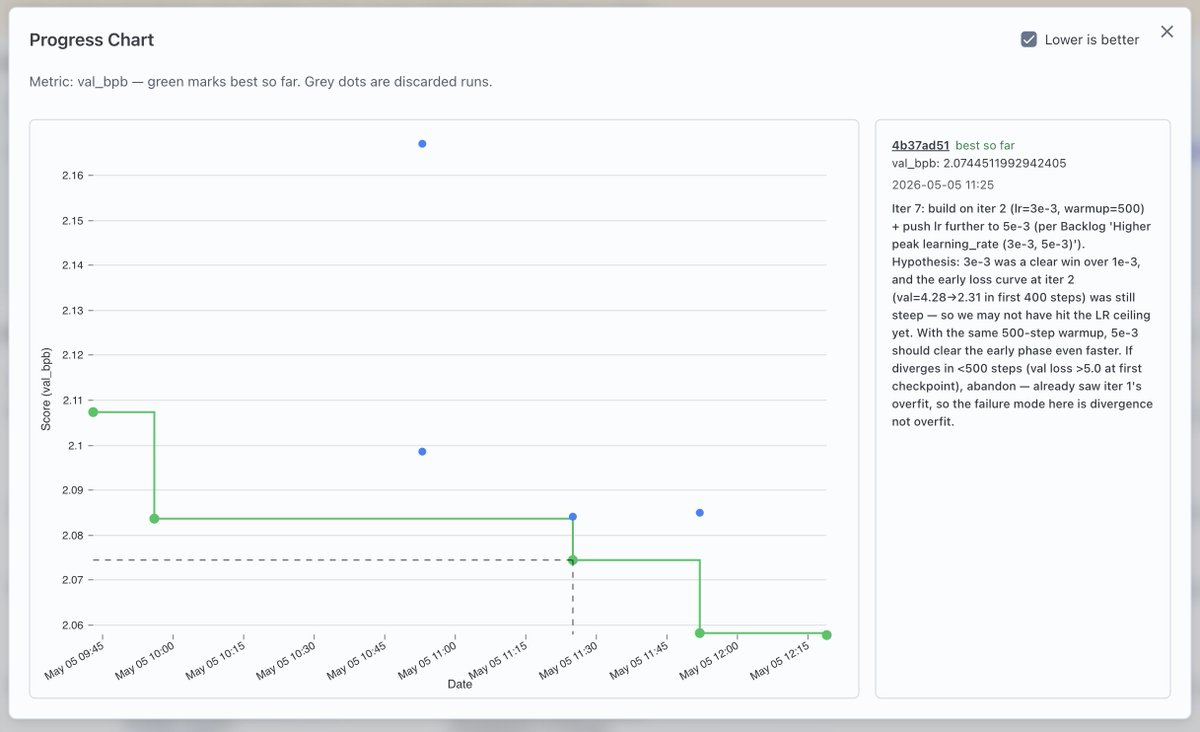
Have been writing an open source guide to building your own Machine Learning Research Platform from scratch. From 1 node to 1000... Launching soon. DM or reply if you want early access.
Ali Asaria tweet media
English
3
1
9
405
Ali Asaria
Ali Asaria@aliasaria·
Here at @transformerlab we are big fans of what @bentlegen and his team are building at @modemdev . The product is slick. When you use it you and your team instantly feel like you're transported into the future of what software development will be like.
Ben Vinegar@bentlegen

🚀 We raised $4.4M from @Accel, @inovia and some baller angels to build the AI product assistant for the agentic coding era. Because as code is being written faster than ever – product execution needs to keep pace! 👇 More via @BetaKit, or try @modemdev today!

English
0
0
9
798