Alisa Cohn

8.3K posts

Alisa Cohn banner
Alisa Cohn

Alisa Cohn

@AlisaCohn

Startup & CEO Coach; advisor; author and podcast host of From Start-up to Grown-up; journalist; angel investor; Broadway investor; ENTJ ftw!
New York City Katılım Şubat 2009
4.1K Takip Edilen5K Takipçiler
Sabitlenmiş Tweet
Alisa Cohn
Alisa Cohn@AlisaCohn·
(1/13) Here are the 10 most downloaded episodes of my podcast From Start-up to Grown-up of 2021 (A thread): #podcasts #startups #leadership
English
6
5
53
0
Alisa Cohn
Alisa Cohn@AlisaCohn·
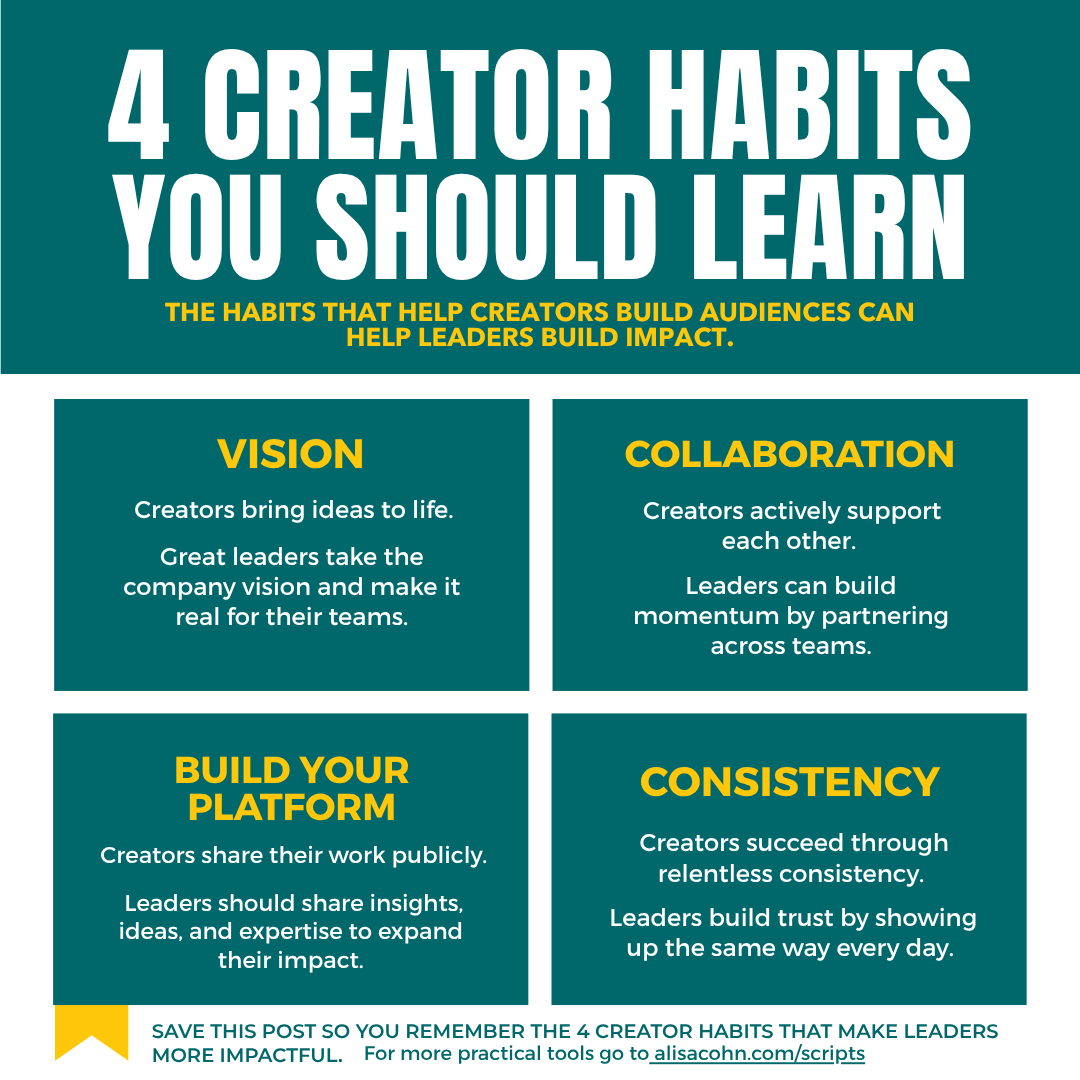
The most effective leaders steal from creators. Not their content. Their habits. After working with executives who've transformed their teams, I've noticed something: the ones who build real impact think exactly like the creators building massive audiences online. Same playbook. Different stage. Here are 4 creator habits that transform leaders: 1️⃣ VISION Creators have a point of view about the world and shares it. Leaders create a compelling "why" for their teams and help them get on board. 2️⃣ COLLABORATION Creators band together with others, celebrating their wins and supporting their content. Leaders connect departments, amplify good work, and create conditions where everyone's success feeds everyone else's success. 3️⃣ SHARE OPENLY Creators put their best ideas and strategies out there. That helps people get to know them personally and grab onto their ideas. Leaders share their decision-making process, their learnings, even their mistakes. They make their thinking transparent so others can contribute and learn. 4️⃣ CONSISTENCY Creators put out their work when engagement is down. When the algorithm isn't working. Even when they don't feel like it. Leaders know that showing up is part of the job. And so is being the same person every day. Which creator habit could most strengthen your leadership right now?
Alisa Cohn tweet media
English
0
0
0
27
Alisa Cohn
Alisa Cohn@AlisaCohn·
"I had it the whole time, but it was in my head." That's what the CFO said when the CEO pressed him about the strategic dashboard and planning work he'd been working on. The CEO had been asking for months. Board meetings came and went without clarity. Strategic decisions were being made in the dark. All because the work existed only in someone's head. The CFO lost his seat at the leadership table. Not because he wasn't doing the work, but because no one could see it. Here's the thing about executive projects: If your stakeholders can't see your work, it might as well not exist. It doesn't matter how brilliant your analysis is if it stays locked away. It doesn't matter how comprehensive your strategy is if it lives only in your mind. Your job isn't just to do the thinking. It's to make sure everyone buys in and can take action based on your work. That’s why the best leaders: ✅ Share and document critical insights, including work in progress. . ✅ Provide context and their thought process. ✅ Learn from the input of others. Take the time to make your process visible. Share your thinking. Document your progress. Because the best strategy in your head is worthless if no one else can access it.
Alisa Cohn tweet media
English
0
0
0
45
Alisa Cohn
Alisa Cohn@AlisaCohn·
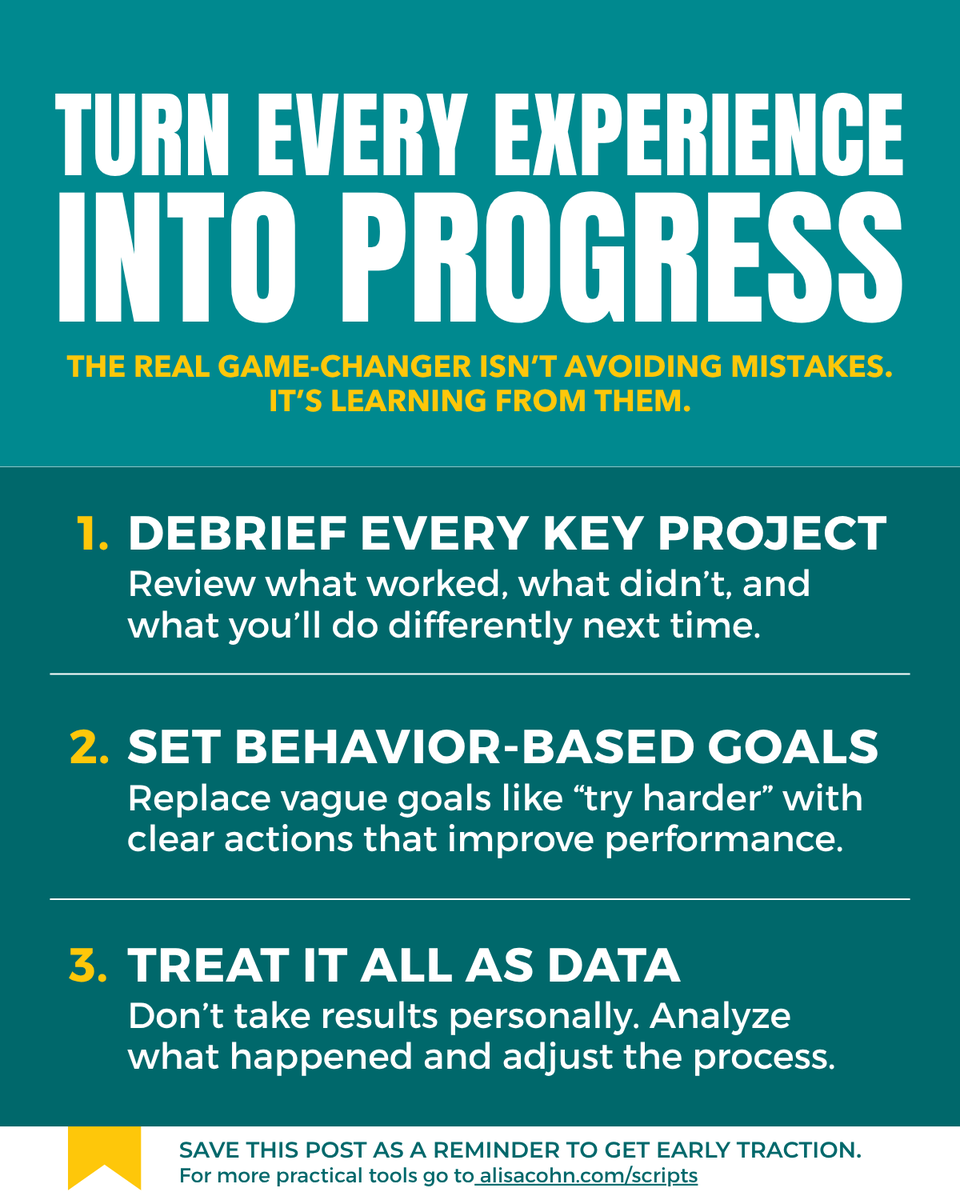
Most teams move on quickly after projects without taking time to reflect. One of the most powerful ways to improve performance is surprisingly simple: a thoughtful debrief. Debriefs help you turn experiences into progress. Here are three principles that make them effective. ✅Debrief Every Key Project Review what worked, what didn't, and what you'll do differently next time. ✅Set Behavior-Based Goals Replace vague goals like "try harder" with clear actions that improve performance. ✅Treat It All as Data Don't take results personally. Analyze what happened and adjust the process. The best teams don't succeed because they never make mistakes. They succeed because they learn faster than everyone else. 📌 Save this post so you remember these 3 ways to turn experience into progress.
Alisa Cohn tweet media
English
2
0
2
13
Alisa Cohn
Alisa Cohn@AlisaCohn·
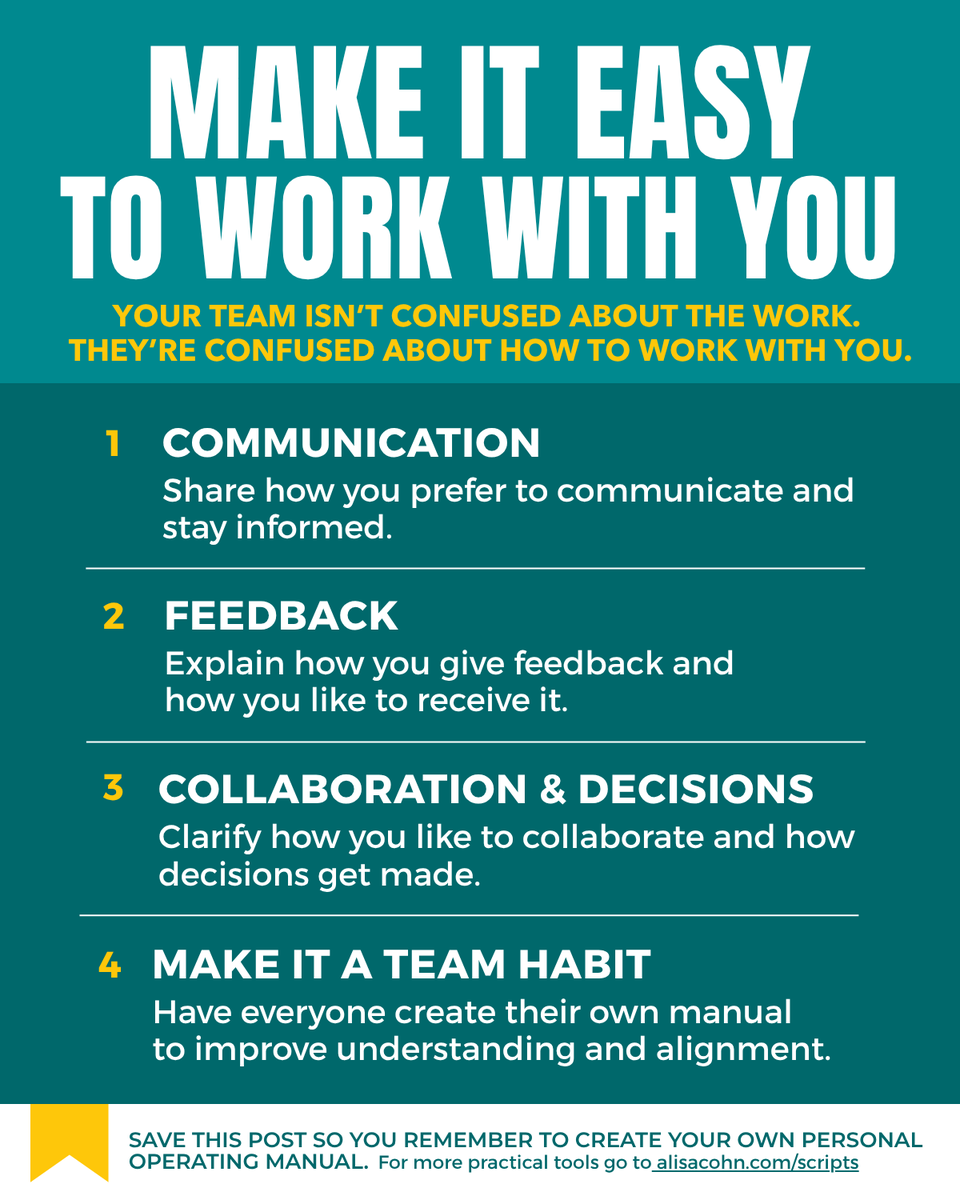
Your team isn't confused about the work. They're confused about how to work with you. After coaching executives for over 25 years, I've seen this play out in small and large ways. The CEO who would say "Great, keep me posted"  was overwhelmed with emails asking for permission. His team thought he was a micro-manager. He'd just wanted to know outcomes, not approve every step. Another leader I worked with wanted to get a "pre-read" before important decisions, but she never said that explicitly. She and her team were constantly at odds because she didn't clarify for them when she wanted information in advance and when they should just talk off the cuff. The issue here wasn't about competence or intelligence or processes. The issue was not making it ridiculously easy to work with you. Enter: your personal operating manual. It's a simple short guide that eliminates the guesswork. It has sections that answer the best way to work with you upfront, to prevent friction down the road. It should include: 1️⃣ Communication Spell it out. Do you want a daily Slack update or weekly email summary? When you say "ASAP," do you mean within the hour or by end of day? How should they escalate urgent issues? 2️⃣ Feedback Be specific about your style. Do you give feedback immediately or wait for scheduled check-ins? Can they challenge your ideas openly, or do you prefer private pushback? What's the best way to deliver bad news? 3️⃣ Collaboration & Decisions Define your role clearly. Are you the final decision maker or a collaborator? Do you want problems brought with solutions attached? When do you need to be consulted vs. just kept informed? 4️⃣ Invite Your Team to Do the Same Make this process exponentially better by asking everyone on your team to create their own manual. Now you know Sarah processes feedback better in writing. Mike needs context before jumping into solutions. Lisa's most creative in the morning. The result? Less confusion. Fewer do-overs. Way more trust. Your team stops tiptoeing around your preferences because they actually know what they are. Save this post and carve out 30 minutes this week to write yours. Your team has been waiting for this clarity.
Alisa Cohn tweet media
English
0
0
0
66
Alisa Cohn
Alisa Cohn@AlisaCohn·
The one thing 100% of successful people wish they'd done sooner surprised me. I had dinner with my financial planner last week. He works with people who've built serious wealth over successful careers. In his 20 years of practice, 100% of his clients share the same regret: not retiring sooner. But here's the twist. Their definition of "retirement" isn't what you'd expect. It's not about golf courses or cruise ships. To them, retirement means this: ✅ Doing work you'd choose even without a paycheck ✅ Asking yourself: "Would I pay to do this job?" ✅ Focusing on what genuinely lights you up His clients don't regret making money. They regret waiting so long to do work that actually mattered to them. My takeaway for everyone: Don't wait until you've "made it" to do meaningful work. Start now. Even if it's just 5 hours a week on the side. Your future self will thank you. Thanks for a great discussion Sotirios Keros @KerosSotirios, Cabe Franklin @cabefranklin , Caroline Webb @Caroline_Webb_ and Eric Schurenberg @EricSchurenberg .
Alisa Cohn tweet media
English
0
0
3
54
Alisa Cohn
Alisa Cohn@AlisaCohn·
“Why didn’t you tell me?” And then the harder question: “Why didn’t anyone tell me?” In this clip, Kim Scott @kimballscott shares this story about a mistake many leaders make: By not giving honest feedback, you don’t protect people. You blindside them. And by the time you say something, it’s too late to fix it. Leadership isn’t about being nice. It’s about being clear. Say the hard thing. While it can still help. Before it becomes a consequence instead of a conversation. 👉Listen to the full podcast episode through the link in the comments.
English
1
0
2
151
Alisa Cohn
Alisa Cohn@AlisaCohn·
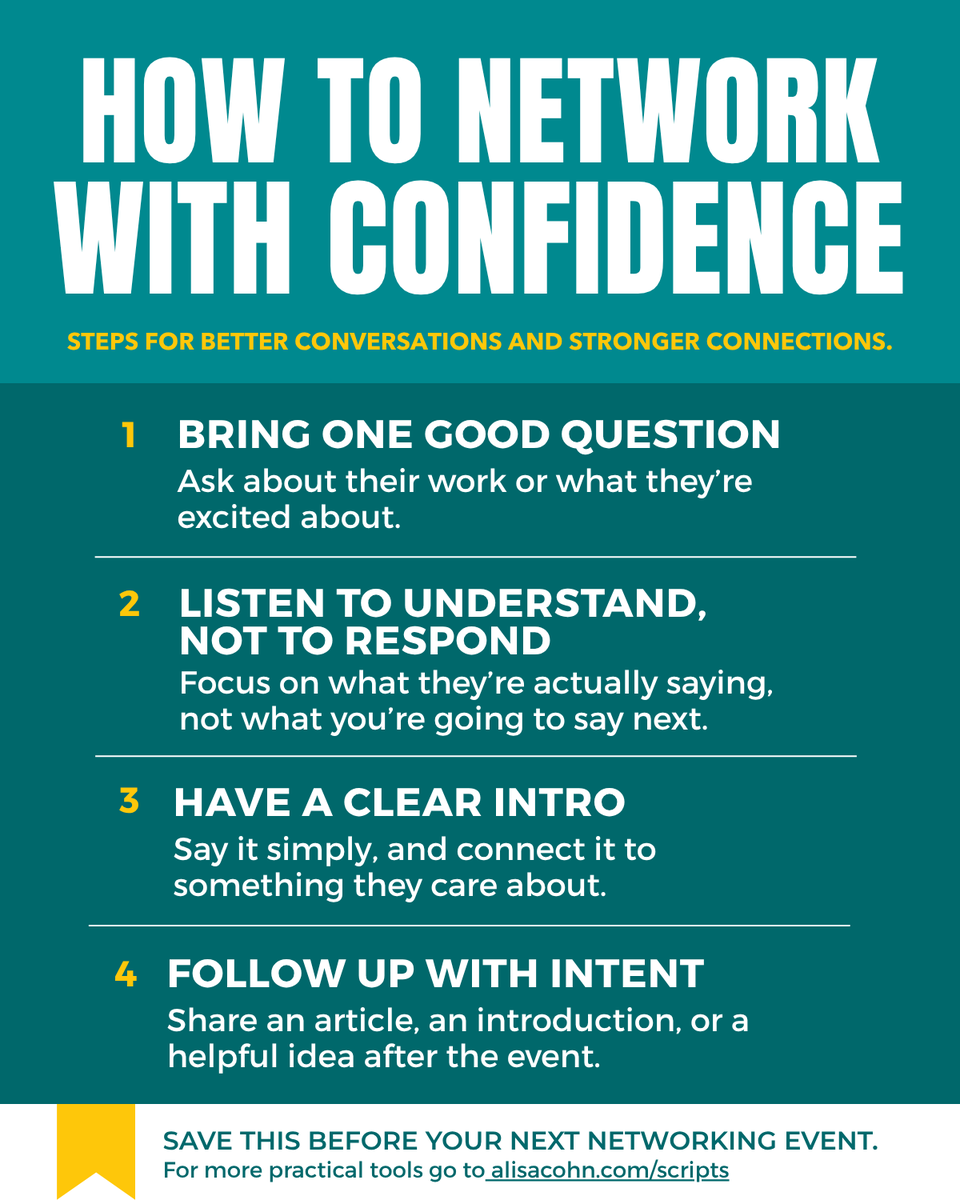
The biggest lie about networking: You need to be naturally charismatic. Nope. The best networkers I know are prepared, not extroverted. Here's how to think about it: ✅ One thoughtful question that gets people talking about what matters ✅ Better listening than talking ✅ A crisp explanation of what you do ✅ Follow-up within 48 hours Master these, and something shifts. Conversations stop feeling scripted. Real connections start to form. Which one of these trips you up the most?
Alisa Cohn tweet media
English
0
0
0
25
Alisa Cohn
Alisa Cohn@AlisaCohn·
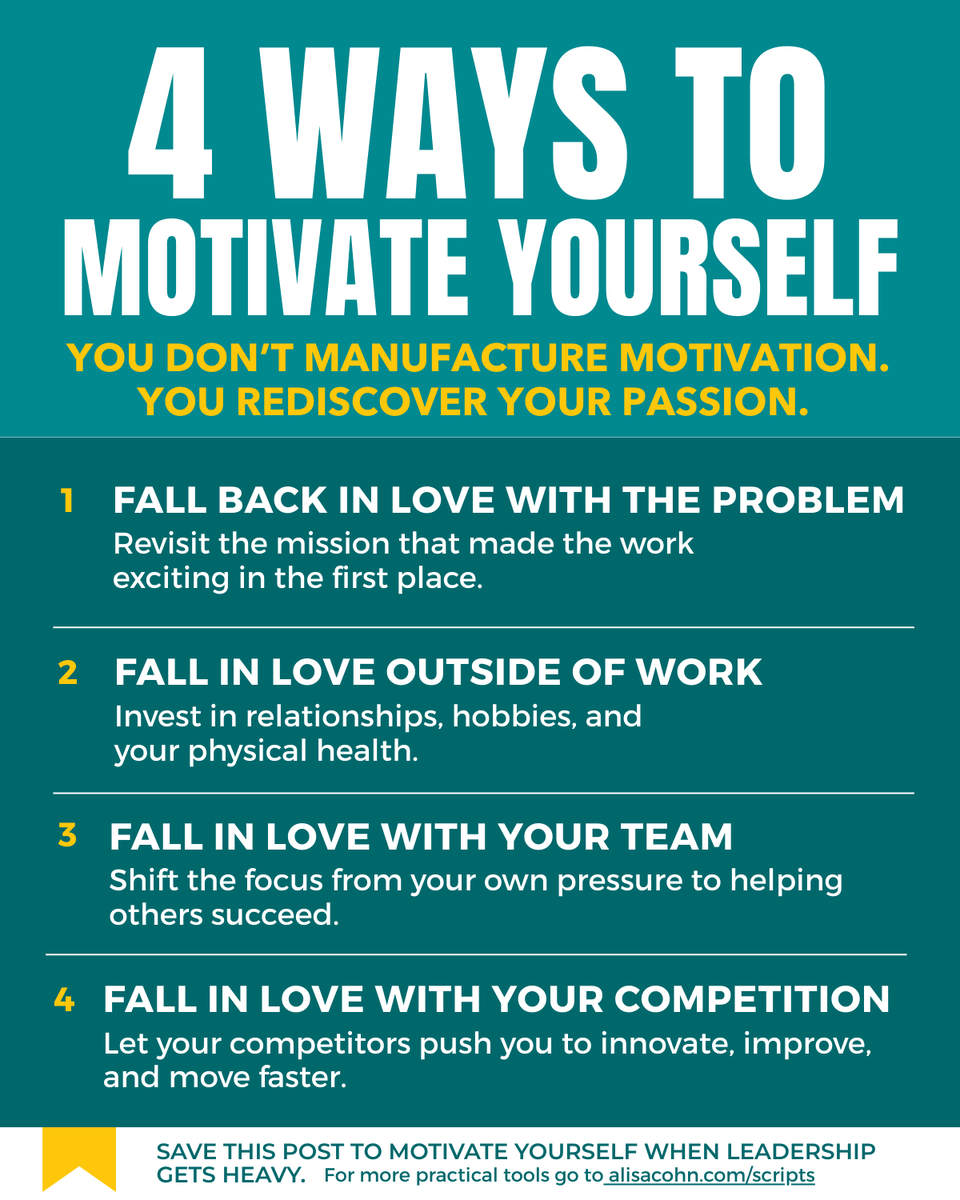
I've coached hundreds of leaders through burnout. The pattern is the same. They achieve success, then lose the fire that got them there. The solution isn't more vacation days or better work-life balance talks. It's rediscovering what made you fall in love with this work in the first place. Here are 4 ways to reignite that energy: ❤️ Fall in love with the problem you're solving So many leaders are buried in metrics and back to back meetings. Last month, I had a client revisit their original vision for their team. They actually got a bit teary. And energized. Here's what you can do: ✅ Block 30 minutes this week to write down why this role mattered to you ✅ Revisit the mission that made the work exciting in the first place ✅ Talk to someone your work has positively impacted ❤️ Fall in love with life outside the office The most energized leaders I know have something that lights them up beyond work. One of my clients started rock climbing. Another writes poetry. It doesn't compete with leadership. It fuels it. Here's what you can do: ✅ Schedule one activity this week that has nothing to do with work ✅ Set a hard boundary on weekend work (even 4 hours makes a difference) ✅ Text an old friend you've been meaning to catch up with ❤️ Fall in love with your team's success Nothing recharges a burned-out leader faster than watching someone they developed succeed. This single shift transform founders who were ready to quit into leaders who couldn't wait to get to work. Here's what you can do: ✅ Identify one team member who's ready for their next growth opportunity ✅ Spend 15 minutes this week asking them about their career goals ✅ Make one introduction that could accelerate their development ❤️ Fall in love with the competition Your biggest competitor just launched something bold? Good. Use that fire. One client told me: "When our rival raised a lot of money, we used that to galvanize the team. We're building something big here." Here's what you can do: ✅ Research what your top competitor is doing differently ✅ Identify one area where you can outperform them ✅ Turn competitive pressure into fuel for your team, not fear The energy that brought you to leadership is still there. You just need to remember what made you fall in love with this work. Which of these resonates most with where you are right now?
Alisa Cohn tweet media
English
0
0
2
188
Alisa Cohn
Alisa Cohn@AlisaCohn·
Most leaders I know obsess over performance. 🔹Feedback cycles. 🔹Accountability metrics. 🔹Progress reviews. And they should! This is all necessary. But here's what I've learned: it's not enough. I often ask a question in the sessions I lead: who was the leader who had the most impact on you. And here’s who people describe: the leader who had high standards and ALSO cared about where you were going. When your team knows you're invested in their development, not just their output: ➡️ Loyalty deepens ➡️Confidence compounds ➡️ Your bench strength multiplies How do you showcase this? With a simple practice: Regular career conversations. 🔵Ask where they want to go. 🔵Ask what skills they're itching to build. 🔵Ask how you can clear the path. What if you don’t specifically know the path they can use to grow? It doesn’t matter. Just asking these questions signals you care about them. And they help people find their own path. Which is what real growth is anyway. Leadership isn't just about hitting targets. It's about creating the conditions for your people to grow. And achieve heights that neither of you had anticipated.
Alisa Cohn tweet media
English
0
0
0
30
Alisa Cohn
Alisa Cohn@AlisaCohn·
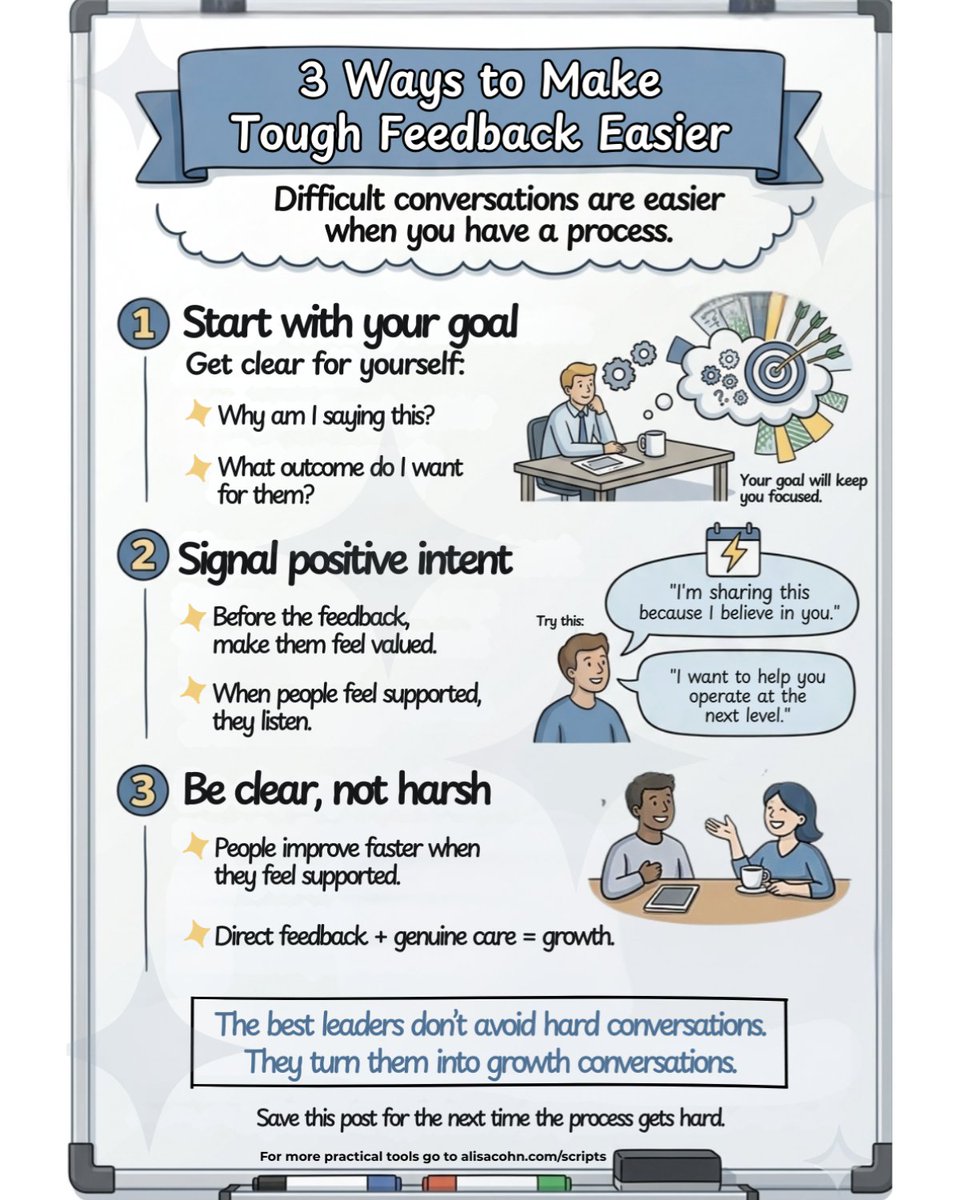
Many leaders dread giving tough feedback. They rehearse the conversation in their heads. They delay the meeting. They soften their words so much the message gets lost. But here's what I've learned after coaching leaders for over 25 years: difficult conversations get easier when you have a clear process. Here are 3 ways to make tough feedback easier: 1️⃣ Start With Your Goal Get clear before you speak: Why am I saying this? What outcome do I want for them? Your goal keeps you focused during the conversation. It prevents you from wandering into personal frustration or past grievances. 2️⃣ Signal Positive Intent Before giving feedback, make the person feel valued. When people feel supported, they're more open to listening. Try these phrases: "I'm sharing this because I believe in you." "I want to help you operate at the next level." People hear criticism differently when they know it comes from a place of care. 3️⃣ Be Clear, Not Harsh The key equation: Direct feedback + genuine care = growth. People improve faster when they feel respected, supported, and challenged at the same time. You don't need to soften your message. You need to deliver it with genuine intention to help. It's easy to delay. But I promise you'll regret it. The best time to have that conversation is now. What's one feedback conversation you've been putting off that could change someone's trajectory?
Alisa Cohn tweet media
English
0
0
0
29
Alisa Cohn
Alisa Cohn@AlisaCohn·
A professional poker player taught me a powerful leadership lesson. "When poker players owe money, it's not the money that's the problem," he said. "It's not even that the debt grows. The problem is when they stop responding to your texts." "The moment they stop communicating," he said, "that's when they're finished. They become pariahs. Nobody will trust them again." It's the same for you as a leader. When a crisis hits, your instinct might tell you to buy time. Figure it out quietly. Keep it contained until you have answers. That's backwards. When you're in trouble, you need to double down on your communication. Not hide from it. ✅ Call the board yourself. Don't let them hear bad news from someone else. ✅ Tell your team what's wrong, what you're doing about it, and what help you need. ✅ Update stakeholders constantly, even when progress is slow. The leaders who excel aren't the ones who never face problems (there are always crises). They're the ones who face them with clear eyes and straight talk. Your reputation isn't built on perfection. It's built on how you handle imperfection. 💭 Don't go silent. Who needs to hear from you this week?
Alisa Cohn tweet media
English
0
0
0
45
Alisa Cohn
Alisa Cohn@AlisaCohn·
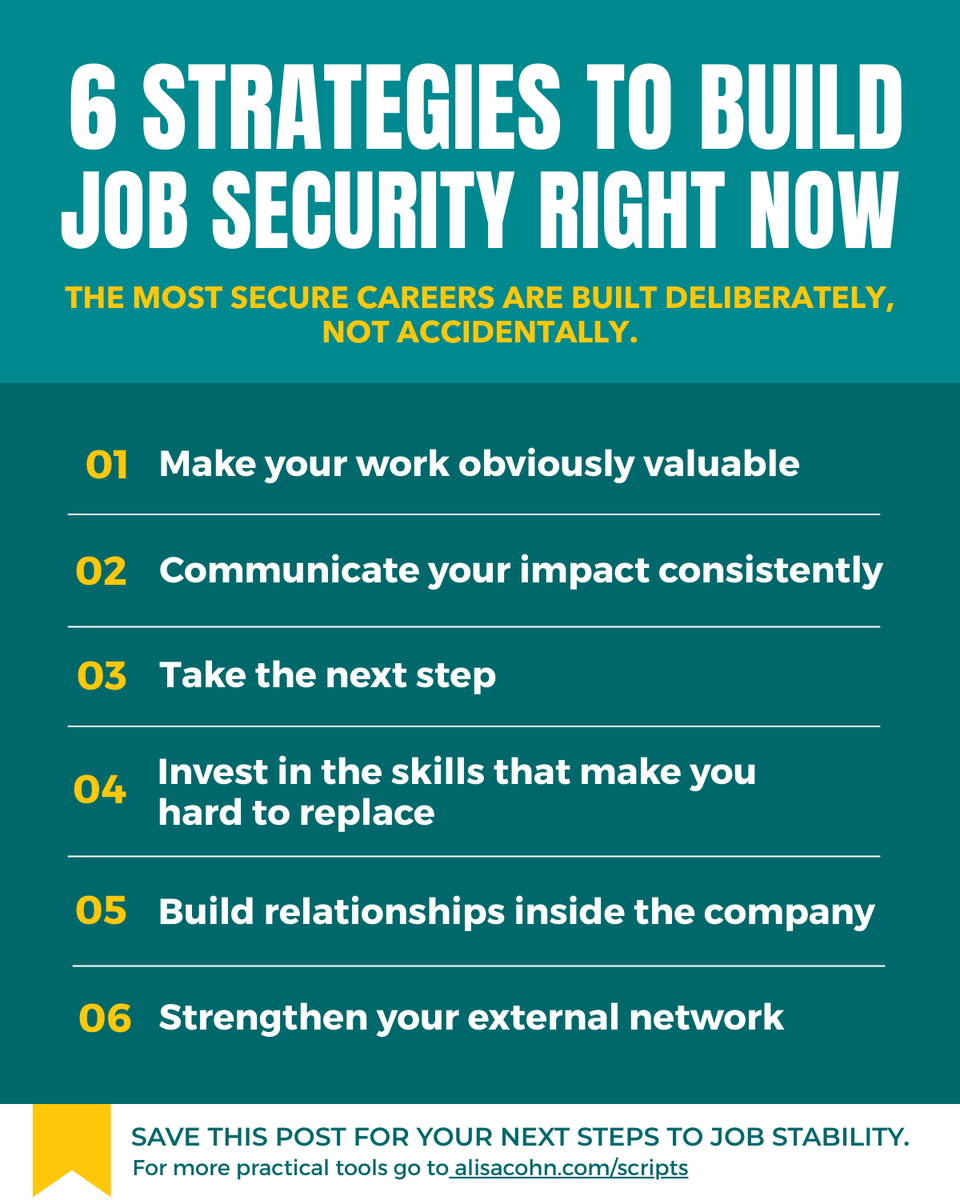
Layoffs are all over the news. Don't panic. Just take action. After 25 years of coaching people at all levels through multiple economic cycles, I've seen this pattern before. You can't control the macro environment or what your company will decide to do. But you can control how you position yourself. Here are 6 strategies that can help you build your job security right now. 1️⃣ Make your work obviously valuable Look for high-impact projects. Get involved with initiatives that everyone knows are critical and strategic. The question isn't "Am I doing good work?" It's "Am I working on what matters most?" 2️⃣ Communicate your impact consistently Send simple updates to your manager about what you're working on and the results you're driving. Mention what you’re working on to others. You don’t have to oversell. Facts strategically shared are more powerful than any pitch. 3️⃣ Take the next step Rather than handing off problems, think through the next step. Don't say "I'm stuck. What should I do?" Instead say, "I'm stuck. Here's what I think my next few steps are." Your manager can redirect you, but you've positioned yourself as proactive. 4️⃣ Invest in the skills that make you hard to replace Master the tool no one else wants to learn. Or build expertise in the area the company is betting on. Then invest the time to own it. 5️⃣ Build relationships inside the company Being known and liked often matters more than your performance. It may not be fair, but it's reality. Strong internal relationships help you survive layoffs or find new roles within the company. 6️⃣ Strengthen your external network Stay connected with former colleagues and industry contacts. Offer to help them. Make time for coffee meetings. This keeps you current on market opportunities and gives you options when you need them. Here's the test I give my clients to gauge network health: How many calls would it take you to land a new job? If the answer is more than 10, start building relationships now. 👉 Pick one. Start this week.
Alisa Cohn tweet media
English
0
0
0
58
Alisa Cohn
Alisa Cohn@AlisaCohn·
The setback is never the problem. Your response to it is. You didn't get the promotion you deserved. Someone else took credit for your breakthrough idea. The new hire got a better offer than you did after three years. It stings. I get it. But here's what separates people who recover from those who stay stuck. Most people respond to workplace setbacks in ways that sabotage them: ➡️ They get bitter and let resentment poison their performance ➡️ They gossip to anyone who'll listen ➡️They shut down or turn passive-aggressive You might feel justified. But you're just shrinking your own influence. Here's what actually moves the needle: ✅ Feel it, then release it Process the frustration fully. Just don't set up camp there. ✅ Mine it for intelligence What does this tell you about how decisions really get made? How can you position yourself differently next time? ✅ Invest your energy strategically Figure out where, and with whom, you can be successful and focus on those areas. When you stop fixating on what went wrong and start focusing on what's possible, everything becomes clearer. And easier. You gain respect. You build real allies. You get opportunities that actually matter. The people who advance aren't the ones who never face setbacks. They're the ones who refuse to let setbacks define their next move. Follow Alisa Cohn @AlisaCohn for more practical strategies that help you lead more successfully.
Alisa Cohn tweet media
English
0
0
0
78
Alisa Cohn
Alisa Cohn@AlisaCohn·
The most formidable obstacle to meaningful change isn't a lack of strategy or resources. We don't fail because we make mistakes. Mistakes can be fixed. We fail because we quit. And we quit far more often than we should. That’s the thesis behind my friend Nir Eyal's @nireyal new book “Beyond Belief.” I love his framework for understanding motivation: The 3 B's: 💡Behavior — knowing what to do 💡Benefit — knowing why to do it 💡Belief — believing your effort will make a difference Most of us focus on the first two. We study strategy. We clarify our goals. We understand the ROI. But without the third B, motivation collapses. You can have the perfect plan and crystal-clear purpose, but if you don't believe your effort matters, you'll quit the moment things get hard. Here are 3 things you can do right now: 1️⃣Audit Your Limiting Beliefs Identify one area where you're stuck or close to quitting. Write down what you currently believe about your ability to succeed there. Then ask: "Is this belief serving me?" Not "Is it true?" but "Does it help me move forward?" 2️⃣Practice Mental Contrasting Don't just visualize success. It actually saps your energy! Instead, visualize your goal, then list the 3 biggest obstacles in your way. Your brain will automatically start linking solutions to challenges. 3️⃣ Reframe Setbacks as Information, Not Identity The next time something goes wrong, catch yourself. Don't say "I'm not good at this" or "This isn't working." Say, "I haven't figured this out yet." One is a permanent label. The other is temporary data. The question isn't whether you have what it takes. The question is whether you believe you do. Belief isn’t mindless positivity. It profoundly changes how you think. It changes what you see and feel. And there it changes what you're capable of doing. 👉 Grab a copy of Beyond Belief before March 16th and you’ll get all sorts of goodies! Link in the thread.
Alisa Cohn tweet media
English
1
0
0
37
Alisa Cohn
Alisa Cohn@AlisaCohn·
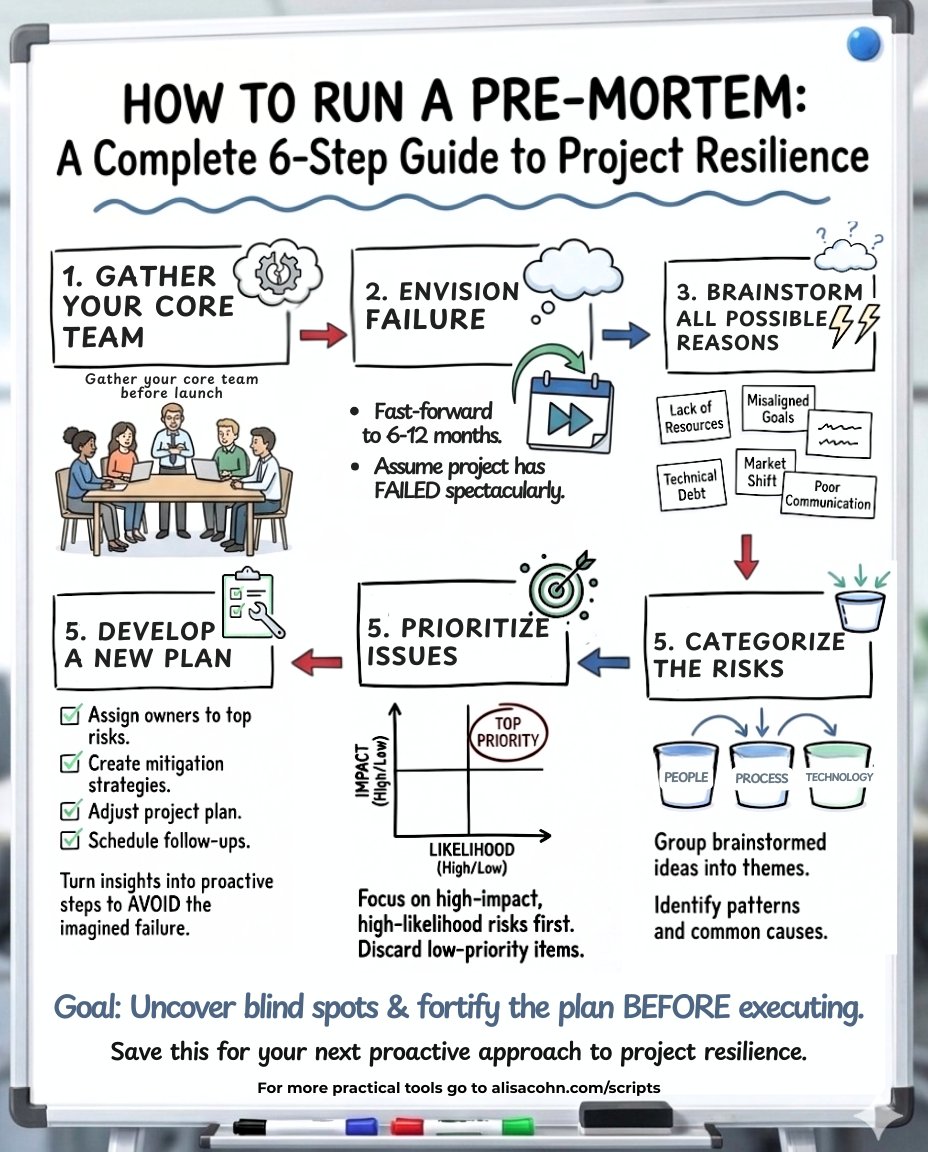
Most teams do post-mortems. High-performing teams do pre-mortems. I’ve been coaching teams for over 25 years and this very powerful tool drives higher level outcomes. Here’s why: Post-mortems dissect what went wrong after the damage is done. Pre-mortems identify what could go wrong before you start. Here's how it works: Put yourself six months in the future. Imagine your project has failed spectacularly. Ask yourself why. That thought experiment surfaces key risks. It also gives permission to name things that people see but won’t say. That nagging feeling about the timeline; concern about stakeholder buy-in; worry about the process. A pre-mortem gives your team permission to voice their concerns without seeming negative or unsupportive. Here's your step-by-step process to run your own pre-mortem: 🎯 Gather your core team in one room ⏰ Set the scene: "It's six months from now. This project failed spectacularly." ✍️ Give everyone 10 minutes to write down specific reasons why it failed 💬 Go around the room and share every scenario 🔍 Identify patterns in the responses ⚡ Create concrete mitigation plans for the top 3-5 risks When you run this process, people feel safe being productively skeptical. They can share what’s on your mind, and then everyone can work together to address these concerns. In advance, not after they’ve advanced to become a major problem. Your team already knows what could derail the project. A pre-mortem just gives them permission to say it. What's one risk everyone on your team can see but nobody wants to mention?
Alisa Cohn tweet media
English
1
0
2
60
Alisa Cohn
Alisa Cohn@AlisaCohn·
I asked Matt Oppenheimer @matt_oppy what he's still working on as a leader. Matt is the founder and CEO of Remitly @remitly . He grew it from an idea based on his travels to a public company serving customers in 170 countries. His curiosity and growth mindset built the company. In this clip he talks about the shadow side. Those same qualities can cost him decisiveness. Someone brings him a compelling argument and he thinks “good point.” Which is mostly good. Until it slows things down. He called it his towering strength and its shadow. Every strength has one. In this entire conversation Matt is so honest about what’s really going on when you start and build a company. We talk about how upbringing shapes your leadership, how to  manage your executive team as the company grows, and  what it’s really like to get your company ready to go public. 👉 Check out the episode and let me know what you think (link in the thread.)
English
1
0
0
69
Alisa Cohn
Alisa Cohn@AlisaCohn·
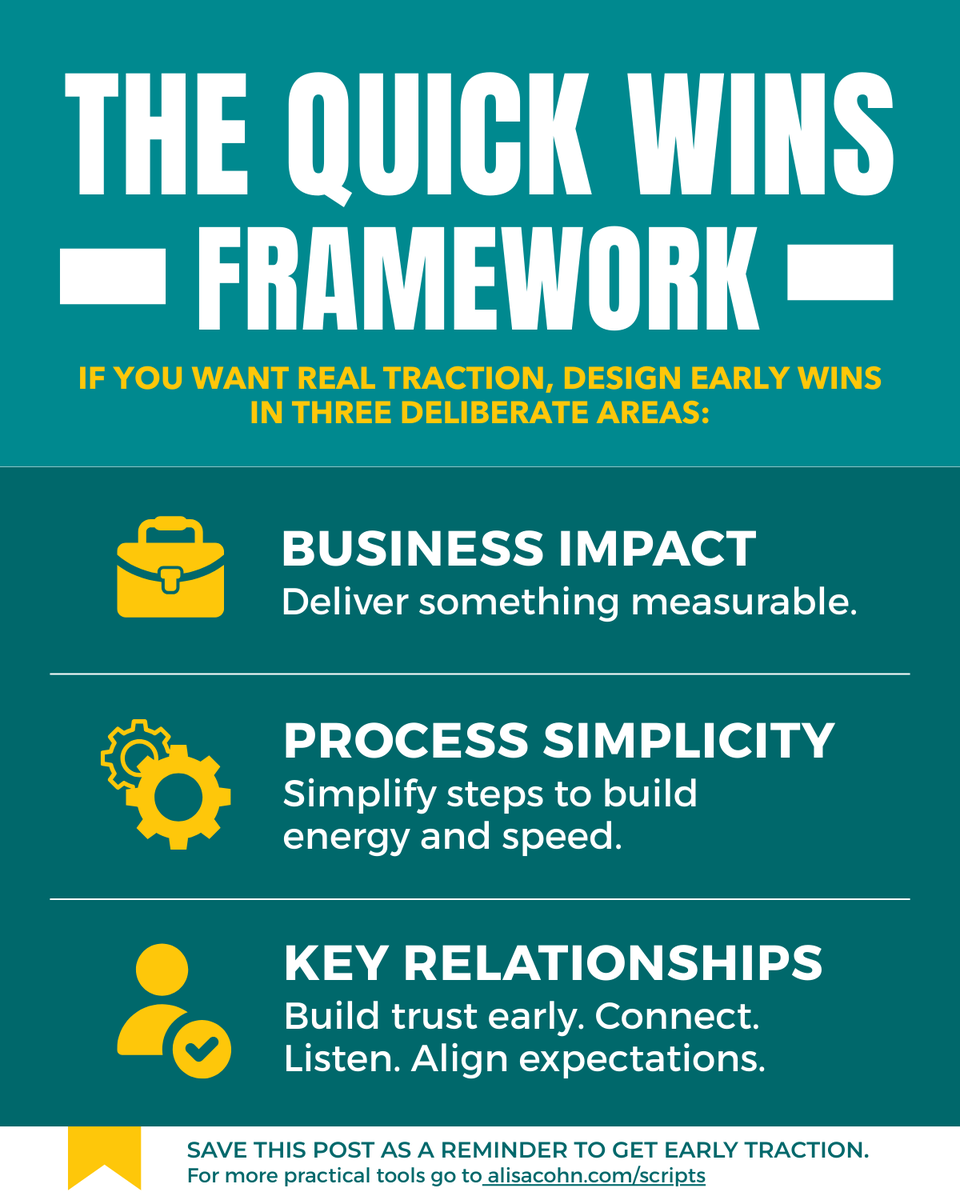
What enables success as a new leader isn't the brilliance of your ideas. It's your ability to gain traction. After working with hundreds of leaders in new roles, I've seen the same pattern. The ones who succeed fastest don't start with the biggest initiatives. They start with wins that matter to the people around them. Traction comes from quick wins. The graphic shows the Quick Wins Framework that I use with my clients. Design early wins in three deliberate areas: 📊 Business Impact: Deliver something measurable Close a deal that's been stuck in pipeline. Ship a delayed feature or project. Improve a specific metric like response time or customer satisfaction score. ⚡ Process Simplicity: Simplify steps to build energy and speed Eliminate a redundant approval step. Consolidate three recurring meetings into one. Create a template that saves your team hours weekly. 🤝 Key Relationships: Build trust early. Connect. Listen. Align expectations. Schedule 1:1s with your key stakeholders in your first two weeks. Ask people "What are your top priorities?" "What are some things you hope I'll change?" And then get back to them about what you did with that insight. Even if you don't take action, people feel heard and that's a win. The critical insight most new leaders miss: these are wins in the eyes of others, not necessarily you. That new system you think is brilliant? Your team might find it complicated. That metric you're focused on? Your boss might care about something completely different. Quick wins aren't about impressing people with your genius. They're about delivering on what matters to them. What's one quick win you could design in your role right now that would matter most to the people around you?
Alisa Cohn tweet media
English
0
0
0
53