Hugh Macken, Jr.
7.4K posts

Hugh Macken, Jr.
@alisteninghead
Family man, catholic media man & tech advisor. Will travel long distances for a slice of NY pizza. I admire great listeners and aspire to be one!


There is a way past the absurd and deeply divisive “war” between the President and the Pope, which has been enthusiastically ginned up by the press. And it is indicated in the Catechism of the Catholic Church, paragraph 2309 to be precise. After laying out the various criteria for determining a just war—proportionality, last resort, declaration by a competent authority, reasonable hope of success, etc.—the Catechism points out that “the evaluation of these conditions for moral legitimacy belongs to the prudential judgment of those who have responsibility for the common good.” The assumption is that the just war principles function, to use the technical term, as heuristic devices, designed to guide the practical decision-making of those civil authorities who have to adjudicate matters of war and peace. The role of the Church, therefore, is to call for peace and to urge that any conflict be strictly circumscribed by the moral constraints of the just war criteria. But it is not the role of the Church to evaluate whether a particular war is just or unjust. That appraisal belongs to the civil authorities, who, one presumes, have requisite knowledge of conditions on the ground. So, is the war in question truly the last resort? Is there really a balance between the good to be attained and the destruction caused by the war? Are combatants and non-combatants being properly distinguished in the waging of the conflict? Do the belligerents have right intention? Is there a reasonable hope of success? The posing of those questions—indeed the insistence upon their moral relevance—belongs rightly to the Church, but the answering of them belongs to the civil authorities. The Pope has said, on numerous occasions, that he is not a politician and that his role is not the determination of any nation's foreign policy. But he has just as clearly said that he will continue to speak for peace and for moral constraint. In making both of these claims, he is operating perfectly within the framework of paragraph 2309 of the Catechism. If we understand that the Pope and the President have qualitatively different roles to play in the determination of moral action in regard to war, we can, I hope, extricate ourselves from the completely unhelpful narrative of “Pope vs. President.”


There is a way past the absurd and deeply divisive “war” between the President and the Pope, which has been enthusiastically ginned up by the press. And it is indicated in the Catechism of the Catholic Church, paragraph 2309 to be precise. After laying out the various criteria for determining a just war—proportionality, last resort, declaration by a competent authority, reasonable hope of success, etc.—the Catechism points out that “the evaluation of these conditions for moral legitimacy belongs to the prudential judgment of those who have responsibility for the common good.” The assumption is that the just war principles function, to use the technical term, as heuristic devices, designed to guide the practical decision-making of those civil authorities who have to adjudicate matters of war and peace. The role of the Church, therefore, is to call for peace and to urge that any conflict be strictly circumscribed by the moral constraints of the just war criteria. But it is not the role of the Church to evaluate whether a particular war is just or unjust. That appraisal belongs to the civil authorities, who, one presumes, have requisite knowledge of conditions on the ground. So, is the war in question truly the last resort? Is there really a balance between the good to be attained and the destruction caused by the war? Are combatants and non-combatants being properly distinguished in the waging of the conflict? Do the belligerents have right intention? Is there a reasonable hope of success? The posing of those questions—indeed the insistence upon their moral relevance—belongs rightly to the Church, but the answering of them belongs to the civil authorities. The Pope has said, on numerous occasions, that he is not a politician and that his role is not the determination of any nation's foreign policy. But he has just as clearly said that he will continue to speak for peace and for moral constraint. In making both of these claims, he is operating perfectly within the framework of paragraph 2309 of the Catechism. If we understand that the Pope and the President have qualitatively different roles to play in the determination of moral action in regard to war, we can, I hope, extricate ourselves from the completely unhelpful narrative of “Pope vs. President.”


Following the completion of an initial examination regarding a photograph published earlier today of an IDF soldier harming a Christian symbol, it was determined that the photograph depicts an IDF soldier operating in southern Lebanon. The IDF views the incident with great severity and emphasizes that the soldier’s conduct is wholly inconsistent with the values expected of its troops. The incident is being investigated by the Northern Command and is currently being addressed through the chain of command. Appropriate measures will be taken against those involved in accordance with the findings. Furthermore, the IDF is working to assist the community in restoring the statue to its place. The IDF is operating to dismantle the terrorist infrastructure established by Hezbollah in southern Lebanon, and has no intention of harming civilian infrastructure, including religious buildings or religious symbols.


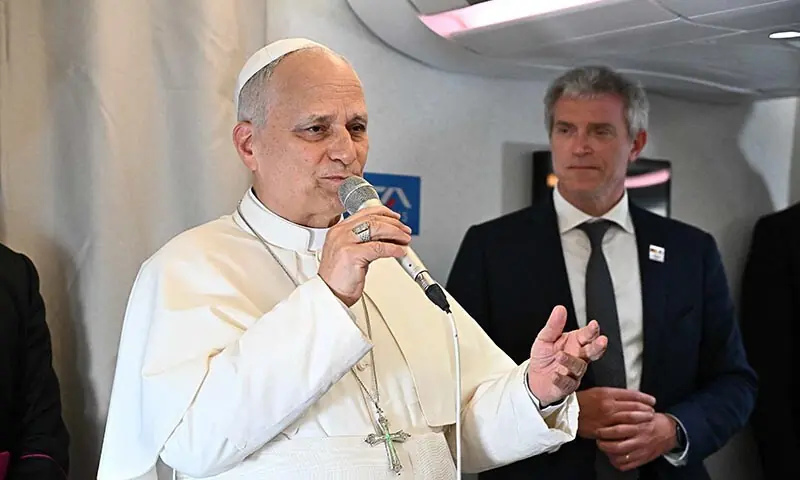
NEW: Pope Leo downplays tensions with President Trump, addressing a "narrative that has not been accurate in all of its aspects." He says it is “not in my interest at all” to debate the president and will keep preaching a message of peace.


DUBLIN TONIGHT: Grabbed a diet coke and walked about O'Connell St. for a Wednesday night. What a time!