@tjstebbing Thanks for the answer — I’ll think about it based on your advice.
I was curious how engineers handle these kinds of problems in the real world.
great question, good engineering is a balance between reducing complexity while allowing for pragmatic expansion.
If a system is overly complex the first step I like to do is to identify logical boundaries, and establish interfaces (api boundaries for multi process, or actual interfaces for a monolith) .. these boundaries give you breathing room, they isolate complex sub systems and abstract them.
From that point you can begin to refactor the parts. Hope that helps!
@tjstebbing quick question:
In software development, is it better to focus on simplifying systems, or adding more features even if it increases complexity?
And if a system is already too complex, how do you deal with it?
Matthew Gallagher, 41, grew up in poverty—family was homeless at times, bouncing between trailer parks, motels, and government aid in Florida and North Carolina. Parents struggled with substance issues.
Self-taught coder as a kid (made fan sites, websites for locals). Brief stint at University of Cincinnati, dropped out at 22 for full-time coding gigs and freelancing for brands like Nike.
Tried acting in LA, ran an ad agency, then launched Watch Gang (watch subscription club) in 2016, which hit $11M revenue in year one. Medvi is his latest—built on that hustle plus AI.
Sam Altman predicted the first one-person billion-dollar company.
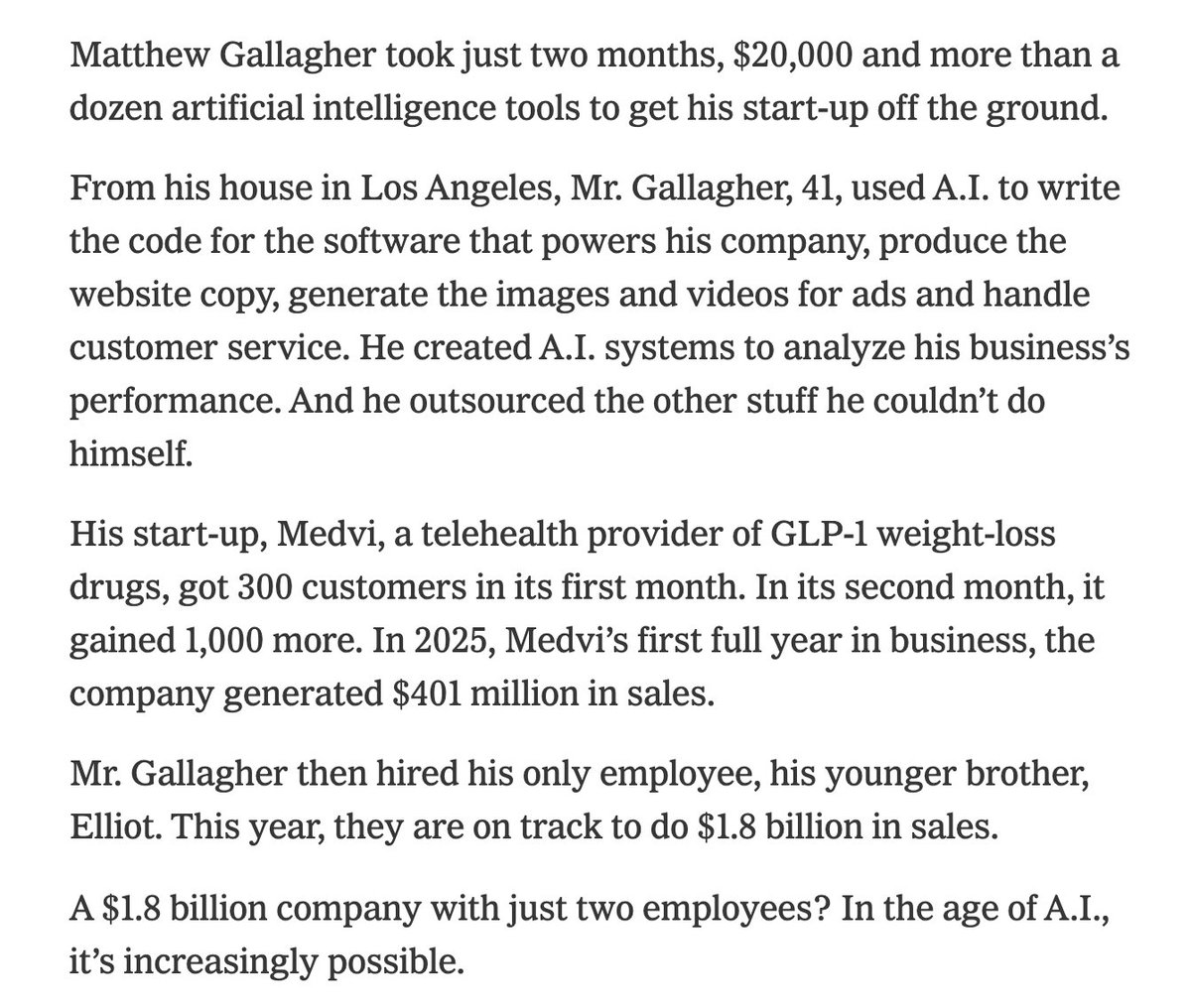
Matthew Gallagher built a $401M company in year one with $20,000, AI tools, and zero employees.
This year he's on track for $1.8B. With 2 people.
The playbook has changed:
Old path:
- Come up with an idea
- Fundraise from friends or VCs
- Hire a team
- Build the product
- Hope it works
New path:
- Start with an audience (X, Instagram, TikTok)
- Vibe code something for that audience
- Build a community around it
- Automate fulfillment with AI agents
- Repeat
That's the new barrier to entry is a laptop and an idea.
Matthew Gallagher's Medvi is a telehealth provider for GLP-1 weight-loss drugs. He launched it solo from his LA house in 2 months for $20k, using 12+ AI tools to code the software, build the site, create ads/videos, handle customer service, and analyze performance. Outsourced the rest.
Month 1: 300 customers. Month 2: +1,000. 2025 full year: $401M revenue, $65M profit (16.2% margins). No VC funding—he owns 100%.
Hired only his brother Elliot. Now just 2 people total. On track for $1.8B in 2026 sales.
NYT confirmed all numbers. Wild example of AI enabling solo-scale execution.