Optimus Time
806 posts

Optimus Time
@amarsinghcodes
AI x Security @OpenZeppelin | KISS
Florida, USA Katılım Haziran 2017
260 Takip Edilen268 Takipçiler

Open sourced my daily audit workflow as a pi extension:
github.com/amarsinghcodes…
It's built for tomorrow, not today. Chose pi for its fine grain control over context via /tree
cc @badlogicgames
English
Optimus Time retweetledi

Most people still get this wrong:
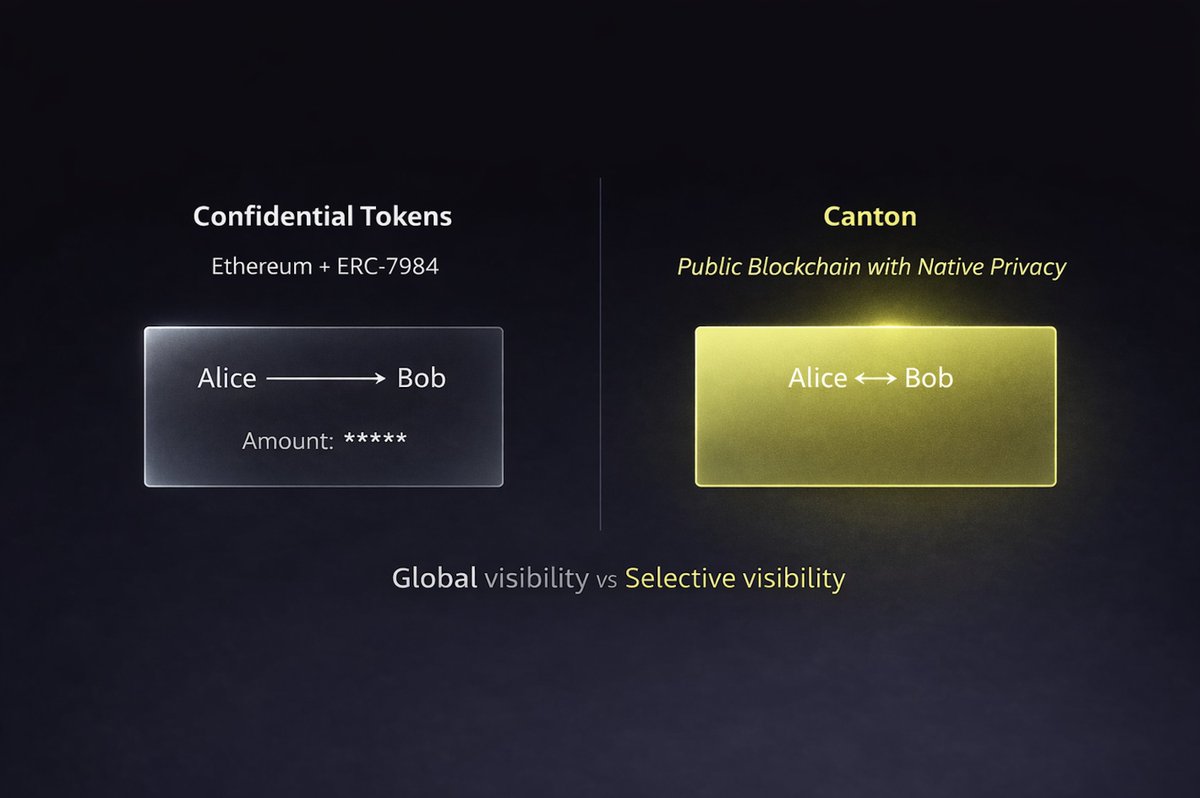
confidential tokens and blockchains with native privacy do NOT solve the same problem.
And if you’re building for institutions, this difference is everything.
Take ERC-7984 and Canton.
Both aim to bring privacy to on-chain finance.
But they operate at completely different layers.
ERC-7984 is about making public blockchains more confidential.
You keep Ethereum’s global state, but encrypt sensitive data like balances and transfer amounts.
So instead of seeing:
→ Alice sent 1,000 USDC to Bob
You see:
→ Alice sent ***** to Bob
This is a major improvement.
But the system itself doesn’t change.
Transactions are still visible.
Addresses are still visible.
Flows are still traceable.
You’re not removing transparency.
You’re reducing data leakage within a transparent system.
Canton takes a different approach.
It doesn’t try to hide data.
It removes the assumption that data should be globally visible in the first place.
There is no shared global state.
Data is only distributed to involved parties.
Each participant has a scoped view of the ledger.
Transactions are not universally broadcast.
That means you don’t just hide amounts.
You control:
• who sees the asset
• who sees the transaction
• who sees the logic
• who even knows the transaction exists
This is not “confidential DeFi”.
This is institutional-grade privacy at the infrastructure level.
The difference is simple:
ERC-7984 hides what happened.
Canton controls who knows it happened.
And this difference has real implications.
You cannot recreate Canton’s privacy model on Ethereum.
Because public chains require global verification.
Some data will always remain visible.
But Canton introduces another constraint.
The moment assets leave its environment and move to public chains, they inherit a different data model.
Private assets become observable.
Selective visibility becomes global transparency.
This is the real gap today.
Not a lack of bridges.
A lack of privacy-preserving asset representations across chains.
Confidential tokens like ERC-7984 are a key piece of the answer.
They allow assets to remain partially shielded even on public rails.
But they don’t replicate Canton’s model.
They adapt it.
The future is not choosing between both.
It’s combining them.
• Canton for private execution and ownership
• Cross-chain infrastructure like LayerZero for distribution
• Confidential token standards for controlled exposure
The real challenge is not moving assets across chains. It’s preserving their properties when they arrive.
That’s where most of the industry is still early.
And where the biggest opportunities are being built.

English
Optimus Time retweetledi

@gvanrossum LLM = CPU (data: tokens not bytes, dynamics: statistical and vague not deterministic and precise)
Agent = operating system kernel
English

DAML is what you get when you design for correctness first. Solidity is cope.
OpenZeppelin@OpenZeppelin
We identified an entirely new taxonomy of bug classes specific to Daml's execution model and built three open source tools to address them. Read our full research here 👇 openzeppelin.com/news/smart-con…
English
Optimus Time retweetledi

This is the talk I gave in San Francisco at PyAI on how you can figure out what present and future models are good at when it comes to writing your own agents.

Pydantic@pydantic
"How do agentic coding tools work? I have no idea. And you probably also don't." That was @mitsuhiko opening his talk at PyAI. What follows is one of the most useful 20 minutes on working with agents we've ever seen. youtu.be/8RHYyRUxVrA
English
Optimus Time retweetledi

I'm usually not one to write thought pieces without much technical depth. But here we go.
Slow the fuck down.
mariozechner.at/posts/2026-03-…
English
Optimus Time retweetledi

i think the difference between clanker and people trash is that people trash is limited by people velocity. natural bottleneck. also forces you to rewrite trash eventually, because there's only so much trash people can deal with, before things fall apart.
no such bottleneck with agents. and at least with SOTA, i haven't seen agents being great at revising the monumental amoubts of trash they generate. maybe some day.
English
Optimus Time retweetledi

guys, writing _simple_ software is becoming a true lost art. We are all so fucking addicted to dependency bloated, hyper composable Frankenstein systems where every tiny diff triggers a transitive verification nightmare. Oh and we keep pretending abstraction is free. Well guess what it is fucking NOT. Every layer introduces more state, more edge cases, more undefined behaviour, and more emergent interactions that nobody really fully models. Remember: observability decreases as indirection increases. I mean, formal reasoning effectively collapses when the effective system boundary is the entire ecosystem. Oh and then you guys vibe code even more dependency stuffed software and implicitly feed it back into the same LLM, great. Can we stop this insanity for a second?
Fewer dependencies (or even better _no_ dependencies). Smaller trusted computing base. Deterministic builds. Reproducibility. Code you can actually read, reason about, and audit e2e. Simplicity is not nostalgia. It is the only thing standing between us and a fucking systemic collapse.
English

"slow is smooth, smooth is fast"
most force speed
masters remove friction
speed becomes inevitable
Mario Zechner@badlogicgames
in a time of everybody stressing out because of ngmi, slowness is the new super power. oss vacation for everyone! zero complaints, zero fires. nothing's running away. love it.
English
Optimus Time retweetledi

We are currently syncing the Polkadot light clients across all connected networks. Official comms will be shared once hyperbridge is fully recovered.
Thanks to all our partners & users for their patience. Also huge thanks to @OliverTaleYazdi @bkchr for coordinating the upgrade
English