English
Amie Rotherham
3.2K posts
@amieroth
Product comms @anthropicAI, focused on devs. Big fan of Jeopardy and snail mail.

I'm hiring someone to join my team at Anthropic to lead Claude Code comms. This is not a role for someone who wants to run an old playbook. You'll need to be a Claude Code super user, understand developers and dev tools, and have great taste. You'll work hard, learn a lot, and ship with the best people around. Non-traditional comms paths welcome. My DMs are open!

A statement from Anthropic CEO, Dario Amodei, on our discussions with the Department of War. anthropic.com/news/statement…


Introducing Claude Opus 4.6. Our smartest model got an upgrade. Opus 4.6 plans more carefully, sustains agentic tasks for longer, operates reliably in massive codebases, and catches its own mistakes. It’s also our first Opus-class model with 1M token context in beta.
I can’t wait for the Olympics to become my entire personality for the next two weeks

Introducing Cowork: Claude Code for the rest of your work. Cowork lets you complete non-technical tasks much like how developers use Claude Code.

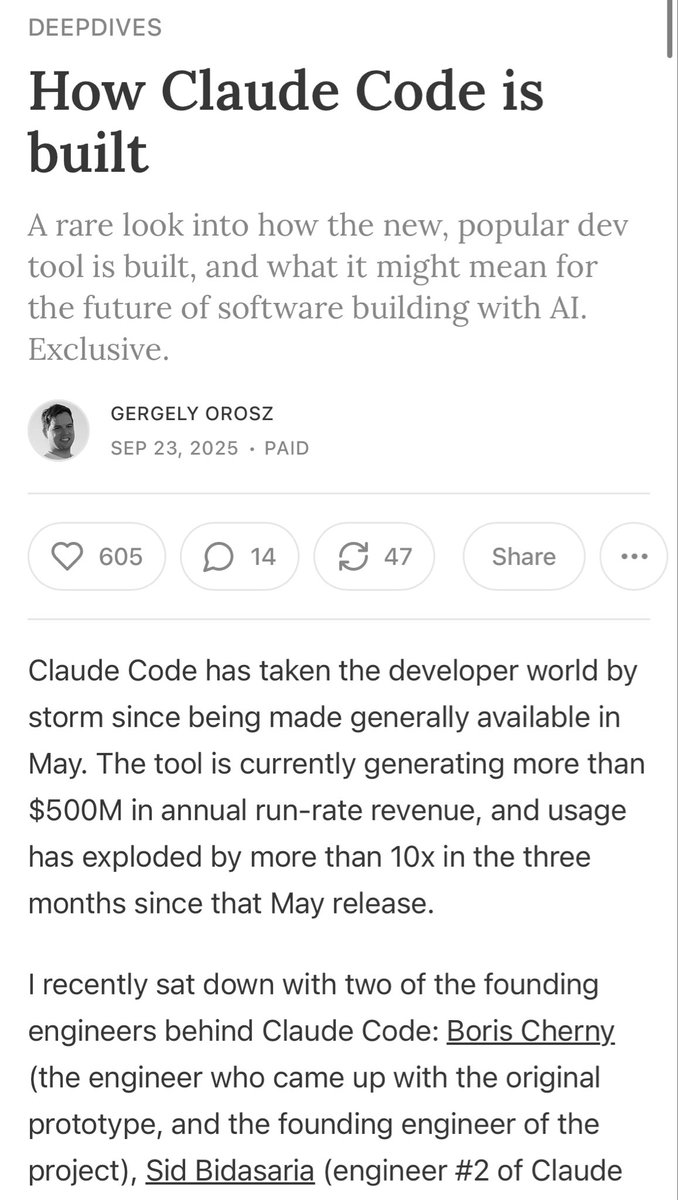
Think of these roles as being a Substacker within Anthropic with access to real time data, insider knowledge of what’s happening at the frontier of AI + independence to write about the topics that matter most to you. These roles are for big thinkers and domain experts, not content marketers.
Claude Code cracked something open for us @every. Now I ship to codebases I barely know, every feature we ship makes the next one easier, and non-technical members of the team use the terminal. I’m genuinely grateful. So I brought its creators, Cat Wu (@_catwu) and Boris Cherny (@bcherny) from @AnthropicAI, on AI & I to say thank you—and to talk about everything they’ve learned from building Claude Code. We get into: • The workflows Anthropic’s smartest engineers use to push Claude Code to its limits. Why they pit subagents against each other to get cleaner results, how they turn past code into leverage, and the slash commands and MCPs they rely on most. • The product lessons behind one of the most loved AI agents in the world. How the team balances simplicity and power—building a tool that anyone can use, but that experts can bend to their will—and their philosophy of “unshipping,” or cutting back whenever there’s a simpler, more intuitive path to user intent. • A peek into the future of coding with AI. The new form factors they’re experimenting with to make Claude Code more autonomous, more reliable, and more accessible to non-technical users This is a must-watch for anyone—both technical and non-technical—who wants to learn how to use Claude Code like the people who built it. Watch below! Timestamps: Introduction: 00:01:26 Claude Code’s origin story: 00:02:25 How Anthropic dogfoods Claude Code: 00:07:03 Boris and Cat’s favorite slash commands: 00:14:06 How Boris uses Claude Code to plan feature development: 00:15:49 Everything Anthropic has learned about using sub-agents well: 00:21:53 Use Claude Code to turn past code into leverage: 00:26:16 The product decisions for building an agent that’s simple and powerful: 00:33:14 Making Claude Code accessible to the non-technical user: 00:36:38 The next form factor for coding with AI: 00:45:12

Introducing Claude Haiku 4.5: our latest small model. Five months ago, Claude Sonnet 4 was state-of-the-art. Today, Haiku 4.5 matches its coding performance at one-third the cost and more than twice the speed.