

Amit
808 posts

Amit
@amiitanand
Even Ram was Criticized, So what did u expect?
Multiverse Katılım Ağustos 2016
181 Takip Edilen46 Takipçiler


@amiitanand We’re happy to assist you. Could you please confirm if the amount was paid in cash or through a digital payment method? If it was a digital payment, kindly share a screenshot of the transaction for reference. We’ll look into this and follow up soon. Appreciate your cooperation.
English
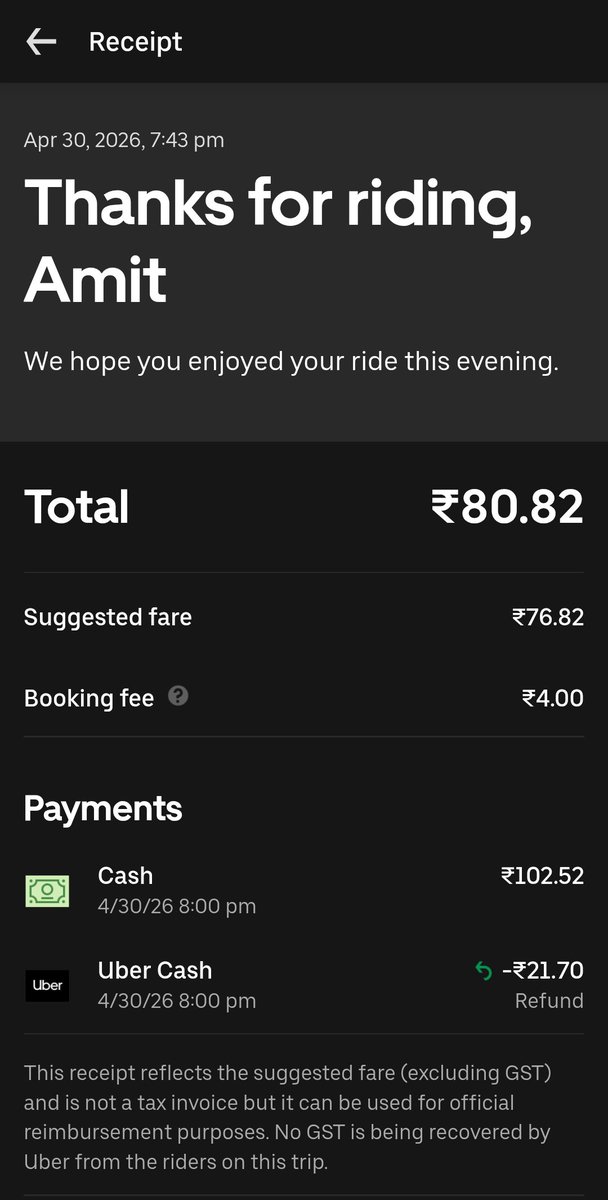
@Uber_India @UberIN_Support Is this some kind of scam for customers ?
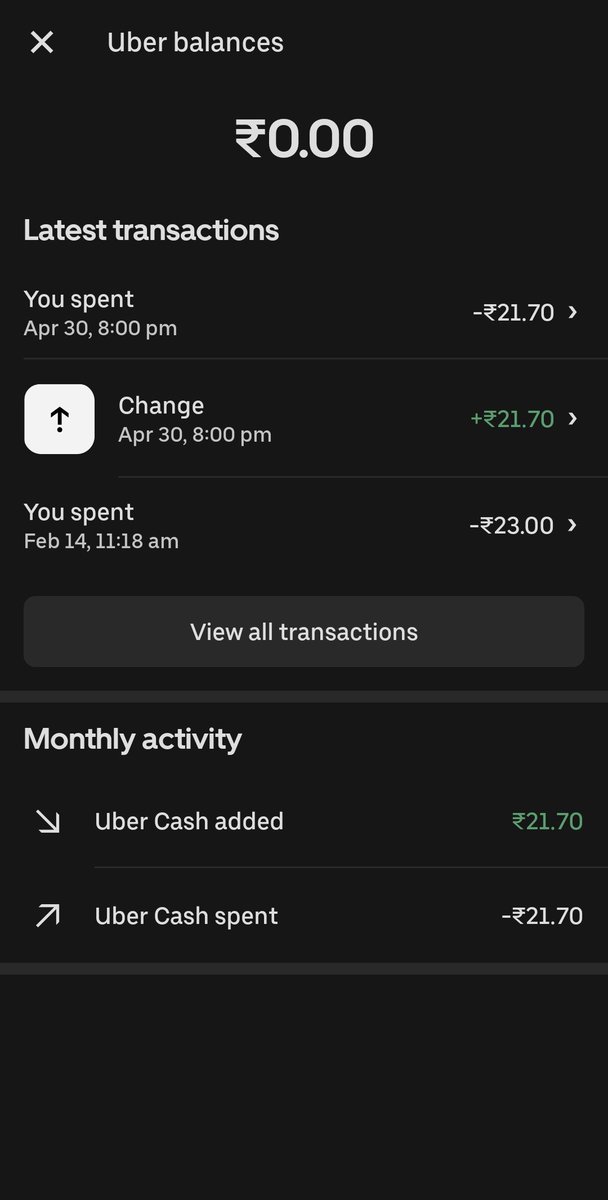
I was shown 80 rupees while booking the ride, while completion I hot notification to pay 104.5 to the driver which I did.
When i went back to check why price got increases, I was surprsied to see this -
English
@amiitanand Sorry to hear about the hassle. This is certainly not the experience we'd like you to have. If you want us to review a specific trip, please share your contact details used to request the ride along with the date and time of the trip via Direct Message. We'll follow up. twitter.com/messages/compo…
English
HT

AI, Layoffs, and the Noise Around Us
Nowadays everyone seems to be giving lectures on how AI is going to replace everything around the world. A massive revolution is coming, they say, one that will change the way we live, work, and learn.
In India, this conversation hits differently. IT has been one of the biggest employment providers for decades. For many families, it has been the backbone that helped them build a stable life. It has helped people achieve dreams that once felt out of reach. For people like us, it made it possible to think beyond what earlier generations could even imagine.
But for the last three years, another trend has been running alongside all this talk about the future. Layoffs. News of layoffs has become routine. Even tech giants have been letting go of a significant share of their workforce in the name of restructuring, efficiency, or better margins. And whatever happens at the top of the industry rarely stays there. It flows downward. Service-based companies follow. Then smaller players.
This wave of layoffs was no different.
The service-based IT industry was once called a safe haven for the Indian workforce. That sentiment has clearly taken a hit. We have seen layoffs, hiring freezes, and at the same time, a constant stream of commentary from industry leaders about making their workforce “AI ready.”
Let’s pause for a moment and ask a couple of simple questions. First, what actually is AI? And second, why are companies running behind it as if nothing else matters?
We all know the textbook definition of AI, and there is no point repeating it. What matters more, at least in the current context, is this: AI is a product. A product that can be built, packaged, marketed, and sold.
And that also answers the second question.
Companies are adopting AI as fast as possible because no one wants to be left behind in a race where the winner could capture a massive market. In the technology world, the success of a product often depends on how fast you can ship it. Time to market decides who leads and who follows.
If you listen to tech leaders, you will often hear predictions that by 2030, or maybe sooner, many tasks will be automated and fewer people will be needed. On the other hand, leaders in the services industry are equally vocal about how most of their workforce is already skilled in AI and ready for the future.
And then there are engineers like us. Sometimes skeptical about what lies ahead. Sometimes excited, but with a bit of nervous energy. Curious, but also uncertain.
The truth is, we cannot control everything that is happening around us. We can only keep working, keep learning, and see how things unfold.
But it helps to zoom out and look at the bigger picture. Why are industry leaders talking about AI day and night?
A simple answer is: they are selling.
If AI is a product, it needs customers. And like any product, it needs marketing and a sales pitch. Today, there is a clear race among tech giants to monetize their breakthroughs and sell as much as possible.
The pitch you often hear sounds something like this: “Our model can do this. It can replace that. It can reduce costs drastically.”
In simple terms, they are telling potential customers: here is a tool that can reduce your cost of building and maintaining systems to a fraction of what it used to be. And businesses, by nature, are always looking for ways to improve profitability. When they see an opportunity, they move quickly. That explains, at least partly, why layoffs tend to follow these waves of technological change.
There is another angle to this, especially in the IT services industry. The traditional model has been straightforward—acquire clients, deliver work, and charge in foreign currency. For years, this model worked well because many businesses depended heavily on large teams to build and maintain software.
But clients are also becoming smarter. They are asking a simple question: if new tools can help do the same work with fewer people, why would we pay for large teams?
That puts pressure on service companies. So they are also in a race—to show that they have adopted AI, that their workforce is skilled, that they can deliver faster and cheaper. This helps them attract new clients and retain existing ones. In a way, they are selling confidence as much as they are selling services.
So where does all this lead?
If you ask me what the future is going to look like, I honestly don’t know. Nobody really does. There are too many moving parts, too many assumptions, and too much noise.
What we can do, however, is stay grounded. Keep learning. Keep building. Keep adapting.
Every major shift in technology has created fear as well as opportunity. This one is no different. The headlines may sound dramatic, the predictions may sound absolute, but reality usually unfolds in slower, more complicated ways.
For now, perhaps the best approach is simple: be curious, keep your skills sharp, and keep batting. The game is still in progress, and we are all learning how to play it as it unfolds.
Having said all this, it would be unfair to say that nothing meaningful is happening. Some of the progress is real. Tools are improving productivity, reducing repetitive work, and helping teams move faster. Many engineers are already using them in their daily work. So the shift is not imaginary, even if the marketing around it sometimes feels louder than the reality on the ground.
Maybe the truth lies somewhere in between. AI is neither magic that will replace everyone overnight, nor is it something that can be ignored. Like every major shift before, it will change the way we work, and we will have to change with it.
English
@GabbbarSingh Its in Mumbai, let it come to delhi you wont miss old foggy telecast.
English

@bhogleharsha They are already assuming that they aint gonna play the finals.
English

It will be very interesting to see the response of the ICC if Pakistan go to the World Cup but don't play India. I don't know the legal position, or how the precedence could play out, but I won't be surprised if the ICC asks that the broadcaster's loss be deducted from Pakistan's share of ICC revenues. And, by the way, what if it is an India-Pakistan final?
English
@Intrinsic_cycle This change wont matter for people who can afford to buy. It was affordable then, its affordable now.
For most of the people, it was beyond reach and it remains beyond.
English

🇪🇺 Luxury Cars Prices in , Before vs After India-EU FTA
Current Price After FTA
Porsche Cayenne~2.0 Cr 1.4 Cr
Lamborghini~₹6.5 Cr 4.2Cr
Defender₹2 Cr 1.4 Cr
BMW X5 ~₹1.1Cr 1 Cr
Mercedes GLC ~1.0 Cr 0.9 Cr
Audi Q5 ~0.85 Cr 0.7Cr
English

Subhash Chandra Bose would’ve been a DISASTER for India?
English


harsh truth about solo travel:
once you've eaten dinner alone at 9pm in a random place in rajasthan because you felt like it, once you've changed your entire itinerary at 6am because you wanted to, once you've spent 4 hours at top of hill without anyone rushing you...
you can't go back.
group travel feels like babysitting adults who can't decide where to eat.
English


Photographers, show us some of your minimalism photos (can be anything) 📸

English

Can you suggest a baby boy name that sounds like he comes from an ultra-wealthy family ??
English