Ben Anderson

166 posts

Ben Anderson banner
Ben Anderson

Ben Anderson

@anchorstack_dev

Senior engineer. Building things that actually work, fixing things that don't. I fix vibe coded apps so they hold up when your users need them.

San Antonio, TX, USA Katılım Şubat 2026
208 Takip Edilen48 Takipçiler
Sabitlenmiş Tweet
Ben Anderson
Ben Anderson@anchorstack_dev·
Vibe coding got you to MVP and your first customers. Congrats! Now you have to: Onboard a dev who's never seen the code Debug with no observability Refactor without reading every file Add a feature without breaking 3 more That's the gap between "it works" and "it's engineered"
English

2
0
2
119
Duca
Duca@big_duca·
Holy shit. I just saw someone in a coffee shop writing hand written code. No AI agents. He was typing into the editor directly. I almost wanted to go up to him and ask him why.
English
131
6
375
25.9K
Ben Anderson
Ben Anderson@anchorstack_dev·
Let an LLM write docs with no constraints and you get markdown soup. Ask for a runbook instead: what to check what command to run what good looks like what to do if it fails
English
1
0
1
20
Ben Anderson
Ben Anderson@anchorstack_dev·
@arvidkahl It's fun to listen to the doomsday theorists talking about how AI will break free and take over the world. Fortunately it's just bunch of transformers...
English
0
0
0
12
Ben Anderson
Ben Anderson@anchorstack_dev·
@arvidkahl That's wild! I think its partly because GitHub has integrated so closely with Claude (genius move) that everything just defaults there.
English
0
0
0
92
Simon Høiberg
Simon Høiberg@SimonHoiberg·
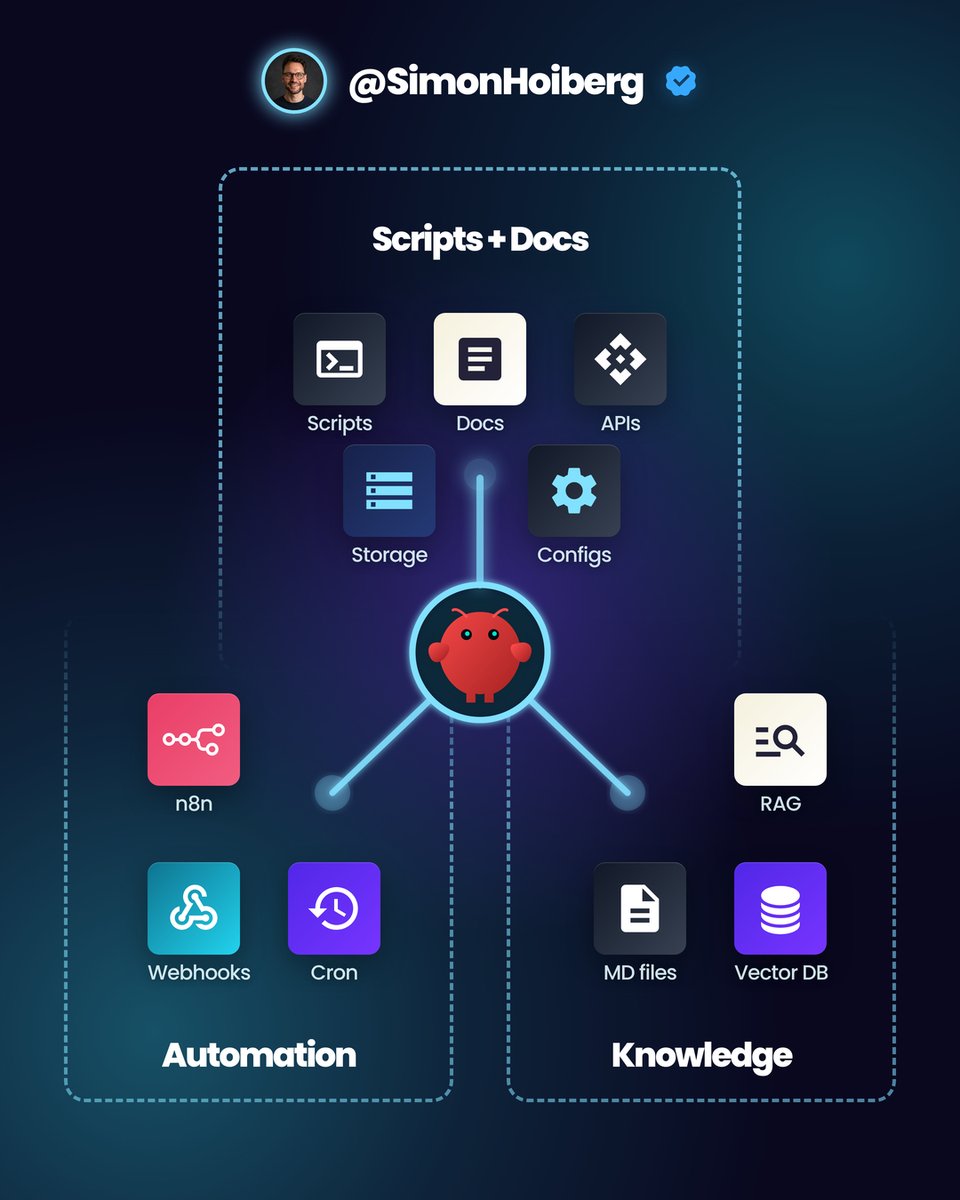
One thing I think most people get wrong with agents: They keep trying to make the agent smarter. I mostly try to make everything around it more predictable. That is why OpenClaw works so well for me. OpenClaw sits in the middle, but I have a bunch of very boring infrastructure wrapped around it: n8n workflows. Webhooks. Cron jobs. Reusable scripts. Markdown docs. Runbooks. RAG + vector DB. Nothing fancy. Just the stuff that turns random one-off requests into repeatable systems. If I ask the agent to do something twice, that is usually a sign it should become a workflow. If I explain a process once, it should probably be documented. If something needs to happen every Monday, I should not be remembering it. That is where the leverage comes from. The agent uses fewer tokens because it does not need the same context explained 50 times. The output gets more predictable because the paths are already defined. And the whole setup gets better every time we turn a messy repeated task into a script, doc, or workflow. A lot of people are still using AI like a browser tab. I think the real unlock is when the agent becomes the interface to the systems you already run.
Simon Høiberg tweet media
English
3
0
16
1.5K
Ben Anderson
Ben Anderson@anchorstack_dev·
@SimonHoiberg Good call out. I think a lot of people get trapped in having AI validate them, part of why its addictive for some. Sometimes I'll have it red-team and idea I felt pretty good about it only to come back deflated wondering how I'd ever thought it would work.
English
0
0
0
20
Simon Høiberg
Simon Høiberg@SimonHoiberg·
We used to think of AI as extra hands. Helpful for writing, summarizing, sorting stuff. Lately I use it way more for decisions. Not to blindly decide for me, but to challenge my assumptions, point out edge cases, and tell me where my logic is weak. A founder with AI pushing back properly is making better calls than a founder thinking alone in a Notion doc.
English
10
0
9
920
Ben Anderson
Ben Anderson@anchorstack_dev·
@rowancheung Seems like it's one meteoroid stream away from a few billion dollar loss...
English
0
0
0
138
Rowan Cheung
Rowan Cheung@rowancheung·
Meta is planning to power its AI data centers with solar energy beamed from space. If it works, solar farms could produce power 24/7 without batteries or backup generators. The company behind it all is Overview Energy -- they want to launch 1,000 satellites into orbit, 22,000 miles above the equator, where sunlight is constant. For context, Meta's data centers used over 18,000 gigawatt-hours of electricity last year. Enough to power 1.7 million American homes for a year. Each satellite collects solar energy, converts it into a wide beam of near-infrared light, and aims it at existing solar farms on the ground. The farms convert the light into electricity, just like they do with sunlight. Unlike high-power lasers or microwave beams, this infrared light is safe enough to stare directly into. Solar farms normally sit idle at night, so this system fixes that... from space. Really fascinating tech.
English
43
19
162
33.6K
Ben Anderson
Ben Anderson@anchorstack_dev·
@Plebian_2 @Tech_girlll Agreed. I think putting time in up front pays dividends. It's almost a reversion back to the old waterfall principles. A lot of planning up front before you execute.
English
1
0
1
17
Plebian
Plebian@Plebian_2·
@anchorstack_dev @Tech_girlll Yes, very important. An LLM can build a complete working app but typically it's only useful as an MVP or demo. Too many implicit assumptions. I'm having great success with a simple bottom up approach. It does take longer (grilling/planning) but you get less patchwork.
English
1
0
0
21
Mari
Mari@Tech_girlll·
Why is no one talking about this?
Mari tweet media
English
232
12
365
74.5K
Ben Anderson
Ben Anderson@anchorstack_dev·
This is a symptom of poor project structure and application design. Context should be located in a single location and reference relevant files. Your app needs to be designed in a way that you can work on it indefinitely without this happening. That is why I'm a fan of Domain Driven Design to keep changes targeted and limit the need for the LLM to understand the whole system at once.
Mari@Tech_girlll

Why is no one talking about this?

English
0
0
0
34
Ben Anderson
Ben Anderson@anchorstack_dev·
@pavelhegler I think if anything it's in more demand than ever. Could be they aren't handling the scale well, although I doubt that. If you had to pick an alternative what would you use? Gitlab?
English
1
0
1
14
Pavel Hegler
Pavel Hegler@pavelhegler·
Github is degrading... have we reached THE END of internets golden era?
Pavel Hegler tweet media
English
1
0
4
275
Ben Anderson
Ben Anderson@anchorstack_dev·
The mistake is treating an LLM output like a finished deliverable. I had an agent build agents for me last week. It got the broad shape right and missed details that mattered. That is the real workflow now: Prompt → generate → inspect → tune → repeat.
English
0
0
0
15
Ben Anderson
Ben Anderson@anchorstack_dev·
@vikrambuilds Agreed! The more I use AI to code the slower I go. Building a contextual foundation for the LLM is crucial.
English
0
0
2
32
Vikoo
Vikoo@vikrambuilds·
The best devs won’t be the ones who code the fastest. They’ll be the ones who prompt the smartest... Agree..?
English
47
0
35
2K
Ben Anderson
Ben Anderson@anchorstack_dev·
@konnydev Seems like a question of get left behind or stay relevant. I'm going to go with never code manually again.
English
1
1
2
37
Konny
Konny@konnydev·
Pick one: - Never use AI again - Never code manually again
English
77
1
63
2.3K
Ben Anderson
Ben Anderson@anchorstack_dev·
@neon_time I don't feel like this is that unpopular based on the number of vibe coders on this platform. 😂 And I agree, you've got to start somewhere. The first think you build will be trash but that's just part of learning.
English
1
0
1
27
Neon Dev
Neon Dev@neon_time·
Unpopular opinion: You don’t need to know EVERYTHING to start building. Agree or disagree?
English
45
1
48
1.1K
Ben Anderson
Ben Anderson@anchorstack_dev·
@mcuban The fact that AI is non-deterministic by nature is one of it's biggest strengths and drawbacks. You're right though, domain knowledge is increasingly important, without it you are going on blind faith and that won't get you too far.
English
1
0
5
560
Mark Cuban
Mark Cuban@mcuban·
I’m coming to the conclusion that the biggest challenge for Enterprise AI, and AI in general , as of now, is that it’s still impossible to make sure that everyone gets the same answer to the same question, every time. Which is a great response to the doomers. AI doesn’t know the consequences of its output. Judgement and the ability to challenge AI output is becoming increasingly necessary, and valuable. Which makes domain knowledge more valuable by the second. Am I wrong ?
English
1.6K
327
4.5K
816.8K
Ben Anderson
Ben Anderson@anchorstack_dev·
@Dan_Jeffries1 I appreciate this positive take. The demand for software engineers is only growing as now companies can tackle more problems!
English
0
0
0
35
Daniel Jeffries
Daniel Jeffries@Dan_Jeffries1·
AI will create more jobs than any other technology in history. The doomers' fundamental error isn't just the lump of labor fallacy. It's deeper than that. They assume a finite problem space. This is the fundamental error of AI and job doomers. They look at the economy and see a fixed amount of work to be done, a pie that can only be sliced thinner as machines take bigger bites. They see humans a competitive resource for a finite amount of work and a finite amount of problems to solve that must be eliminated. This is fundamentally, totally and completely wrong. The pie isn't fixed. It never was. And the reason it isn't fixed is baked into the very nature of technology itself. Technology is nothing but abstraction stacking. And abstraction stacking is infinite. Therefore the work is infinite. The hammer didn't reduce the amount of work. It moved the work up the stack. And the new work was more complex, more varied, and more interesting than the old work. Complexity breeds more complexity and more variety. Once you have houses instead of mud huts, you have a cascade of new problems that didn't exist before. Plumbing. Wiring. Insulation. Roofing materials that don't rot. Drainage systems so the foundation doesn't flood. Fire codes so your neighbor's bad wiring doesn't burn down the whole block. Each of those problems becomes a job. A plumber. An electrician. An insulator. A roofer. A civil engineer. A building inspector. None of those jobs existed when we lived in mud huts. They exist because we solved the mud hut problem. Think of all of human technological development as a stack of abstraction layers, each one built on top of the ones below it. At the bottom: raw survival. Finding food. Building shelter. Making fire. These are the base-layer problems. Each major technology wave solved a base-layer problem and in doing so created an entirely new layer of problems above it: Agriculture solved "how do we reliably eat?" — and created problems of land ownership, irrigation, crop rotation, storage, trade, taxation, and governance. Writing solved "how do we remember things across generations?" — and created problems of literacy, education, record-keeping, law, bureaucracy, and literature. The printing press solved "how do we spread knowledge at scale?" — and created problems of intellectual property, censorship, journalism, publishing, public opinion, and democratic discourse. The steam engine solved "how do we generate mechanical power without muscles?" — and created problems of factory design, worker safety, urban planning, railroad engineering, coal mining, labor relations, and environmental pollution. Electricity solved "how do we deliver energy anywhere?" — and created problems of grid design, power generation, appliance manufacturing, electrical safety codes, utility regulation, and an entire consumer electronics industry. The Internet solved "how do we connect all human knowledge?" — and created problems of cybersecurity, digital privacy, online commerce, content moderation, network infrastructure, cloud computing, social media dynamics, and an entire digital economy that employs tens of millions. Notice the pattern? Each solution didn't just solve a problem. It created an entirely new problem space that was larger, more complex, and more varied than the one it replaced. The stack grows. It never shrinks. It's turtles all the way down and all the way up.
English
243
323
1.3K
123.8K
NOVA
NOVA@Its_Nova1012·
AI is already writing better code than many devs today, so what are your future plans?
English
104
4
95
5.2K
Ben Anderson
Ben Anderson@anchorstack_dev·
What part of your AI-built app are you most nervous to touch right now? Auth? Billing? Database? Deployment? The answer usually says where the real engineering work starts.
English
0
0
0
14
Ben Anderson
Ben Anderson@anchorstack_dev·
The rest of the skills in the mlopstapus/anchorstack-skills repo build on this one setting up shared context.
English
0
0
0
8
Ben Anderson
Ben Anderson@anchorstack_dev·
Day 1/7 as-setup-project from anchorstack-skills. Most AI coding sessions waste time rediscovering the repo. That is setup tax. I designed my skills repo so that you run it once. It saves stack, branch, commands, and compliance scope to .claude/anchorstack/project.md. Shared memory beats prompt archaeology.
English
1
0
0
21