Androctasya

1.9K posts

Androctasya

Androctasya

@androctasya

Katılım Nisan 2023
312 Takip Edilen21 Takipçiler
O'Fallacy
O'Fallacy@Cpt_OFallacy·
At some point, you need to realize that the scene has tournaments with self explanatory names. I'm a no-name old soul of the scene. Cis woman, not feeling threatened. Most cis women don't feel threatened don't make us say what we didn't. All my love and support to wnb players 🧡
SK Gaming League of Legends@SKGamingLeague

Get to know our returning SK Avarosa Toplaner, @GWolfieG What makes her stand out as a Toplaner, what motivates her - find out here 📺 #EQUALESPORTS #SKWIN #theSKway

English
21
1
45
4.2K
Público
Público@Publico·
Se a direita portuguesa analisasse os países nórdicos com os mesmos critérios que usa para Portugal, teria inevitavelmente de concluir que estes países são “socialistas”. Crónica de Bruna Santos publico.pt/2026/05/22/p3/…
Português
35
13
70
6.1K
Androctasya
Androctasya@androctasya·
@fcancio Convém ver a proveniência dessas "populações heterossexuais".
Português
0
0
3
310
fcancio
fcancio@fcancio·
migas, preservativo é para usar.
fcancio tweet media
Português
33
9
106
10K
Androctasya
Androctasya@androctasya·
@sar_raphael @fcancio Mas que confusão que vai para aí. Os comportamentos sexuais da maioria das mulheres heterossexuais não têm nada a ver com os comportamentos sexuais dos homens gays.
Português
2
0
0
72
àNoiteSouMiguel
àNoiteSouMiguel@sar_raphael·
@fcancio Consigo contar pelos dedos duma mão as minhas amigas que fazem análises regularmente. Nenhuma delas por exemplo faz Prep. Já nos meus amigos (maioritariamente gays) a atenção às ISTs é muito maior.
Português
1
0
2
715
Androctasya
Androctasya@androctasya·
@fcancio @ffigueiredo14 Quais pareceres de especialistas?? Não existe consenso científico nenhum relativamente a essa imbecilidade do género. Grande parte dos países está a retroceder nessa loucura, em PT continua-se a fingir um consenso científico que nunca existiu.
Português
0
0
0
4
fcancio
fcancio@fcancio·
@androctasya @ffigueiredo14 científicos são os projectos de lei q contradizem as normas internacionais e os pareceres dos especialistas e q arriscam inconstitucionalidade né?
Português
1
0
4
110
fcancio
fcancio@fcancio·
afinal o parecer da comissão para a igualdade sobre diplomas sobre identidade de género q a ministra balseiro lopes garantiu q ñ existia eram três, q foram pedidos pelo gabinete da sec de estado. @ffigueiredo14 mostrou-os hoje no parlamento, dn examinou-os #goog_rewarded" target="_blank" rel="nofollow noopener">dn.pt/sociedade/iden…
Português
7
17
107
4.4K
Androctasya
Androctasya@androctasya·
@thefireneverdie @KirkegaardEmil "Women's brains don't switch to that level of extremity." There are a lot of top level female pianists and violinists. Totally on par with men. They need an "extreme" mindset to achieve that level. You can't explain the absence of top level female chess players with it.
English
0
0
0
15
The_W
The_W@thefireneverdie·
@KirkegaardEmil I was thinking out loud about this not long ago. I think I wrote down some interesting observations. x.com/thefireneverdi…
The_W@thefireneverdie

Chess analogy: Besides Judit, no woman has ever been in the top male chess field. She became this good because of her father who gave her 30x better training in that era than the male generation had. She had brutally good conditions: 2 GM sisters, 0-24 chess, homeschooling, the best coaches, and even the state had conflicts because her father took the kids home with his plan back then. Her father had a strong vision. That anyone can be raised to be a genius. (In today's very strong competition I'm not so sure that this could be proven again to this degree.) Hou Yifan, who they called the next Judit Polgár (and said she could even break into the male elite), went to study instead at 23 years old(!!) and is no longer a full-time pro. For more than a hundred years women have been able to compete in men's chess tournaments and no one has even come close. But it's the same in other sports where physical strength isn't needed: e-sports, darts, billiards. Nowhere is any woman near the top. Women's brains don't switch to that level of extremity. They always correct back toward normal. They don't want to prove their value that much, it doesn't become a full part of their identity. True testosterone doesn't recognize any limits and wants to break through them with any force. They are less prone to autism, which also helps in this sport, and there could even be listed a ton of evolutionary reasons etc. And for example, my own subjective view is that men are more receptive to neuroplasticity in extreme directions, while women have a much, much more stable brain network.

English
1
0
0
219
Emil Kirkegaard
Emil Kirkegaard@KirkegaardEmil·
Of the top Starcraft 2 players, there are only 3 'females' I could find in the top players lists. Of these, the top 2 are trans (Scarlett and Nina). The last one is a real woman from Korea I think (Aphrodite), who basically never made it and made some small money from female-only tournaments.
Emil Kirkegaard tweet mediaEmil Kirkegaard tweet mediaEmil Kirkegaard tweet media
English
13
0
173
9.4K
Androctasya
Androctasya@androctasya·
@salltweets @SethDillon Women's sports federations and clubs are run by women who are imposing this gender bulshit to teenage girls. They are in positions of power and are the ones who must be publicly denounced. Men alone would be unable to impose this aberration.
English
0
0
2
120
Sall Grover
Sall Grover@salltweets·
With all due respect, it just isn’t that simple. I say this has someone who has been in federal court for 4.5 years, costing over $1million in legal fees, standing up against trans ideology & men who claim to be women in female spaces. If it was as easy as you’re saying, the ideology wouldn’t be as dangerous or powerful as it is. Trans ideology is psychological abuse, it has weaponized empathy & forced people to accept the most obvious bullsh*t. No one believes a man can be a woman on their own accord for no reason. Literally no one. Recently in Australia, a woman athlete has managed to get a message to media anonymously explaining that a woman’s football club has told all of the members that they will be punished if they forfeit matches against the team that has 5 men (who claim to be women) on it. Another woman has been found guilty of vilification & ordered to pay $95,000 in damages for bringing attention to the fact there are men in that football competition. So the women in the competition are being told they will be punished while fully aware that a woman already has been, to the tune of $95,000. (@KirralieS is appealing the decision & continues to fight against this ideology after years of being dragged through the courts). That’s what they’re looking down the barrel at. So, they’ve done the next best thing: anonymous media report. No one in power has done anything to help them. Nothing. The organization that should help them - the Australian Human Rights Commission- won’t, because it is corrupted with gender ideology. I know this because they’re fighting in federal court against me fighting for female only spaces. So, do I wish that every woman in the world would speak up against trans ideology? Of course. But I understand why many don’t because I understand the ideology and manipulative power that it has.
Sall Grover tweet media
English
53
709
4.1K
45.1K
Androctasya
Androctasya@androctasya·
@3RenChengHu @cremieuxrecueil If practice and training accounted for most of the variance in chess ability, women would be in equal standing with men and (ironically) Judit Polgar would be a non story and the post you are commenting would not even exist.
English
0
0
0
14
Against Narrative
Against Narrative@3RenChengHu·
@cremieuxrecueil But also because chess isn't that heavily g-loaded. Practice and training account for most of the variance in chess ability, and the vast majority of people smart enough to become top chess players never put in the necessary time and effort.
English
2
0
2
198
Crémieux
Crémieux@cremieuxrecueil·
Crémieux tweet media
Ihtesham Ali@ihtesham2005

A Hungarian psychologist raised three daughters to prove that any child could become a chess grandmaster through early specialization. He succeeded. Two of them became grandmasters. One became the greatest female chess player who ever lived. Then a sports scientist looked at the data and found something nobody wanted to hear. His name is David Epstein. The book is called "Range." The Polgar experiment is one of the most famous case studies in the history of deliberate practice. Laszlo Polgar wrote a book before his daughters were even born arguing that geniuses are made, not born. He homeschooled all three girls in chess from age four. By their teens, Susan, Sofia, and Judit were dominating tournaments against grown men. Judit became the youngest grandmaster in history at the time, breaking Bobby Fischer's record. The story became the gospel of early specialization. Pick a domain young, drill it hard, and you can manufacture excellence. Epstein opens his book by telling that story honestly and then quietly demolishing the conclusion most people drew from it. Chess works that way. Most things do not. Here is the distinction that took him four years of research to articulate, and that almost nobody who quotes the 10,000 hour rule has ever read. There are two kinds of environments in which humans develop expertise. Psychologists call them kind and wicked. A kind environment has clear rules, immediate feedback, and patterns that repeat reliably. Chess is the cleanest example. Every game ends with a winner and a loser. Every move is recorded. The board never changes shape. The pieces never invent new ways to move. A child who plays ten thousand games will see most of the patterns that exist in the game, and pattern recognition is exactly what chess mastery is built on. A wicked environment is the opposite. Feedback is delayed or misleading. Rules shift. The patterns that worked yesterday may be exactly the wrong patterns to apply tomorrow. Most of the real world looks like this. Medicine is wicked. Investing is wicked. Building a company is wicked. Scientific research is wicked. Almost every job that involves a complex changing system with humans in it is wicked. The Polgar sisters trained in the kindest environment any human can train in. Their success was real and the method was correct. The mistake was generalizing the method to fields where the underlying structure of the environment is completely different. Epstein's research is what made the implication impossible to ignore. He looked at the careers of elite athletes outside of chess and golf and found that the pattern was almost the inverse of what people assumed. The athletes who reached the very top of their sports were overwhelmingly people who had played multiple sports as children, specialized late, and often switched disciplines well into their teens. Roger Federer played squash, badminton, basketball, handball, tennis, table tennis, and soccer before tennis became his focus. The kids who specialized in tennis at age six and trained year-round for a decade mostly burned out, got injured, or topped out at lower levels of the sport. The same pattern showed up everywhere he looked outside of kind environments. Inventors with the most patents had worked in multiple unrelated fields before their breakthrough work. Comic book creators with the longest careers had drawn for the most different genres before settling. Scientists who won Nobel Prizes were dramatically more likely than their peers to be serious amateur musicians, painters, sculptors, or writers. The skill that mattered in wicked environments was not depth in one pattern. It was the ability to recognize when a pattern from one domain applied unexpectedly in another. That kind of thinking cannot be built by drilling a single subject. It can only be built by accumulating mental models from many subjects and learning to move between them. The deeper finding is the one that should change how you think about your own career. Specialists in wicked environments often get worse with experience, not better. Epstein cites studies of doctors, financial analysts, intelligence officers, and forecasters showing that years of experience in a narrow domain frequently produce more confident judgments without producing more accurate ones. The expert builds elaborate mental models that feel comprehensive and turn out to be increasingly disconnected from the actual structure of the problem. They stop noticing what does not fit their framework. They mistake fluency for understanding. Generalists do better in wicked domains for a reason that sounds almost mystical until you understand the mechanism. They have less invested in any single mental model, so they abandon broken models faster. They are used to being a beginner, so they are not threatened by the discomfort of not knowing. They have seen enough different domains that they can usually find an analogy from one field that unlocks a problem in another. The technical name for this is analogical thinking, and the research on it is one of the most underrated bodies of work in cognitive science. The single most useful sentence in the entire book is the one Epstein puts almost as a throwaway. Match quality matters more than head start. A person who tries six different fields in their twenties and finds the one that genuinely fits them will outperform a person who picked one field at fourteen and stuck to it on willpower alone. The lost years were not lost. They were the search process that produced the match. Every field they walked away from taught them something they later imported into the field they finally chose. The reason this is so hard to accept is cultural, not empirical. We tell children to pick a path early. We reward the prodigy who knew at six. We treat the late bloomer as someone who failed to launch on time, when the data suggests they were running an entirely different and often more effective optimization process underneath. The Polgar sisters were not wrong. The conclusion the world drew from them was. If your environment is genuinely kind, specialize early and drill hard. If it is wicked, and almost every interesting human problem is, then the people who win are the ones who refused to specialize until they had seen enough to know what was actually worth specializing in. You are not behind. You were running the right experiment all along.

ZXX
10
25
439
48.6K
Hamilton
Hamilton@FolkeHamilton·
@vascobrum1989 @1followernodad Something that favors shorter limbs, strong glutes and thighs. Women wouldn't dominate but I can see a world where they have a slight edge.
English
5
0
0
3.4K
Androctasya
Androctasya@androctasya·
@KirkegaardEmil I also found very annoying that in the Netflix documentary they never mentioned the fact that Judit was Jewish. As if belonging to an ethnic minority that excels in chess was not relevant.
English
0
0
4
78
Androctasya
Androctasya@androctasya·
@KirkegaardEmil Being an egirl and an influencer require other skills not related to chess. She indeed failed in chess even for the low standarts of female players. The Polgar story has been used to prove that geniuses can be "created" dismissing endless cases where it was tried and failed.
English
1
0
2
93
Emil Kirkegaard
Emil Kirkegaard@KirkegaardEmil·
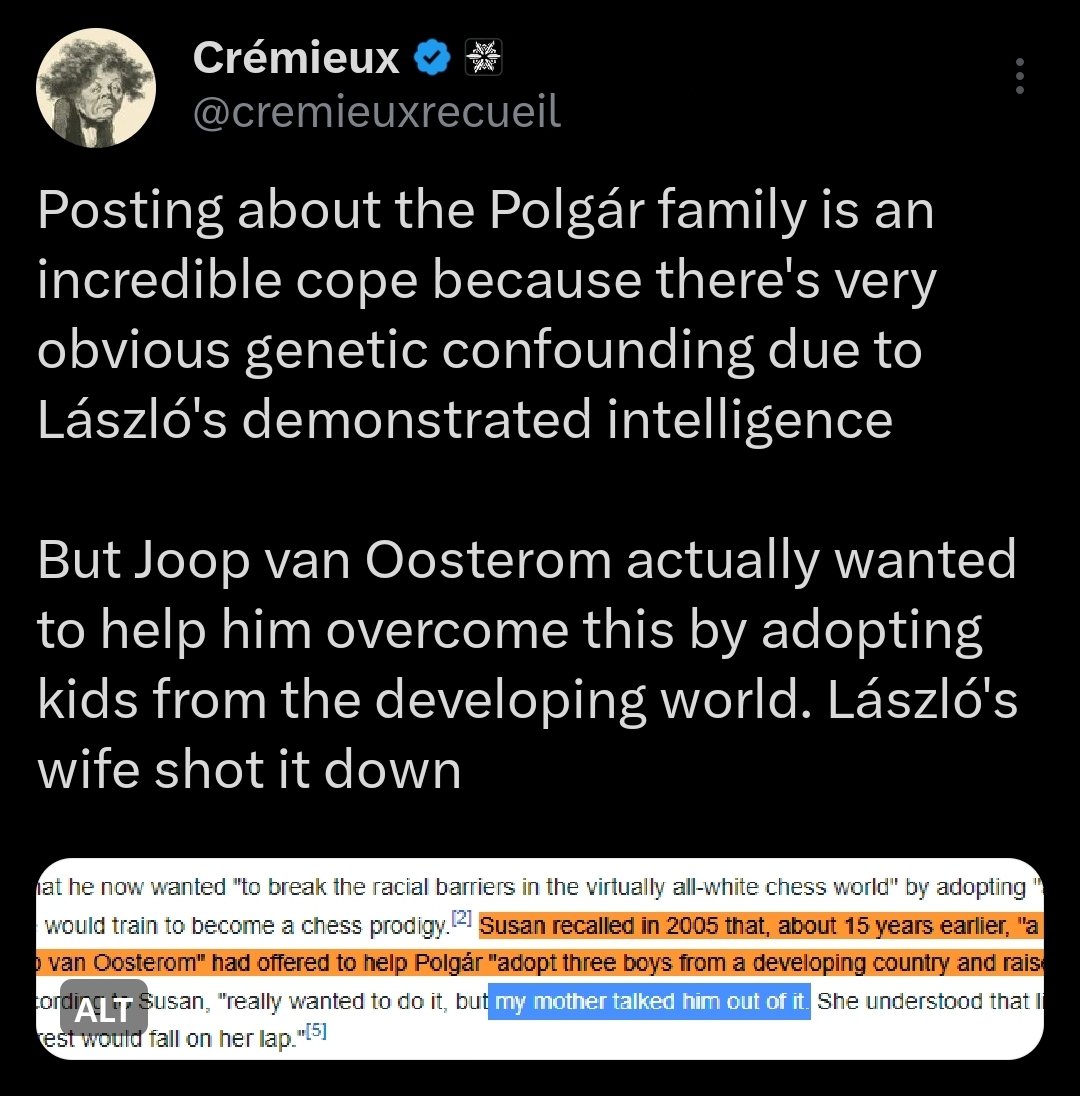
The main issue with Polgar example is rather that the parents were not average kids. Rather the father was an obsessive, smart Jew and it's far less surprising that such a person ends up being extreme children. Of course it's still quite the achievement but less so statistically. He later bragged he would adopt an African and do it again (didn't happen).
Ihtesham Ali@ihtesham2005

A Hungarian psychologist raised three daughters to prove that any child could become a chess grandmaster through early specialization. He succeeded. Two of them became grandmasters. One became the greatest female chess player who ever lived. Then a sports scientist looked at the data and found something nobody wanted to hear. His name is David Epstein. The book is called "Range." The Polgar experiment is one of the most famous case studies in the history of deliberate practice. Laszlo Polgar wrote a book before his daughters were even born arguing that geniuses are made, not born. He homeschooled all three girls in chess from age four. By their teens, Susan, Sofia, and Judit were dominating tournaments against grown men. Judit became the youngest grandmaster in history at the time, breaking Bobby Fischer's record. The story became the gospel of early specialization. Pick a domain young, drill it hard, and you can manufacture excellence. Epstein opens his book by telling that story honestly and then quietly demolishing the conclusion most people drew from it. Chess works that way. Most things do not. Here is the distinction that took him four years of research to articulate, and that almost nobody who quotes the 10,000 hour rule has ever read. There are two kinds of environments in which humans develop expertise. Psychologists call them kind and wicked. A kind environment has clear rules, immediate feedback, and patterns that repeat reliably. Chess is the cleanest example. Every game ends with a winner and a loser. Every move is recorded. The board never changes shape. The pieces never invent new ways to move. A child who plays ten thousand games will see most of the patterns that exist in the game, and pattern recognition is exactly what chess mastery is built on. A wicked environment is the opposite. Feedback is delayed or misleading. Rules shift. The patterns that worked yesterday may be exactly the wrong patterns to apply tomorrow. Most of the real world looks like this. Medicine is wicked. Investing is wicked. Building a company is wicked. Scientific research is wicked. Almost every job that involves a complex changing system with humans in it is wicked. The Polgar sisters trained in the kindest environment any human can train in. Their success was real and the method was correct. The mistake was generalizing the method to fields where the underlying structure of the environment is completely different. Epstein's research is what made the implication impossible to ignore. He looked at the careers of elite athletes outside of chess and golf and found that the pattern was almost the inverse of what people assumed. The athletes who reached the very top of their sports were overwhelmingly people who had played multiple sports as children, specialized late, and often switched disciplines well into their teens. Roger Federer played squash, badminton, basketball, handball, tennis, table tennis, and soccer before tennis became his focus. The kids who specialized in tennis at age six and trained year-round for a decade mostly burned out, got injured, or topped out at lower levels of the sport. The same pattern showed up everywhere he looked outside of kind environments. Inventors with the most patents had worked in multiple unrelated fields before their breakthrough work. Comic book creators with the longest careers had drawn for the most different genres before settling. Scientists who won Nobel Prizes were dramatically more likely than their peers to be serious amateur musicians, painters, sculptors, or writers. The skill that mattered in wicked environments was not depth in one pattern. It was the ability to recognize when a pattern from one domain applied unexpectedly in another. That kind of thinking cannot be built by drilling a single subject. It can only be built by accumulating mental models from many subjects and learning to move between them. The deeper finding is the one that should change how you think about your own career. Specialists in wicked environments often get worse with experience, not better. Epstein cites studies of doctors, financial analysts, intelligence officers, and forecasters showing that years of experience in a narrow domain frequently produce more confident judgments without producing more accurate ones. The expert builds elaborate mental models that feel comprehensive and turn out to be increasingly disconnected from the actual structure of the problem. They stop noticing what does not fit their framework. They mistake fluency for understanding. Generalists do better in wicked domains for a reason that sounds almost mystical until you understand the mechanism. They have less invested in any single mental model, so they abandon broken models faster. They are used to being a beginner, so they are not threatened by the discomfort of not knowing. They have seen enough different domains that they can usually find an analogy from one field that unlocks a problem in another. The technical name for this is analogical thinking, and the research on it is one of the most underrated bodies of work in cognitive science. The single most useful sentence in the entire book is the one Epstein puts almost as a throwaway. Match quality matters more than head start. A person who tries six different fields in their twenties and finds the one that genuinely fits them will outperform a person who picked one field at fourteen and stuck to it on willpower alone. The lost years were not lost. They were the search process that produced the match. Every field they walked away from taught them something they later imported into the field they finally chose. The reason this is so hard to accept is cultural, not empirical. We tell children to pick a path early. We reward the prodigy who knew at six. We treat the late bloomer as someone who failed to launch on time, when the data suggests they were running an entirely different and often more effective optimization process underneath. The Polgar sisters were not wrong. The conclusion the world drew from them was. If your environment is genuinely kind, specialize early and drill hard. If it is wicked, and almost every interesting human problem is, then the people who win are the ones who refused to specialize until they had seen enough to know what was actually worth specializing in. You are not behind. You were running the right experiment all along.

English
19
17
258
15.4K
Androctasya
Androctasya@androctasya·
@girifreespirit @Gyan49485 "Have to still prove himself at elite level." He literally won an elite tournament. What the hell are you smoking?
English
0
0
10
153
gi
gi@girifreespirit·
@Gyan49485 Han’s’ obnoxious behaviour, is what put people off. He is a decent player. Have to still prove himself at elite level. He won this but scraped through. Fedoseev’s perf last year was dominant with a 26 score. And btw,Gukesh defeated Hans in both Blitz games ..
English
4
0
11
1.9K
Hans Niemann
Hans Niemann@HansMokeNiemann·
Grand Chess Tour Superbet Warsaw Rapid & Blitz Champion
English
121
78
1.3K
59.6K
Isabel Moreira
Isabel Moreira@IsabelLMMoreira·
Era evidente e fizemos bem, nós, @PS_Parlamento em pedir a fiscalização preventiva de uma lei desta dimensão. Que o PSD e o CDS rejeitem pilares básicos do nosso chão comum é coisa que já não espanta. Não há categoria de nacionais.
Expresso@expresso

OTribunal Constitucional (TC) voltou a chumbar o decreto parlamentar que determina a pena de perda da nacionalidade portuguesa para quem cometer uma série de crimes Saiba mais: expresso.pt/politica/2026-…

Português
186
41
368
15.6K
Androctasya
Androctasya@androctasya·
@RealDianeYap I read a discussion some time ago and learned that many men are not attracted by women who like astrology and who spend too much time on social media. And reading the comments on your post now I find the same pattern. So, you are just wrong.
English
0
0
0
30
Diane Yap
Diane Yap@RealDianeYap·
“What hobbies make women unattractive?” None. Men don’t care about women that way. She’s attractive based on her appearance alone. If she’s hot, no hobby can make her unattractive.
English
402
40
648
35.8K