

Anna Strumpel
537 posts

Anna Strumpel
@anna_strumpel
Head of BD Europe at Stealth Defence Tech, Austrian/American
London, England Katılım Aralık 2024
1.1K Takip Edilen303 Takipçiler

@anna_strumpel I'm rooting for him.
I just wish people would enjoy their life's more it can end so quickly
English
In case you are not aware
There is no harmony or real karma in the universe apart from the harmony of overwhelming and collective murder.
You could be killed by a drunk driver any second
A random crackhead could stab you to death walking by and be released the next day.
Boom that's it your life is over and the years you spend wasted you are nothing except another number on a crime statistic.
If you are statistically lucky your picture will be (ab)used to further a political agenda depending on if your murderer is trans, black or has a maga cap in his car
So one side can dunk on the other side on twitter
The common denominator of the universe is not harmony but chaos hostility and murder.
Enjoy your life and make something that remains.
Family, scientific advancements and the life's you changed are the only thing that remains of you in this universe
Eryk Krusinski@5krus
no dating until $1B arr
English
@WarMonitor3 wow that’s wild
DW says the same p.dw.com/p/5Be4g
English

German men from the ages of 17-45 must now obtain permission to leave the country for more than three months as Germany takes a war footing.
Wow...
English



@drnovac that would take a while to explain to an 87 year old!!
English
@anna_strumpel tell her you might even get paid by this guy Elon for it :-))
English
my granny asked me why i’m ‘so busy’ as i’m scrolling on x
>tell her i’m busy monitoring the situation
>she asks me ‘how’s your monetary situation?’
English
@AnjneyMidha @AmandaAskell @AnthropicAI @CS153Systems if your course doesn’t have a course site you’re ngmi
English

excited to announce that @AmandaAskell from @AnthropicAI will be speaking in @CS153Systems at stanford this quarter
it will be a window into some of the most challenging frontier AI design questions of our time
English
great piece by @nicolange_
europe won’t get stronger by spending more money on defence - it will only get stronger by spending on the right technologies and deploying them fast
love the call for a quota of up to 30% spending on innovative defence tech in Germany by 2030 and 10% quota now
Nico Lange@nicolange_
Eine souveräne europäische Verteidigungsökonomie entsteht nur im Zusammenspiel von Regierung, Streitkräften, Industrie, Finanzsektor und Wissenschaft. Wenn die USA es nicht mehr machen, müssen wir es selbst tun – mit Plan, Tempo und Technologie. /END handelsblatt.com/meinung/kolumn…
English
a good time to join an air defence startup
Shanaka Anslem Perera ⚡@shanaka86
JUST IN: The United States has fired 2,400 Patriot interceptors in 31 days. It manufactures 650 per year. Replenishment at current production takes three and a half years. It has consumed 40 percent of its global THAAD inventory. It produces fewer than 100 THAAD interceptors annually. Full replenishment takes four to five years. Each interceptor contains neodymium and samarium-cobalt magnets sourced from Chinese-controlled supply chains. The US defence rare earth stockpile has approximately two months remaining. Read those numbers again. The US military has consumed more precision weapons in one month than it can manufacture in three years, using materials it can only source from the country it may need to fight next. Every Patriot fired at an Iranian Fattah-2 over Riyadh is a Patriot that does not exist for a Chinese DF-21 over the Taiwan Strait. Every rare earth magnet consumed in Gulf interceptors is a magnet that cannot be installed in a replacement built for the Pacific. The Iran war is not just depleting American arsenals. It is depleting American deterrence against China. And the country counting the interceptors from both sides of the table, as supplier and as future adversary, is the same country hosting peace talks in Beijing right now. China controls 90 percent of rare earth refining. China produces 90 percent of the world’s high-performance magnets. China buys 80 to 91 percent of Iran’s oil exports. China provides BeiDou navigation and ammonium perchlorate propellant to the Iranian missiles that are forcing the US to burn through its interceptor stockpile. China is simultaneously the supplier of the weapons America is using, the supplier of the weapons Iran is using, the primary customer of the oil the war is disrupting, and the only country with the leverage to end the disruption. The arithmetic of the grand bargain is not complicated. The US needs Chinese rare earths to rebuild its interceptor inventory. China needs Hormuz open to receive Iranian oil. The US needs the war to end before its stockpiles hit zero. China needs tariff relief, semiconductor export control rollbacks, and Taiwan arms-sale restraint. Both sides need something only the other can provide. The question is not whether a deal happens. The question is how much of America’s strategic position in the Pacific gets traded for the minerals needed to survive the Gulf. RAND estimated that 78 percent of US defence contractors would face production shutdowns within 90 days of a Chinese rare earth cutoff. The 2027 deadline to ban Chinese-sourced magnets from Pentagon procurement is nine months away with no domestic alternative at scale. MP Materials operates the only US rare earth mine and ships its concentrate to China for processing. The mine-to-magnet supply chain that the Pentagon needs to survive a Taiwan contingency runs through the country the Taiwan contingency is designed to deter. This is not a supply chain problem. This is a civilisational dependency. The United States built the most advanced military in human history on materials processed by its principal strategic competitor. It is now fighting a war that burns through those materials at a rate that makes replenishment impossible without the competitor’s cooperation. And the competitor is sitting in a conference room in Beijing today, across the table from Pakistan’s foreign minister, calculating exactly how much of America’s future it can extract in exchange for the minerals America needs to have a future at all. The deal of the century is not a choice. It is arithmetic. And the arithmetic leads to Beijing. open.substack.com/pub/shanakaans…
English


Today I opened @THEON_INT’s new production facility in Zaventem.
Here, thousands of IRIS-C thermal imaging systems for the Belgian and German Armed Forces will be produced.
This state-of-the-art facility shows THEON’s ambition to strengthen European defense and industrial resilience.
Congratulations to the entire team!

English
@rcanedesignwrks gorgeous! this was while it was snowing though
English

@anna_strumpel Thats not a rainbow...this is a rainbow!
(We get 4-5 meters of rain annually, it helps)

English

2000 drones a year to 4m drones a year is no joke - well done Ukraine
youtube.com/watch?v=jgT8UR…

YouTube
English
@Bouazizalex when did ‘special projects’ turn into ‘ghostbuster’
English

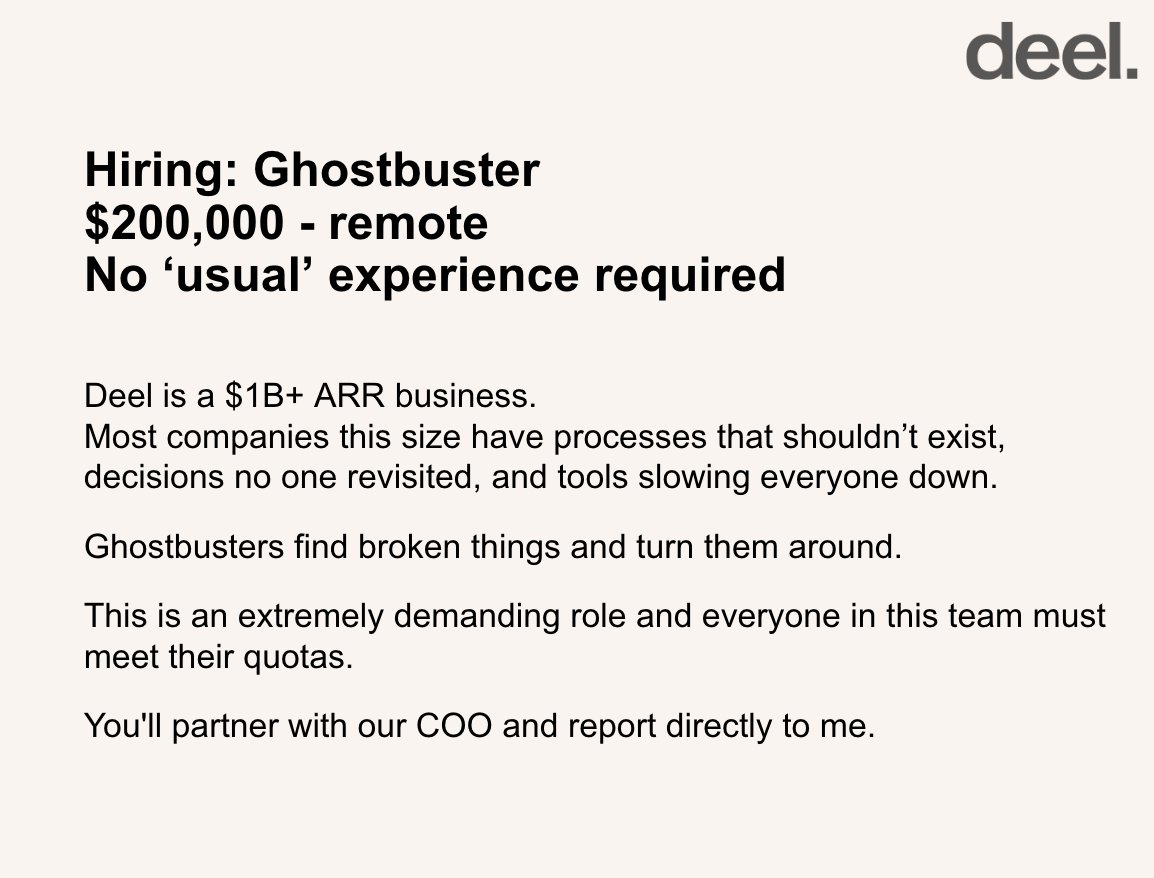
We're hiring: Ghostbuster position open.
Join Deel's version of DOGE, our strongest operational team.
$200k+/year - remote.
Over 7 years, Deel scaled to 7,000+ people across 100+ countries.
Every company this size accumulates ghosts:
- A process installed by someone who left 2 years ago
- A tool slowing everyone down that nobody wants to call out
- A decision from 2022 that no one revisited
Ghostbusters find broken things and fix them.
Own the outcome end to end.
You'll partner directly with our COO & myself on the highest-priority operational and strategic initiatives at the company. No busywork. No micromanagement. Just the objective.
What it takes:
- Builder mentality. You'll get resources, but you'd crush it without them
- First-principles thinker. You walk into any department and ask, "Why does this even exist?"
- Financially sharp. Business-minded. Operationally elite
- AI-native. You help every team rethink how they work, every single week
- Self-directed. We give you the mission, not the playbook
This is the strongest operational team at Deel.
Every person on it is a force.
If that's you: jobs.ashbyhq.com/deel/b168b5dd-…
English