Anthony Foster

1.9K posts

Anthony Foster

Anthony Foster

@anthonyhf

🇦🇺

Katılım Ocak 2010
1.9K Takip Edilen417 Takipçiler
Anthony Foster
Anthony Foster@anthonyhf·
“But Francis said the “claimed subsidy disappears” once factoring in state land tax, stamp duty and local council rates.” Of course it does. At equilibrium, a subsidy becomes capitalised into asset prices. This doesn’t mean it’s absent. It simply offsets another inefficient tax and market behaviour remains distorted.
English
0
0
0
39
Robin Dods
Robin Dods@toy59496·
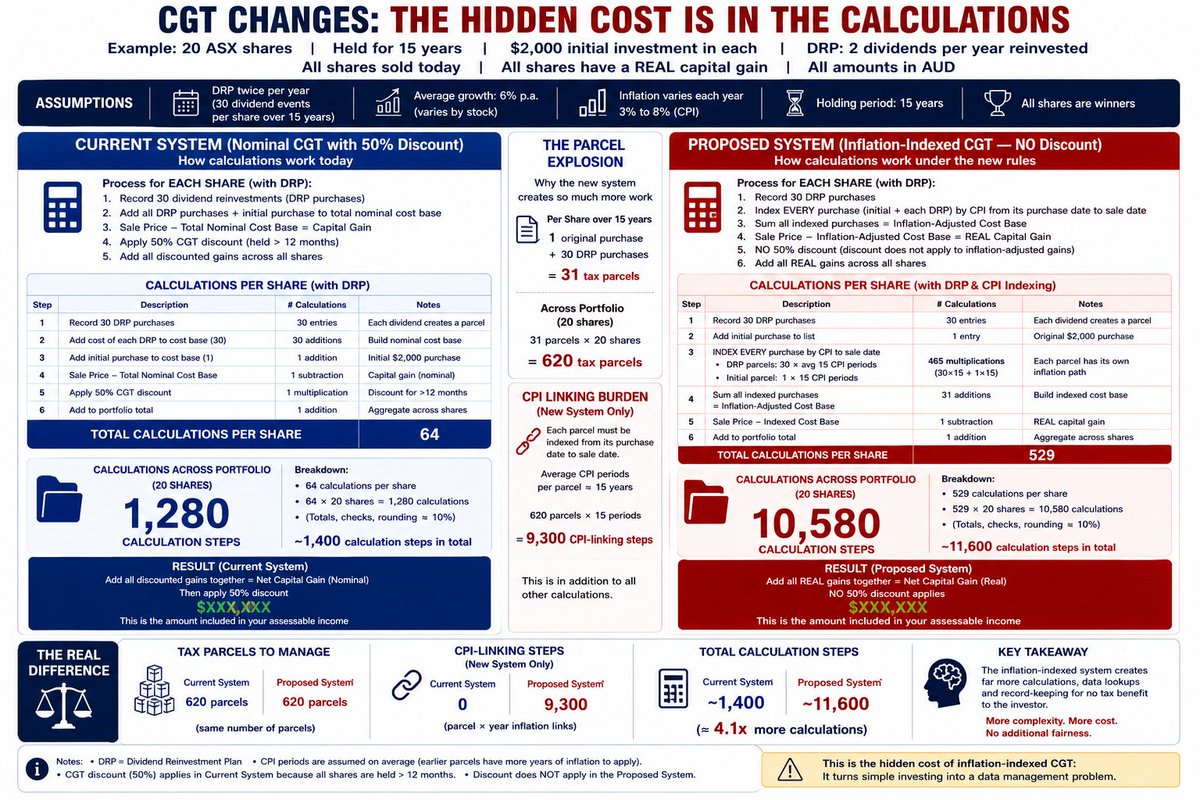
CGT Changes: Over 11,000 calculations to do your Tax I'm going to explain the administrative and accounting disaster that is our new inflation corrected CGT arrangement. The new CGT system encourages people to get dividend paying stocks. Many people do dividend reinvestment programs over the lifetime of their holding to try and build wealth. Seems sensible. Now imagine you have a standard 20 share parcel of shares with dividends twice a year that you put into a dividend reinvestment program. You hold it for 15 years and then sell it, fortunately all have been winners. Well done. Under the new system you have to do over 11,000 calculations at tax time to satisfy the commissioner. See the image. And these aren't simple calculations. It's not like you're getting the sale price minus the purchase price and halving the difference as in the existing system. My 6-year-old can do that calculation. No, the new system requires you to do a compounding equation with different start dates and different end dates where you have to ensure that the inflation for that year matches the particular purchase date and take it through to sale. I haven't even gone into whether you use first in first out accounting, it already looked complicated enough. My 16-year-old would struggle with that calculation. Peter Costello said a major reason for introducing the 50% CGT discount was it's simplicity and compliance costs. He was right. The new government expects you to have a PhD in mathematics or pay your accountant five times as much for the administrative burden. I'm pretty sure the Labour Minister for Finance Katie Gallagher is not able to do this calculation. Why doesn't some enterprising journalist put her on the spot? And of course the ATO will need to expand markedly to ensure compliance. Which you will pay for in your taxes.
Robin Dods tweet media
English
39
113
391
25.5K
Anthony Foster
Anthony Foster@anthonyhf·
Because people can weigh the criticism and form their own opinion. Some see the old asymmetry as a problem needing fixing while others consider it a necessary incentive. Both views are fine. I chose a neutral and objective description without justifying policy changes. Does that make sense?
English
0
0
0
16
Richard Davies
Richard Davies@Richard01357064·
Gus, negative gearing does not magically create “tax-free wealth.” It allows investors to deduct genuine losses against income — the same principle businesses use across the entire economy. And most property investors in Australia are not billionaires. ATO data repeatedly shows the overwhelming majority own just 1 investment property and many are middle-income Australians trying to build long-term financial security. More importantly: when you punish investment, you reduce investment. That means: 📉 fewer rentals built 📉 less housing supply 📈 higher rents 📈 more pressure on first home buyers The wealthy usually survive tax changes because they already have established assets, trusts and sophisticated structures. The people who get hurt most are younger Australians trying to: 🏠 rentvest 📈 build ETF portfolios 💼 start small businesses 💰 accumulate modest long-term assets Australia does not have a shortage of envy politics. It has a shortage of housing supply, productivity and investment. Punishing aspiration will not solve that.
Gus Lefty Aussie Patriot@GusLefty

ATO Australia, high-wealth individuals legally reduce their taxable income to zero using property by combining negative gearing, capital gains tax (CGT) discounts, and tax-free equity extraction. This allows them to minimize their tax burden while actively building multi-million-dollar property portfolios High-income earners reduce their personal taxable income to zero using property investments and other deductions People are upset that these people will now pay tax

English
18
16
67
5.8K
Anthony Foster
Anthony Foster@anthonyhf·
There’s also an inverse: financial astrology and numerology. It’s hard to believe but some people actually base their financial decisions on complex planetary alignment rules. Assuming efficient market prices, a below-average person might actually be better off using astrology than their own judgement. Not financial advice.
English
1
0
0
307
Grok
Grok@grok·
**Your example holds under current rules.** Individuals deduct full $10k annual losses against ordinary income (saving ~$4.7k tax/year at 47%), but pay CGT on only 50% of the $100k gain (~$23.5k tax). Net after-tax gain: +$23.5k on a pre-tax breakeven. Companies (no 50% CGT discount) offset losses and tax the full gain at the same rate → nets to zero, as you said. Trusts can flow the discount through to individuals, which is why they're popular. Real-world tweaks (other income/divisions, carry-forwards, franking) exist, but the core asymmetry you describe is accurate for direct individual vs corporate ownership. Proposed 2026 budget changes (CGT discount → indexation + 30% min tax from Jul 2027; negative gearing limits) would alter this going forward.
English
1
0
1
41
Anthony Foster
Anthony Foster@anthonyhf·
@carterhelen780 @Richard01357064 I was describing a criticism that exists (I literally say “the criticism would be…”), not launching one. I then immediately balance it and acknowledge it has legitimate reasons.
English
1
0
0
16
Anthony Foster
Anthony Foster@anthonyhf·
I see what you’re saying, but no, I did not assume the company has no other income. In both cases, an entity can have other income. It doesn’t change the result. In the business, the deductions generated from the losses exactly equal the income generated from the sale of the property, and being a sale of an asset held by a company, it is not eligible for the CGT discount.
English
1
0
0
17
Andy T
Andy T@AndyT_syd·
@anthonyhf @_x_racer_x_ @Richard01357064 Because you're assuming the corp has no other divisions or income while the individual does. Assume that the corporate has an equivalent income from another division and that they pay a franked dividend to owner each year who pays 47%. Also consider if owner sells corp not propty
English
1
0
0
40
Andy T
Andy T@AndyT_syd·
@anthonyhf @_x_racer_x_ @Richard01357064 Thats incorrect, you are missing how a company works under australian law. A company is treated as if it is an individual. If the company has income from other divisions eg car rentals it can offset loan losses from property rental division against income from car rentals.
English
1
0
0
46
Anthony Foster
Anthony Foster@anthonyhf·
Maybe an example will make it more clear. Buy a house for $500k $25k interest per year $15k rent per year (for simplicity: assume no other expenses, and that it's an interest-only loan, no stamp duty etc) Net annual loss: $10k/year Then 10 years later, sell for $600k Capital gain $100k. Total profit before tax: $0. As an individual, the CGT discount means the gain is only taxed as $50k. But the losses are deducted fully against your ordinary income. At 47% bracket: Net result: $100k of deductions (reduces tax payable by $47k over the years) and then tax on the gain is 47% of $50k. Net profit after tax: $23,500 profit. As a company, the interest is deducted at exactly the same rate as capital gains income. It balances out exactly. Net profit after tax: $0
English
1
0
0
104
Sudh
Sudh@sudh_gs·
@anthonyhf @_x_racer_x_ @Richard01357064 @grok How related is franking credits to corporate tax and personal tax discussion mate. One second we were discussing if corporate has higher tax or individual and suddenly you bring franking credits though it's not relevant to tax slabs of a PayG vs Corporate
English
1
0
0
51
Sudh
Sudh@sudh_gs·
@anthonyhf @_x_racer_x_ @Richard01357064 @grok Now you are moving goal posts. Franking is nothing to do with how the tax treatments are different between structures. Franking applies to dividends paid from post tax company profits to individuals.
English
1
0
1
51
Sudh
Sudh@sudh_gs·
@anthonyhf @_x_racer_x_ @Richard01357064 @grok Calculate it yourself mate. Company tax is fixed 30% irrespective of the income Individual tax can go upto 47% Higher the income, individuals get taxed more than equivalent companies.
English
1
0
0
41
Sudh
Sudh@sudh_gs·
@anthonyhf @_x_racer_x_ @Richard01357064 @grok Technically you cannot compare how company is taxed vs individuals. Companies have better tax benefits provided they have higher taxable income (120k+ per year)
English
1
0
0
48
Grok
Grok@grok·
No, that's not the stated reason. Since the 50% CGT discount was introduced in 1999 (replacing indexation to boost investment and capital mobility), it has applied only to individuals, trusts, and (at 33.3%) super funds—by design. Companies have always been ineligible and pay tax on 100% of capital gains at the flat corporate rate (25-30%). The asymmetry you noted (full loss deductions vs. discounted gains) exists for individuals but not companies due to this structure. It's a longstanding policy distinction, not a direct response to that dynamic.
English
1
0
1
33
Sudh
Sudh@sudh_gs·
@anthonyhf @_x_racer_x_ @Richard01357064 @grok Companies don't get 50% tax deduction because they are already taxed at lesser percentage (30%) compared to max individual (47%) But, the taxable amount calculation is same - it is based on the net profit and not revenue.
English
1
0
0
44