Anton

262 posts

Anton

Anton

@antonhauns

NFS, (PH)EM-addict #FOAMed

Katılım Mayıs 2015
238 Takip Edilen93 Takipçiler
Anton retweetledi
Dr. Chacón-Lozsán F .'.
Dr. Chacón-Lozsán F .'.@franciscojlk·
💉The 2026 Anaphylaxis Guidelines highlight something uncomfortable for all of us in acute care: we do not fail because we lack knowledge, but because we fail to act on what we already know. Across 12 international guidelines, there is almost perfect agreement on one point: intramuscular epinephrine is the first and most important intervention⚠️. Yet in real practice, it remains significantly underused, often replaced or delayed by antihistamines or corticosteroids, therapies with no evidence for acute life saving benefit This gap between evidence and behavior is the central clinical problem. From a bedside perspective, three insights are particularly relevant: First, diagnosis remains the main bottleneck, not treatment. The guidelines clearly show that variability in diagnostic criteria, especially in patients without skin manifestations or in infants, leads to hesitation. Clinically, this reinforces a key principle: -> anaphylaxis is a clinical diagnosis driven by physiology, not by complete textbook criteria. Waiting for skin signs or full multisystem involvement delays epinephrine and worsens outcomes. Second, the document reframes management from a pharmacologic problem to a systems and education problem. Underrecognition by clinicians, lack of training in schools and community settings, and poor patient education all contribute to undertreatment. In reality, the success of anaphylaxis management depends less on ICU level interventions and more on early recognition and immediate action in prehospital environments. Third, there is a clear shift toward proactive risk management rather than reactive treatment. Modern guidelines emphasize emergency action plans, patient carried epinephrine, and structured education programs. This aligns with a broader trend in critical care: outcomes improve when interventions occur before physiological collapse, not after. An important nuance for critical care physicians is the role of adjunctive therapies. Antihistamines and corticosteroids are consistently positioned as SECONDARY, non life saving treatments. Their continued overuse reflects a cognitive bias toward treating visible symptoms rather than addressing the underlying hemodynamic and airway threat. Clinically, this is equivalent to treating hypotension in septic shock with paracetamol. 🤓Bottom line: Anaphylaxis is one of the clearest examples in medicine where the evidence is simple, but implementation fails. The priority is not new drugs or devices, but closing the gap between recognition and immediate epinephrine administration. 📃Reference Wallace DV, Immunol Allergy Clin N Am ▪ (2026) doi.org/10.1016/j.iac.…
Dr. Chacón-Lozsán F .'. tweet media
English
2
138
456
29.7K
Anton
Anton@antonhauns·
@medizinfreiburg @qhit Also als Dopaminantagonisten gehen theoretisch noch Haloperidol und Droperidol aber…
Deutsch
0
0
0
45
Anton
Anton@antonhauns·
@medizinfreiburg @qhit Ist meines Wissens nach aber tatsächlich das einzige evidente Antiemetikum bei Migräne. Sagt wenn ich falsch liege😅
Deutsch
1
0
0
71
Guido Burkhardt RN
Guido Burkhardt RN@qhit·
Paspertin Ampullen (Metoclopramid) werden vom 🇨🇭Markt genommen. Eine üble Nachricht für Patienten mit Übelkeit. Nach Primperan nun kein i.v. Präparat mehr verfügbar. 🙄
Deutsch
4
1
11
2.6K
Fabian Klumpp
Fabian Klumpp@medizinfreiburg·
(1/3) #Notfallmedizin #Analgesie #Notfallsanitäter ich bereite gerade einen artikel für eine fachzeitschrift vor und betreibe dafür literaturrecherche. dabei bin ich auf einen artikel gestossen, in dem ich folgendes lesen musste:
Deutsch
2
0
3
245
Fabian Klumpp
Fabian Klumpp@medizinfreiburg·
(3/3) WiE kAnN mAn NuR sO eiNeN BuLLsHiT sChReiBen ??? findet da kein proofreading statt ? sowas kann man doch nicht veröffentlichen ? liebe NÄ und liebe NFS. werden den patienty schmerzmittel vorenthalten, so kann das als körperverletzung durch unterlassung geahndet werden.
Deutsch
2
0
11
185
Anton
Anton@antonhauns·
@ecgandrhythmRoe VT on pretest probability vs AFlutter 2:1 with aberancy
English
0
0
2
68
Dr. Andreas Roeschl
Dr. Andreas Roeschl@ecgandrhythmRoe·
70 yo man with CAD and HTN, palpitations; what`s your take? 50 mm/s ‼️
Dr. Andreas Roeschl tweet media
English
30
11
59
8.7K
Anton
Anton@antonhauns·
@LiffersGert @medizinfreiburg Wichtig ist ja vor allem: kein HWS Orthese heißt ja nicht, dass keine Immobilisation stattfinden sollte und HWS Orthese alleine ist keine ausreichende Immobilisierung.
Deutsch
0
0
1
28
G. Liffers
G. Liffers@LiffersGert·
@medizinfreiburg Kurze Frage. Kürzlich VU. 2 Mofafahrer von Auto bein Abbiegen. Beide Kopfschmerz, einer Nackenschmerzen und agitiert. Dieser auch Knie/ Beinschmerzen unter Jeans. Beide Helm, offen, beide fomst kein schutz. Auto Blech Totalschaden, Windschutzscheibe kaputt. Stoff Neck d. RTW
Deutsch
2
0
0
250
Anton
Anton@antonhauns·
@suzyleebee @ecgandrhythmRoe I‘m definitly not sure about it. Seems like. Actually i think morphology of the qrs varies from beat to beat.
English
0
0
0
25
Dr. Andreas Roeschl
Dr. Andreas Roeschl@ecgandrhythmRoe·
This is not Wellen`s syndrome, the patient does not have CHD; what is your diagnosis then?
Dr. Andreas Roeschl tweet media
English
39
19
123
19.5K
Anton
Anton@antonhauns·
@ecgandrhythmRoe @GERpocus Im Brief steht VT. KHK mit PCI ausgeschlossen. Echo: minimal dias. Funktionsstörung. Bisher keine EPU.
Deutsch
1
0
3
107
Anton
Anton@antonhauns·
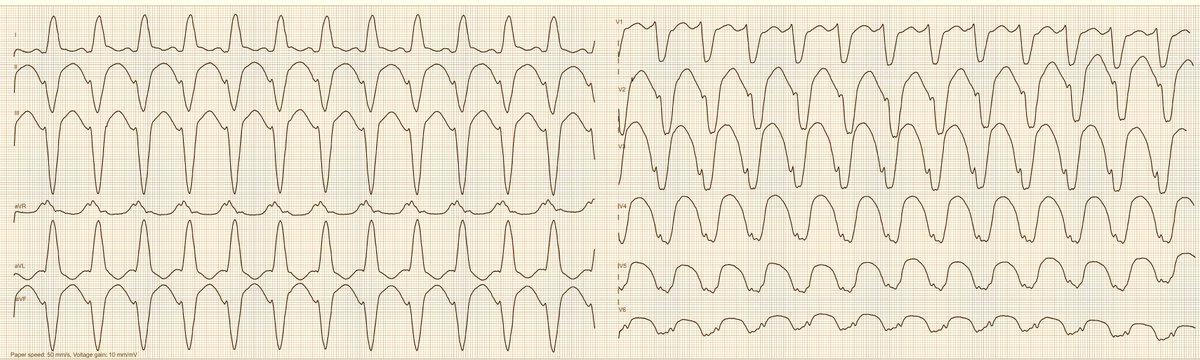
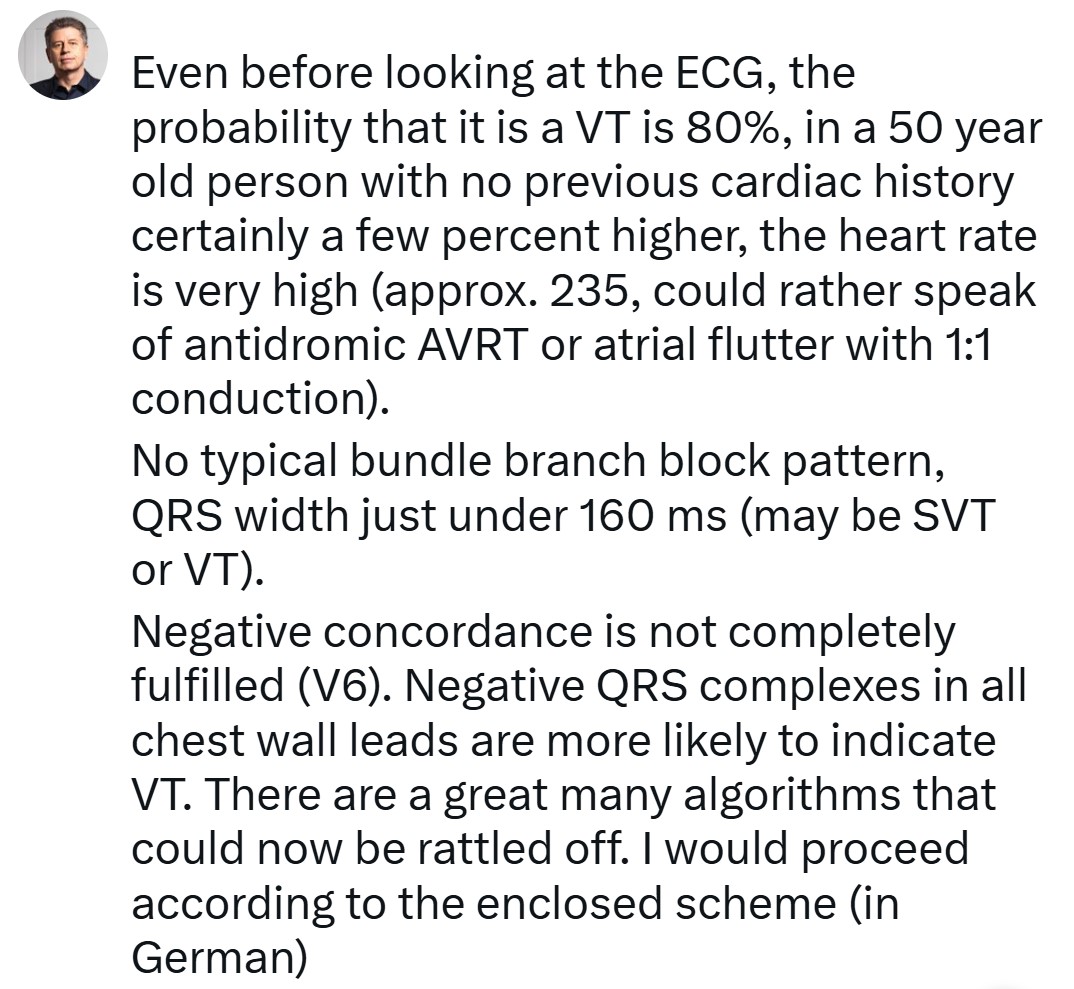
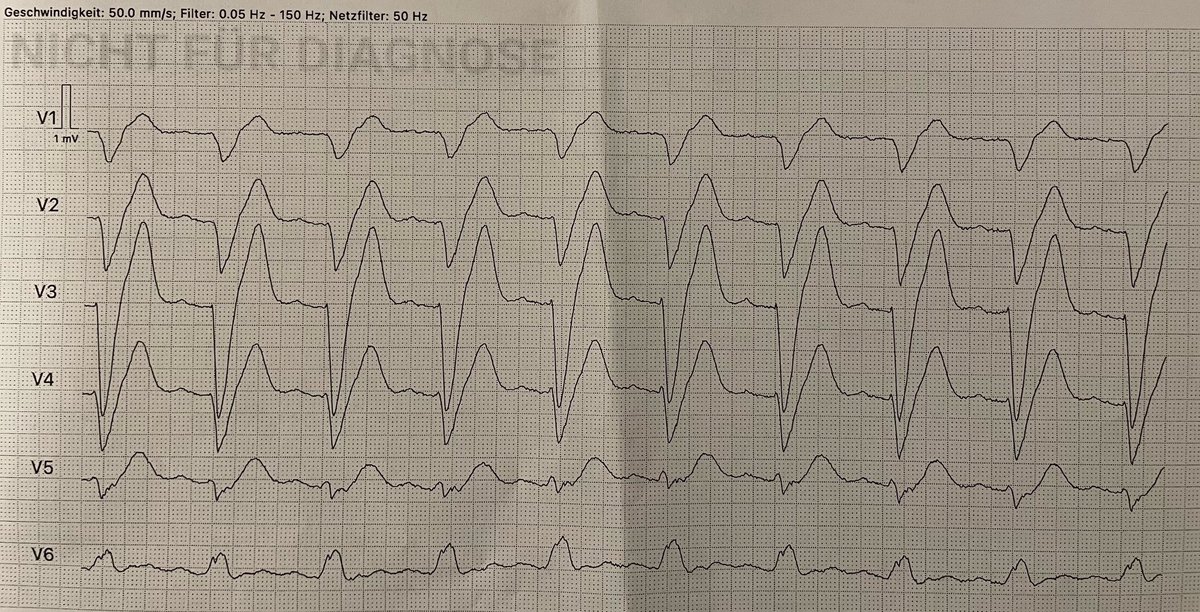
~ 50, male, pale and diaphoretic, chest pain, no medical history beside obesity VT or SVT with abberancy? 50 mm/s!
Anton tweet mediaAnton tweet media
English
15
6
44
8.2K
Anton
Anton@antonhauns·
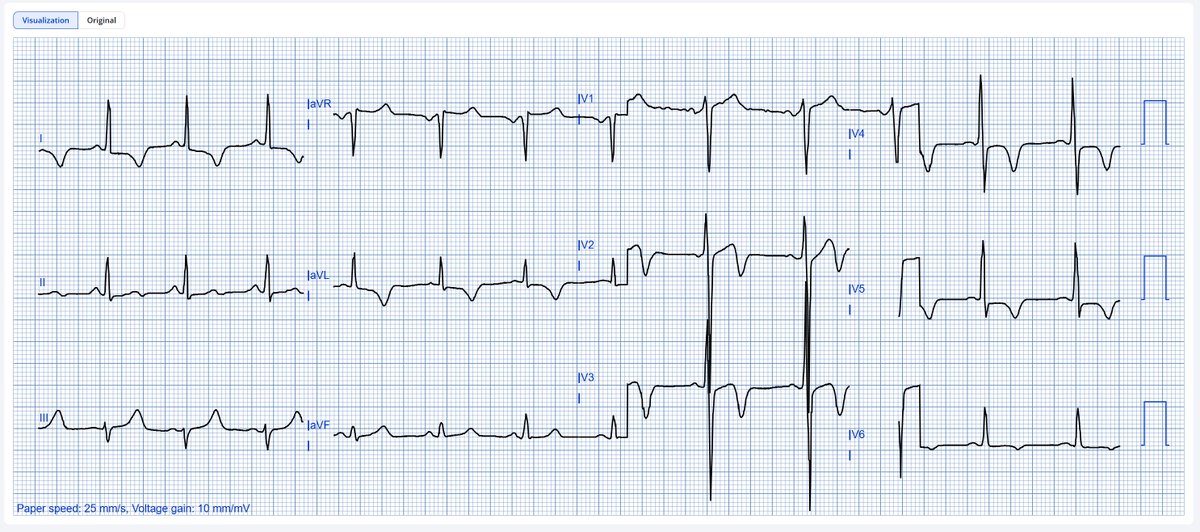
@ecgandrhythmRoe @GERpocus In preparation for cardioversion he converted spontaniously. First ECG + 30s, 2. + 5 min.
Anton tweet mediaAnton tweet mediaAnton tweet mediaAnton tweet media
English
2
0
2
406
Anton
Anton@antonhauns·
rhythm?
English
0
0
2
477