Arman Young retweetledi

this is from a portfolio mgr at a multi bn $ fund.
first gradually, then suddenly.
FEEL THE AGI
English
Arman Young
205 posts



It's sometimes hard to grasp the significance of the reasoning and logic updates that are starting to emerge in powerful models, like GPT-5. Here's a *very simple* example of how powerful these models are getting. I took a recent NVIDIA earnings call transcript document that came in at 23 pages long and had 7,800 words. I took part of the sentence "and gross margin will improve and return to the mid-70s" and modified "mid-70s" to "mid-60s". For a remotely tuned-in financial analyst, this would look out of place, because the margins wouldn't "improve and return" to a lower number than the one described as a higher number elsewhere. But probably 95% of people reading this press release would not have spotted the modification because it easily fits right into the other 7,800 words that are mentioned. With Box AI, testing a variety of AI models, I then asked a series of models "Are there any logical errors in this document? Please provide a one sentence answer." GPT-4.1, GPT4.1 mini, and a handful of other models that were state of the art just ~6 months ago generally came back and returned that there were no logical errors in the document. For these models, the document probably seems coherent and follows what it would expect an earnings transcript to look like, so nothing really stands out for them on what to pay attention to - sort of a reverse hallucination. GPT-5, on the other hand, quickly discovered the issue and responded with: "Yes — the document contains an internal inconsistency about gross-margin guidance, at one point saying margins will “return to the mid-60s” and later saying they will be “in the mid-70s” later this year." Amazingly, this happened with GPT-5, GPT-5 mini, and, remarkably, *even* GPT-5 nano. Bear in mind, the output tokens of GPT-5 nano are priced at 1/20th of GPT-4.1's tokens. So, more intelligent (at this use-case) for 5% the cost. Now, while doing error reviews on business documents isn't often a daily occurrence for every knowledge worker, these types of issues show up in a variety of ways when dealing with large unstructured data sets, like financial documents, contracts, transcripts, reports, and more. It can be finding a fact, figuring out a logical fallacy, running a hypothetical, or requiring sophisticated deductive reasoning. And the ability to apply more logic and reasoning to enterprise data becomes especially critical when deploying AI Agents in the enterprise. So, it's amazing to see the advancements in this space right now, and this is going to open up a ton more use-cases for businesses.
Interesting to see the way IBs are combating PE recruiting. Basically if you recruit and disclose, you’ll be moved to a diff business segment. Kinda defeats the point of PE funds recruiting early and expecting analysts to gain deal experience. Still seems like the best move for analysts is to simply recruit and stfu about it. No other way around it


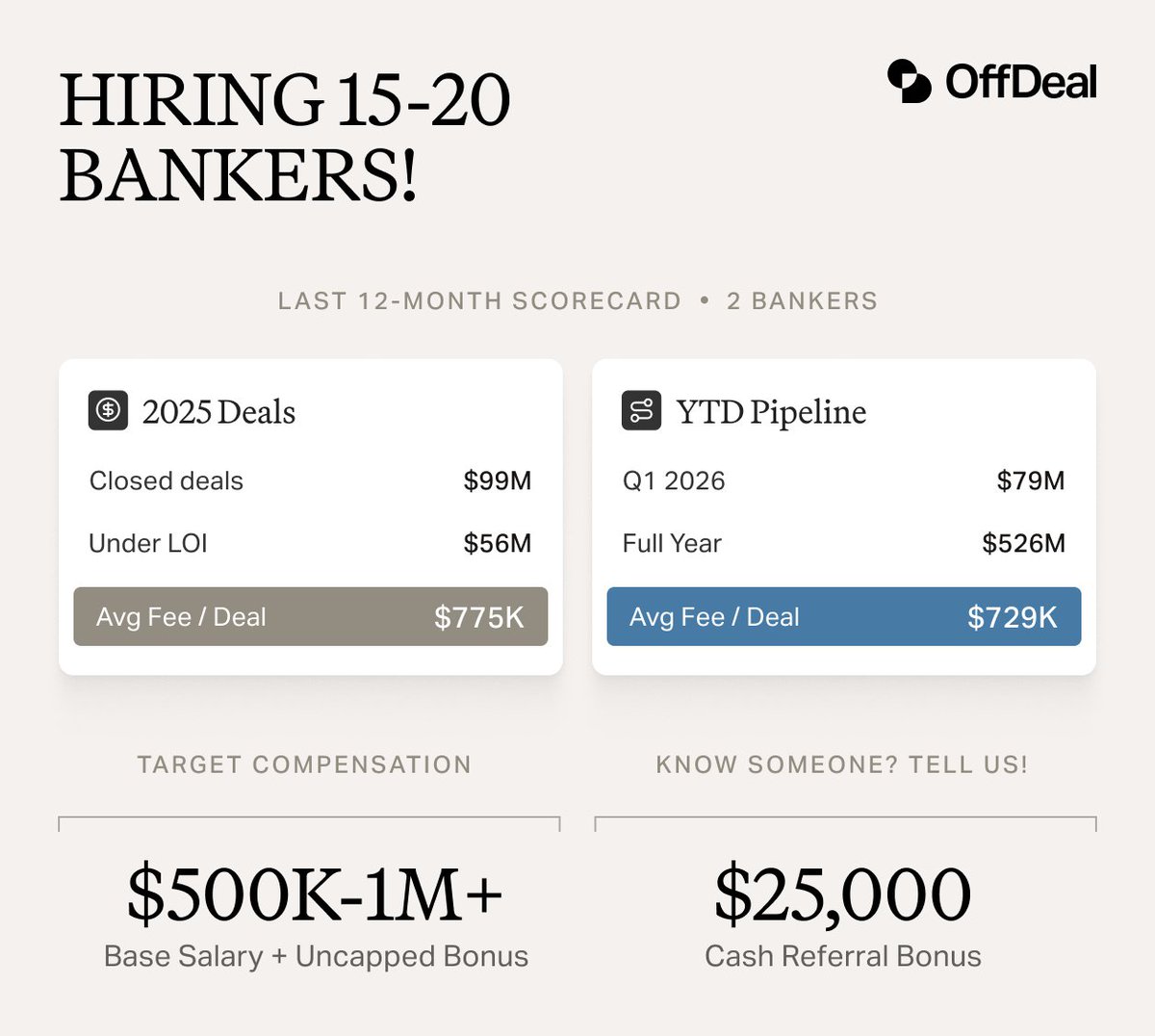
Yesterday's @FinancialTimes article went super viral and we got flooded with questions about the $2M banker bonus. The math is pretty simple actually: > $5M EBITDA business sells for 6x > $30M EV -> $1.5M fee > $1.5M fee -> $300K bonus to banker And that's just one deal. If you're a banker interested in running your own deals and using the most cutting edge AI, we'd love to hear from you. We're drowning in deal flow and need help. Apply on our website.


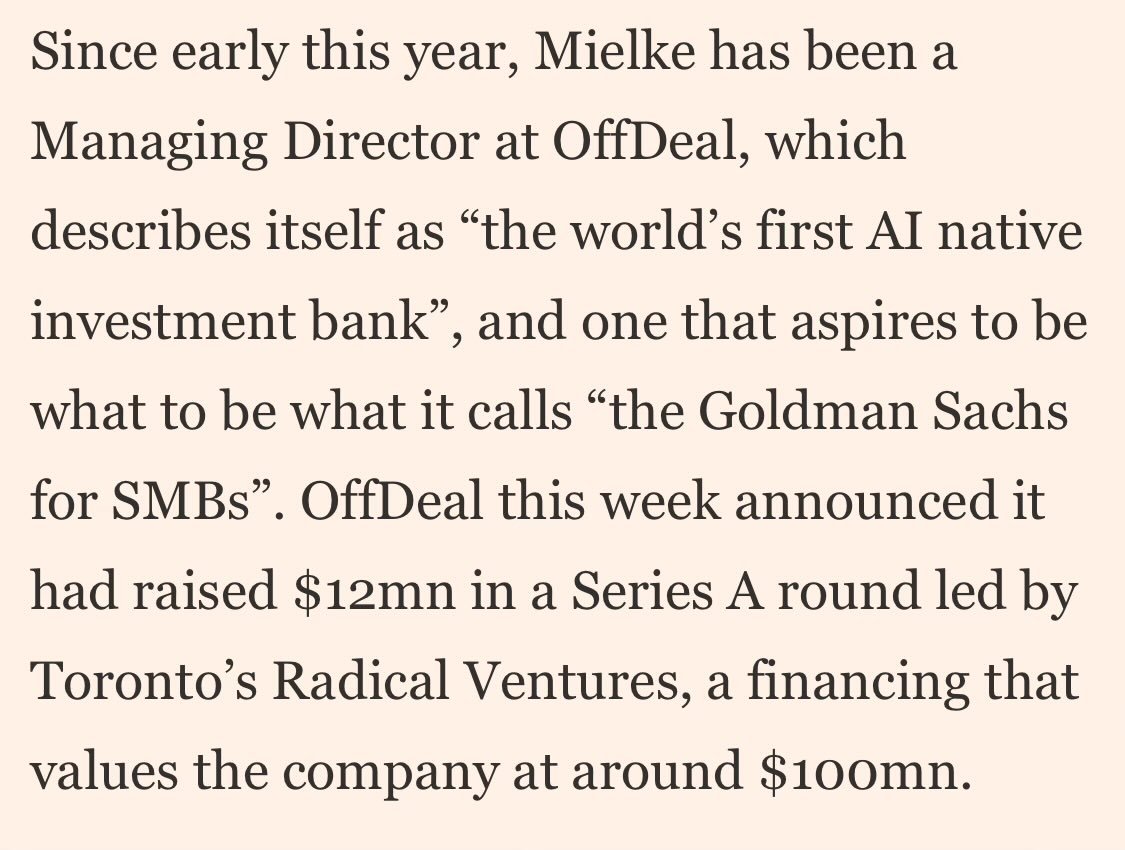
Excited to share that @tryoffdeal has raised a $12M Series A to build the world’s first AI-native investment bank, less than 10 months after our Seed. This year we already launched over 30 M&A sell-sides, and delivered numerous multi-million $ exits to our clients. A quick 🧵