The Kathmandu Post@kathmandupost
Nepal appoints Sushila Karki as first female executive head
The former chief justice widely praised for her integrity was chosen by Gen Z to lead transitional government.
BINOD GHIMIRE
KATHMANDU, SEPT 12
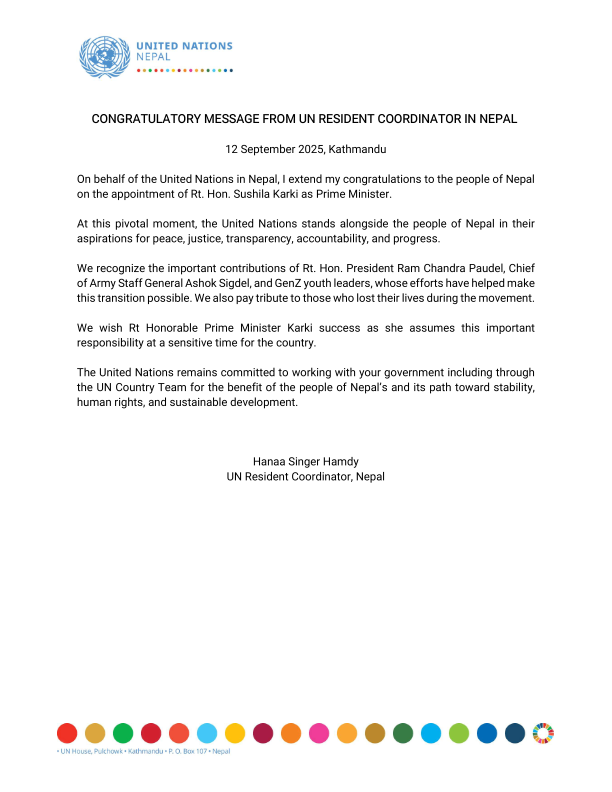
Sushila Karki, a septuagenarian former chief justice, on Friday registered her name in a Nepali history yet again becoming the country's first female executive head. In July 2016, she made history becoming the first woman chief justice in Nepal.
Following rounds of deliberations the Gen Z movement, which toppled the KP Sharma Oli-led government, agreed on Karki to lead the transitional government. She had received the highest votes on Discord, a free communication platform, on Wednesday, making her the most favoured candidate to lead the post-revolution government.
Not only among the youngsters, she is also the most acceptable figure from among the proposed names for the traditional political forces.
Born on June 7, 1952, in Shankarpur of the present-day Biratnagar Metropolitan City, she studied at Mahendra Morang College in Biratnagar. She completed her Bachelor’s in Arts at the age of 20.
She moved to India for higher studies where she completed a master’s degree from Banaras Hindu University. Upon her return, she studied law and, at age 26, completed her Bachelor of Law (BL) from Tribhuvan University in 1978.
A year after earning her BL, on March 30, 1979, Karki began her career as a lawyer. From 1986 to 1989, she also taught at Mahendra Multiple Campus in Dharan.
During her time as a legal professional, she served as the president of the Koshi Zonal Bar from 1988 to 1990. She was also the president of the Biratnagar Appellate Bar from 2002 to 2004.
She earned the title of a senior advocate on December 19, 2004. Four years later, on January 22, 2009, she was appointed temporary justice of the Supreme Court. And two years later, on November 18, 2010, she became a permanent justice of the Supreme Court.
And, six years later, in July 2016, she became the first woman chief justice and led the judiciary for around a year. She retired in June 2017 upon reaching the mandatory retirement age, after the Sher Bahadur Deuba-led ruling coalition had brought an impeachment motion in April—widely seen as an attempt to block her verdict on the police chief appointment.
Those who have worked with her describe Karki as courageous and possessing the highest level of integrity. She is also known for her spartan way of life, they say. Ananda Mohan Bhattarai, former Supreme Court justice, says Karki and her husband have made significant contributions to the country’s democratic movement.
They are true Gandhians not just in ideology but also in lifestyle. “She has agreed to shoulder such a huge challenge demonstrating her courage. We all need to support her,” said Bhattarai, former Supreme Court justice who worked with her. “I am fully hopeful that she will lead through the transition period embracing democratic principles at the highest level.”
She has remained very vocal against corruption. During her tenure her bench issued landmark verdicts in corruption cases against politicians. Though she entered the top court through the Nepali Congress quota, she never compromised her integrity, according to those who know her work.
She is married to Durga Subedi, a Congress leader, who was involved in plane hijacking in 1973 to fund the anti-Panchayat movement.
“She has always maintained high level integrity in her entire life,” said senior advocate Bipin Adhikari, professor at Kathmandu University School of Law. He said in these challenging times she needs a sound team to lead the government. She needs to have good people around to ensure she leads the government successfully, he said.
Some argue that it might be difficult for her to move hand in hand with the way the new generation wants. However, Bhattarai thinks that should not be a problem.
“Gen Z found a true guardian in her. They have made the best choice,” he said.