Uber gave 5,000 engineers access to Claude Code in December. By February, usage had nearly doubled. By April, the CTO told the company they'd burned through the entire annual AI budget.
The adoption curve tells you everything about what happened. In December 2024, 32% of Uber's engineers were using Claude Code. By February 2026, that number was 63%. That's not a gradual rollout. That's a product so useful that engineers pulled it into their workflow faster than finance could model the spend.
Uber has about 34,000 employees. Engineering is roughly 15% of that headcount, somewhere around 5,100 people. At enterprise API pricing, Claude Code runs $100 to $200 per developer per month on Sonnet alone. But that's the subscription math. The real number is token consumption, and Uber's engineers aren't building hello-world apps. They're building rider-driver matching algorithms, dynamic pricing engines, and real-time logistics across 70+ countries. Every one of those tasks eats context windows for breakfast.
The scale of what these engineers are actually doing with AI is wild. 92% of Uber's developers use AI agents monthly. 65 to 72% of code written inside IDEs is now AI-generated. 11% of all pull requests are opened by agents, not humans. The company's AI code review system, uReview, analyzes over 90% of the 65,000 diffs Uber ships per week.
AI-related costs at Uber are up 6x since 2024.
CTO Praveen Neppalli Naga's quote was "I'm back to the drawing board." That's the CTO of a $144 billion company admitting that the tools work so well his team can't afford to keep using them at this rate.
Here's the part nobody is pricing in. Anthropic's Claude Code hit $2.5 billion in annualized revenue by February 2026. That's up from $1 billion in November 2025. The fastest enterprise software ramp in history, and a huge portion of that growth is coming from exactly this pattern: companies deploy Claude Code, engineers love it, usage explodes, budgets evaporate.
Uber won't be the last company to have this conversation. The average Claude Code developer burns about $6 per day. Multiply that across thousands of engineers running complex agentic workflows, spawning sub-agents that each maintain their own context windows, and the math compounds fast. One engineering team running Claude Code in automated CI/CD loops can drain a monthly budget in days.
The CFO problem is now the bottleneck for AI adoption at the enterprise level. The technology works. The productivity gains are real. Uber's own data says 75% of AI code review comments are marked helpful by engineers. The constraint is that traditional annual budgeting was designed for tools with predictable per-seat costs, and AI coding agents have usage curves that look like cloud compute bills from 2015: exponential until someone notices.
Every enterprise CTO is about to have the same meeting Praveen just had. The tools are too good to pull back. The costs are too unpredictable to ignore. And the companies that figure out token cost optimization first will have a structural advantage over every competitor still running annual budget cycles against exponential adoption curves.
Why do some brands get links in Google AI Overviews while others stay plain text? 🔗
It's about:
✅ Direct Sourcing
✅ High E-E-A-T
✅ Knowledge Graph Status
✅ Schema Markup
Be the source of truth. 🚀 #SEO
What the Artemis II astronauts did over the last 10 days was a testament to their bravery. And the fact that they traveled farther from Earth than anyone ever has, re-entered our atmosphere at more than 24,000 mph, and splashed down safely was a testament to human ingenuity. Thanks to everyone at @NASA for making this mission possible, and for taking us along for the ride.
The internet was supposed to connect the world.
It connected the infrastructure. The people stayed divided.
For thirty years, a Japanese user and an American user existed on the same network and couldn’t understand a single word the other one typed.
The information was accessible. The conversation was not.
Language was the last wall. And nobody was building a door.
X just removed it.
Calacanis: “This auto-translate feature has done more for understanding across borders than anything I’ve ever seen.”
Grok is integrated directly into the platform. Every post, every reply, every thread. Translated in real time, both directions, automatically.
A user in Tokyo writes in Japanese. You read it in English. You reply. They read your response in Japanese.
Neither of you switched a setting. Neither of you copied text into a translator. The friction simply doesn’t exist anymore.
Calacanis: “People who don’t speak the same language engaging on X in a very nuanced, fun, interesting way. And that, as a truth mechanism, is just absolutely extraordinary.”
This has never existed before.
Not at this speed. Not at this scale. Not with this level of nuance preserved.
Previous translation tools gave you the words. They butchered the tone, the context, the cultural weight behind them.
An LLM doesn’t just translate language. It translates intent.
Sarcasm. Subtext. The meaning underneath the words.
That changes what’s possible on the platform.
Americans, Japanese, Israeli, French, Russian, and Middle Eastern users debating, arguing, laughing, and exchanging culture directly.
No journalist filtering the message. No editor deciding what’s relevant. No network choosing which perspectives get airtime.
Peer to peer. Unmediated. Unfiltered.
Calacanis: “Journalists are not even taking the time to translate and cover what’s going on in those areas, and this is happening automatically in real time.”
For decades, your understanding of another country was shaped entirely by whichever outlet decided to cover it.
If they didn’t translate it, you never saw it. If they did, you saw their version of it.
That filter is gone.
The raw, unedited perspective of every culture on Earth is now accessible to every other culture on Earth.
Instantly. Without permission. Without a middleman.
That is what a real town square looks like.
Not a platform where people from the same country talk to each other in the same language about the same news cycle.
A platform where the entire species can hear each other for the first time.
X didn’t just build a social network.
It built the first global conversation where language is no longer the barrier to entry.
The walls between cultures were never ideological. They were linguistic.
The wall is down. And 8 billion people just entered the same room.
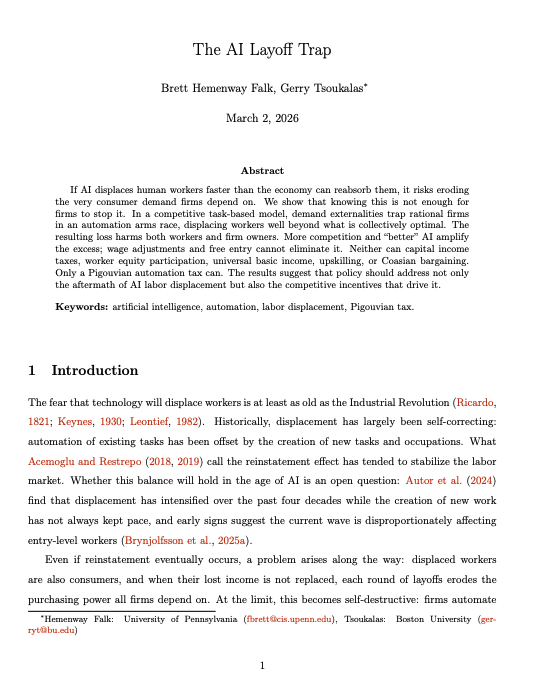
🚨RESEARCHERS JUST MATHEMATICALLY PROVED THAT AI LAYOFFS WILL DESTROY THE ECONOMY.. AND EVERY CEO ALREADY KNOWS IT.. BUT NONE OF THEM CAN STOP..
Two researchers from UPenn and Boston University just published a paper called "The AI Layoff Trap"..
They proved something terrifying..
Every company replacing workers with AI is also firing its own customers.. Every laid-off employee is someone who used to spend money.. When enough people lose their jobs.. Nobody can afford to buy anything.. And the companies that fired everyone go bankrupt selling products to an economy with no purchasing power..
Every CEO can see this coming.. The math is obvious.. Fire workers.. Lose customers.. Lose revenue.. Collapse..
But here's the trap..
No company can afford to stop..
If you don't automate.. Your competitor will.. They cut costs.. Undercut your prices.. Steal your market share.. And you die anyway..
So every company automates.. Knowing it's collectively suicidal.. Because the alternative is dying alone while everyone else survives..
It's a Prisoner's Dilemma.. And the researchers proved it mathematically..
The numbers are already stacking up..
Block cut nearly half its 10,000 employees this year.. CEO Jack Dorsey said AI made those roles unnecessary and that "within the next year, the majority of companies will reach the same conclusion"..
Salesforce replaced 4,000 customer support agents with AI..
Goldman Sachs deployed an AI coder that lets one senior engineer do the work of a five-person team..
Over 100,000 tech workers were laid off in 2025 alone.. AI was cited as the primary driver in more than half the cases..
80% of US workers hold jobs with tasks susceptible to AI automation..
And here's what should scare policymakers..
The researchers tested every proposed solution..
Universal Basic Income.. Doesn't fix it.. It raises living standards but doesn't change a single company's incentive to automate..
Capital income taxes.. Don't fix it.. They change profit levels but not the per-task decision to replace a human..
Worker equity and profit sharing.. Narrows the gap but can't close it..
Collective bargaining.. Can't fix it.. Because automating is a dominant strategy.. No voluntary agreement between companies is self-enforcing..
Only one thing works.. A Pigouvian automation tax.. A per-task charge that forces every company to pay for the demand it destroys when it fires a worker..
The researchers call it a "Red Queen effect".. Better AI doesn't solve the problem.. It makes it worse.. Because every company sees a bigger market share gain from automating faster than rivals.. But at the end.. Everyone automates equally.. The gains cancel out.. And the only thing left is more destroyed demand..
The paper's conclusion is devastating..
This isn't a transfer from workers to company owners.. Both sides lose.. Workers lose their income.. Companies lose their customers.. It's a deadweight loss that harms everyone..
And no market force can break the cycle..
The AI layoff trap isn't a prediction.. It's already happening.. And the math says it won't stop on its own.
Elon Musk on why the smartest people drop out of college:
"You don't need college to learn. Learn stuff. Everything is available basically for free. You can learn anything you want for free. It is not a question of learning."
Musk explains what college actually provides:
"There is a value that colleges have, which is seeing whether somebody can work hard at something, including a bunch of annoying homework assignments, and still do their homework, and kind of soldier through and get it done. That's the main value of college. And also, you probably want to hang around with a bunch of people your own age for a while instead of going right into the workforce. So I think colleges are basically for fun and to prove you can do your chores. But they're not for learning."
On hiring at his companies:
"There is a requirement of evidence of exceptional ability. I don't consider going to college evidence of exceptional ability. In fact, ideally you dropped out and did something. Obviously, Gates is a pretty smart guy, he dropped out. Jobs was pretty smart, he dropped out. Larry Ellison, smart guy, he dropped out. Obviously not needed."
Musk shares how education should work:
"Generally, you want education to be as close to a video game as possible. Like a good video game. You do not need to tell your kid to play video games; they will play video games on autopilot all day. If you can make it interactive and engaging, you can make education far more compelling and far easier to do."
He challenges the current system:
"You really want to disconnect the whole 'grade level' thing from the subjects. Allow people to progress at the fastest pace that they can, or are interested in, in each subject. It seems like a really obvious thing."
Musk criticizes traditional teaching:
"Most teaching today is a lot like vaudeville. Somebody's standing up there lecturing to you. They've done the same lecture several years in a row. They're not necessarily all that engaged. That lack of enthusiasm is conveyed to the students; they're not very excited about it. They don't know why they're there. 'Why are we learning this stuff?' We don't even know why. A lot of things people learn, probably there's no point in learning them, because they never use them in the future."
On whether university is necessary:
"A university education is often unnecessary. That's not to say it's unnecessary for all people. But I think you learn about as much, the vast majority of what you're going to learn there, in the first two years. And most of it is from your classmates. If the goal is to start a company, I would say no point in finishing college."
Musk started his own school for his kids:
"I created a little school. It's small, only 14 kids now, and it'll have 20 in September. It's called Ad Astra, which means 'to the stars.'"
He explains what makes it different:
"There aren't any grades. There's no grade one, grade two, grade three. Not making all the children go in the same grade at the same time, like an assembly line. People are not objects on an assembly line. That's a ridiculous notion. Some people love English or languages. Some people love math. Some people love music. Different abilities at different times. It makes more sense to cater the education to match their aptitudes and abilities."
Musk shares a key principle:
"It's important to teach problem-solving, or teach to the problem, not to the tools. Let's say you're trying to teach people about how engines work. A more traditional approach would be: 'We're going to teach you all about screwdrivers and wrenches. You're going to have a course on screwdrivers, a course on wrenches.' This is a very difficult way to do it."
He offers a better approach:
"A much better way would be: 'Here's the engine. Now let's take it apart. How are we going to take it apart? Oh, you need a screwdriver, that's what the screwdriver is for. You need a wrench, that's what the wrench is for.' And then a very important thing happens: the relevance of the tools becomes clear."
The result:
"It seems to be going pretty well. The kids really love going to school. I think that's a good sign. I hated going to school when I was a kid; it was torture. The fact that they actually think vacations are too long, they want to go back to school. Weird, I know."
Musk reframes what education really is:
"If you think about it, what is education? You're basically downloading data and algorithms into your brain. And it's actually amazingly bad in conventional education. It shouldn't be this huge chore. The more you can gamify the process of learning, the better."