Ali Saee

512 posts

Ali Saee banner
Ali Saee

Ali Saee

@asaee57

Derby, England Katılım Ocak 2021
652 Takip Edilen100 Takipçiler
Ali Saee retweetledi
amit
amit@amitisinvesting·
A TON OF THINGS HAPPENED IN THE STOCK MARKET TODAY. Here's a full recap: 1. $CBRS Cerebras opened about 75% above its expected IPO price of $185, giving the AI chip company a roughly $100B market cap despite generating $585M in revenue last year. Ark Invest also bought 105,616 shares just one day after the IPO, adding more attention to the name. The momentum is set to continue with LeverageShares launching a 2x leveraged Cerebras ETF tomorrow morning. 2. President Trump submitted his latest stock purchase and sale disclosures to the White House Office of Ethics, with the filing reportedly spanning more than 100 pages and including thousands of trades. The disclosure is notable because it shows a sitting president actively trading individual securities rather than only holding assets like corporate debt, index funds, or Treasuries. Some of the names listed as purchases include $PLTR, $HOOD, $NVDA, $SOFI, $MSFT, $AAPL, $DIS, $V, $ULTA, $JPM, $COIN, $LYFT, $AMZN, and $RKLB. 3. The U.S. has approved around 10 Chinese companies to purchase Nvidia’s $NVDA H200, the company’s second-most powerful AI chip. Nvidia hit an all time high at $240 today. 4.Figure AI has been livestreaming its humanoid robots performing real warehouse-style package sorting tasks using its Helix-02 AI system. The robots pick up, scan, rotate, and place packages onto conveyor belts autonomously while operating for extremely long periods, including a reported 24/7 run after initially targeting an 8-hour shift. The livestream is meant to prove that humanoid robots can handle repetitive labor reliably and economically, rather than just perform flashy demos. Many viewers see it as one of the first convincing demonstrations of commercially viable humanoid labor, especially for warehouses and logistics. The robot has so far dealt with 34K packages live and has reached parity with a human worker that can do 3 every second. 5. The most traded stocks in the options market today were $NVDA with 5.0M contracts, $TSLA with 2.5M, $NOK with 889K, $F with 860K, $ONDS with 849K, $INTC with 814K, $AAPL with 752K, $MSFT with 736K, $MSTR with 670K, and $MU with 644K. 6. Semiconductor leverage flows surged, with $SOXL, the 3x long semiconductor ETF, taking in a record $1.03B on Tuesday. At the same time, $SOXS, the 3x short semiconductor ETF, saw $230M of outflows, its largest daily withdrawal since late March. $TQQQ also added $161M, its biggest inflow since March 31, but $SOXL inflows were more than 6x larger as traders concentrated bullish exposure in semiconductors. Since the March 30 bottom, $SOXL is up 354%, its strongest 31-day gain since launching in 2010, while the $SOX semiconductor index is up 68%, its third-best 31-day run on record. 7. Retail investors are buying stocks at one of the fastest paces in years. Year-to-date retail equity inflows are ahead of every comparable period over the last seven years except 2021, and after slowing briefly in March, retail buying jumped sharply in April. The week ending May 1 ranked in the top 2% of weekly retail inflows since 2019, and at the current pace, individual investor purchases could surpass the 2021 record as soon as July. Retail options activity is also elevated, with average daily volume now at 1.57x January 2024 levels, the highest since the October 2025 peak. 8. SpaceX could release its IPO prospectus as soon as next week, according to CNBC, after confidentially filing in April. The company’s roadshow is expected to start June 8, with SpaceX reportedly targeting one of the largest public offerings ever following its merger with xAI at a combined $1.25T valuation. The IPO could raise around $70B-$75B, which would be more than twice the size of Saudi Aramco’s record 2019 listing. 9. AI data center demand is putting pressure on power costs across PJM, the largest U.S. grid, which serves 67M people across 13 states and Washington, D.C. Wholesale power prices averaged $136.53/MWh in Q1 2026, up 75.5% from $77.78/MWh a year ago. Capacity costs rose 398.1% year-over-year, while congestion costs increased 300.4% to $2B. 10. Tech layoffs have now passed 100,000 in 2026, with TNW reporting cuts across roughly 250 events this year. LinkedIn is reducing headcount by about 5% despite 12% revenue growth, while Cloudflare is cutting more than 1,100 roles, or about 20% of its workforce. AI is becoming a major driver of the reset, with Challenger citing it as the top reason for job cuts in both March and April and linking AI to 49,135 announced layoffs so far this year. 11. President Trump said President Xi told him China will not supply military equipment to Iran and supports a peace agreement. Trump also said Xi offered to help mediate the situation and work toward reopening the Strait of Hormuz, a critical shipping route for global oil flows. 12. The CLARITY Act advanced out of the Senate Banking Committee today in a 15-9 bipartisan vote. The bill would create clearer federal rules for crypto, including when tokens are treated as securities versus commodities. Crypto stocks rallied on the news, including Coinbase, as investors viewed it as a major step toward regulatory certainty. The bill still is not law and needs full Senate approval, House reconciliation, and final passage. The main fights now are over stablecoin rewards, anti-money-laundering rules, and ethics concerns tied to political figures profiting from crypto. $BTC Bitcoin passed $81,000. WALL STREET IS THE GREATEST SHOW ON EARTH.
English

115
179
2.5K
289.6K
Ali Saee retweetledi
unusual_whales
unusual_whales@unusual_whales·
BREAKING: India’s Prime Minister Narendra Modi has asked citizens and businesses to save fuel by carpooling, adopting electric vehicles, and continuing work-from-home practices introduced during the Covid-19 pandemic, saying it is “in the interest of the country.”
English
146
253
3.2K
342.1K
Nicolas Boucher
Nicolas Boucher@BoucherNicolas·
The Claude Bundle (master Claude in 1 hour) 👉 Comment "CLAUDE" and I'll send them both for free I am planning to limit this to only the first 100 comments so don't wait Most finance teams using Claude are getting maybe 10% of what it can do They open it, type a basic prompt, get a generic answer and conclude Claude is just another chatbot That's the wrong way to use it Here's what's inside the Claude Bundle: 📘 Claude Finance Playbook 1. Build full financial models directly in Excel → Install the Claude add-in, describe your outcome in plain English, and let Claude generate structure, formulas, and charts 2. Create models using only your voice → Open Claude on your phone, use Voice Mode, state your context and assumptions, download the Excel file 3. Generate interactive scenario dashboards → Adjust growth, churn, and pricing in real time during meetings → Answer "what-if" questions without rebuilding slides every time 📋 100 Claude Tips (cheat sheet) → 25 Claude in Excel tips → 25 Claude Cowork tips for batch automation and file management → 25 Dashboard tips for board-ready P&Ls and KPI scorecards → 25 best practices including CSI+FBI prompting and extended thinking One rule I always repeat: Claude gets you to 80–90% in minutes Your finance judgment gets it to 100% Always review formulas, stress-test assumptions, and verify chart ranges before you share anything with management 👉 Comment "CLAUDE" to get both resources Bonus: you also get a free seat to my AI Finance Masterclass (copies are limited) 🔁 Repost if your finance team is still figuring out Claude on their own
Nicolas Boucher tweet media
English
233
41
136
13.2K
Ali Saee retweetledi
Kris Patel 🇺🇸
Kris Patel 🇺🇸@KrisPatel99·
$NOW We're at the precipice of a shift in valuation methodology for SaaS. As companies face limited IT budgets, they are forced to choose between traditional SaaS products that have long served them and creating their own custom solutions with the help of AI tools. The incentive for the latter is that the cost of development and quality of output are improving by the day. Every time a more powerful AI model is released, it causes those with limited budgets to wonder whether it wouldn't be cheaper to simply build something custom themselves or work with a third party to create a tailored solution that meets their needs at a fraction of the cost. Against this backdrop, we have companies like ServiceNow, which have been darlings of the industry due to the quality and stickiness of their core products and the durability of their business model. These companies are in the process of adapting to this new environment and are under pressure to deliver more value per dollar spent in order to remain the default option rather than the fallback. This shift conflicts with the traditional high-margin, high-growth narrative that has allowed these companies to trade at significantly higher multiples than the rest of the market. This multiple compression has not been kind to the sector, and uncertainty around the durability of both growth and margins is very much in question. At some point the market will find its floor, but until then we're playing a waiting game to see just how much AI will impact SaaS. Traditional SaaS still has many levers it can pull in the face of these headwinds to boost investor confidence like cost controls on future SBC, share repurchases, TAM expansion via bolt-on acquisitions, headcount discipline, and so on. But these are financial engineering tactics, not real drivers of the organic growth the market wants to see. ServiceNow in particular is doing everything listed above, yet the market has rejected the plan and sold off double digits. Rather than interpreting these moves as a value creation strategy, the market appears to have read them as desperation. The question we all need to ask going forward is: who do we believe? Management, which is doing everything in its power to boost confidence? Or the numbers, which on the surface looked solid but beneath revealed some signs of stress. Most notably a guidance update projecting meaningful margin compression in the near term as the company works to integrate its recent acquisitions. The one silver lining the market may be overlooking is the potential unlock of a top-line reacceleration opportunity that could help lift the current multiple malaise. I went into this earnings thinking under $100/share as undervalued $NOW but now with everything out in the open, I think $100/share is more fair value, atleast until they show that they can accelerate growth WITHOUT compressing margins. I think the new floor should be $75-100 for an someone looking for at 15% annualized long term return,$100-135 for someone looking for a 10% annualized long term return and $135-175 for a 5-7% annualized long term return. Only time will tell...
Kris Patel 🇺🇸 tweet media
English
9
10
174
16.7K
Ali Saee retweetledi
Jason Luongo
Jason Luongo@JasonL_Capital·
30 DTE is where I like to sell my cash-secured puts. Here's why: 1. Theta decay accelerates here. At 60 DTE, time decay barely moves. At 30 DTE, it's working hard for you every single day without the gamma stress of the final week. 2. Premium vs. risk is optimized. Go further out and you tie up capital for months for marginally more premium. Go shorter and you're taking on assignment risk with no room to adjust. 3. Capital rotation speeds up. I close at 50% profit, which usually happens in 7-14 days. Then I redeploy into the next setup. Compounding beats waiting. 4. Adjustments are cleaner. If the stock moves against me at 30 DTE, I still have time to roll, manage, or take assignment on my terms. At 7 DTE? You're reacting, not managing. My framework: 0.20 delta, 30 DTE, 50% profit target. It's not flashy. It doesn't produce screenshot-worthy single trades. It produces consistent income month after month.
Jason Luongo tweet media
English
10
31
211
16.5K
Ali Saee retweetledi
Jason Luongo
Jason Luongo@JasonL_Capital·
I'm only going to say this once. These 12 stocks have the potential to create millionaires by 2028: $NVDA at $175 → Avg PT $266 (+52%) $AMZN at $212 → Avg PT $281 (+33%) $IREN at $34 → Avg PT $65 (+91%) $RKLB at $67 → Avg PT $88 (+31%) $ONDS at $9.35 → Avg PT $20 (+114%) $SOFI at $16 → Avg PT $25 (+56%) $HIMS at $19.87 → Avg PT $40 (+101%) $SYNA at $73 → Avg PT $101 (+38%) $ZETA at $15.69 → Avg PT $29 (+85%) $UUUU at $17.65 → Avg PT $27 (+53%) $IBRX at $6.95 → Avg PT $14 (+101%) 7 sectors. AI, defense, space, fintech, healthcare, energy, and critical minerals. Every analyst target on this list represents significant upside from current prices. The market is giving you a window. NFA DYOR
Jason Luongo tweet mediaJason Luongo tweet mediaJason Luongo tweet mediaJason Luongo tweet media
English
34
100
718
80K
Ali Saee retweetledi
Jason Luongo
Jason Luongo@JasonL_Capital·
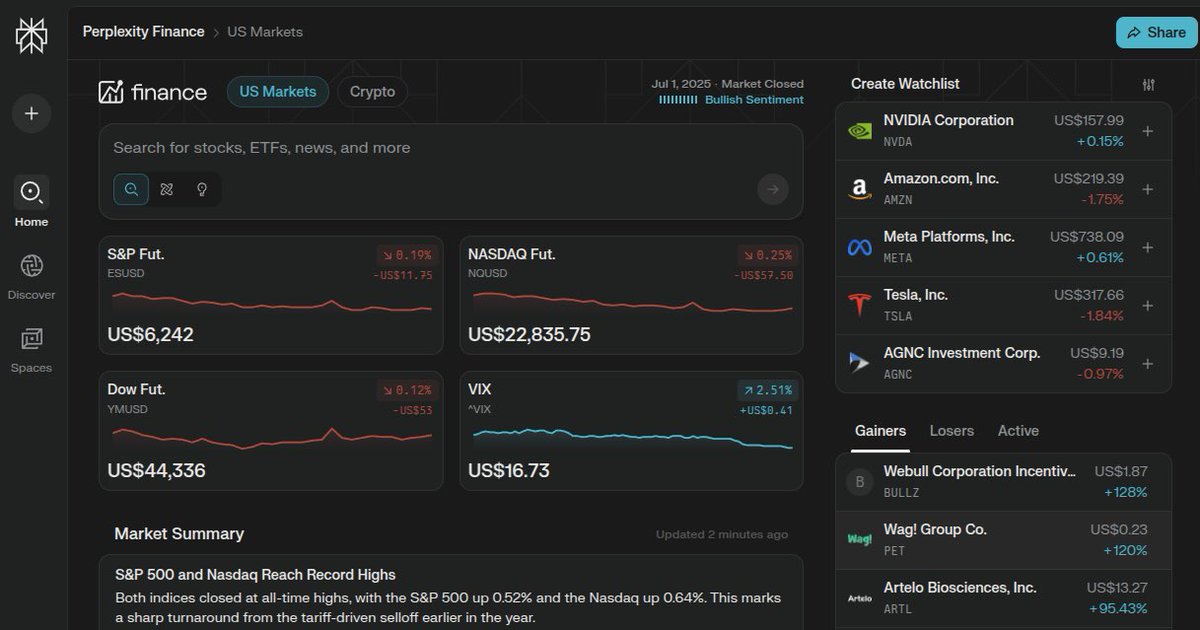
If you're not using Perplexity Finance for stock research, you're doing extra work for no reason. A Bloomberg Terminal costs $20,000 a year. Perplexity Finance starts free and Pro is $20/month. Here are the 5 best ways I use it as a retail trader: 1. Instant company deep dives Type any ticker and get a full snapshot in seconds. Business model, revenue breakdown, key metrics, recent performance, analyst ratings, all with cited sources. What used to take an hour of bouncing between 5 tabs now takes 30 seconds. 2. Earnings season research The Earnings Hub gives you summarized call highlights, management commentary, and KPI changes as they happen. You can compare guidance from last quarter to this quarter across multiple companies without reading a single 50-page transcript. 3. Understanding why a stock is moving Instead of scrolling Twitter trying to figure out why something is up or down 8%, just ask. It pulls together news, analyst commentary, and macro context into one cited answer in real time. 4. Screening and finding new ideas Run natural language screens like "small cap AI stocks with 30%+ revenue growth and positive free cash flow" and get actual results. No filters to configure. No database to subscribe to. Just ask in plain English. 5. SEC filings and financial data It pulls data from Financial Modeling Prep, live earnings transcripts from Quartr, and SEC filings. You can analyze 10-Ks, earnings reports, and financial statements without manually digging through the SEC website. This isn't a replacement for doing your own research. But it compresses hours of work into minutes and gives retail traders access to research tools that used to be locked behind enterprise paywalls. The basic finance features are free. Pro is $20/month for deeper research and advanced AI models.
Jason Luongo tweet media
English
25
31
269
19.8K
Jason Luongo
Jason Luongo@JasonL_Capital·
My LEAP system broken down step by step: Step 1: Build conviction first. Research the company deeply. If you wouldn't own shares for years, don't buy LEAPs on it. Step 2: Wait for multi-timeframe RSI alignment. Daily oversold. Weekly stabilizing. Don't force entries. Step 3: Price should be at meaningful support. Long-term support zones, prior consolidation ranges, or key moving averages. Step 4: Check the IV environment. Low IV means cheaper premiums and a lower breakeven. If IV is elevated, sell puts instead. Step 5: Confirm liquidity. Tight bid-ask spreads, strong open interest. Wide spreads on expensive LEAP contracts destroy your edge. Step 6: Buy 360+ days out minimum. Give your thesis time to play out. Holding over one year qualifies for long-term capital gains. Step 7: Pick your strike based on conviction. ITM for safety. ATM for balance. ~10% OTM for max leverage. Step 8: Size it properly. No single LEAP should be large enough to damage your portfolio if it goes to zero. Step 9: Scale out on strong gains to recover initial capital. Let the rest run with reduced risk. Step 10: Have an exit plan before theta accelerates inside 60 DTE. Roll, sell, or exercise if deep ITM. I only make a handful of LEAP trades per year. The patience to wait for genuine alignment is what separates a LEAP trade from a gamble. Important: LEAPs are one tool inside a broader portfolio. I also own shares and sell options on the same names. The core of my system is long-term equity holdings, cash-secured puts, and the wheel. LEAPs are the selective add-on for high-conviction moments. Comment "LEAP" and I'll send you my free cheat sheet.
Jason Luongo tweet media
English
90
40
295
26.2K
Ali Saee retweetledi
Gab
Gab@GabGrowth·
Just published my Q4 2026 earnings review for $RBRK I cover: - Financials - Guidance - Management Commentary - Personal Thoughts on the Q Next up is $DLO. Link below and in bio.
Gab tweet media
English
3
2
82
9.3K
Ali Saee retweetledi
Yalda Hakim
Yalda Hakim@SkyYaldaHakim·
A Pakistani airstrike hit a drug rehabilitation hospital in Kabul, killing or wounding an unspecified number of people, according to an Afghan Taliban spokesperson. Pakistan’s govt rejects this, claiming they targeted “military installations” - Reuters twitter.com/SkyYaldaHakim/…
English
240
1.2K
2.7K
75.4K
Ali Saee retweetledi
Jason Luongo
Jason Luongo@JasonL_Capital·
You could buy $HOOD at $76 right now. Or you could sell a $65 cash-secured put expiring 4/17 and get paid $240 today. Three possible outcomes: 1. $HOOD stays above $65 You keep the $240 premium. That's a 3.7% return on capital in 36 days, or 37% annualized. 2. $HOOD drops below $65 but you still like the stock You roll the put down and out to a lower strike and later expiration, collecting additional premium in the process. You get paid more to wait at an even better price. 3. $HOOD drops below $65 and you get assigned You buy the shares at $65, but your real cost basis is $62.60 because of the premium collected. That's a 17% discount from today's price. Then you start selling covered calls. That's the power of selling options.
Jason Luongo tweet media
English
19
18
198
25.8K
Ali Saee retweetledi
Jason Luongo
Jason Luongo@JasonL_Capital·
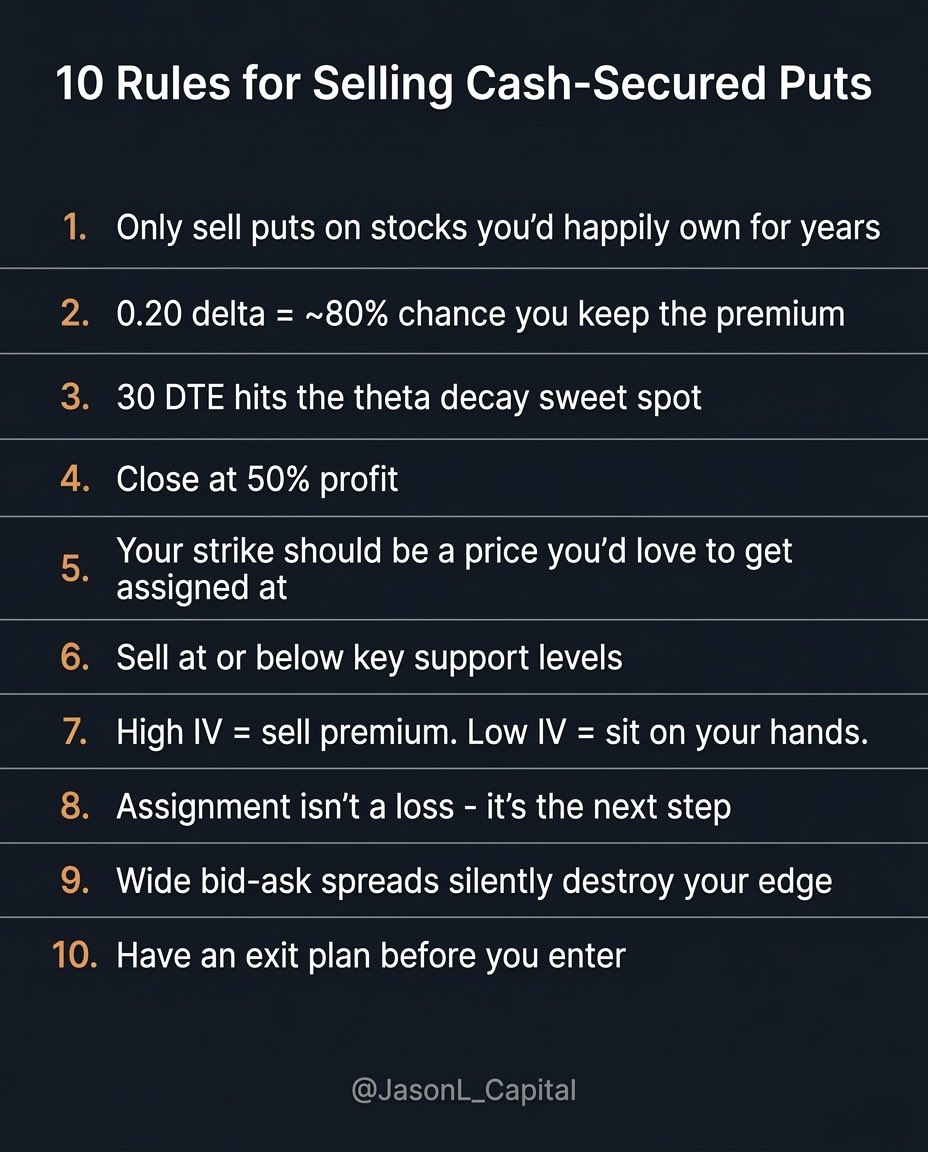
Do not sell cash-secured puts without knowing these 10 things: 1. Stock selection is 90% of the trade. If you wouldn't hold the stock for years, don't sell puts on it. 2. Target the 0.20 delta range. That's roughly an 80% probability of keeping your premium. 3. 30 days to expiration is the sweet spot. Theta decay accelerates hardest in this window. 4. Close at 50% profit. Don't hold to expiration. The annualized math on closing early destroys holding for the full premium. 5. Your strike should be at a price you'd love to get assigned at. Not tolerate. Love. If there's hesitation, move the strike lower or skip the trade. 6. Pick strikes at or below support levels. Stack technical conviction on top of the statistical edge from delta. 7. Check the IV environment first. High IV means fatter premiums and more cushion. Low IV means you're not getting paid enough for the risk. 8. If you're assigned, that's not a loss. That's the next phase. You now own a stock you wanted at a price you chose. Start selling covered calls. 9. Check liquidity on the specific contract. Wide bid-ask spreads are a hidden tax on every trade. If the spread is wide, move on. 10. Have an exit plan before you enter. Know when you'll roll, when you'll take assignment, and when you'll cut the loss. This is the foundation of my entire system. I sell puts on stocks I want to own, at prices I've already decided I'm comfortable with, and I get paid to wait. NFA DYOR
Jason Luongo tweet media
English
17
63
347
26K
Ali Saee retweetledi
Jason Luongo
Jason Luongo@JasonL_Capital·
BREAKING: Claude can now help you build a $100,000 options portfolio (for free) Here are 12 prompts you use every week to sell puts, run the wheel, and compound premium income:
Jason Luongo tweet media
English
18
67
616
111.2K
Ali Saee retweetledi
Barchart
Barchart@Barchart·
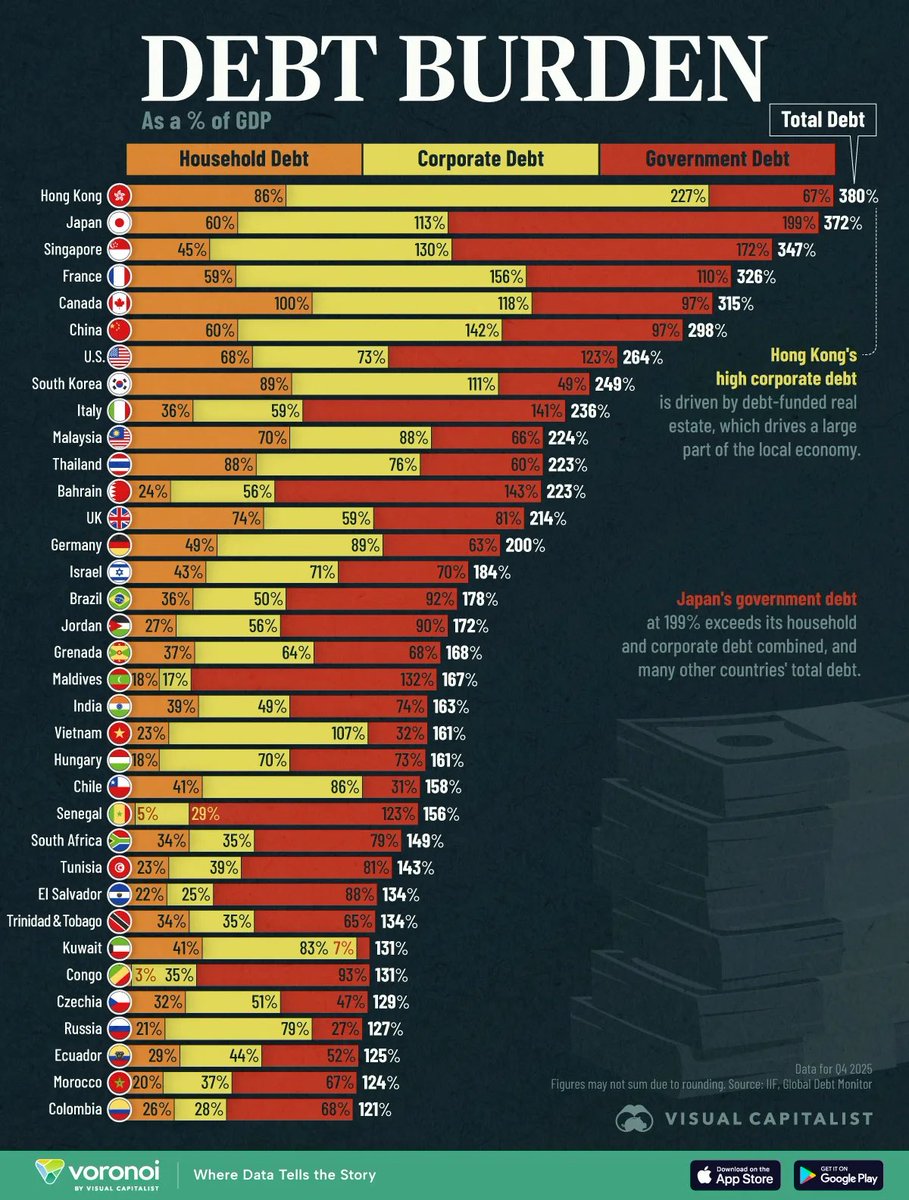
Countries With Highest Debt Burden 🚨🚨
Barchart tweet media
English
21
164
488
43.9K
Ali Saee retweetledi
Investing visuals
Investing visuals@InvestingVisual·
I’m an official $TTD bag holder, with my position now down about 65%. I’d like to share some thoughts on my position and the disappointing Q4 2025, especially the outlook. Hopefully posts like this encourage others to share not only the good, but also the bad. Losers are part of investing too, but they’re not often shared. ------------------------------------------------- Q4 2025 I listened to the call and went through the Q4 results. The quarter itself was okay, but the outlook was bad. I can’t make it any prettier than that. Revenue growth is decelerating from 18% this quarter to a guided 10% next quarter, with management citing sustained weakness among some large customers as the main reason. With a material slowdown like that, a stock doesn’t deserve a premium valuation (like it had). It’s also a competitive space, and the market is pricing in that $TTD is being outcompeted. Margins are still strong, but revenue growth is the main issue. What bothers me as a shareholder is that $TTD has been pointing to the macro environment for quite a while now, which I’m finding increasingly hard to believe at this point. Especially with peers like $ZETA (which I own as well) posting great results, I’m questioning whether the macro environment is as bad as they suggest. I’m well aware both businesses operate differently, but if there’s that much weakness in the industry, other peers should feel it too. Why am I still holding? I’ve considered selling my stake at a loss multiple times, but I wanted to give them the benefit of the doubt given their history of great execution. They have a strong balance sheet, a unique position in the Ads space, and a seasoned leadership team. But with revenue growth slowing down this materially, the stock is rightfully being sold off. It remains to be seen if they can reaccelerate it. In hindsight, it's easy to say “I should’ve sold earlier,” but I purposely decided not to, because I trust their prior execution and leadership team. So far, I’ve paid the price for that, and that’s okay. Now what? My mental safeguard is to never act right away, but to take time to let the information sink in and think it over. The same goes for $TTD and this disappointing guide. I’ll take at least two days before I do anything out of initial emotion. Some considerations to hold my position: a lot of bad news is already priced in. If management sandbagged Q1 2026 and their main customers return to normal spending, the stock might be in for a rerating, but that remains to be seen. In addition, connected TV is a large addressable market and there’s still a lot of room for international expansion. They have a great leadership team, a strong balance sheet, and margins are still strong. Some considerations to sell: cracks in the thesis and uncertainty around how much of this slowdown is due to competitive pressure. Another one is opportunity cost. This might turn out to be dead money for quite some time. Money that could compound better elsewhere. I’ll soon create a full earnings recap, which will also include what I’ll be doing with my position. If you are a (prior) $TTD shareholder, I'd love to hear your take as well. Thanks for reading! ~ Jan
Investing visuals@InvestingVisual

$TTD Q4 2025 earnings: • Revenue $847M vs Est. $841M • EPS $0.59 vs Est. $0.58 Q1 Guidance • Revenue $678M vs. Est. $688M

English
43
16
197
93.9K
Ali Saee retweetledi
The Investing for Beginners Podcast
ROIC = 72,459 ÷ $146,180 = 49.5% If you want to dig deeper into ROIC, I strongly suggest you check out the amazing article below from Michael Mauboussin. He's the expert and explains the finer details in an easy-to-read way. morganstanley.com/im/publication…… Hope it helps!
English
0
1
3
459
Ali Saee retweetledi
Barchart
Barchart@Barchart·
The Great Cocoa Collapse continues as price has now fallen to its lowest level since June 2023 🍫📉
Barchart tweet media
English
38
75
616
43.4K
Ali Saee retweetledi
Barchart
Barchart@Barchart·
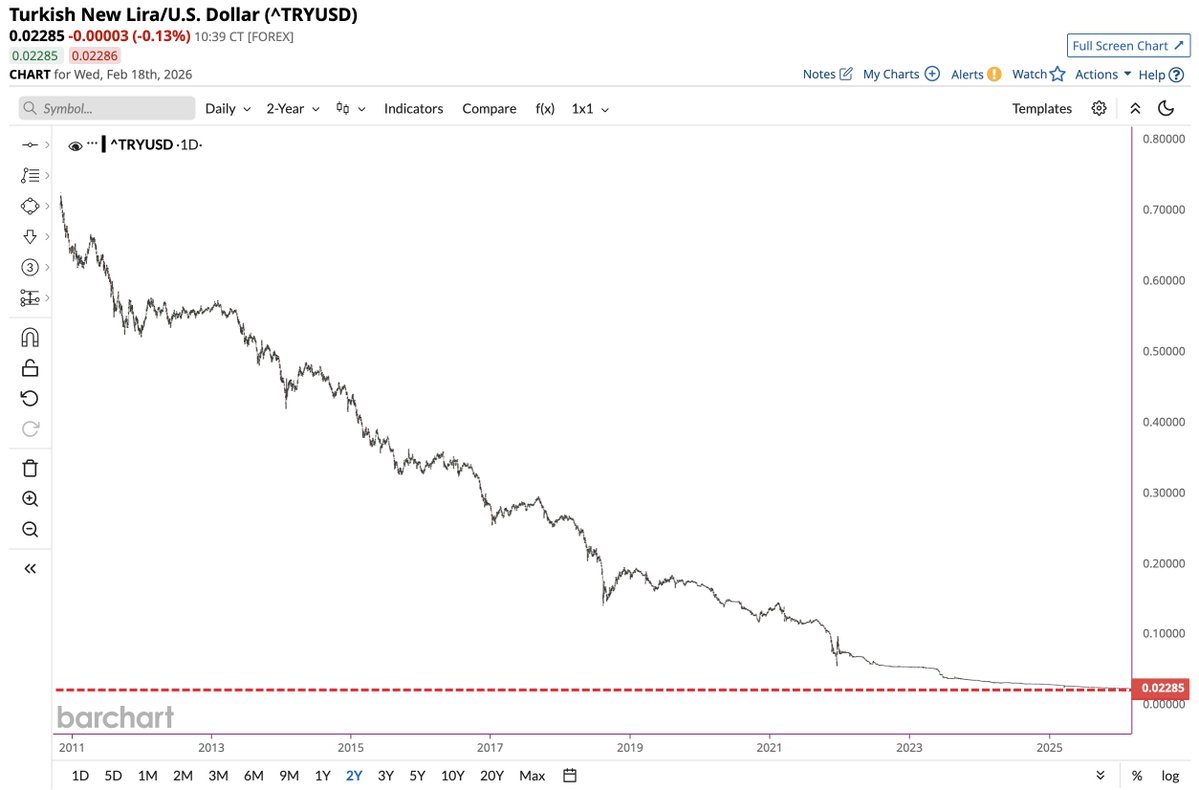
BREAKING 🚨: Turkey Turkish Lira falls to an all-time low against the U.S. Dollar 🇹🇷📉 Now down 97% since 2010 🤯👀
Barchart tweet media
English
262
869
4.9K
1.8M
Ali Saee retweetledi
Bourbon Capital
Bourbon Capital@BourbonCap·
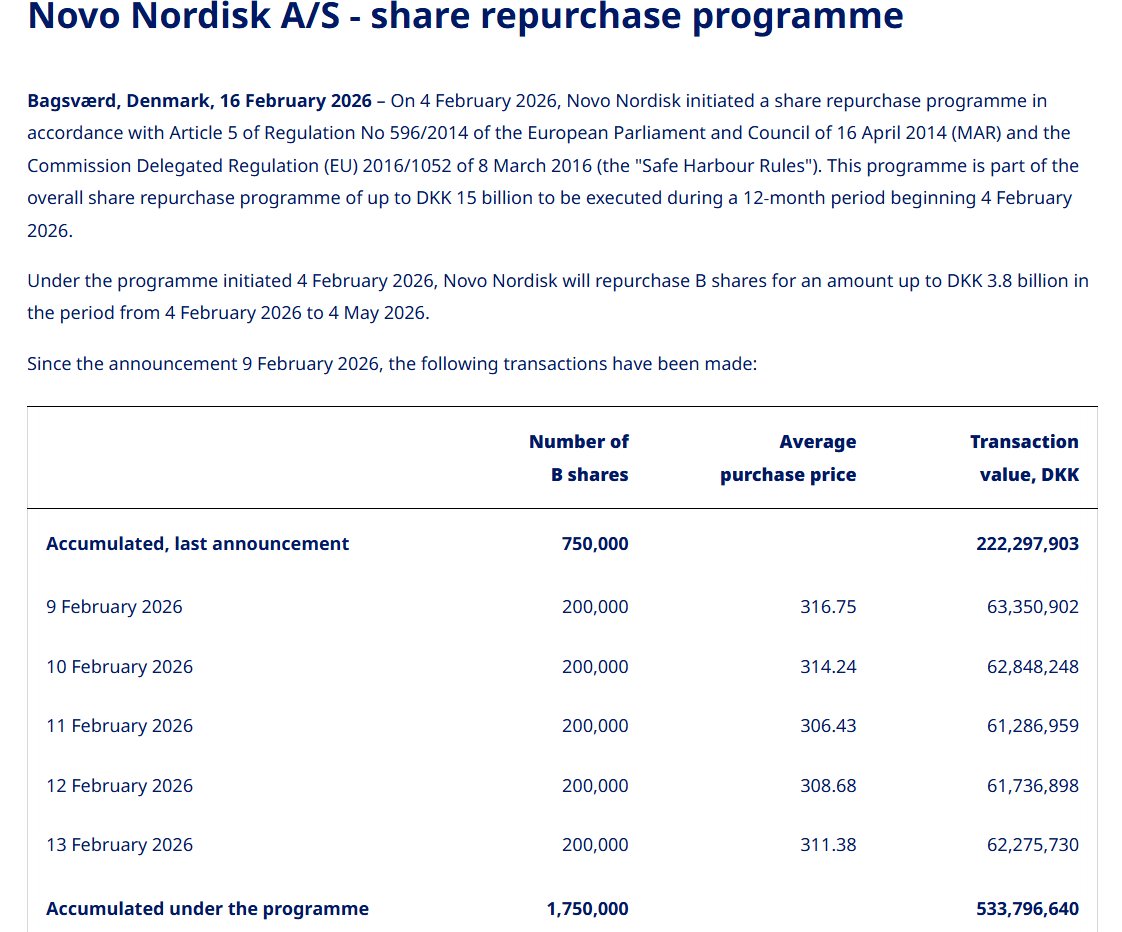
$NVO is doing buybacks again About time....
Bourbon Capital tweet media
English
12
14
381
55.5K